CG Board Class 12 Economics Solutions | NCERT Class 12 Economics (Micro & Macroeconomics) (2026-27)
Step-by-step solutions for CG Board Class 12 Economics Chapter 3: Introductory Macroeconomics strictly following the prescribed NCERT Class 12 Economics (Micro & Macroeconomics) syllabus.
📚 Chapter Overview:
- Board: Chhattisgarh Board (CGBSE / SCERT — NCERT Syllabus)
- Textbook & Chapter: NCERT Class 12 Economics (Micro & Macroeconomics) — Chapter 3: Introductory Macroeconomics
- Medium: English Medium
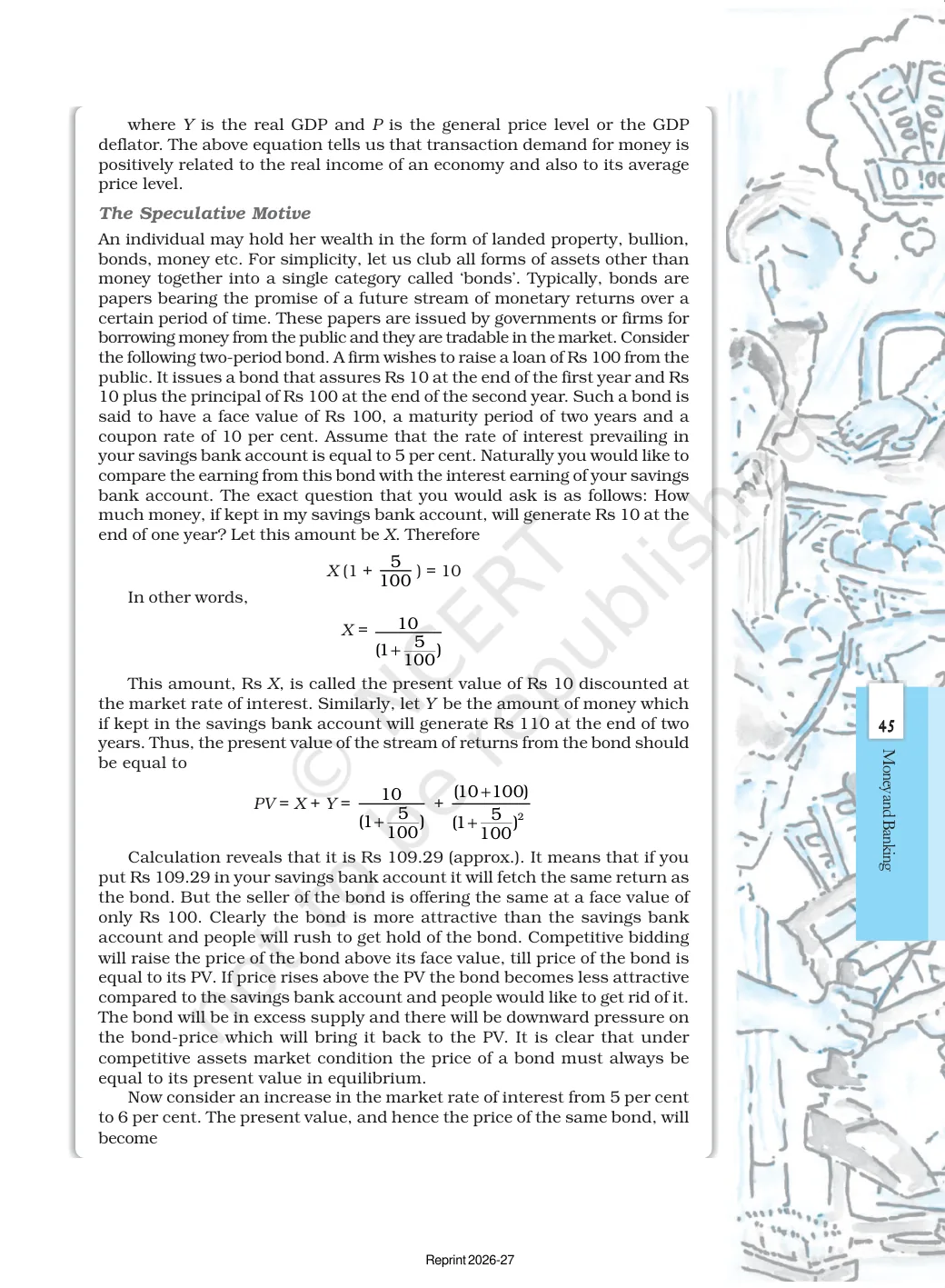
📖 Textbook Pages (NCERT / CG Board 2026-27)

✍️ Chapter 3 Exercise Solutions: Introductory Macroeconomics
Exercises
Q1. What is a barter system? What are its drawbacks?
Answer: A barter system is the direct exchange of goods and services for other goods and services without using money as a medium of exchange.
Drawbacks:
- Lack of double coincidence of wants: Both parties must simultaneously want what the other offers, which is rare and time-consuming.
- Lack of a common unit of account: There is no standard measure to express the value of all goods.
- Difficulty in storing wealth: Goods are often perishable or bulky, making it hard to store value for future use.
- Difficulty in deferred payments: Future contracts and credit repayments are difficult to settle in kind.
Q2. What are the main functions of money? How does money overcome the shortcomings of a barter system?
Answer: The main functions of money are:
- Medium of exchange: Eliminates the need for double coincidence of wants by allowing goods to be sold for money and money to be used to buy other goods.
- Unit of account (measure of value): Expresses the value of all goods and services in a single monetary unit, simplifying exchange ratios.
- Store of value: Allows purchasing power to be stored conveniently and without perishability for future use.
- Standard of deferred payments: Facilitates borrowing, lending, and future contractual payments in stable monetary terms.
Q3. What is transaction demand for money? How is it related to the value of transactions over a specified period of time?
Answer: Transaction demand for money is the amount of money people hold to carry out day-to-day purchases and payments, arising because receipts and expenditures do not occur simultaneously.
It is directly and positively related to the total value of transactions (and therefore to nominal GDP, P·Y):
MTd = k · P · Y (or k · T), where k is a positive constant, P is the general price level, and Y is real GDP.
Q4. What are the alternative definitions of money supply in India?
Answer: The Reserve Bank of India (RBI) publishes four alternative measures of money supply:
- M1 = CU + DD (Currency notes and coins held by the public + Net demand deposits of commercial banks).
- M2 = M1 + Savings deposits with Post Office savings banks.
- M3 = M1 + Net time deposits of commercial banks (also called Aggregate Monetary Resources).
- M4 = M3 + Total deposits with Post Office savings organisations (excluding National Savings Certificates).
M1 and M2 are known as narrow money, while M3 and M4 are broad money, arranged in decreasing order of liquidity.
Q5. What is a ‘legal tender’? What is ‘fiat money’?
Answer: Legal tender: Money that cannot be refused by any citizen of the country for the settlement of any transaction (e.g., currency notes and coins in India; cheques are not legal tender).
Fiat money: Money whose value is derived from the authority and guarantee of the issuing government or central bank rather than any intrinsic commodity value like gold or silver (e.g., paper currency notes and token coins).
Q6. What is High Powered Money?
Answer: High Powered Money (also called the monetary base or reserve money, denoted by H) is the total liability of the monetary authority (RBI) in the country. It consists of currency (notes and coins) held by the public plus vault cash of commercial banks and deposits held by commercial banks with the RBI. It serves as the base on which commercial banks create credit and expand the money supply.
Q7. Explain the functions of a commercial bank.
Answer: The primary functions of a commercial bank are:
- Accepting deposits: Mobilises savings from the public through savings accounts, current accounts (demand deposits), and fixed deposits (time deposits).
- Advancing loans and credit creation: Lends a major portion of deposits to individuals and businesses after keeping required reserves, thereby creating derivative deposits and expanding money supply.
- Payment and agency services: Facilitates cheque clearing, electronic fund transfers, collection of bills, and investment/advisory services.
Q8. What is money multiplier? What determines the value of this multiplier?
Answer: The money multiplier is the ratio of the stock of total money supply (M) to the stock of high powered money (H). It shows how many times total money supply expands for a given increase in high powered money.
Formula: Money Multiplier = (1 + cdr) / (cdr + rdr), where:
- cdr (Currency Deposit Ratio): Ratio of currency held by the public to bank deposits.
- rdr (Reserve Deposit Ratio): Ratio of total reserves (CRR + excess reserves) held by commercial banks to their deposits.
A lower cdr or lower rdr increases the value of the money multiplier.
Q9. What are the instruments of monetary policy of RBI?
Answer: The RBI uses quantitative and qualitative instruments to regulate money supply:
- Open Market Operations (OMO): Buying and selling of government securities in the open market to inject or absorb liquidity.
- Bank Rate: The rate at which RBI lends long-term funds to commercial banks.
- Repo Rate and Reverse Repo Rate: Short-term rates at which RBI lends to or borrows from commercial banks against government securities.
- Cash Reserve Ratio (CRR): The minimum fraction of deposits that commercial banks must keep as cash reserves with the RBI.
- Statutory Liquidity Ratio (SLR): The fraction of deposits banks must hold in liquid assets like gold or government securities.
- Qualitative tools: Margin requirements, moral suasion, and selective credit controls.
Q10. Do you consider a commercial bank ‘creator of money’ in the economy?
Answer: Yes. Commercial banks act as creators of money through the process of credit creation. When a bank receives a primary deposit, it keeps only a fraction as reserves (according to the reserve deposit ratio) and lends out the rest. The loaned amount is spent and re-deposited in the banking system, enabling banks to grant further loans. Through successive rounds, total demand deposits expand by a multiple of the initial reserve injection (equal to 1 / rdr in a no-currency-leakage system).
Q11. What role of RBI is known as ‘lender of last resort’?
Answer: When a solvent commercial bank faces a sudden liquidity crisis or temporary shortage of funds and cannot obtain credit from any other source, the RBI steps in to provide emergency funds against approved securities. By guaranteeing liquidity in times of crisis and preventing bank runs, the RBI acts as the lender of last resort.