CG Board Class 11 Chemistry Solutions | NCERT Class 11 Chemistry (Part I & II) (2026-27)
Step-by-step solutions for CG Board Class 11 Chemistry Chapter 2: Structure of Atom strictly following the prescribed NCERT Class 11 Chemistry (Part I & II) syllabus.
📚 Chapter Overview:
- Board: Chhattisgarh Board (CGBSE / SCERT — NCERT Syllabus)
- Textbook & Chapter: NCERT Class 11 Chemistry (Part I & II) — Chapter 2: Structure of Atom
- Medium: English Medium
📖 Textbook Pages (NCERT / CG Board 2026-27)

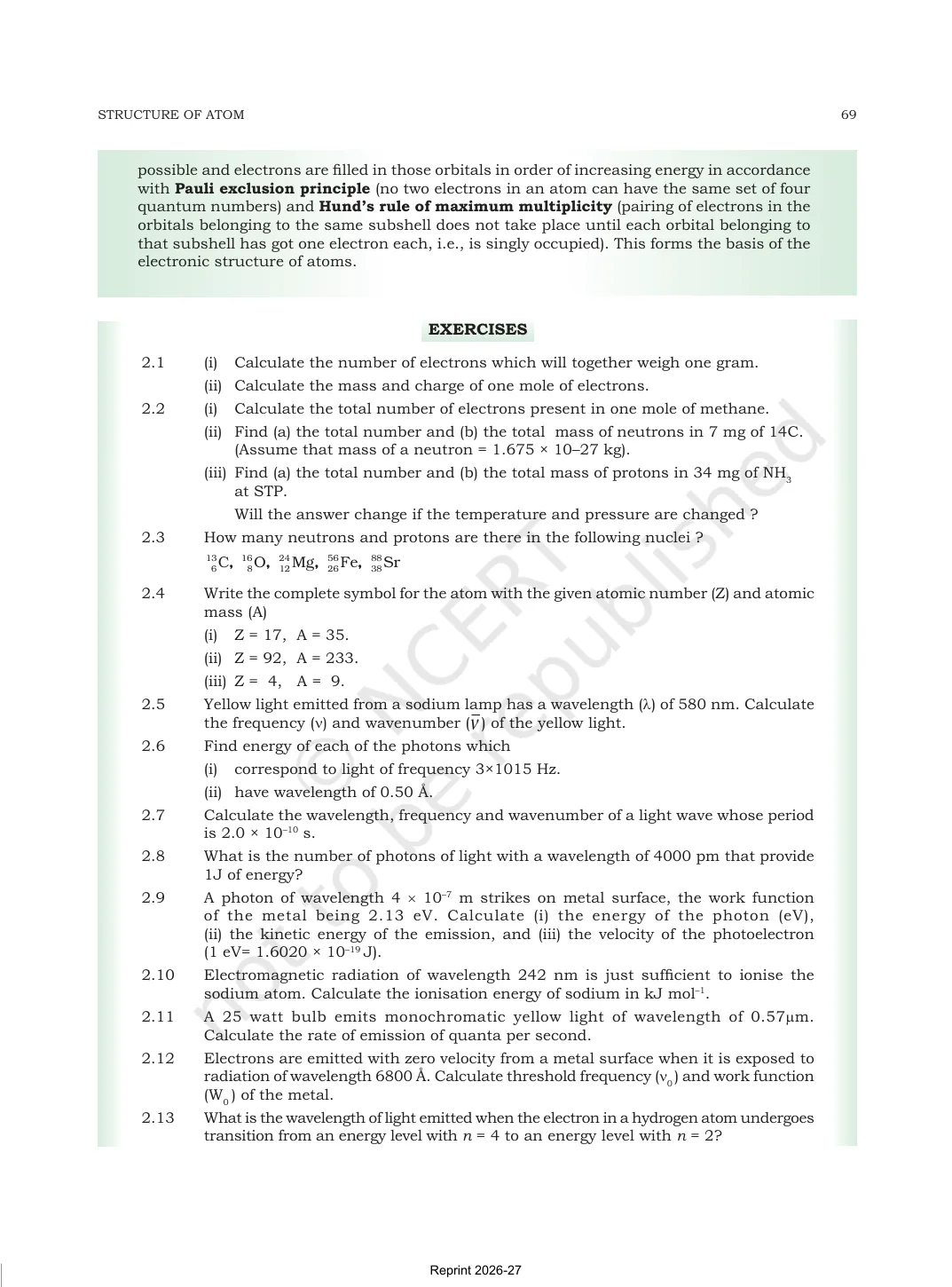
✍️ Chapter 2 Exercise Solutions: Structure of Atom
Exercises
Q2.1. (i) Calculate the number of electrons which will together weigh one gram. (ii) Calculate the mass and charge of one mole of electrons.
Answer: (i) Mass of 1 electron = 9.109 × 10⁻³¹ kg = 9.109 × 10⁻²⁸ g. Number of electrons in 1 g = 1 / (9.109 × 10⁻²⁸) = 1.098 × 1027 (1.099 × 1027).
(ii) Mass of 1 mol = 9.109 × 10−31 × 6.022 × 1023 = 5.48 × 10⁻⁷ kg. Charge = 1.602 × 10−19 × 6.022 × 1023 = 9.65 × 10⁴ C.
Q2.2. (i) Total electrons in 1 mol methane. (ii) Total number and mass of neutrons in 7 mg of 14C. (iii) Total number and mass of protons in 34 mg of NH3 at STP. Will the answer change with T and P?
Answer: (i) 1 CH4 has 6 + 4 = 10 electrons → 1 mol has 10 × 6.022 × 1023 = 6.022 × 1024 electrons.
(ii) Moles of 14C = 0.007 / 14 = 5 × 10⁻⁴ mol. Each 14C atom has 8 neutrons. Total neutrons = 5 × 10−4 × 6.022 × 1023 × 8 = 2.4088 × 10²¹. Total mass = 2.4088 × 1021 × 1.675 × 10−27 = 4.0347 × 10⁻⁶ kg.
(iii) Moles of NH3 = 0.034 / 17 = 2 × 10⁻³ mol. Each NH3 has 10 protons. Total protons = 2 × 10−3 × 6.022 × 1023 × 10 = 1.2044 × 10²². Total mass = 1.2044 × 1022 × 1.673 × 10−27 = 2.015 × 10⁻⁵ kg. No, mass and number of protons do not depend on temperature or pressure.
Q2.3. How many neutrons and protons are there in: 136C, 168O, 2412Mg, 5626Fe, 8838Sr?
Answer: 136C: 6 protons, 7 neutrons; 168O: 8 protons, 8 neutrons; 2412Mg: 12 protons, 12 neutrons; 5626Fe: 26 protons, 30 neutrons; 8838Sr: 38 protons, 50 neutrons.
Q2.4. Write the complete symbol for the atom with: (i) Z = 17, A = 35 (ii) Z = 92, A = 233 (iii) Z = 4, A = 9.
Answer: (i) 3517Cl; (ii) 23392U; (iii) 94Be.
Q2.5. Yellow light from a sodium lamp has λ = 580 nm. Calculate frequency (ν) and wavenumber.
Answer: ν = c / λ = (3.0 × 10⁸) / (580 × 10−9) = 5.17 × 10¹⁴ s−1.
Wavenumber = 1 / λ = 1 / (580 × 10−9 m) = 1.72 × 10⁶ m−1.
Q2.6. Find energy of photons with (i) ν = 3 × 10¹⁵ Hz, (ii) λ = 0.50 Å.
Answer: (i) E = hν = 6.626 × 10−34 × 3 × 1015 = 1.988 × 10⁻¹⁸ J.
(ii) E = hc / λ = (6.626 × 10−34 × 3 × 108) / (0.50 × 10⁻¹⁰) = 3.98 × 10⁻¹⁵ J.
Q2.7. Calculate wavelength, frequency and wavenumber of a light wave whose period is 2.0 × 10⁻¹⁰ s.
Answer: ν = 1 / T = 1 / (2.0 × 10⁻¹⁰) = 5.0 × 10⁹ s−1.
λ = c / ν = (3.0 × 10⁸) / (5.0 × 10⁹) = 6.0 × 10⁻² m.
Wavenumber = 1 / λ = 16.67 m−1.
Q2.8. What is the number of photons of light with λ = 4000 pm that provide 1 J of energy?
Answer: Ephoton = hc / λ = (6.626 × 10−34 × 3 × 108) / (4000 × 10−12) = 4.9695 × 10⁻¹⁷ J.
Number of photons = 1 / (4.9695 × 10⁻¹⁷) = 2.012 × 10¹⁶ photons.
Q2.9. A photon of λ = 4 × 10⁻⁷ m strikes a metal with work function 2.13 eV. Calculate (i) photon energy (eV), (ii) kinetic energy, (iii) velocity of photoelectron.
Answer: (i) E = hc / λ = (6.626 × 10−34 × 3 × 108) / (4 × 10⁻⁷) = 4.97 × 10⁻¹⁹ J = 4.97 × 10⁻¹⁹ / (1.602 × 10⁻¹⁹) = 3.10 eV.
(ii) KE = 3.10 − 2.13 = 0.97 eV = 1.55 × 10⁻¹⁹ J.
(iii) v = √(2 KE / m) = √(2 × 1.55 × 10−19 / 9.11 × 10⁻³¹) = 5.84 × 10⁵ m s−1.
Q2.10. Radiation of λ = 242 nm just ionises sodium atom. Calculate ionisation energy of sodium in kJ mol−1.
Answer: E per atom = hc / λ = (6.626 × 10−34 × 3 × 108) / (242 × 10−9) = 8.21 × 10⁻¹⁹ J.
IE per mol = 8.21 × 10−19 × 6.022 × 1023 = 4.94 × 10⁵ J mol−1 = 494 kJ mol−1.
Q2.11. A 25 W bulb emits monochromatic yellow light of λ = 0.57 μm. Calculate rate of emission of quanta per second.
Answer: Ephoton = hc / λ = (6.626 × 10−34 × 3 × 108) / (0.57 × 10⁻⁶) = 3.487 × 10⁻¹⁹ J.
Rate = Power / Ephoton = 25 / (3.487 × 10⁻¹⁹) = 7.17 × 10¹⁹ s−1 (7.18 × 10¹⁹ s−1).
Q2.12. Electrons are emitted with zero velocity from a metal surface at λ0 = 6800 Å. Calculate threshold frequency (ν0) and work function (W0).
Answer: ν0 = c / λ0 = (3.0 × 10⁸) / (6800 × 10−10) = 4.41 × 10¹⁴ s−1.
W0 = hν0 = 6.626 × 10−34 × 4.41 × 1014 = 2.92 × 10⁻¹⁹ J (2.91 × 10⁻¹⁹ J).
Q2.13. What is the wavelength of light emitted when the electron in a hydrogen atom undergoes transition from n = 4 to n = 2?
Answer: Wavenumber = 1.097 × 10⁷ (1/22 − 1/42) = 1.097 × 107 × (3/16) = 2.057 × 10⁶ m−1.
λ = 1 / (2.057 × 10⁶) = 4.86 × 10⁻⁷ m = 486 nm.
Q2.14. How much energy is required to ionise a H atom if the electron occupies n = 5 orbit? Compare with n = 1.
Answer: ΔE = E∞ − E5 = 0 − (−2.18 × 10⁻¹⁸ / 52) = 8.72 × 10⁻²⁰ J.
For n = 1, IE = 2.18 × 10⁻¹⁸ J, which is 25 times greater than for n = 5.
Q2.15. What is the maximum number of emission lines when the excited electron of a H atom in n = 6 drops to the ground state?
Answer: Maximum lines = n(n − 1)/2 = 6(5)/2 = 15 emission lines.
Q2.16. (i) E1 in H atom is −2.18 × 10⁻¹⁸ J atom−1. Find E5. (ii) Calculate radius of Bohr’s 5th orbit for H atom.
Answer: (i) E5 = −2.18 × 10⁻¹⁸ / 52 = −8.72 × 10⁻²⁰ J.
(ii) rn = 0.0529 × n2 nm → r5 = 0.0529 × 25 = 1.3225 nm.
Q2.17. Calculate the wavenumber for the longest wavelength transition in the Balmer series of atomic hydrogen.
Answer: Longest wavelength in Balmer series corresponds to n1 = 2, n2 = 3.
Wavenumber = 1.097 × 10⁷ (1/22 − 1/32) = 1.097 × 107 × (5/36) = 1.523 × 10⁶ m−1.
Q2.18. What is the energy in joules required to shift the H electron from n = 1 to n = 5, and what is the wavelength of emitted light on return? Ground state energy = −2.18 × 10⁻¹¹ ergs.
Answer: ΔE = 2.18 × 10⁻¹¹ (1/12 − 1/52) = 2.09 × 10⁻¹¹ ergs = 2.09 × 10⁻¹⁸ J.
λ = hc / ΔE = (6.626 × 10−34 × 3 × 108) / (2.09 × 10⁻¹⁸) = 9.50 × 10⁻⁸ m = 950 Å.
Q2.19. En = (−2.18 × 10⁻¹⁸)/n2 J. Calculate energy to remove electron from n = 2 and the longest wavelength in cm.
Answer: ΔE = 2.18 × 10⁻¹⁸ / 4 = 5.45 × 10⁻¹⁹ J.
λ = hc / ΔE = (6.626 × 10−34 × 3 × 108) / (5.45 × 10⁻¹⁹) = 3.647 × 10⁻⁷ m = 3.647 × 10⁻⁵ cm (3647 Å).
Q2.20. Calculate the wavelength of an electron moving with velocity 2.05 × 10⁷ m s−1.
Answer: λ = h / (mv) = 6.626 × 10⁻³⁴ / (9.11 × 10−31 × 2.05 × 107) = 3.55 × 10⁻¹¹ m.
Q2.21. Mass of electron is 9.1 × 10⁻³¹ kg. If K.E. is 3.0 × 10⁻²⁵ J, calculate its wavelength.
Answer: v = √(2 KE / m) = √(2 × 3.0 × 10−25 / 9.1 × 10⁻³¹) = 812 m s−1.
λ = h / (mv) = 6.626 × 10⁻³⁴ / (9.1 × 10−31 × 812) = 8.967 × 10⁻⁷ m (8967 Å).
Q2.22. Which are isoelectronic species: Na+, K+, Mg2+, Ca2+, S2−, Ar?
Answer: Na+ (10e−) and Mg2+ (10e−) are isoelectronic. K+ (18e−), Ca2+ (18e−), S2− (18e−), and Ar (18e−) are isoelectronic.
Q2.23. (i) Electronic configurations of H−, Na+, O2−, F−. (ii) Atomic numbers for outermost 3s1, 2p3, 3p5. (iii) Atoms for [He]2s1, [Ne]3s23p3, [Ar]4s23d1.
Answer: (i) H−: 1s2; Na+: 1s22s22p6; O2−: 1s22s22p6; F−: 1s22s22p6.
(ii) 3s1 → Z = 11 (Na); 2p3 → Z = 7 (N); 3p5 → Z = 17 (Cl).
(iii) [He]2s1 → Li; [Ne]3s23p3 → P; [Ar]4s23d1 → Sc.
Q2.24. What is the lowest value of n that allows g orbitals to exist?
Answer: For g orbital, l = 4. Since l ≤ n − 1, the lowest value is n = 5.
Q2.25. An electron is in one of the 3d orbitals. Give possible values of n, l and ml.
Answer: n = 3, l = 2, and ml can be any one of −2, −1, 0, +1, +2.
Q2.26. An atom contains 29 electrons and 35 neutrons. Deduce (i) protons and (ii) electronic configuration.
Answer: (i) Number of protons = 29 (Copper).
(ii) Electronic configuration: 1s2 2s2 2p6 3s2 3p6 3d10 4s1.
Q2.27. Give the number of electrons in H2+, H2 and O2+.
Answer: H2+: 1 electron; H2: 2 electrons; O2+: 15 electrons.
Q2.28. (i) For n = 3, possible l and ml. (ii) Quantum numbers (ml and l) for 3d orbital. (iii) Which orbitals are possible: 1p, 2s, 2p, 3f?
Answer: (i) l = 0 (ml = 0); l = 1 (ml = −1, 0, +1); l = 2 (ml = −2, −1, 0, +1, +2).
(ii) l = 2, ml = −2, −1, 0, +1, +2.
(iii) Only 2s and 2p are possible (1p and 3f are not possible since l must be < n).
Q2.29. Describe orbitals: (a) n=1, l=0; (b) n=3, l=1; (c) n=4, l=2; (d) n=4, l=3.
Answer: (a) 1s; (b) 3p; (c) 4d; (d) 4f.
Q2.30. Explain which sets of quantum numbers are not possible: (a) n=0, l=0, ml=0, ms=+1/2; (b) n=1, l=0, ml=0, ms=−1/2; (c) n=1, l=1, ml=0, ms=+1/2; (d) n=2, l=1, ml=0, ms=−1/2; (e) n=3, l=3, ml=−3, ms=+1/2; (f) n=3, l=1, ml=0, ms=+1/2.
Answer: (a) Not possible because n cannot be 0.
(c) Not possible because for n = 1, l cannot be 1 (l < n).
(e) Not possible because for n = 3, l cannot be 3 (l < n).
Sets (b), (d), and (f) are possible.
Q2.31. How many electrons in an atom may have: (a) n = 4, ms = −1/2; (b) n = 3, l = 0?
Answer: (a) Total electrons in n = 4 is 2n2 = 32; half have ms = −1/2, so 16 electrons.
(b) n = 3, l = 0 corresponds to 3s orbital, which holds 2 electrons.
Q2.32. Show that the circumference of the Bohr orbit for H atom is an integral multiple of the de Broglie wavelength.
Answer: By Bohr’s postulate, angular momentum mvr = nh / (2π). Rearranging gives 2πr = n(h / mv). Since de Broglie wavelength λ = h / (mv), we get 2πr = nλ.
Q2.33. What transition in the hydrogen spectrum would have the same wavelength as the Balmer transition n = 4 to n = 2 of He+ spectrum?
Answer: For He+ (Z = 2): 1/λ = R × 22 (1/22 − 1/42) = R (1 − 1/4). For H (Z = 1), 1/λ = R (1/n12 − 1/n22). Equating gives n1 = 1, n2 = 2 (transition from n = 2 to n = 1).
Q2.34. Calculate the energy required for He+(g) → He2+(g) + e−. IE for H = 2.18 × 10⁻¹⁸ J atom−1.
Answer: IE for He+ = IEH × Z2 = 2.18 × 10−18 × 22 = 8.72 × 10⁻¹⁸ J atom−1.
Q2.35. Diameter of a carbon atom is 0.15 nm. Calculate the number of carbon atoms placed side by side across 20 cm.
Answer: Number = (20 × 10−2 m) / (0.15 × 10⁻⁹ m) = 1.33 × 10⁹ atoms.
Q2.36. 2 × 10⁸ atoms of carbon are arranged side by side in 2.4 cm. Calculate the radius of carbon atom.
Answer: Diameter = 2.4 × 10⁻² m / (2 × 10⁸) = 1.2 × 10⁻¹⁰ m = 0.12 nm. Radius = 0.06 nm.
Q2.37. Diameter of zinc atom is 2.6 Å. Calculate (a) radius in pm, (b) number of atoms in 1.6 cm.
Answer: (a) Radius = 1.3 Å = 130 pm = 1.3 × 10² pm.
(b) Number = (1.6 × 10⁻² m) / (2.6 × 10⁻¹⁰ m) = 6.15 × 10⁷ atoms.
Q2.38. A particle carries 2.5 × 10⁻¹⁶ C of static electric charge. Calculate the number of electrons.
Answer: n = q / e = (2.5 × 10⁻¹⁶) / (1.602 × 10⁻¹⁹) = 1560 electrons.
Q2.39. In Millikan’s experiment, charge on oil drop is −1.282 × 10⁻¹⁸ C. Calculate number of electrons.
Answer: n = (1.282 × 10⁻¹⁸) / (1.602 × 10⁻¹⁹) = 8 electrons.
Q2.40. In Rutherford’s experiment, what difference would be observed if thin foil of light atoms like Al is used instead of heavy atoms?
Answer: Lighter nuclei have smaller positive charge and mass, so far fewer α-particles would be deflected through large angles or bounced back; most would pass straight through.
Q2.41. Symbols 7935Br and 79Br can be written, whereas 3579Br and 35Br are not acceptable. Answer briefly.
Answer: The atomic number (35) is fixed for bromine, whereas the mass number (79) can vary across isotopes. Also, standard notation places mass number as superscript and atomic number as subscript.
Q2.42. An element with mass number 81 contains 31.7% more neutrons than protons. Assign the atomic symbol.
Answer: Let protons = p. Neutrons n = 1.317 p. Since p + n = 81, 2.317 p = 81 → p = 35. Symbol: 8135Br.
Q2.43. An ion with mass number 37 possesses one unit of negative charge and 11.1% more neutrons than electrons. Find the symbol.
Answer: Let electrons = e. Then protons p = e − 1, neutrons n = 1.111 e. Since p + n = 37, (e − 1) + 1.111 e = 37 → 2.111 e = 38 → e = 18, p = 17. Symbol: 3717Cl−.
Q2.44. An ion with mass number 56 contains 3 units of positive charge and 30.4% more neutrons than electrons. Assign the symbol.
Answer: Let electrons = e. Then protons p = e + 3, neutrons n = 1.304 e. Since p + n = 56, 2.304 e = 53 → e = 23, p = 26. Symbol: 5626Fe3+.
Q2.45. Arrange in increasing order of frequency: microwave, amber light, FM radio, cosmic rays, X-rays.
Answer: FM radio < microwave < amber light < X-rays < cosmic rays.
Q2.46. Nitrogen laser produces radiation at 337.1 nm. If 5.6 × 1024 photons are emitted, calculate power (energy emitted per second).
Answer: E = N hc / λ = (5.6 × 1024 × 6.626 × 10−34 × 3 × 108) / (337.1 × 10⁻⁹) = 3.3 × 10⁶ J (so power = 3.3 × 10⁶ W for 1 s).
Q2.47. Neon gas emits at 616 nm. Calculate (a) frequency, (b) distance travelled in 30 s, (c) energy of quantum, (d) number of quanta for 2 J.
Answer: (a) ν = c / λ = 3 × 10⁸ / (616 × 10−9) = 4.87 × 10¹⁴ s−1.
(b) Distance = c × t = 3 × 108 × 30 = 9.0 × 10⁹ m.
(c) E = hν = 6.626 × 10−34 × 4.87 × 1014 = 3.227 × 10⁻¹⁹ J (32.27 × 10⁻²⁰ J).
(d) Quanta = 2 / (3.227 × 10⁻¹⁹) = 6.2 × 10¹⁸ quanta.
Q2.48. Detector receives 3.15 × 10⁻¹⁸ J from 600 nm radiation. Calculate number of photons.
Answer: Ephoton = hc / λ = (6.626 × 10−34 × 3 × 108) / (600 × 10−9) = 3.313 × 10⁻¹⁹ J. Number = 3.15 × 10⁻¹⁸ / (3.313 × 10⁻¹⁹) ≈ 10 photons.
Q2.49. A pulsed source of duration 2 ns emits 2.5 × 10¹⁵ photons. Calculate energy of the source.
Answer: ν = 1 / (2 × 10⁻⁹) = 5 × 10⁸ s−1. E = N h ν = 2.5 × 1015 × 6.626 × 10−34 × 5 × 108 = 8.28 × 10⁻¹⁰ J.
Q2.50. Doublet absorption at 589 and 589.6 nm. Calculate frequency of each transition and energy difference.
Answer: ν1 = 3 × 10⁸ / (589 × 10−9) = 5.093 × 10¹⁴ s−1; ν2 = 3 × 10⁸ / (589.6 × 10⁻⁹) = 5.088 × 10¹⁴ s−1.
ΔE = h(ν1 − ν2) = 6.626 × 10−34 × 5.2 × 1011 = 3.45 × 10⁻²² J.
Q2.51. Work function for Cs is 1.9 eV. Calculate (a) λ0, (b) ν0. If irradiated with 500 nm, find KE and velocity of photoelectron.
Answer: W0 = 1.9 × 1.602 × 10−19 = 3.044 × 10⁻¹⁹ J.
(a) ν0 = W0 / h = 4.598 × 10¹⁴ s−1; λ0 = c / ν0 = 652.46 nm.
(b) At 500 nm, E = 3.976 × 10⁻¹⁹ J. KE = 3.976 × 10⁻¹⁹ − 3.044 × 10−19 = 9.32 × 10⁻²⁰ J (9.29 × 10⁻²⁰ J).
v = √(2 KE / m) = 4.52 × 10⁵ m s−1.
Q2.52. Sodium metal irradiated with 500, 450, 400 nm gives v × 10−5 cm s−1 = 2.55, 4.35, 5.35. Calculate (a) threshold wavelength, (b) Planck’s constant.
Answer: Using ½ mv2 = hc(1/λ − 1/λ0) for two pairs (500 nm and 450 nm) and solving simultaneously gives λ0 ≈ 530.9 nm (or ~540 nm depending on pair) and h ≈ 6.62 × 10⁻³⁴ J s.
Q2.53. Photoelectron from silver is stopped by 0.35 V when 256.7 nm radiation is used. Calculate work function for silver.
Answer: Ephoton = hc / λ = (6.626 × 10−34 × 3 × 108) / (256.7 × 10⁻⁹) = 7.74 × 10⁻¹⁹ J = 4.83 eV.
W0 = 4.83 − 0.35 = 4.48 eV.
Q2.54. Photon of 150 pm strikes an atom and ejects an electron with v = 1.5 × 10⁷ m s−1. Calculate binding energy.
Answer: Ephoton = hc / λ = 1.325 × 10⁻¹⁵ J. KE = ½ mv2 = 0.5 × 9.11 × 10−31 × (1.5 × 107)2 = 1.025 × 10⁻¹⁶ J.
Binding energy = 1.325 × 10⁻¹⁵ − 1.025 × 10−16 = 1.2225 × 10⁻¹⁵ J = 7.63 × 10³ eV.
Q2.55. Paschen series: ν = 3.29 × 10¹⁵ (1/32 − 1/n2) Hz. Find n if λ = 1285 nm and the spectral region.
Answer: ν = c / λ = 3 × 10⁸ / (1285 × 10−9) = 2.335 × 10¹⁴ Hz. Solving 1/9 − 1/n2 = 2.335 × 10¹⁴ / (3.29 × 10¹⁵) = 0.0710 → 1/n2 = 0.0401 → n = 5. Region: Infrared.
Q2.56. Calculate wavelength for transition from orbit of radius 1.3225 nm to 211.6 pm. Name series and region.
Answer: rn = 52.9 n2 pm → 1322.5 / 52.9 = 25 (n = 5); 211.6 / 52.9 = 4 (n = 2).
Transition n = 5 to n = 2 belongs to Balmer series (visible region). 1/λ = 1.097 × 10⁷ (1/4 − 1/25) → λ = 434 nm.
Q2.57. Velocity of electron in microscope is 1.6 × 10⁶ m s−1. Calculate de Broglie wavelength.
Answer: λ = h / (mv) = 6.626 × 10⁻³⁴ / (9.11 × 10−31 × 1.6 × 106) = 4.55 × 10⁻¹⁰ m = 455 pm.
Q2.58. Neutron diffraction uses λ = 800 pm. Calculate velocity of neutron (m = 1.675 × 10⁻²⁷ kg).
Answer: v = h / (mλ) = 6.626 × 10⁻³⁴ / (1.675 × 10−27 × 800 × 10−12) = 494.5 m s−1.
Q2.59. Velocity of electron in Bohr’s first orbit is 2.19 × 10⁶ m s−1. Calculate de Broglie wavelength.
Answer: λ = 6.626 × 10⁻³⁴ / (9.11 × 10−31 × 2.19 × 106) = 3.32 × 10⁻¹⁰ m = 332 pm.
Q2.60. Hockey ball of mass 0.1 kg moves at 4.37 × 10⁵ m s−1. Calculate wavelength.
Answer: λ = 6.626 × 10⁻³⁴ / (0.1 × 4.37 × 105) = 1.516 × 10−38 m.
Q2.61. Position of electron measured within +0.002 nm. Calculate Δp. Can momentum be h/(4πm × 0.05 nm)?
Answer: Δp = h / (4π Δx) = 6.626 × 10⁻³⁴ / (4 × 3.1416 × 0.002 × 10−9) = 2.637 × 10⁻²³ kg m s−1.
Note: h / (4π × 0.05 nm) = 1.055 × 10⁻²⁴ kg m s−1, which is smaller than Δp (2.637 × 10⁻²³), so it cannot be defined accurately.
Q2.62. Arrange six electrons in increasing order of energies: (1) n=4,l=2; (2) n=3,l=2; (3) n=4,l=1; (4) n=3,l=2; (5) n=3,l=1; (6) n=4,l=1.
Answer: By (n + l) rule: (5) 3+1=4; (2) and (4) 3+2=5; (3) and (6) 4+1=5 (higher n than 3d); (1) 4+2=6.
Order: (v) < (ii) = (iv) < (vi) = (iii) < (i).
Q2.63. Br has 35 electrons (6 in 2p, 6 in 3p, 5 in 4p). Which experiences lowest effective nuclear charge?
Answer: The 4p electrons experience the lowest effective nuclear charge because they are farthest from the nucleus and most shielded by inner electrons.
Q2.64. Which orbital experiences larger effective nuclear charge: (i) 2s and 3s, (ii) 4d and 4f, (iii) 3d and 3p?
Answer: (i) 2s (closer to nucleus); (ii) 4d (better penetration than 4f); (iii) 3p (better penetration than 3d).
Q2.65. Unpaired electrons in Al and Si are in 3p orbital. Which experiences more effective nuclear charge?
Answer: Si (Z = 14) has higher nuclear charge than Al (Z = 13) for the same 3p shell, so 3p electrons in Si experience greater effective nuclear charge.
Q2.66. Indicate the number of unpaired electrons in: (a) P, (b) Si, (c) Cr, (d) Fe, (e) Kr.
Answer: (a) P: 3; (b) Si: 2; (c) Cr: 6 (3d54s1); (d) Fe: 4 (3d6); (e) Kr: 0.
Q2.67. (a) How many subshells are associated with n = 4? (b) How many electrons will be present in subshells having ms = −1/2 for n = 4?
Answer: (a) 4 subshells (4s, 4p, 4d, 4f).
(b) Total electrons in n = 4 is 32; half have ms = −1/2, so 16 electrons.