CG Board Class 11 Sociology Solutions | NCERT Class 11 Sociology (Introducing Sociology & Understanding Society) (2026-27)
Complete solutions for CG Board Class 11 Sociology Chapter 1: Sociology and Society strictly following the prescribed NCERT Class 11 Sociology (Introducing Sociology & Understanding Society) syllabus.
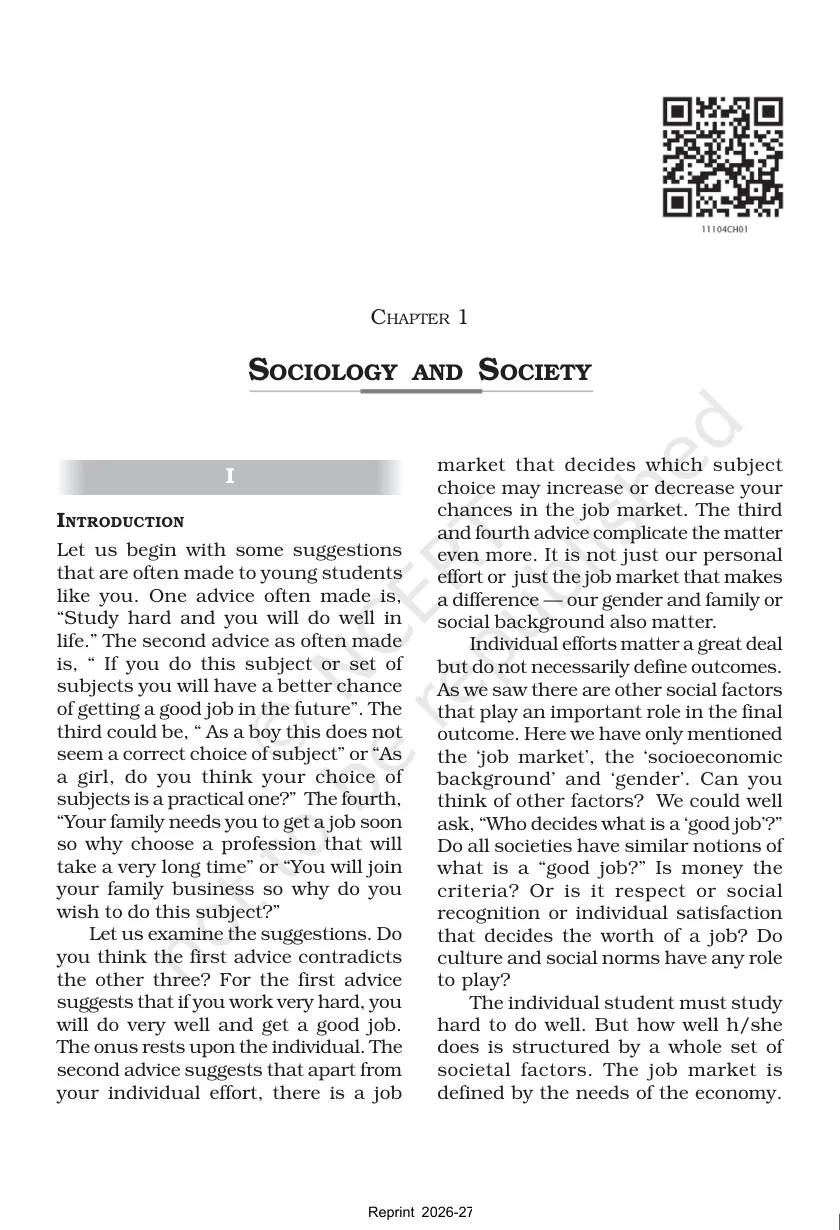
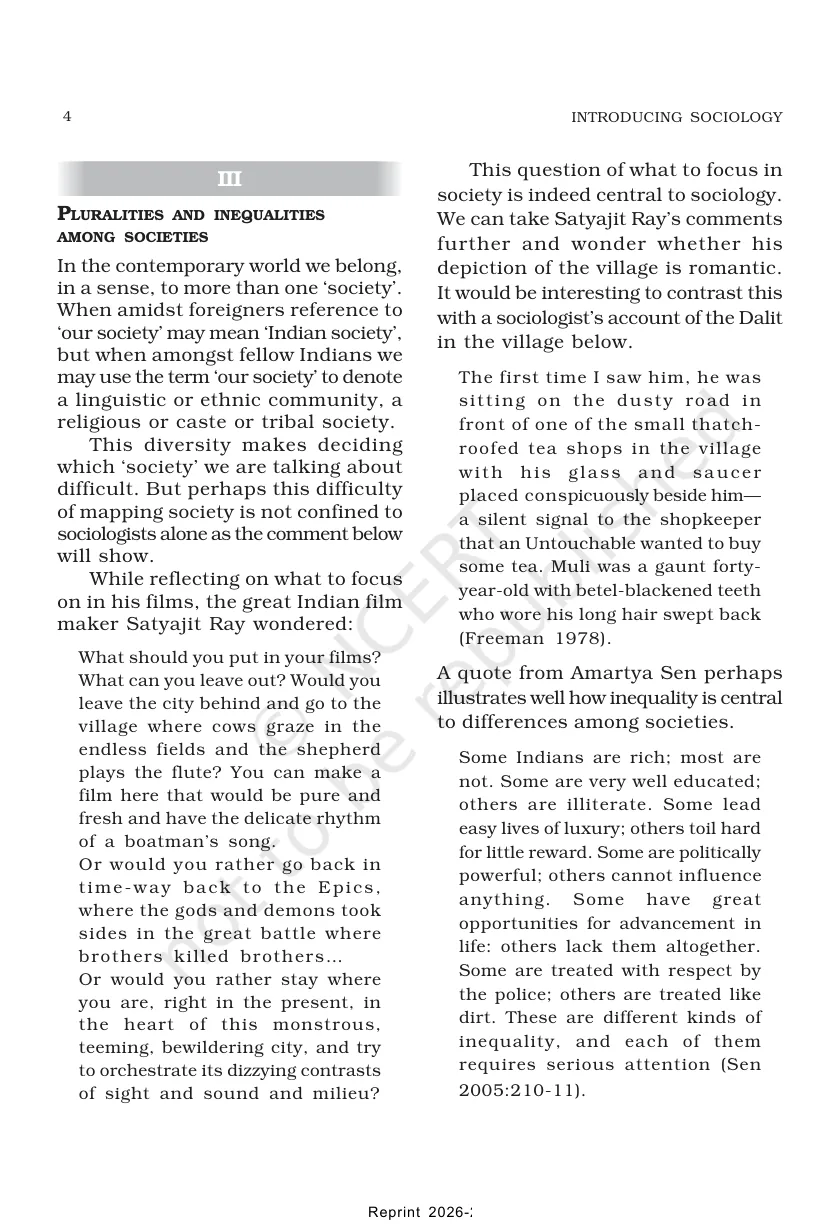
📖 Textbook Pages (NCERT / CG Board 2026-27)
✍️ Chapter 1 Exercise Solutions: Sociology and Society
Exercises
1. Why is the study of the origin and growth of sociology important?
Answer: Studying the origin and growth of sociology helps us understand why the discipline emerged and how its key ideas developed in response to real historical changes:
- Historical context of ideas: Sociology arose in 18th and 19th century Europe during the Enlightenment, the French Revolution, and the Industrial Revolution. Knowing this context clarifies why early sociologists focused on social order, class conflict, urbanisation, and secularisation.
- Understanding the colonial encounter: In India, sociology developed under British colonial rule, where Western evolutionary models often portrayed non-Western societies as backward. Studying this history explains why Indian sociologists questioned colonial stereotypes and built perspectives rooted in Indian reality.
- Connecting theory to empirical reality: The intellectual traditions that shaped sociology—such as comparing society to a living organism or studying poverty through social surveys—directly influence how sociologists study society today.
2. Discuss the different aspects of the term ‘society’. How is it different from your common sense understanding?
Answer: In sociology, the term ‘society’ refers to a web of social relationships, institutions, norms, and inequalities rather than just a collection of individuals.
- Plurality of societies: A person belongs to multiple overlapping ‘societies’ at once—for example, Indian society as a whole, as well as a linguistic, religious, caste, or regional community.
- Structured inequalities: Society is marked by unequal access to wealth, education, power, and respect, as highlighted by thinkers like Amartya Sen.
- Difference from common sense: Common sense views society as natural, fixed, and obvious, often explaining personal outcomes solely through individual effort or luck. Sociological understanding, by contrast, uses systematic evidence to show how social structures—such as gender, caste, class, and the job market—shape individual choices and opportunities.
3. Discuss how there is greater give and take among disciplines today.
Answer: Contemporary social sciences increasingly borrow concepts, methods, and insights from one another because real-world problems rarely fit inside a single academic boundary:
- Sociology and Economics: Economic sociology studies how markets, consumption, and work are shaped by social networks, culture, and power rather than pure supply and demand.
- Sociology and History: Historians use sociological concepts like class, caste, and gender to study everyday life in the past, while sociologists rely on historical records to trace long-term social change.
- Sociology and Political Science / Psychology / Anthropology: Political sociology examines voting behaviour and social movements; social psychology links individual attitudes with group norms; and sociology and social anthropology now share fieldwork methods to study both rural and urban communities.
4. Identify any personal problem that you or your friends or relatives are facing. Attempt a sociological understanding.
Answer: Following C. Wright Mills’ concept of the ‘sociological imagination’, a personal trouble can be linked to broader public issues. For example, consider a student feeling anxious about choosing a career stream or finding a secure job after school:
- Personal trouble: At the individual level, the student may worry about exam scores, personal aptitude, or family expectations.
- Sociological issue: Viewed sociologically, this anxiety is shaped by larger social forces—the structure of the job market, unequal access to quality coaching and English-medium schooling, family income, and social expectations tied to gender or region. Recognising these broader forces shows that the problem is shared by millions of young people and cannot be explained by individual effort alone.