NCERT Solutions for Class 6 English Poorvi Unit 1 (Fables and Folk Tales): Complete question-and-answer solutions for Chapter 1: A Bottle of Dew, Poem: The Raven and the Fox, and Rama to the Rescue from the latest 2026–27 NCF Class 6 English textbook Poorvi.
| Class 6 English Poorvi Resource | Stories & Poems Covered | Direct Link |
|---|---|---|
| Unit 1 Textbook PDF (Fables and Folk Tales) | A Bottle of Dew · The Raven and the Fox · Rama to the Rescue | Download Unit 1 PDF |
| Unit 1 Online Reader & Revision Notes | Interactive PDF Reader + Word Meanings | Read Unit 1 Online |
| Full Poorvi Class 6 English Book PDF | All 5 Units (Complete 2026–27 Book) | Download Full Book PDF |
| All Class 6 NCERT Books (2026–27) | Ganita Prakash, Curiosity, Exploring Society, Malhar | Class 6 NCERT Main Page |
Fables And Folk Tales Questions and Answers – Free PDF Download
NCERT Solutions for Class 6 English Poorvi, Chapter 1: Fables and Folk Tales includes two captivating stories: “A Bottle of Dew” and “Rama to the Rescue,” along with a thought-provoking poem, “The Raven and the Fox.” Each story is a delightful fable or folk tale with important lessons and charming characters. “A Bottle of Dew” teaches us that hard work is more valuable than magic, as Rama Natha learns through his efforts in growing bananas. “The Raven and the Fox” shows the danger of being tricked by flattery, illustrated by the clever fox and the proud raven. “Rama to the Rescue” highlights how clever thinking and bravery can protect against danger, as Rama and his wife outsmart a thief. With Class 6 English (Poorvi) NCERT Solutions, learning becomes more enjoyable and effective, helping students understand fables and folk tales.
Unit 1 of Class 6 English Poorvi features two interesting stories and one poem:
- “A Bottle of Dew”: This story is about Rama Natha, who learns that working hard is better than looking for magic. By growing bananas, he finds real success.
- “The Raven and the Fox”: In this poem, a raven is tricked by a fox’s flattery and drops a piece of food. The story teaches us to be careful about being flattered.
- “Rama to the Rescue”: This story shows how cleverness and bravery help Rama and his wife catch a thief and keep their home safe.
Fables and Folk Tales – Grade 6: Question & Answer Guide
Story 1: A Bottle of Dew
Before Reading Activities
I. Circle the Picture That Matches the Word
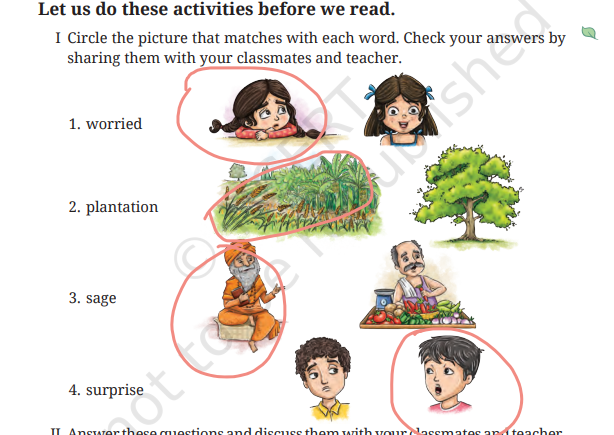
II. Discussion Questions
1. Think of a time when you worked hard. What did you do then?
Last year, I worked hard to prepare for my school annual exam. I studied every day, revised my lessons, and solved extra questions to understand the topics better.
2. How did it help you?
It helped me understand my lessons clearly, remember important points, and score good marks in the exam.
3. How did it make you feel?
It made me feel proud and confident. I was happy that my hard work gave good results and that I could achieve my goal.
Let us discuss
What did Rama Natha believe?
- He believed a magic potion could turn anything into gold.
How did the sage help Rama Natha?
- He gave him a task to collect dew from banana plants, teaching the value of hard work.
Do you think Rama Natha could collect the dew? Reason?
- Yes, with patience and effort, as he tended the plantation diligently.
Why was Rama Natha angry?
- The potion didn’t turn copper to gold; he felt six years were wasted.
How did Rama Natha and Madhumati create wealth?
Rama Natha grew and cared for banana plants, and Madhumati sold the fruits in the market.
1. Lines Analysis
(i) Complete the sentence:
Rama Natha did not ‘give up’ because he strongly believed that the magic potion could turn objects into gold.
(ii) What Happened → Outcome
| What Happened | Outcome |
|---|---|
| People promised to tell Rama Natha about the magic potion. | He spent money and time trying to learn about it. |
| Rama Natha was spending a lot of money. | Madhumati became worried that they would run out of money. |
(iii) True or False
A. Madhumati was troubled about what her husband did. → True
B. Rama Natha was very happy digging his fields. → False
C. The sage wanted to show the right path to Rama Natha. → True
2. Carefully, he took the bottle to the sage. The sage smiled and muttered something over the water. Then he returned the bottle and said, “Try it out.” Rama Natha sprinkled a few drops on a copper vessel and waited
for it to turn to gold. To his surprise nothing happened!
(i) Choose the option that lists the events given below in the correct order.
A. The sage smiled B. Rama Natha gave the bottle to the sage. C. Rama Natha dropped a few drops of water on a copper vessel. D. He said something in a low voice over the water. E. Rama Natha waited to see if the magic worked.
(a) a, e, d, b, c (b) b, a, d, c, e
(c) c, d, a, b, e (d) a, d, b, e, c
The correct order of events is:
B → A → D → C → E
Explanation:
- B. Rama Natha gave the bottle to the sage.
- A. The sage smiled.
- D. The sage muttered something in a low voice over the water.
- C. Rama Natha sprinkled a few drops on a copper vessel.
- E. Rama Natha waited to see if the magic worked.
✅ So, the correct option is: (b) B, A, D, C, E
(ii) Fill in the blank:
Seeing that the plant had dried up, the gardener poured some water on it.
(iii) How might Rama Natha have felt when nothing happened to the copper vessel?
Rama Natha might have felt disappointed, angry, and frustrated because he had spent six years collecting the dew, expecting it to turn into gold, but nothing happened.
1. What did the sage ask Rama Natha to do to make the magic potion?
The sage asked Rama Natha to plant banana plants, water them regularly, and collect the morning dew from their leaves with his own hands. Once he had five litres of dew, he was to bring it to the sage, who would chant magic words to turn it into the potion.
2. Why did the sage ask Rama Natha to do everything himself?
The sage asked him to do everything himself because he wanted Rama Natha to learn the value of hard work and take responsibility for his efforts.
3. How could Rama Natha have a big banana plantation after six years?
Rama Natha and his wife worked hard, planted more and more banana plants over the years, tended them carefully, and sold the fruits in the market. Their consistent effort and care helped them grow a huge plantation.
4. How did the sage make Rama Natha believe that there is no magic potion?
The sage gave Rama Natha the dew, muttered some words over it, and asked him to try it. When Rama Natha sprinkled it on a copper vessel, nothing happened. Then the sage showed that the real wealth came from the plantation and selling bananas, teaching him that hard work, not magic, created the wealth.
5. Fill in the ‘before’ and ‘after’ table about Rama Natha:
Before & After Table
| Before Meeting Sage | After Meeting Sage |
|---|---|
| Ignored his land, searching for potion | Planted banana trees and tended them |
| Spent money on potions | Earned wealth through effort |
| Believed in magic | Learned hard work creates wealth |
There was a farmer who had a huge coconut plantation. He worked hard and did not depend on luck. Every day was difficult but he did not give up. One day, a man bought a bag of coconuts from him, and promised to pay him the money the next day. Days passed and the man did not pay him anything. The farmer felt cheated. About two months later, he met the same man and asked him about his money. The man said, “Oh! I had forgotten. Now, I remember buying coconuts from you.” And he paid the money.
These words are homophones. Homophones are words that sound the same but have different spellings and meanings.
| Column A | Column B | Meaning of words in Column B |
|---|---|---|
| eye | I | the organ with which we see |
| your | you’re | short form of ‘you are’ |
| dew | due | happening at some time in the future |
| son | sun | the star that gives us light and heat |
| one | won | past tense of win |
| ate | eight | the number 8 |
| see | sea | large body of salt water |
Here are four pairs of homophones from the table and example sentences using both words in the same sentence:
- I / Eye
- I saw a bird with my left eye.
- Son / Sun
- The son played outside under the bright sun.
- One / Won
- She won the race by just one second.
- See / Sea
- I can see the sea from my window.
Here are the matched phrases and complete sentences:
- The children submitted their work as soon as the bell rang.
- He did not want to try rock climbing because of his fear of heights.
- The children ran towards the gate before the deadline.
- Nitin was late to school today because there was a traffic jam.
Here are some easy tongue twisters with the letter ‘b’ suitable for Class 6:
- Big blue ball bounced.
- Bobby bought a big bag.
Visits her mother and gives her two dozen bananas → 3
Goes to the market to sell the bananas → 7
Meets her friend Kalawati in the market → 2
Gives twelve bananas to her friend → 6
Chooses to go home as only some bananas were left → 4
Gives two bananas to a boy who is hungry → 1
Visits her neighbour and gifts them a bunch of bananas → 5
Here’s the pronunciation guide for the /s/ and /z/ sounds in the words you listed:
| Word | Sound of ‘s’ |
|---|---|
| beds | /z/ |
| sand | /s/ |
| clothes | /z/ |
| sea | /s/ |
| was | /z/ |
| keys | /z/ |
| bags | /z/ |
| nose | /z/ |
1. What does hard work mean to you?
Hard work means trying your best to do something. It is when you keep doing your work properly without giving up.
2. Give three reasons why you think hard work is important.
- First, hard work helps us finish our goals.
- Second, it teaches us to be patient and careful.
- Third, it makes us proud and happy when we succeed.
3. Share three ideas you would give to someone who needs to work hard.
- First, make a plan for what you want to do.
- Second, do a little work every day.
- Third, don’t give up, even if it takes time.
Story 2: The Raven and the Fox
“Which animal is shown to be cunning in stories? Circle the correct answer.”
Options:
- Tiger
- Fox ✅
- Bear
👉 The correct answer is: Fox
Comprehension Questions
1. Stanza 1
(i) Mr Raven is a bird.
(ii) The name of the fox is Reynard.
(iii) Mr Raven had a piece of food in his beak.
2. Stanza 2
(i) The Fox calls the Raven a good-looking bird.
(ii) The Fox asks the Raven to sing.
(iii) The Raven and the Fox live in the woods.
3. Stanza 3
(i) The Raven forgot that he croaked.
(ii) The Raven opened its beak to sing.
(iii) The food fell down.
4. Stanza 4
(i) The Fox laughed at the Raven.
(ii) It is not wise to be too proud of oneself.
(iii) The Raven learnt a lesson.
Column A → Column B
- perched → iv) sat on a branch
- morsel → i) a small piece of food
- seek → v) to look for something
- pride → iii) feeling that you are better than others
- eyed → ii) looked with interest at something
- limb → vii) branch of a tree
- woods → vi) a smaller area of forest with similar kind of trees
True/False Questions
- The Raven remembered he could only croak. → False
- The Fox used clever words to trick the Raven. → True
- The teaching was a surprise for the Raven. → True
Word Match
| Column A | Column B |
|---|---|
| perched | iv. sat on a branch |
| morsel | i. a small piece of food |
| seek | v. to look for something |
| pride | iii. feeling that you are better than others |
| eyed | ii. looked with interest at something |
| limb | vii. branch of a tree |
| woods | vi. a smaller area of forest |
Opposites
| Word | Opposite |
|---|---|
| perched | flew |
| forgot | remembered |
| foolish | wise |
| pride | humility |
| laughed | cried |
Story 3: Rama to the Rescue
Comprehension Questions
- Who is the kotwal?
Answer: The village policeman. - What does “rescue” mean?
Answer: To save someone. - Who needed to be rescued in the story?
Answer: A man stuck in a building on fire, a dog with a hurt leg, etc. - How did Rama help?
Answer: He quickly acted and rescued the people. - Why is cleverness important in solving problems?
Answer: It helps to find solutions quickly and safely.
Grammar & Vocabulary Questions
- Fill in the Present Progressive tense:
- I ______________ a story. → am reading
- The teachers ______________ in the staff room. → are sitting
- Contractions:
- I am → I’m
- We are → We’re
- That is → That’s
- Adverbs:
- The car moved quickly along the highway.
- Shobha danced beautifully.
- Punctuate and identify:
- Wow, what an intelligent man he is! → Exclamatory
- Do you like to read comic books? → Interrogative