DAV Class 8 Maths · Chapter 15
Statistics and Probability: Previous Year Questions Solved
Every question on this chapter we found in DAV Class 8 annual exams, mock tests and unit tests from 2018-19 to 2025-26, grouped by topic in the order of your book, with the full working. The paper name and year are printed on each question.
35 questions6 topics11 papersLatest papers first
Jump to a topic
1. Raw Data, Arranging Data and Range (2)2. Grouped Data: Class Limits, Class Size and Class Mark (3)3. Histogram (1)4. Reading a Pie Chart (Circle Graph) (10)5. Drawing a Pie Chart: Central Angles (2)6. Probability (17)
Book exercise answers are on the Chapter 15 solutions page. For the whole chapter as classroom notes (every topic explained, these questions, new practice and a revision sheet), see the Chapter 15 notes PDF.
✦ DAV CLASS 8 · ANNUAL EXAM REVISION
Revise Maths fast: handwritten-style chapter notes
📖 Every chapter in short, neat pages🧠 Diagrams, tables, points to remember⚡ PDF on your email at once
Maths notes: all 16 chapters in one PDF, ₹99

Or one chapter at a time:
Ch 1 · Squares and Square Roots ₹11Ch 2 · Cubes and Cube Roots ₹11Ch 3 · Exponents and Radicals ₹11Ch 4 · Direct and Inverse Variation ₹11Ch 5 · Profit, Loss and Discount ₹11Ch 6 · Compound Interest ₹11Ch 7 · Algebraic Identities ₹11Ch 8 · Polynomials ₹11Ch 9 · Linear Equations ₹11Ch 10 · Parallel Lines ₹11Ch 11 · Understanding Quadrilaterals ₹11Ch 12 · Construction of Quadrilaterals ₹11Ch 13 · Introduction to Graphs ₹11Ch 14 · Mensuration ₹11Ch 15 · Statistics and Probability ₹11Ch 16 · Rotational Symmetry ₹11
Any problem or question about the notes or your payment? Email [email protected]
1Raw Data, Arranging Data and Range
Q11 markAsked in: Annual Exam 2021-22
Listed below are the temperatures in °C for 7 consecutive days : −5, −4, 0, 3, 1, 5, 4. Find the range of the data.
Solution
Think: range = highest value − lowest value. With minus numbers, the lowest is the one furthest below 0.
Arrange in order: −5, −4, 0, 1, 3, 4, 5.
Highest = 5 °C. Lowest = −5 °C (colder than −4).
Range = 5 − (−5) = 5 + 5 = 10 °C (taking away a minus number adds it).
Check: on a thermometer, from −5 up to 0 is 5 steps and from 0 up to 5 is 5 more: 10.
Answer: 10 °C
Q21 markAsked in: Annual Exam 2022-23
Heights of 20 saplings in a nursery is noted (in cm) as – 89, 79, 102, 90, 94, 124, 111, 87, 88, 103, 72, 126, 125, 88, 98, 96, 127, 128, 74, 80. Find the range of their heights.
Solution
Think: only two numbers matter: the tallest and the shortest.
Tallest: scan for the biggest: 124, 126, 125, 127, 128: highest = 128 cm.
Shortest: 79, 72, 74: lowest = 72 cm.
Range = 128 − 72 = 56 cm.
Check: 72 + 56 = 128.
Answer: 56 cm
2Grouped Data: Class Limits, Class Size and Class Mark
Q31 markLatest paperAsked in: Second Unit Test 2025-26, West Bengal
The class mark of the class (500 − 600) is : (A) 550 (B) 500 (C) 600 (D) 540
Solution
Think: class mark = the middle of the class = (lower limit + upper limit) ÷ 2.
(500 + 600) ÷ 2 = 1100 ÷ 2 = 550. (A).
Check: 550 is 50 more than 500 and 50 less than 600.
Answer: (A) 550
Q42 marksLatest paperAsked in: Annual Exam 2025-26
Study the frequency distribution table given below : Marks: 10-20, 20-30, 30-40, 40-50, 50-60, 60-70; Number of students: 7, 11, 9, 13, 16, 4. (i) What is the class size of each interval? (ii) What is the class mark of class interval having maximum frequency?
Solution
Think: class size = upper limit − lower limit of one class. Maximum frequency = the biggest number in the second row.
(i) 20 − 10 = 10 (every class is 10 wide).
(ii) The biggest frequency is 16, for the class 50-60.
Class mark = (50 + 60) ÷ 2 = 110 ÷ 2 = 55.
Check: 55 lies in the middle of 50 and 60.
Answer: (i) 10 (ii) 55
Q51 markAsked in: Mock Test 2024-25, West Bengal
The class mark of the class 100 − 120 is (a) 100 (b) 110 (c) 10 (d) 120
Solution
Think: class mark = (lower limit + upper limit) ÷ 2.
(100 + 120) ÷ 2 = 220 ÷ 2 = 110. (b).
Check: (c) 10 is half the class SIZE, a trap.
Answer: (b) 110
3Histogram
Q63 marksAsked in: Mock Test 2024-25, West Bengal
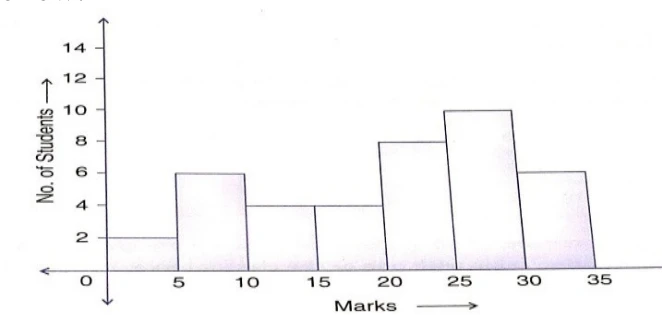
The following histogram shows the marks obtained by 40 students of class VIII in a test of Mathematics. Look at it carefully and answer the questions that follow: (i) What is the class size? (ii) How many students obtained less than 10 marks? (iii) Find the number of students obtained more than 15 but less than 30 marks.
Solution
Think: each bar is one class; its width is the class size and its height (read across to the left axis) is the number of students.
| Marks | Height of the bar (frequency) |
|---|---|
| 0-5 | 2 |
| 5-10 | 6 |
| 10-15 | 4 |
| 15-20 | 4 |
| 20-25 | 8 |
| 25-30 | 10 |
| 30-35 | 6 |
| Total | 40 |
Check first: 2 + 6 + 4 + 4 + 8 + 10 + 6 = 40 students, as the question says.
(i) Each bar goes 0 to 5, 5 to 10, …: class size = 5 − 0 = 5.
(ii) Less than 10 marks: classes 0-5 and 5-10: 2 + 6 = 8 students.
(iii) More than 15 but less than 30: classes 15-20, 20-25, 25-30: 4 + 8 + 10 = 22 students.
Check: 8 + 4 (10-15) + 22 + 6 (30-35) = 40.
Answer: (i) 5 (ii) 8 (iii) 22
4Reading a Pie Chart (Circle Graph)
Q74 marksLatest paperAsked in: Annual Exam 2025-26
CASE STUDY: A school conducted a survey of 500 students to know their favourite sports. The results are shown in the pie chart below. Using the above information answer the following:
(1) How many students prefer cricket?
(2) Which sport is the least popular and how many students prefer it?
(3) Find the central angle for football in the pie chart. Also state the number of students playing football.
OR Find the central angle for volleyball in the pie chart. How many more students like cricket as compared to volleyball?

Solution
Think: the whole circle = 360° = 100% = everything. A sector's share of the whole is its angle ÷ 360 (or its % ÷ 100). Share × total = that sector's number.
Check: the sectors add up to the whole: 36 + 10 + 14 + 16 + 24 = 100%.
Here 1% of 500 = 5 students.
(1) Cricket 36% = 36 × 5 = 180 students.
(2) Smallest sector: volleyball 10% = 10 × 5 = 50 students.
(3) Football 24%: angle = 24/100 × 360° = 86.4°; students = 24 × 5 = 120.
OR: Volleyball 10%: angle = 10/100 × 360° = 36°. Cricket − volleyball = 180 − 50 = 130 more.
Check: 180 + 50 + 70 + 80 + 120 = 500.
Answer: (1) 180 (2) Volleyball, 50 students (3) 86.4°, 120 students OR 36°, 130 more
Q84 marksLatest paperAsked in: Second Unit Test 2025-26, West Bengal
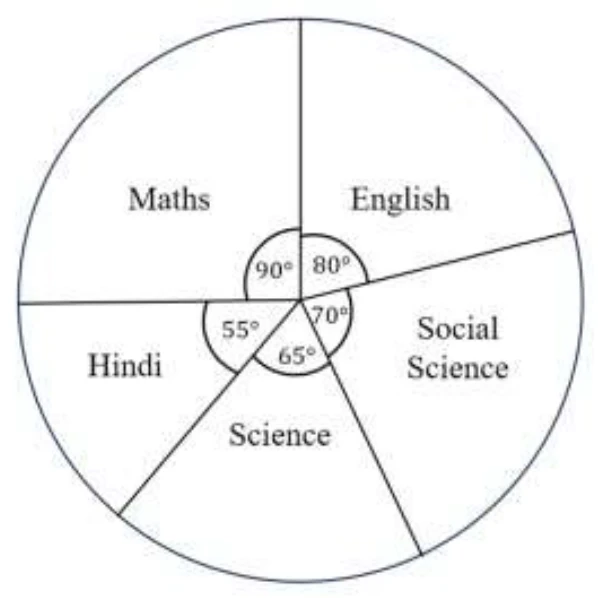
CASE STUDY: The following pie-chart represents the marks scored by a student in his final term of class VIII. He obtained 540 as total marks. Based on the above information answer the following questions: (i) In which subject did the student score 120 marks? (ii) (a) What is the difference in the marks obtained in Maths and English?
OR (b) What is the total marks scored in Hindi, Science and Social Science. (iii) Find the highest marks scored by the student.
OR (b) What is the total marks scored in Hindi, Science and Social Science. (iii) Find the highest marks scored by the student.
Solution
Think: the whole circle = 360° = 100% = everything. A sector's share of the whole is its angle ÷ 360 (or its % ÷ 100). Share × total = that sector's number.
Check: the sectors add up to the whole: 90 + 80 + 70 + 65 + 55 = 360°.
Here 360° = 540 marks, so 1° = 540 ÷ 360 = 1.5 marks (2° = 3 marks).
(i) 120 marks = 120 ÷ 1.5 = 80°: the sector with 80° is English.
(ii) (a) Maths − English = 90° − 80° = 10° = 10 × 1.5 = 15 marks.
OR (b) Hindi + Science + Social Science = 55° + 65° + 70° = 190° = 190 × 1.5 = 285 marks.
(iii) The biggest sector is Maths, 90° = 90 × 1.5 = 135 marks.
Check: 135 + 120 + 105 + 97.5 + 82.5 = 540.
Answer: (i) English (ii) (a) 15 OR (b) 285 (iii) 135 (Maths)
Q94 marksAsked in: Annual Exam 2023-24
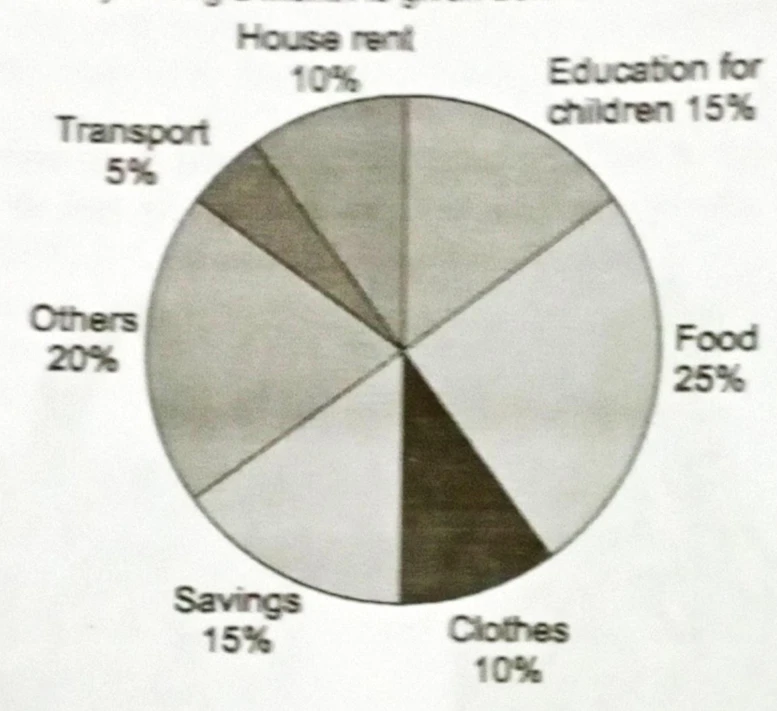
CASE STUDY: The expenditure (in percentage) on various items and savings of Abhishek's family during a month is given below. Read the pie chart and answer the following questions. (i) If monthly savings of family is ₹3000, then monthly income is (a) ₹12,000 (b) ₹20,000 (c) ₹22,500 (d) ₹30,000 (ii) The Central angle for house rent is (a) 36° (b) 48° (c) 72° (d) 45° (iii) How much more money is spent on food than clothes?
OR Find the total money spent on transport and education of children.
OR Find the total money spent on transport and education of children.
Solution
Think: the whole circle = 360° = 100% = everything. A sector's share of the whole is its angle ÷ 360 (or its % ÷ 100). Share × total = that sector's number.
Check: the sectors add up to the whole: 10 + 15 + 25 + 10 + 15 + 20 + 5 = 100%.
(i) Savings = 15% of income = ₹3000. So 1% = 3000 ÷ 15 = ₹200 and 100% = 200 × 100 = ₹20,000. (b).
(ii) House rent = 10%: angle = 10/100 × 360° = 36°. (a).
(iii) Food − clothes = 25% − 10% = 15% of ₹20,000 = 15 × 200 = ₹3000.
OR: Transport + education = 5% + 15% = 20% of ₹20,000 = 20 × 200 = ₹4000.
Check: 15% of 20,000 = 3000 = the savings given.
Answer: (i) (b) ₹20,000 (ii) (a) 36° (iii) ₹3000 OR ₹4000
Q104 marksAsked in: Annual Exam 2021-22
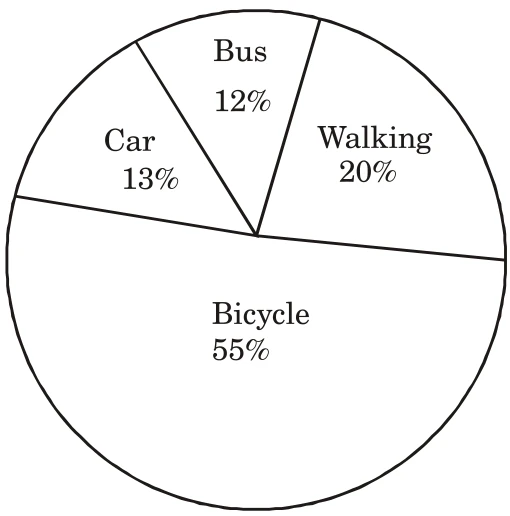
CASE STUDY: There are 800 students in a school. They use different mode of transport to come to school. Mode of transport used represented by pie chart as follows. Based on the above information, answer the following questions (Do any four):
(1) Number of students coming to the school by bicycle is : (a) 120 (b) 160 (c) 400 (d) 440
(2) Total number of students coming to the school by Bus and car is : (a) 200 (b) 540 (c) 280 (d) 600
(3) Which mode of transport is liked by most of the students ? (a) Bus (b) Car (c) Walking (d) Bicycle
(4) Number of students who do not come to school by walking is : (a) 640 (b) 440 (c) 400 (d) 80
(5) Ratio of number of students using mode of transport bus and walking is : (a) 11:2 (b) 12:13 (c) 11:4 (d) 3:5
Solution
Think: the whole circle = 360° = 100% = everything. A sector's share of the whole is its angle ÷ 360 (or its % ÷ 100). Share × total = that sector's number.
Check: the sectors add up to the whole: 12 + 13 + 20 + 55 = 100%.
Here 1% of 800 = 8 students.
(1) Bicycle 55% = 55 × 8 = 440. (d).
(2) Bus + car = 12% + 13% = 25% = 25 × 8 = 200. (a).
(3) The biggest sector is bicycle (55%). (d).
(4) Not walking = 100% − 20% = 80% = 80 × 8 = 640. (a).
(5) Bus : walking = 12 : 20; divide both by 4: 3 : 5. (d).
Check: 440 + 200 + 160 (walking) = 800.
Answer: (1) (d) 440 (2) (a) 200 (3) (d) Bicycle (4) (a) 640 (5) (d) 3:5
Q114 marksAsked in: Annual Exam 2022-23
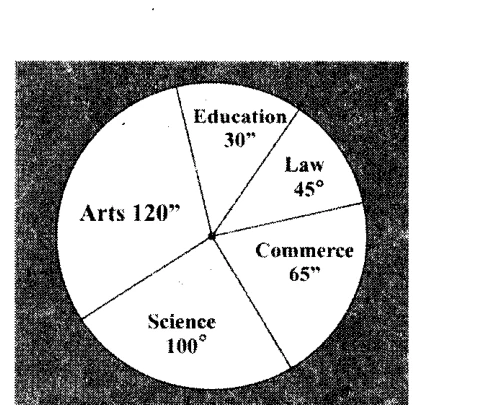
CASE STUDY: After senior secondary examination, students have craze about a new phase of college life. They opt courses of their choice. The given pie-chart shows the number of students admitted in different faculties of a college in a particular year. If 1000 students are admitted in science then answer the following questions based on the given information. (i) Total number of admitted students is – (a) 7200 (b) 3600 (c) 1800 (d) 5400 (ii) Number of students admitted in education is – (a) 300 (b) 600 (c) 450 (d) 150 (iii) Ratio of students admitted in Arts and Commerce is – (a) 5:6 (b) 3:10 (c) 9:13 (d) 24:13 (iv) If the fees of registration form is ₹500 then total amount received by the college for law students is – (a) ₹1,50,000 (b) ₹3,25,000 (c) ₹2,25,000 (d) ₹75,000 (v) The percentage of total number of students admitted in Arts is – (a) 3 1/3 % (b) 6 2/3 % (c) 33 1/3 % (d) 16 2/3 %
Solution
Think: the whole circle = 360° = 100% = everything. A sector's share of the whole is its angle ÷ 360 (or its % ÷ 100). Share × total = that sector's number.
Check: the sectors add up to the whole: 30 + 45 + 65 + 100 + 120 = 360°.
(i) Science 100° = 1000 students, so 1° = 10 students and 360° = 3600. (b).
(ii) Education 30° = 30 × 10 = 300. (a).
(iii) Arts : Commerce = 120 : 65; divide both by 5: 24 : 13. (d).
(iv) Law 45° = 450 students; 450 × ₹500 = ₹2,25,000. (c).
(v) Arts = 120/360 = 1/3 of all = 100 ÷ 3 = 33 1/3 %. (c).
Check: 300 + 450 + 650 + 1000 + 1200 = 3600.
Answer: (i) (b) 3600 (ii) (a) 300 (iii) (d) 24:13 (iv) (c) ₹2,25,000 (v) (c) 33 1/3 %
Q121 markAsked in: Annual Exam 2024-25
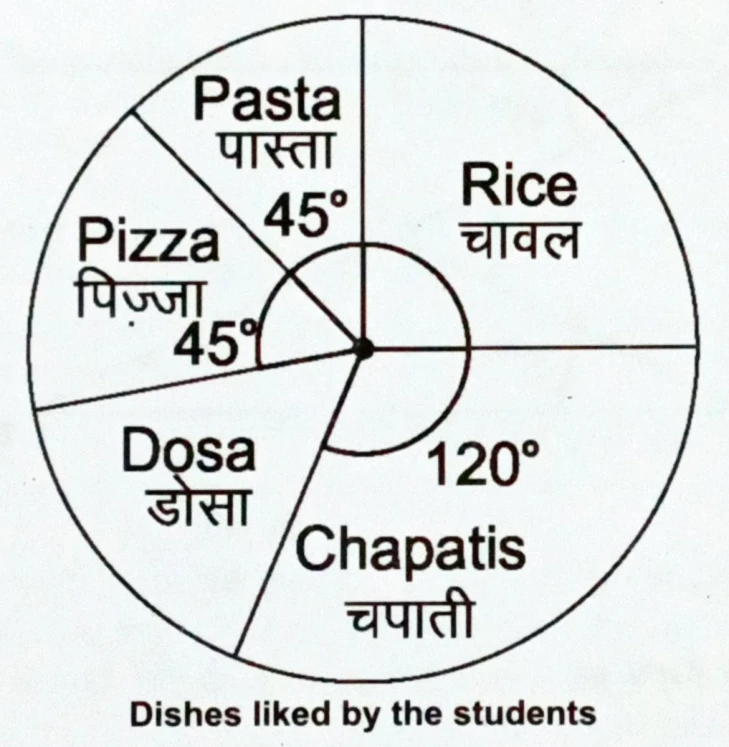
The ratio of the students who liked Rice to those who liked Dosa is ______. (Pie chart: Dishes liked by the students) (a) 3 : 2 (b) 2 : 3 (c) 1 : 2 (d) 3 : 1
Solution
Think: the angles of all sectors add to 360°. Find the two angles that are not printed.
Rice runs from the straight-up line to the straight-across line: a right angle, 90°.
Dosa = 360° − (45° + 45° + 90° + 120°) = 360° − 300° = 60°.
Rice : Dosa = 90 : 60; divide both by 30: 3 : 2. (a).
Check: the number of students in a sector goes with its angle, so the ratio of angles is the ratio of students.
Answer: (a) 3 : 2
Q132 marksAsked in: Annual Exam 2024-25
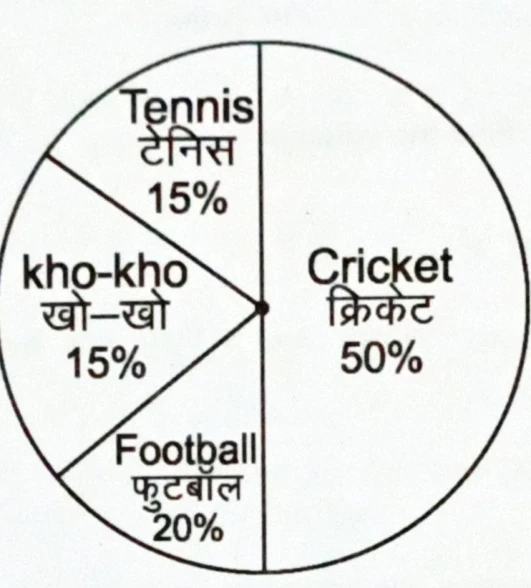
The pie chart depicts the information about the students of a school playing different types of sports in the school. If the kho-kho is played by 45 students, Find the total number of students who play sports in the school.
Solution
Think: the whole circle = 360° = 100% = everything. A sector's share of the whole is its angle ÷ 360 (or its % ÷ 100). Share × total = that sector's number.
Check: the sectors add up to the whole: 50 + 20 + 15 + 15 = 100%.
kho-kho = 15% of all = 45 students.
1% = 45 ÷ 15 = 3 students; 100% = 3 × 100 = 300.
Check: 15% of 300 = 15 × 3 = 45.
Answer: 300 students
Q142 marksAsked in: Mock Test 2024-25, West Bengal
900 men volunteered for joining the armed force. The pie-chart represents the proportion of men in different armed services. Study the pie-chart and answer the questions given below: (i) Find how many men volunteered for Army and Marine together. (ii) What percent of the men volunteered to join Navy force?

Solution
Think: the whole circle = 360° = 100% = everything. A sector's share of the whole is its angle ÷ 360 (or its % ÷ 100). Share × total = that sector's number.
Check: the sectors add up to the whole: 60 + 50 + 150 + 100 = 360°.
Here 360° = 900 men, so 1° = 900 ÷ 360 = 2.5 men.
(i) Army + Marine = 150° + 50° = 200° = 200 × 2.5 = 500 men.
(ii) Navy = 60/360 = 1/6 of all = 100 ÷ 6 = 16 2/3 %.
Check: Navy 60 × 2.5 = 150 men, and 150 out of 900 = 1/6.
Answer: (i) 500 men (ii) 16 2/3 %
Q154 marksAsked in: Mock Test 2023-24, West Bengal
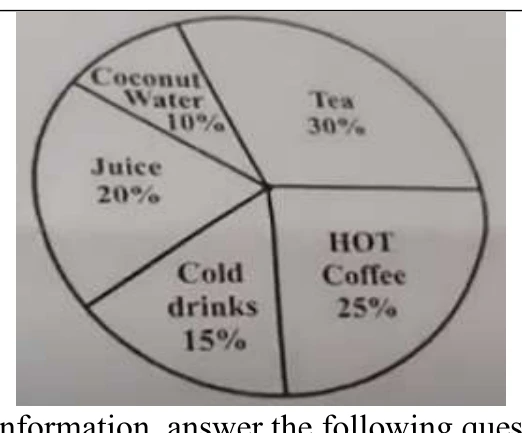
CASE STUDY: In the summer, a survey was conducted among some people about their favorite drinks. The following pie chart shows the data. Based on above information, answer the following questions: (i) If 300 people like coffee, then the number of people on which survey was conducted is: a) 100 b) 120 c) 1200 d) 2000 (ii) The ratio of number of people who like coffee to the total number of people is: a) 1:4 b) 5:6 c) 2:5 d) 3:20 (iii) Find the total number of people who are taking coconut water and Juice?
OR What is the angular representation of cold drinks and tea respectively?
OR What is the angular representation of cold drinks and tea respectively?
Solution
Think: the whole circle = 360° = 100% = everything. A sector's share of the whole is its angle ÷ 360 (or its % ÷ 100). Share × total = that sector's number.
Check: the sectors add up to the whole: 10 + 30 + 25 + 15 + 20 = 100%.
(i) Coffee = 25% = 300 people. 1% = 300 ÷ 25 = 12 people; 100% = 12 × 100 = 1200. c).
(ii) Coffee : total = 25% : 100% = 25 : 100 = 1 : 4. a).
(iii) Coconut water + juice = 10% + 20% = 30% = 30 × 12 = 360 people.
OR: Cold drinks 15/100 × 360° = 54°; tea 30/100 × 360° = 108°.
Check: 54° + 108° = 162° = 45% of 360°, and 15% + 30% = 45%.
Answer: (i) c) 1200 (ii) a) 1:4 (iii) 360 people OR 54° and 108°
Q164 marksAsked in: Mock Test 2023-24, West Bengal
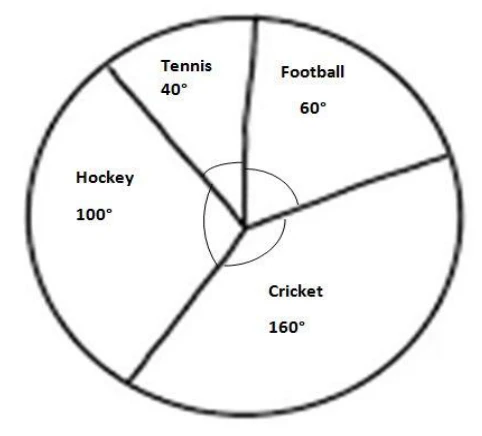
CASE STUDY: The given pie-chart shows the games played by 2700 students of a school. Each student plays only one game. Also, the school management allotted money on football ₹7200. Based on the above information answer the following questions: i) The number of students playing in cricket is (a) 759 (b) 1200 (c) 597 (d) 450 ii) The budget allotted for the students playing tennis is (a) ₹7200 (b) ₹2700 (c) ₹4800 (d) ₹8400 iii) Find the total number of the students who play tennis and hockey.
OR Find the total budget allocated for different sports.
OR Find the total budget allocated for different sports.
Solution
Think: the whole circle = 360° = 100% = everything. A sector's share of the whole is its angle ÷ 360 (or its % ÷ 100). Share × total = that sector's number.
Check: the sectors add up to the whole: 60 + 160 + 100 + 40 = 360°.
Here 360° = 2700 students, so 1° = 2700 ÷ 360 = 7.5 students.
i) Cricket 160° = 160 × 7.5 = 1200. (b).
ii) The money goes by the same angles: football 60° gets ₹7200, so 1° = 7200 ÷ 60 = ₹120. Tennis 40° = 40 × 120 = ₹4800. (c).
iii) Tennis + hockey = 40° + 100° = 140° = 140 × 7.5 = 1050 students.
OR: Whole budget = 360° = 360 × 120 = ₹43,200.
Check: football 60° is 1/6 of the circle, and 6 × 7200 = 43,200.
Answer: i) (b) 1200 ii) (c) ₹4800 iii) 1050 students OR ₹43,200
5Drawing a Pie Chart: Central Angles
Q174 marksAsked in: Annual Exam 2018-19
The following data shows the agricultural production in India during a certain year : Food-grain: Rice, Wheat, Coarse Cereals, Pulses; Production (in million of tonnes): 57, 76, 38, 19. Draw a pie chart to represent the above data.
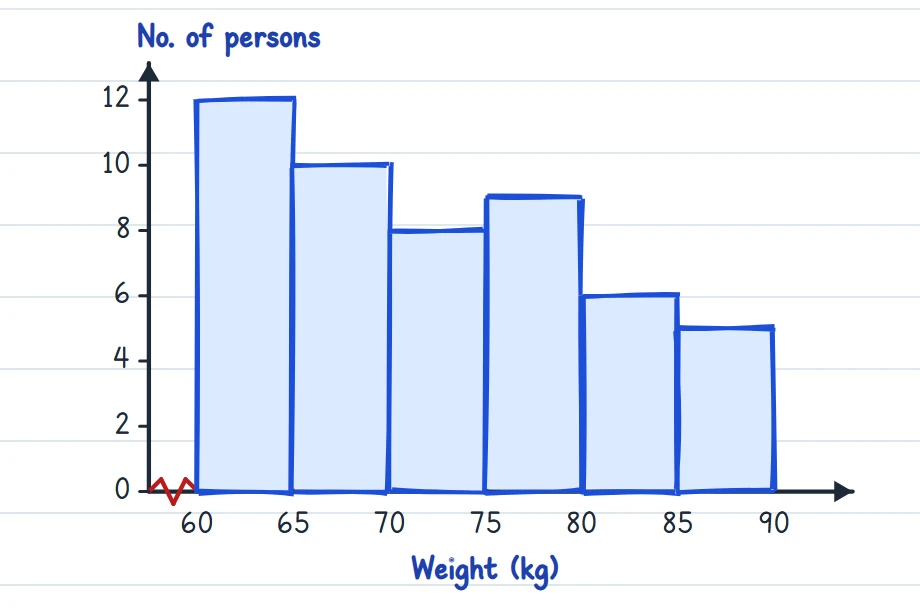
OR The following data shows the distribution of weights (in kg) of 50 persons: Weight (in kg): 60-65, 65-70, 70-75, 75-80, 80-85, 85-90; No. of persons: 12, 10, 8, 9, 6, 5. Draw a histogram for the above data.
OR The following data shows the distribution of weights (in kg) of 50 persons: Weight (in kg): 60-65, 65-70, 70-75, 75-80, 80-85, 85-90; No. of persons: 12, 10, 8, 9, 6, 5. Draw a histogram for the above data.

Solution
Think: a pie chart needs the angle of each sector: (its value ÷ total) × 360°.
Total = 57 + 76 + 38 + 19 = 190 million tonnes.
| Item | Value | Fraction of the whole | Central angle |
|---|---|---|---|
| Rice | 57 | 57/190 = 3/10 | 3/10 × 360° = 108° |
| Wheat | 76 | 76/190 = 2/5 | 2/5 × 360° = 144° |
| Coarse Cereals | 38 | 38/190 = 1/5 | 1/5 × 360° = 72° |
| Pulses | 19 | 19/190 = 1/10 | 1/10 × 360° = 36° |
| Total | 190 | 1 | 360° |
Check: 108° + 144° + 72° + 36° = 360°.
Draw: a circle, one radius; with a protractor make 108° for rice from it, then 144° for wheat from the new line, then 72°; the last 36° is left for pulses. Name each sector.
OR (histogram): classes on the x-axis (60, 65, …, 90, with a kink as they start far from 0), number of persons on the y-axis (1 big division = 2 persons). Draw touching bars of heights 12, 10, 8, 9, 6, 5.
Check: 12 + 10 + 8 + 9 + 6 + 5 = 50 persons.
Answer: Angles: Rice 108°, Wheat 144°, Coarse Cereals 72°, Pulses 36° (pie chart as in the figure). OR histogram as in the figure
Q184 marksAsked in: Annual Exam 2019-20
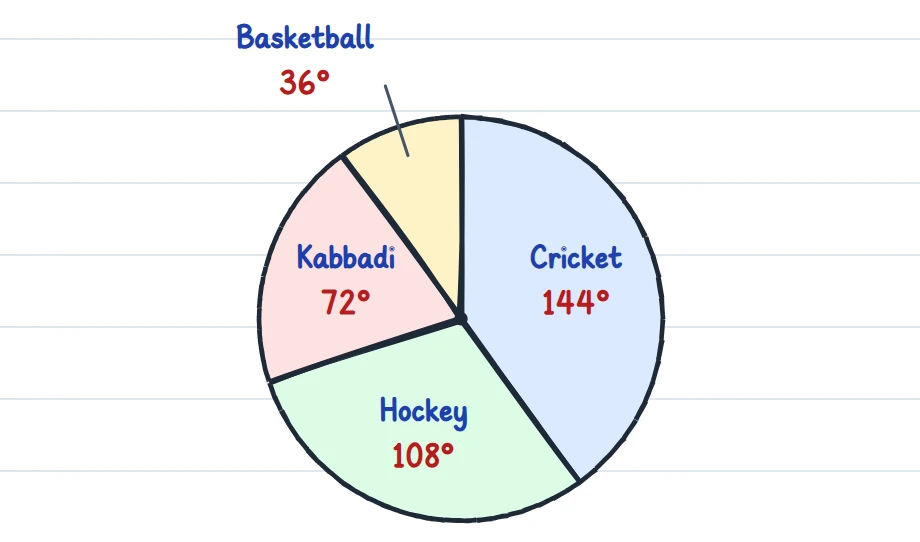
Information about the preferred sports of 100 students was obtained and is given below : Sports: Cricket, Hockey, Kabbadi, Basketball; No. of students: 40, 30, 20, 10. Draw a pie chart for the above data.
Solution
Think: angle = (students in that sport ÷ 100) × 360°. With a total of 100, every student is worth 3.6°.
| Item | Value | Fraction of the whole | Central angle |
|---|---|---|---|
| Cricket | 40 | 40/100 = 2/5 | 2/5 × 360° = 144° |
| Hockey | 30 | 30/100 = 3/10 | 3/10 × 360° = 108° |
| Kabbadi | 20 | 20/100 = 1/5 | 1/5 × 360° = 72° |
| Basketball | 10 | 10/100 = 1/10 | 1/10 × 360° = 36° |
| Total | 100 | 1 | 360° |
Check: 144° + 108° + 72° + 36° = 360°.
Draw a circle and a radius; mark 144°, then 108°, then 72° with a protractor; 36° remains for basketball. Label every sector.
Answer: Angles: Cricket 144°, Hockey 108°, Kabbadi 72°, Basketball 36° (pie chart as in the figure)
6Probability
Q191 markLatest paperAsked in: Annual Exam 2025-26
A dice is thrown. The probability of getting an even prime number is: (A) 1/6 (B) 1/2 (C) 1/3 (D) 1/5
Solution
Think: probability = (number of outcomes that make the event) ÷ (total number of outcomes). First count ALL outcomes, then the ones you want.
Outcomes: 1, 2, 3, 4, 5, 6 = 6.
Even AND prime: only 2 (4 and 6 are even but not prime). P = 1/6. (A).
Check: 2 is the only even prime number of all.
Answer: (A) 1/6
Q201 markLatest paperAsked in: Second Unit Test 2025-26, West Bengal
A number is chosen at random from first 10 natural numbers. The probability of getting of an odd prime number is: (A) 7/10 (B) 3/5 (C) 3/10 (D) 2/5
Solution
Think: probability = (number of outcomes that make the event) ÷ (total number of outcomes). First count ALL outcomes, then the ones you want.
Outcomes: 1 to 10 = 10.
Primes: 2, 3, 5, 7. Odd ones: 3, 5, 7 = 3 (2 is even).
P = 3/10. (C).
Check: 9 is odd but not prime (3 × 3).
Answer: (C) 3/10
Q213 marksLatest paperAsked in: Second Unit Test 2025-26, West Bengal
A card is drawn at random from a well shuffled deck of 52 playing cards. Find the probability that the card drawn is a (a) Red 10. (b) Not a black king. (c) Face card.
Solution
Think: probability = (number of outcomes that make the event) ÷ (total number of outcomes). First count ALL outcomes, then the ones you want.
Total outcomes = 52.
(a) Red 10s: 10 of hearts, 10 of diamonds = 2. P = 2/52 = 1/26.
(b) Black kings = 2, so NOT a black king = 52 − 2 = 50. P = 50/52 = 25/26.
(c) Face cards J, Q, K × 4 suits = 12. P = 12/52 = 3/13.
Check (b): P(black king) + P(not black king) = 1/26 + 25/26 = 1.
Answer: (a) 1/26 (b) 25/26 (c) 3/13
Q222 marksLatest paperAsked in: Mock Test 2025-26, West Bengal
If you have a collection of 6 pairs of white socks and 3 pairs of black socks. What is the probability that a pair you pick without looking is (i) white? (ii) black?
Solution
Think: probability = (number of outcomes that make the event) ÷ (total number of outcomes). First count ALL outcomes, then the ones you want.
Each outcome is a PAIR: total = 6 + 3 = 9 pairs.
(i) White pairs = 6: P = 6/9 = 2/3.
(ii) Black pairs = 3: P = 3/9 = 1/3.
Check: 2/3 + 1/3 = 1 (every pair is white or black).
Answer: (i) 2/3 (ii) 1/3
Q234 marksLatest paperAsked in: Mock Test 2025-26, West Bengal
CASE STUDY: During the lunch break, a school mathematics club organized a fun activity using a standard deck of 52 playing cards. Nidhi is asked to pick one card at random from the well-shuffled deck. (i) What is the total number of possible outcomes? (ii) Find the probability that the card drawn is a Jack of Heart. (iii) Find the probability that the card drawn is a red face card.
OR (iii) Find the probability that the card drawn is neither a Heart nor a Diamond.
OR (iii) Find the probability that the card drawn is neither a Heart nor a Diamond.
Solution
Think: probability = (number of outcomes that make the event) ÷ (total number of outcomes). First count ALL outcomes, then the ones you want.
(i) Any of the 52 cards can come: 52 outcomes.
(ii) Only one jack of hearts: P = 1/52.
(iii) Red face cards: J, Q, K of hearts and of diamonds = 6. P = 6/52 = 3/26.
OR: neither heart nor diamond = a spade or a club = 26 cards. P = 26/52 = 1/2.
Check: hearts + diamonds = 26, the other half 26.
Answer: (i) 52 (ii) 1/52 (iii) 3/26 OR 1/2
Q241 markAsked in: Annual Exam 2021-22
Cards marked with numbers 1 to 25 are placed in a box and mixed thoroughly. One card is drawn at random from the box. What is the probability of getting a prime number ?
OR A man's monthly salary is ₹4,800 and his monthly expenses on travel are ₹240. Find the central angle of the sector representing travel expenses in pie chart.
OR A man's monthly salary is ₹4,800 and his monthly expenses on travel are ₹240. Find the central angle of the sector representing travel expenses in pie chart.
Solution
Think: probability = (number of outcomes that make the event) ÷ (total number of outcomes). First count ALL outcomes, then the ones you want.
Total outcomes = 25 cards.
Favourable outcomes (a prime number): 2, 3, 5, 7, 11, 13, 17, 19, 23: 9.
P(a prime number) = 9/25.
Remember: 1 is NOT a prime number.
OR: travel angle = 240/4800 × 360° = (1/20) × 360° = 18°.
Check: 18° × 20 = 360°, and ₹240 × 20 = ₹4800.
Answer: 9/25 OR 18°
Q252 marksAsked in: Annual Exam 2018-19
A letter is chosen from the letters of the word 'ARITHMETICS'. What is the probability that it is a consonant?
Solution
Think: probability = (number of outcomes that make the event) ÷ (total number of outcomes). First count ALL outcomes, then the ones you want.
Total letters: A, R, I, T, H, M, E, T, I, C, S = 11 (count T and I twice: they are printed twice).
Vowels: A, I, E, I = 4. Consonants: R, T, H, M, T, C, S = 11 − 4 = 7.
P(consonant) = 7/11.
Check: P(vowel) + P(consonant) = 4/11 + 7/11 = 1.
Answer: 7/11
Q263 marksAsked in: Annual Exam 2018-19
From a well-shuffled deck of 52 cards, one card is drawn at random. Find the probability of getting : (i) a red card (ii) a jack of black colour (iii) a face card.
OR A die is thrown at random. Find the probability of getting : (i) an even prime number (ii) A composite number (iii) A number not less than 4
OR A die is thrown at random. Find the probability of getting : (i) an even prime number (ii) A composite number (iii) A number not less than 4
Solution
Think: probability = (number of outcomes that make the event) ÷ (total number of outcomes). First count ALL outcomes, then the ones you want.
Total outcomes = 52 cards: 26 red (hearts, diamonds) and 26 black (spades, clubs); each suit has A, 2 to 10, J, Q, K.
(i) Red cards = 26: P = 26/52 = 1/2.
(ii) Black jacks: jack of spades, jack of clubs = 2: P = 2/52 = 1/26.
(iii) Face cards J, Q, K in 4 suits = 3 × 4 = 12: P = 12/52 = 3/13.
OR: a die has 6 outcomes 1, 2, 3, 4, 5, 6.
(i) Even prime: only 2: P = 1/6.
(ii) Composite: 4, 6: P = 2/6 = 1/3.
(iii) Not less than 4 means 4 or more: 4, 5, 6: P = 3/6 = 1/2.
Check: every answer is between 0 and 1.
Answer: (i) 1/2 (ii) 1/26 (iii) 3/13 OR (i) 1/6 (ii) 1/3 (iii) 1/2
Q272 marksAsked in: Annual Exam 2019-20
A piggy bank contains number of coins of ₹2, ₹5 and ₹10 as given below : ₹2: 20, ₹5: 14, ₹10: 16. If a coin is taken out at random, then find the probability that the coin is of (i) ₹5 (ii) ₹10.
OR A box contains 90 discs which are numbered from 1 to 90. If one disc is drawn at random, find the probability that it bears : (i) a perfect square number (ii) a number divisible by 5
OR A box contains 90 discs which are numbered from 1 to 90. If one disc is drawn at random, find the probability that it bears : (i) a perfect square number (ii) a number divisible by 5
Solution
Think: probability = (number of outcomes that make the event) ÷ (total number of outcomes). First count ALL outcomes, then the ones you want.
Total coins = 20 + 14 + 16 = 50.
(i) ₹5 coins = 14: P = 14/50 = 7/25.
(ii) ₹10 coins = 16: P = 16/50 = 8/25.
OR: total = 90 discs.
(i) Perfect squares up to 90: 1, 4, 9, 16, 25, 36, 49, 64, 81 = 9 (10 × 10 = 100 is too big): P = 9/90 = 1/10.
(ii) Divisible by 5: 5, 10, …, 90 = 90 ÷ 5 = 18: P = 18/90 = 1/5.
Check: 7/25 + 8/25 + 10/25 (₹2 coins) = 1.
Answer: (i) 7/25 (ii) 8/25 OR (i) 1/10 (ii) 1/5
Q282 marksAsked in: Annual Exam 2022-23
A card is drawn from a well shuffled pack of 52 playing cards. Find the probability of getting : (i) a diamond queen. (ii) a red face card.
Solution
Think: probability = (number of outcomes that make the event) ÷ (total number of outcomes). First count ALL outcomes, then the ones you want.
Total outcomes = 52.
(i) There is only one queen of diamonds: P = 1/52.
(ii) Red suits: hearts and diamonds; each has J, Q, K: 2 × 3 = 6 red face cards. P = 6/52 = 3/26.
Check: 6/52: divide top and bottom by 2: 3/26.
Answer: (i) 1/52 (ii) 3/26
Q292 marksAsked in: Annual Exam 2023-24
Numbers from 1 to 20 written on 20 separate slips (one number on one slip) are kept in a box and mixed well. One slip is drawn at random from the box. What is the probability of getting (a) a composite number (b) a number which is a multiple of 3 or 5
Solution
Think: probability = (number of outcomes that make the event) ÷ (total number of outcomes). First count ALL outcomes, then the ones you want.
Total outcomes = 20 slips.
(a) Composite numbers (more than two factors): 4, 6, 8, 9, 10, 12, 14, 15, 16, 18, 20 = 11. P = 11/20.
(b) Multiples of 3: 3, 6, 9, 12, 15, 18. Multiples of 5: 5, 10, 15, 20. 15 is in both: count it once.
Together: 3, 5, 6, 9, 10, 12, 15, 18, 20 = 9. P = 9/20.
Check (a): 1 (neither), 8 primes (2, 3, 5, 7, 11, 13, 17, 19) and 11 composites: 1 + 8 + 11 = 20.
Answer: (a) 11/20 (b) 9/20
Q301 markAsked in: Annual Exam 2024-25
Numbers from 1 to 30 are written on thirty separate slips (one number on one slip), kept in a box and mixed well. One slip is chosen from the box without looking into it. The probability that the number on the slip is not a prime number is: (a) 2/3 (b) 3/2 (c) 3/1 (d) 1/3
Solution
Think: probability = (number of outcomes that make the event) ÷ (total number of outcomes). First count ALL outcomes, then the ones you want.
Primes from 1 to 30: 2, 3, 5, 7, 11, 13, 17, 19, 23, 29 = 10.
Not prime = 30 − 10 = 20 (this includes 1).
P = 20/30 = 2/3. (a).
Check: (b) and (c) are more than 1: a probability can never be more than 1.
Answer: (a) 2/3
Q313 marksAsked in: Annual Exam 2024-25
A card is drawn from a well-shuffled deck of 52 cards. Find the probability of getting : (a) diamond card (b) an ace of heart (c) a black king
Solution
Think: probability = (number of outcomes that make the event) ÷ (total number of outcomes). First count ALL outcomes, then the ones you want.
Total outcomes = 52.
(a) Diamonds: one whole suit = 13 cards. P = 13/52 = 1/4.
(b) Only one ace of hearts. P = 1/52.
(c) Black kings: king of spades, king of clubs = 2. P = 2/52 = 1/26.
Check: 13 × 4 = 52, so one suit is a quarter of the deck.
Answer: (a) 1/4 (b) 1/52 (c) 1/26
Q321 markAsked in: Mock Test 2024-25, West Bengal
A die is thrown. What is the probability of getting a 6? (a) 1 (b) 1/6 (c) 6/1 (d) 0
Solution
Think: probability = (number of outcomes that make the event) ÷ (total number of outcomes). First count ALL outcomes, then the ones you want.
Outcomes 1 to 6 = 6; only one face shows 6. P = 1/6. (b).
Check: 1 means "sure", 0 means "impossible"; a 6 is neither.
Answer: (b) 1/6
Q331 markAsked in: Mock Test 2023-24, West Bengal
A letter is chosen at random from the letters of the word 'ASSASSINATION'. The probability of letter chosen is a vowel: a) 6/13 b) 7/13 c) 1 d) 4/13
Solution
Think: probability = (number of outcomes that make the event) ÷ (total number of outcomes). First count ALL outcomes, then the ones you want.
Letters: A, S, S, A, S, S, I, N, A, T, I, O, N = 13.
Vowels: A three times, I twice, O once: 3 + 2 + 1 = 6.
P(vowel) = 6/13. a).
Check: consonants S × 4, N × 2, T × 1 = 7, and 6 + 7 = 13.
Answer: a) 6/13
Q342 marksAsked in: Mock Test 2023-24, West Bengal
Letters of alphabet are written on 26 separate slips and put in a bag. One slip is chosen from the bag. What is the probability of: (i) Getting the letter Q? (ii) Getting a vowel?
Solution
Think: probability = (number of outcomes that make the event) ÷ (total number of outcomes). First count ALL outcomes, then the ones you want.
Total = 26 slips.
(i) One slip has Q: P = 1/26.
(ii) Vowels A, E, I, O, U = 5: P = 5/26.
Check: 5/26 cannot be cut down: 5 does not divide 26.
Answer: (i) 1/26 (ii) 5/26
Q352 marksAsked in: Mock Test 2023-24, West Bengal
One card is drawn at random from a well shuffled deck of 52 playing cards. What is the probability of getting – i) a face card ii) a black 5.
Solution
Think: probability = (number of outcomes that make the event) ÷ (total number of outcomes). First count ALL outcomes, then the ones you want.
Total = 52.
i) Face cards: J, Q, K in each of 4 suits = 12. P = 12/52 = 3/13.
ii) Black 5s: 5 of spades, 5 of clubs = 2. P = 2/52 = 1/26.
Check: 12 ÷ 4 = 3 and 52 ÷ 4 = 13.
Answer: i) 3/13 ii) 1/26