DAV Class 8 Maths · Chapter 11
Understanding Quadrilaterals: Previous Year Questions Solved
Every question on this chapter we found in DAV Class 8 annual exams, periodic assessments and mock tests from 2018-19 to 2026-27, grouped by topic in the order of your book, with the full working. The paper name and year are printed on each question.
27 questions6 topics11 papersLatest papers first
Jump to a topic
1. Polygons, Diagonals & Angle Sum Property (5)2. Parallelogram Properties: Angles & Opposite Sides (8)3. Angle Bisectors & Diagonals of Parallelogram (3)4. Special Parallelograms: Rhombus (4)5. Special Parallelograms: Rectangle and Square (6)6. Trapezium and Kite Properties (1)
Book exercise answers are on the Chapter 11 solutions page. For the whole chapter as classroom notes (every topic explained, these questions, new practice and a revision sheet), see the Chapter 11 notes PDF.
✦ DAV CLASS 8 · ANNUAL EXAM REVISION
Revise Maths fast: handwritten-style chapter notes
📖 Every chapter in short, neat pages🧠 Diagrams, tables, points to remember⚡ PDF on your email at once
Maths notes: all 16 chapters in one PDF, ₹99


Or one chapter at a time:
Ch 1 · Squares and Square Roots ₹11Ch 2 · Cubes and Cube Roots ₹11Ch 3 · Exponents and Radicals ₹11Ch 4 · Direct and Inverse Variation ₹11Ch 5 · Profit, Loss and Discount ₹11Ch 6 · Compound Interest ₹11Ch 7 · Algebraic Identities ₹11Ch 8 · Polynomials ₹11Ch 9 · Linear Equations ₹11Ch 10 · Parallel Lines ₹11Ch 11 · Understanding Quadrilaterals ₹11Ch 12 · Construction of Quadrilaterals ₹11Ch 13 · Introduction to Graphs ₹11Ch 14 · Mensuration ₹11Ch 15 · Statistics and Probability ₹11Ch 16 · Rotational Symmetry ₹11
Any problem or question about the notes or your payment? Email [email protected]
1Polygons, Diagonals & Angle Sum Property
Q11 markLatest paperAsked in: Annual Exam 2025-26
The number of sides of a regular polygon whose exterior angle has a measure 30° is: (A) 6 (B) 10 (C) 12 (D) 15
Solution
Number of sides = 360° ÷ each exterior angle = 360° ÷ 30° = 12.
Answer: (C) 12
Q21 markAsked in: Annual Exam 2018-19
Find the sum of interior angles of a regular hexagon.
Solution
Sum of interior angles = (n – 2) × 180°, with n = 6.
= (6 – 2) × 180° = 4 × 180° = 720°.
Answer: 720°
Q31 markAsked in: Annual Exam 2022-23
Find the sum of interior angles of a regular octagon.
Solution
Sum of interior angles = (n – 2) × 180°, with n = 8.
= (8 – 2) × 180° = 6 × 180° = 1080°.
Answer: 1080°
Q41 markAsked in: Mock Test 2023-24, West Bengal
Sum of the interior angles of a pentagon is (a) 180° (b) 360° (c) 540° (d) 720°
Solution
(5 – 2) × 180° = 3 × 180° = 540°.
Answer: (c) 540°
Q51 markAsked in: Annual Exam 2024-25
The sum of all exterior angles of an octagon is: (a) 360° (b) 540° (c) 900° (d) 720°
Solution
The exterior angles of ANY convex polygon add up to 360°, whatever the number of sides.
Answer: (a) 360°
2Parallelogram Properties: Angles & Opposite Sides
Q61 markLatest paperAsked in: Annual Exam 2025-26
If one angle of a parallelogram is 24° less than twice the smaller angle then the larger angle of the parallelogram is: (A) 68° (B) 102° (C) 112° (D) 78°
Solution
Let the smaller angle be x. The larger angle is 2x – 24°.
Adjacent angles add to 180°: x + 2x – 24 = 180, so 3x = 204 and x = 68°.
Larger angle = 2 × 68 – 24 = 112°.
Answer: (C) 112°
Q73 marksLatest paperAsked in: Periodic Assessment 1, 2026-27
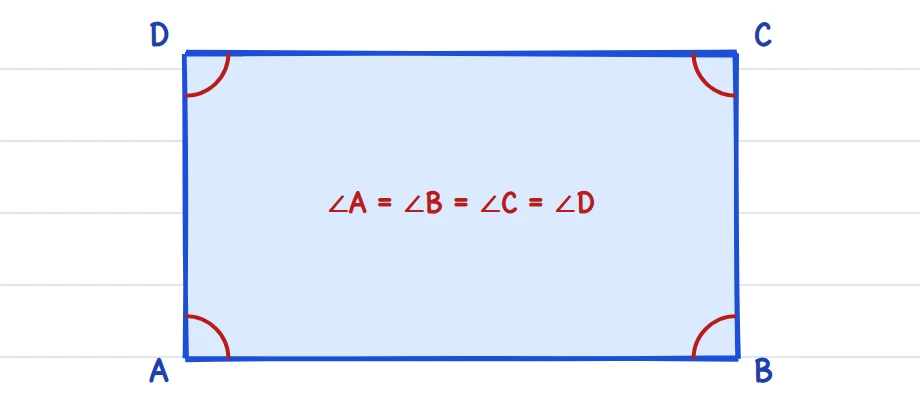
ABCD is a quadrilateral in which all the four angles are equal. Show that AB ∥ CD and AD ∥ BC.
Solution
Given: ABCD is a quadrilateral with angle A = angle B = angle C = angle D.
To prove: AB ∥ CD and AD ∥ BC
| Step | Statement | Reason |
|---|---|---|
| 1 | angle A = angle B = angle C = angle D = x | given |
| 2 | 4x = 360°, so x = 90° | angle sum of a quadrilateral |
| 3 | angle A + angle D = 90° + 90° = 180° | from step 2 |
| 4 | AB ∥ CD | AD is a transversal and the co-interior angles A and D add to 180° |
| 5 | angle A + angle B = 90° + 90° = 180° | from step 2 |
| 6 | AD ∥ BC | AB is a transversal and the co-interior angles A and B add to 180° |
Hence proved.
Answer: Proof (each angle 90°, co-interior angles add to 180°)
Q82 marksAsked in: Annual Exam 2023-24
Two adjacent angles of a parallelogram are of measure (4x + 2)° and (3x – 4)°. Find the measure of each angle of the parallelogram.
Solution
Adjacent angles of a parallelogram add to 180°: (4x + 2) + (3x – 4) = 180.
7x – 2 = 180, so 7x = 182 and x = 26.
Angles: 4 × 26 + 2 = 106° and 3 × 26 – 4 = 74°. Opposite angles are equal: 106°, 74°, 106°, 74°.
Answer: 106°, 74°, 106°, 74°
Q92 marksAsked in: Mock Test 2023-24, West Bengal
The ratio of two adjacent angles of a parallelogram is 5 : 4. Find all angles of the parallelogram.
Solution
Let the angles be 5k and 4k. 5k + 4k = 180°, so k = 20°.
Angles: 100°, 80°, 100°, 80°.
Answer: 100°, 80°, 100°, 80°
Q102 marksAsked in: Mock Test 2023-24, West Bengal
An exterior angle of a parallelogram is 85°. Find the angles of the parallelogram.
Solution
Interior angle next to it = 180° – 85° = 95° (linear pair).
Its adjacent angle = 180° – 95° = 85°.
Angles: 95°, 85°, 95°, 85° (opposite angles are equal).
Answer: 95°, 85°, 95°, 85°
Q11West marksAsked in: Mock Test 2023-24
, 2 marks):
Solution
An exterior angle of a parallelogram is 110°. Find the angles of the parallelogram.
Interior angle next to it = 180° – 110° = 70° (linear pair).
Its adjacent angle = 180° – 70° = 110°.
Angles: 70°, 110°, 70°, 110° (opposite angles are equal).
Answer: 70°, 110°, 70°, 110°
Q122 marksAsked in: Mock Test 2024-25, West Bengal
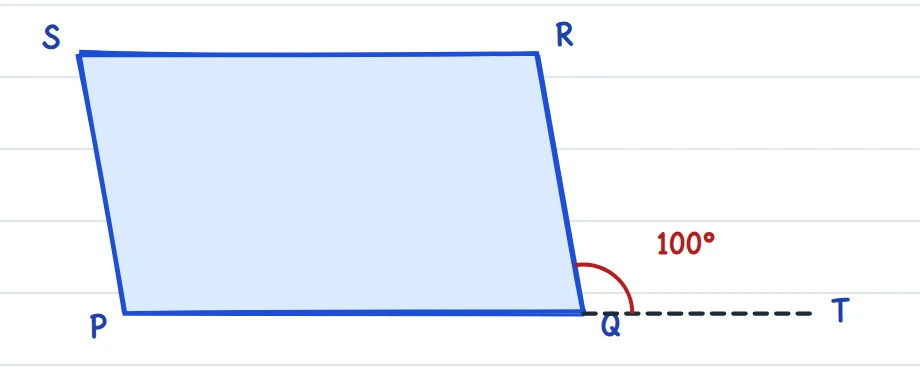
PQRS is a parallelogram and PQ is produced to T. Find the angles of the parallelogram if exterior angle RQT = 100°.
Solution
Angle PQR = 180° – 100° = 80° (linear pair on line PT).
Angle P = 180° – 80° = 100° (adjacent angles).
Opposite angles are equal: R = P = 100°, S = Q = 80°.
Answer: P = 100°, Q = 80°, R = 100°, S = 80°
Q132 marksAsked in: Annual Exam 2019-20
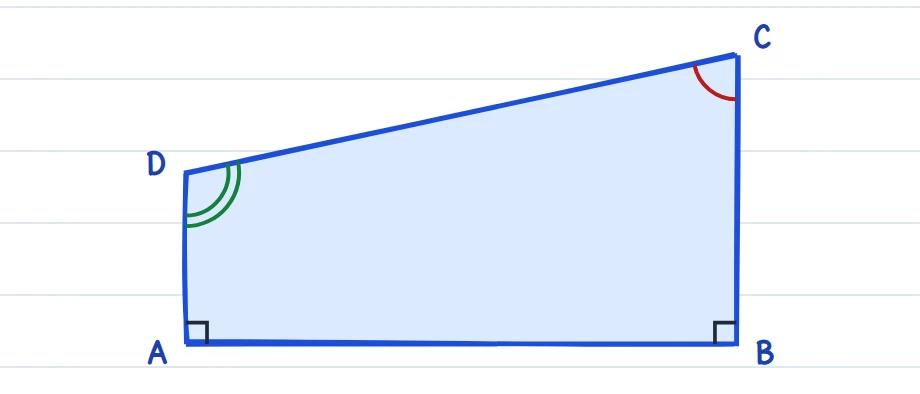
In the quadrilateral ABCD, DA ⊥ AB and CB ⊥ AB. Prove that angle C + angle D = 180°.
Solution
Given: ABCD is a quadrilateral, DA ⊥ AB and CB ⊥ AB.
To prove: angle C + angle D = 180°
| Step | Statement | Reason |
|---|---|---|
| 1 | angle A = 90° | DA ⊥ AB (given) |
| 2 | angle B = 90° | CB ⊥ AB (given) |
| 3 | angle A + angle B + angle C + angle D = 360° | angle sum of a quadrilateral |
| 4 | 90° + 90° + angle C + angle D = 360° | put steps 1 and 2 in step 3 |
| 5 | angle C + angle D = 360° – 180° = 180° | subtract 180° from both sides |
Hence proved.
Answer: Proof (angle C + angle D = 180°)
3Angle Bisectors & Diagonals of Parallelogram
Q145 marksLatest paperAsked in: Annual Exam 2025-26
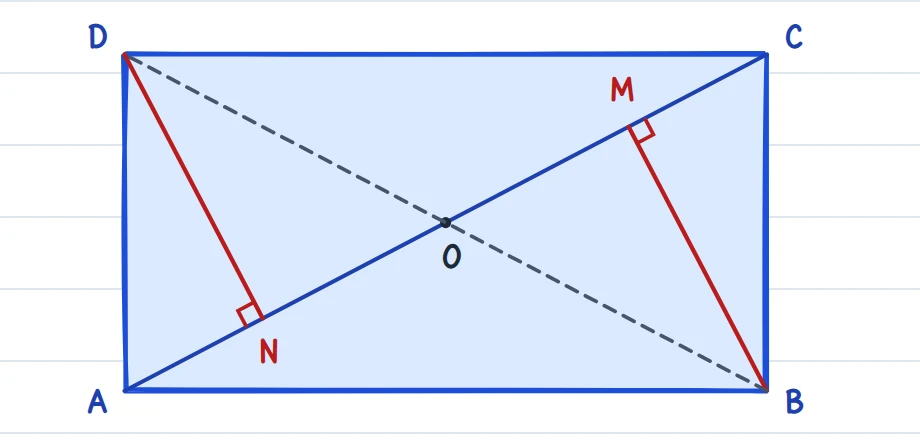
ABCD is a rectangle whose diagonals intersect at O. BM and DN are perpendiculars to AC from B and D respectively. Prove that MO = NO and hence prove that DMBN is a parallelogram.
Solution
Given: ABCD is a rectangle, diagonals meet at O, BM ⊥ AC and DN ⊥ AC.
To prove: MO = NO, and DMBN is a parallelogram
| Step | Statement | Reason |
|---|---|---|
| 1 | OB = OD | diagonals of a rectangle bisect each other |
| 2 | angle BMO = angle DNO = 90° | BM ⊥ AC and DN ⊥ AC (given) |
| 3 | angle BOM = angle DON | vertically opposite angles |
| 4 | triangle BMO ≅ triangle DNO | AAS rule (steps 2, 3 and 1) |
| 5 | MO = NO | CPCT |
| 6 | diagonals BD and MN of DMBN bisect each other at O | steps 1 and 5 |
| 7 | DMBN is a parallelogram | a quadrilateral whose diagonals bisect each other is a parallelogram |
Hence proved.
Answer: Proof (triangles BMO and DNO congruent; diagonals of DMBN bisect each other)
Q153 marksAsked in: Annual Exam 2019-20
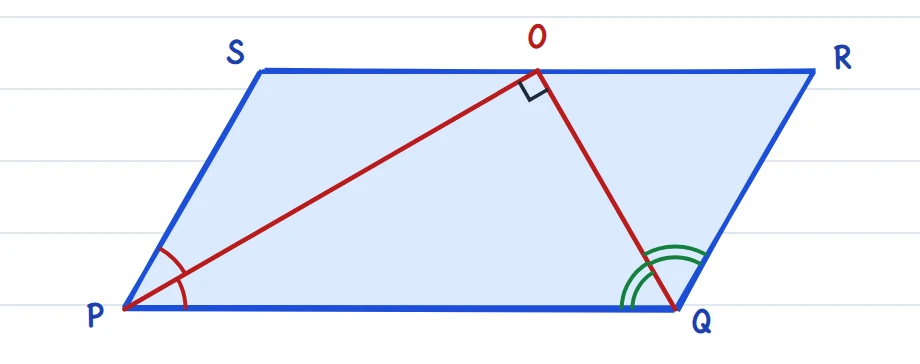
In the parallelogram PQRS, the bisectors of angle P and angle Q meet SR at O. Show that angle POQ = 90°.
Solution
Given: PQRS is a parallelogram; PO bisects angle P and QO bisects angle Q; O lies on SR.
To prove: angle POQ = 90°
| Step | Statement | Reason |
|---|---|---|
| 1 | angle P + angle Q = 180° | adjacent angles of a parallelogram (PS ∥ QR) |
| 2 | angle OPQ = 1/2 angle P | PO bisects angle P |
| 3 | angle OQP = 1/2 angle Q | QO bisects angle Q |
| 4 | angle OPQ + angle OQP = 1/2 × 180° = 90° | add steps 2 and 3, then use step 1 |
| 5 | angle POQ = 180° – 90° = 90° | angle sum of triangle POQ |
Hence proved.
Answer: Proof (angle POQ = 90°)
Q163 marksAsked in: Annual Exam 2019-20
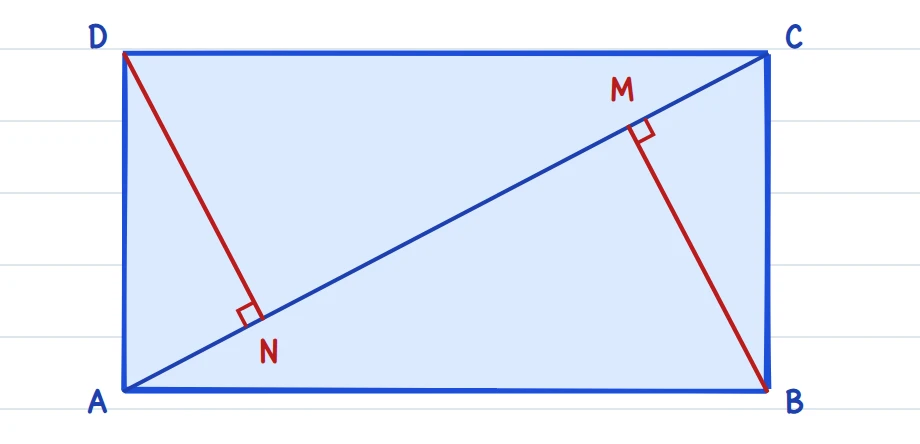
In a rectangle ABCD, BM ⊥ AC and DN ⊥ AC. Prove that (i) triangle ABM ≅ triangle CDN (ii) BM = DN.
Solution
Given: ABCD is a rectangle, BM ⊥ AC and DN ⊥ AC.
To prove: (i) triangle ABM ≅ triangle CDN (ii) BM = DN
| Step | Statement | Reason |
|---|---|---|
| 1 | AB = CD | opposite sides of a rectangle |
| 2 | angle AMB = angle CND = 90° | BM ⊥ AC and DN ⊥ AC (given) |
| 3 | angle BAM = angle DCN | alternate angles: AB ∥ DC and AC is a transversal |
| 4 | triangle ABM ≅ triangle CDN | AAS rule (steps 3, 2 and 1) |
| 5 | BM = DN | CPCT (corresponding parts of congruent triangles) |
Hence proved.
Answer: Proof (AAS congruence, then CPCT)
4Special Parallelograms: Rhombus
Q172 marksAsked in: Annual Exam 2023-24
A diagonal and a side of a rhombus are of equal length. Find the measure of the angles of the rhombus.
Solution
All sides of a rhombus are equal. The diagonal equals a side, so it cuts the rhombus into two equilateral triangles.
So one angle of the rhombus = 60°, and the adjacent angle = 180° – 60° = 120°.
Angles: 60°, 120°, 60°, 120°.
Answer: 60°, 120°, 60°, 120°
Q183 marksAsked in: Annual Exam 2024-25
One of the diagonals of a rhombus is 16 cm and its perimeter measures 40 cm. Find the length of the other diagonal.
Solution
Side = 40 ÷ 4 = 10 cm. Half of the given diagonal = 8 cm.
Diagonals of a rhombus bisect each other at 90°: half of other diagonal = sqrt(102 – 82) = sqrt(100 – 64) = sqrt(36) = 6 cm.
Other diagonal = 2 × 6 = 12 cm.
Answer: 12 cm
Q193 marksAsked in: Mock Test 2024-25, West Bengal
The diagonals of a rhombus are in the ratio 3 : 4. If its perimeter is 40 cm, find the lengths of the sides and diagonals of the rhombus.
Solution
Side = 40 ÷ 4 = 10 cm. Let the diagonals be 3k and 4k; halves are 1.5k and 2k.
(1.5k)2 + (2k)2 = 102, so 2.25k2 + 4k2 = 6.25k2 = 100 and k2 = 16, k = 4.
Diagonals = 3 × 4 = 12 cm and 4 × 4 = 16 cm.
Answer: Side 10 cm; diagonals 12 cm and 16 cm
Q203 marksAsked in: Annual Exam 2022-23
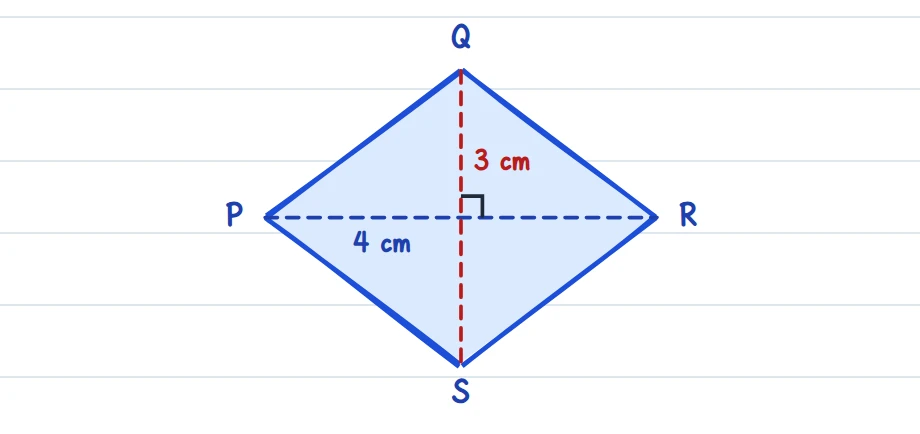
PQRS is a parallelogram whose diagonals intersect each other at right angles. If the lengths of the diagonals are 6 cm and 8 cm, find the lengths of all the sides of the parallelogram.
Solution
A parallelogram whose diagonals are perpendicular is a rhombus.
Diagonals bisect each other: halves are 3 cm and 4 cm.
Each side = sqrt(32 + 42) = sqrt(9 + 16) = sqrt(25) = 5 cm. All four sides are 5 cm.
Answer: 5 cm each
5Special Parallelograms: Rectangle and Square
Q211 markAsked in: Mock Test 2023-24, West Bengal
Which of the given polygons have equal diagonals? (a) square (b) rhombus (c) parallelogram (d) trapezium
Solution
Only rectangles (and so squares) always have equal diagonals. A rhombus, a general parallelogram and a general trapezium do not.
Answer: (a) square
Q222 marksAsked in: Annual Exam 2021-22
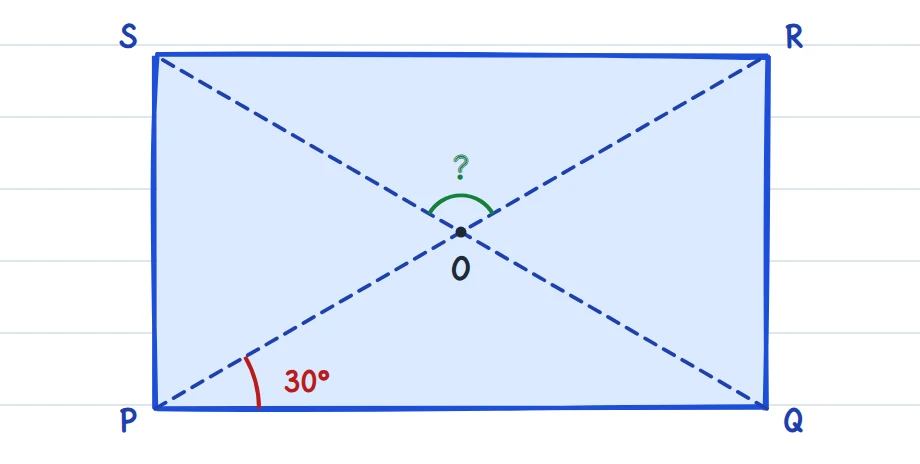
In rectangle PQRS, diagonals PR and QS intersect at O. If angle RPQ = 30°, find angle ROS.
Solution
Diagonals of a rectangle are equal and bisect each other, so OP = OQ.
In triangle OPQ: angle OQP = angle OPQ = 30°, so angle POQ = 180° – 30° – 30° = 120°.
Angle ROS = angle POQ = 120° (vertically opposite angles).
Answer: 120°
Q232 marksAsked in: Annual Exam 2021-22
The width of a rectangle is 3/5 of its length. If its perimeter is 640 m, find the dimensions of the rectangle.
Solution
Length + width = 640 ÷ 2 = 320 m.
l + (3/5)l = (8/5)l = 320, so l = 320 × 5 ÷ 8 = 200 m.
Width = (3/5) × 200 = 120 m.
Answer: Length 200 m, width 120 m
Q243 marksAsked in: Annual Exam 2022-23
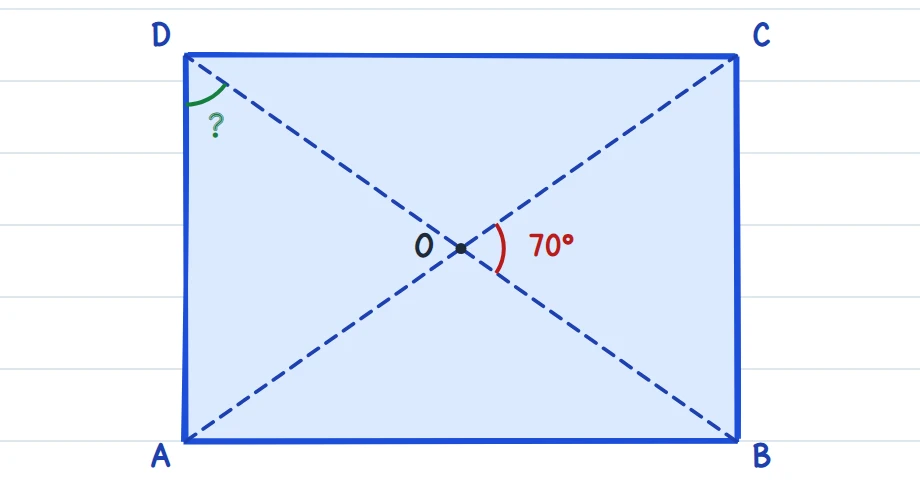
The diagonals of a rectangle ABCD intersect at O. If angle BOC = 70°, find angle ODA.
Solution
Angle AOD = angle BOC = 70° (vertically opposite).
OA = OD (diagonals of a rectangle are equal and bisect each other), so angle OAD = angle ODA.
Angle ODA = (180° – 70°) ÷ 2 = 55°.
Also asked in: Mock Test 2023-24, West Bengal.
Answer: 55°
Q253 marksAsked in: Annual Exam 2023-24
The lengths of a pair of adjacent sides of a rectangle are in the ratio 4 : 3. If its diagonal is 50 cm long, find the lengths of the sides and hence the perimeter of the rectangle.
Solution
Let the sides be 4k and 3k. Each angle of a rectangle is 90°, so (4k)2 + (3k)2 = 502.
25k2 = 2500, so k2 = 100 and k = 10.
Sides = 40 cm and 30 cm.
Perimeter = 2(40 + 30) = 140 cm.
Answer: Sides 40 cm and 30 cm; perimeter 140 cm
Q264 marksAsked in: Annual Exam 2018-19
The lengths of a pair of adjacent sides of a rectangle are in the ratio 3 : 4. If its diagonal is 20 cm long, find the lengths of the sides and hence the perimeter of the rectangle.
Solution
Let the sides be 3k and 4k. Each angle of a rectangle is 90°, so (3k)2 + (4k)2 = 202.
25k2 = 400, so k2 = 16 and k = 4.
Sides = 12 cm and 16 cm.
Perimeter = 2(12 + 16) = 56 cm.
Answer: Sides 12 cm and 16 cm; perimeter 56 cm
6Trapezium and Kite Properties
Q274 marksAsked in: Annual Exam 2021-22
Case study: Each student was given 4 straws of lengths 3 cm, 3 cm, 4 cm and 4 cm to make quadrilaterals.
(1) Name the type of quadrilaterals that can be formed: (a) Square, Rectangle, Parallelogram (b) Rectangle, Kite, Parallelogram (c) Parallelogram, Square, Rhombus (d) Rectangle, Square, Kite.
(2) Which statement is correct? (a) Diagonals of a parallelogram intersect at right angles (b) Opposite sides of a trapezium are parallel to each other (c) Diagonals of a rectangle are equal (d) Each angle of a rhombus is 90°.
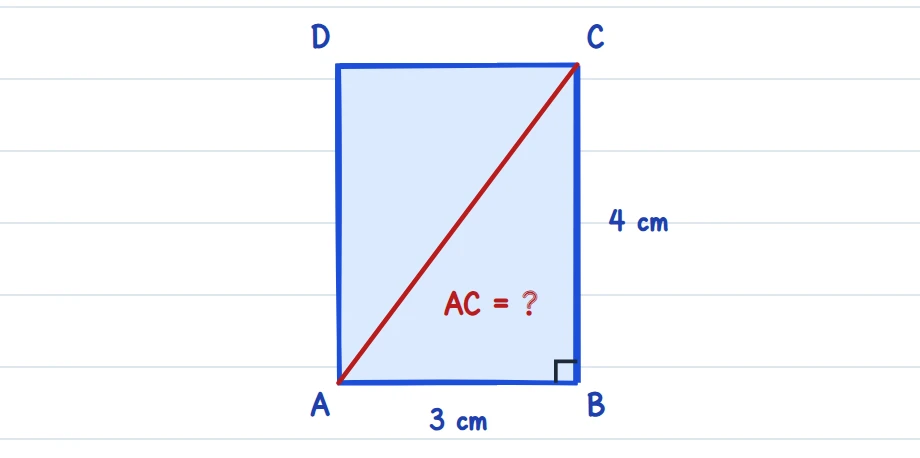
(3) If the quadrilateral formed is rectangle ABCD with AB = 3 cm, BC = 4 cm, find AC: (a) 7 cm (b) 6 cm (c) 5 cm (d) 4 cm.
(4) If ABCD is a parallelogram and angle A = 120°, find angle B: (a) 220° (b) 60° (c) 80° (d) 120°.
(5) If the perimeter of ABCD equals the perimeter of a square, the area of the square is: (a) 14 cm2 (b) 196 cm2 (c) 1.96 cm2 (d) 12.25 cm2
Solution
(1) Two pairs of equal sticks: opposite pairs give a rectangle or parallelogram; equal sticks side by side give a kite. Answer (b).
(2) Only "diagonals of a rectangle are equal" is always true. Answer (c).
(3) AC = sqrt(32 + 42) = sqrt(25) = 5 cm. Answer (c).
(4) Adjacent angles add to 180°: B = 180° – 120° = 60°. Answer (b).
(5) Perimeter = 3 + 3 + 4 + 4 = 14 cm, so square side = 3.5 cm and area = 3.5 × 3.5 = 12.25 cm2. Answer (d).
Answer: (1) b (2) c (3) c, 5 cm (4) b, 60° (5) d, 12.25 cm2