DAV Class 8 Maths · Chapter 14
Mensuration: Previous Year Questions Solved
Every question on this chapter we found in DAV Class 8 annual exams, periodic assessments, periodic tests, half yearly exams and mock tests from 2018-19 to 2026-27, grouped by topic in the order of your book, with the full working. The paper name and year are printed on each question.
67 questions5 topics19 papersLatest papers first
Jump to a topic
1. Area of Trapezium (13)2. Surface Area of Cube and Cuboid (21)3. Right Circular Cylinder: Area & Volume (26)4. Real-Life Applications: Earth Dug Out, Melting and Recasting (1)5. Polyhedrons and Euler's Formula (6)
Book exercise answers are on the Chapter 14 solutions page. For the whole chapter as classroom notes (every topic explained, these questions, new practice and a revision sheet), see the Chapter 14 notes PDF.
✦ DAV CLASS 8 · ANNUAL EXAM REVISION
Revise Maths fast: handwritten-style chapter notes
📖 Every chapter in short, neat pages🧠 Diagrams, tables, points to remember⚡ PDF on your email at once
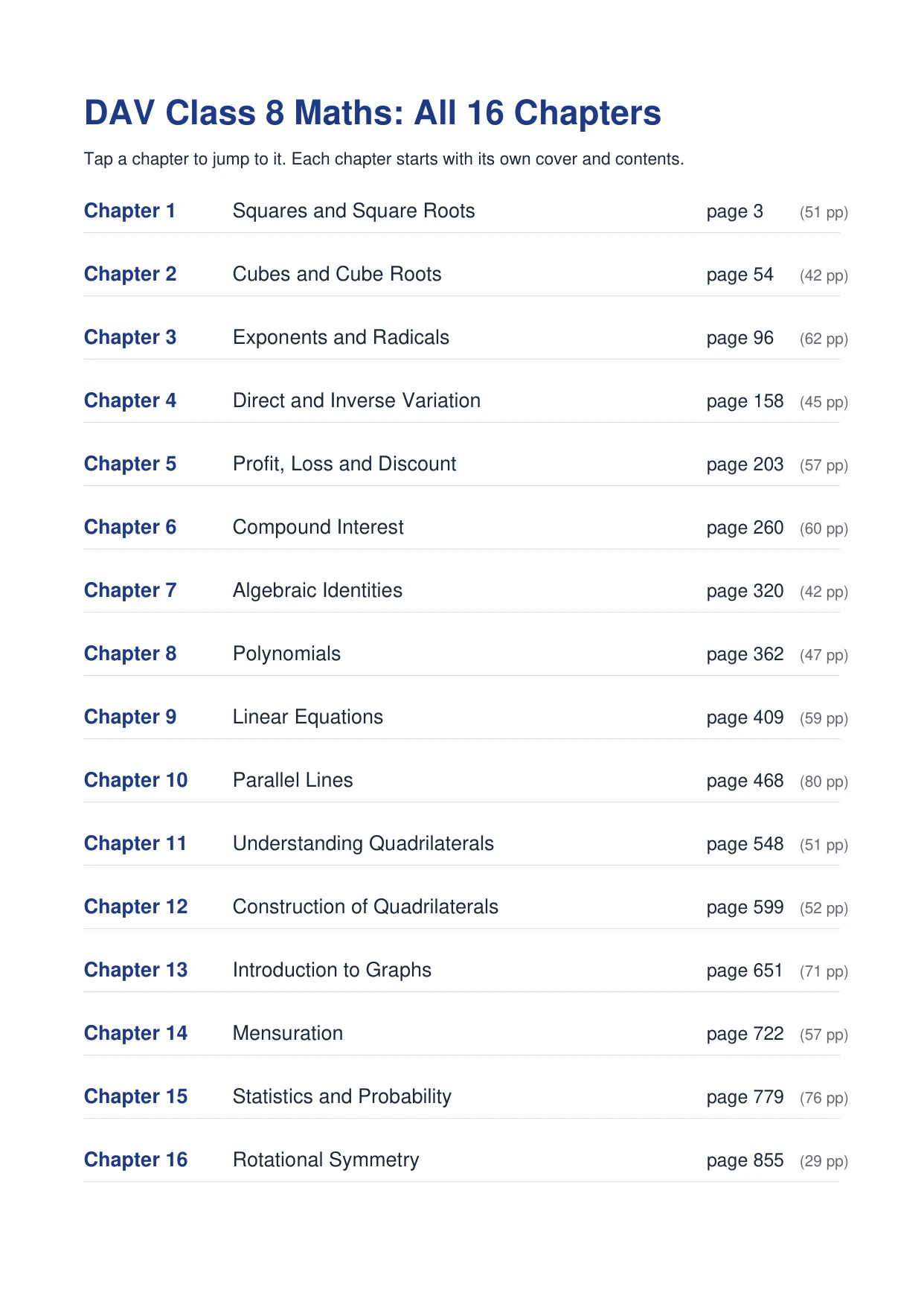
Maths notes: all 16 chapters in one PDF, ₹99

Or one chapter at a time:
Ch 1 · Squares and Square Roots ₹11Ch 2 · Cubes and Cube Roots ₹11Ch 3 · Exponents and Radicals ₹11Ch 4 · Direct and Inverse Variation ₹11Ch 5 · Profit, Loss and Discount ₹11Ch 6 · Compound Interest ₹11Ch 7 · Algebraic Identities ₹11Ch 8 · Polynomials ₹11Ch 9 · Linear Equations ₹11Ch 10 · Parallel Lines ₹11Ch 11 · Understanding Quadrilaterals ₹11Ch 12 · Construction of Quadrilaterals ₹11Ch 13 · Introduction to Graphs ₹11Ch 14 · Mensuration ₹11Ch 15 · Statistics and Probability ₹11Ch 16 · Rotational Symmetry ₹11
Any problem or question about the notes or your payment? Email [email protected]
1Area of Trapezium
Q13 marksLatest paperAsked in: Annual Exam 2025-26
In a trapezium shaped field, one of the parallel sides is thrice the other. If the area of the field is 840 m2 and the perpendicular distance between the two parallel sides is 21 m, find the perimeter of the trapezium if each of the non-parallel sides measures 29 m.
Solution
Let the parallel sides be x and 3x.
Area = 1/2 × (x + 3x) × 21 = 42x.
42x = 840, so x = 20 m and 3x = 60 m.
Perimeter = 20 + 60 + 29 + 29 = 138 m.
Answer: 138 m
Q25 marksLatest paperAsked in: Periodic Assessment 2, 2026-27
The lengths of the parallel sides of a trapezium are 12 cm and 36 cm respectively. The other two non-parallel sides are each equal to 15 cm. Find the area of the trapezium.
Solution
Drop perpendiculars from the ends of the shorter side onto the longer side.
Each end piece = (36 – 12) ÷ 2 = 12 cm (the two slant sides are equal).
Height h = sqrt(152 – 122) = sqrt(225 – 144) = sqrt(81) = 9 cm.
Area = 1/2 × (36 + 12) × 9 = 216 cm2.
Answer: 216 cm2
Q35 marksLatest paperAsked in: Periodic Assessment 2, 2025-26
The area of a trapezium is 384 sq. cm. Its parallel sides are in the ratio 3 : 5 and the perpendicular distance between them is 12 cm. Find the parallel sides.
Solution
Let the parallel sides be 3k and 5k.
Area = 1/2 × 8k × 12 = 48k.
48k = 384, so k = 8.
Parallel sides = 3 × 8 = 24 cm and 5 × 8 = 40 cm.
Answer: 24 cm and 40 cm
Q41 markAsked in: Periodic Assessment 2, 2023-24
The area of a trapezium is 24 m2. If its height is 6 m, then the sum of parallel sides is: (A) 3 m (B) 8 m (C) 20 m (D) 12 m
Solution
Area = 1/2 × (sum of parallel sides) × height.
24 = 1/2 × S × 6 = 3 × S.
S = 24 ÷ 3 = 8 m.
Also asked in: Periodic Test 2, 2026-27, West Bengal.
Answer: (B) 8 m
Q51 markAsked in: Annual Exam 2021-22
The area of a trapezium is 1080 cm2. If the lengths of its parallel sides are 55.6 cm and 34.4 cm, find the distance between them.
Solution
Sum of parallel sides = 55.6 + 34.4 = 90 cm.
Area = 1/2 × 90 × h = 45 × h.
45 × h = 1080, so h = 1080 ÷ 45 = 24 cm.
Answer: 24 cm
Q62 marksAsked in: Periodic Test 2, 2023-24, West Bengal
Find the area of a trapezium whose parallel sides are 24 cm and 20 cm and the distance between them is 15 cm.
Solution
Sum of parallel sides = 24 + 20 = 44 cm.
Area = 1/2 × 44 × 15 = 330 cm2.
Answer: 330 cm2
Q72 marksAsked in: Annual Exam 2022-23
The perimeter of a trapezium is 104 m, its non-parallel sides are 18 m and 22 m, and its altitude is 16 m. Find the area of trapezium.
Solution
Sum of parallel sides = perimeter – non-parallel sides = 104 – 18 – 22 = 64 m.
Area = 1/2 × 64 × 16 = 512 m2.
Also asked in: Periodic Test 2, 2025-26, West Bengal.
Answer: 512 m2
Q82 marksAsked in: Annual Exam 2023-24
The perimeter of a trapezium is 52 cm and its two non parallel sides are of length 10 cm each. If the distance between two parallel sides is 8 cm, then find the area of the trapezium.
Solution
Sum of parallel sides = perimeter – non-parallel sides = 52 – 10 – 10 = 32 cm.
Area = 1/2 × 32 × 8 = 128 cm2.
Answer: 128 cm2
Q92 marksAsked in: Mock Test 2023-24, West Bengal
The perimeter of a trapezium is 110 cm. Its non-parallel sides are 20 cm and 24 cm. If its altitude is 16 cm, then find the area of the trapezium.
Solution
Sum of parallel sides = perimeter – non-parallel sides = 110 – 20 – 24 = 66 cm.
Area = 1/2 × 66 × 16 = 528 cm2.
Answer: 528 cm2
Q103 marksAsked in: Periodic Assessment 2, 2019-20
The area of a trapezium is 176 cm2. The distance between parallel sides is 8 cm and one of the parallel sides is 10 cm. Find the other.
Solution
Area = 1/2 × (10 + x) × 8 = 4 × (10 + x).
4 × (10 + x) = 176, so 10 + x = 44.
x = 44 – 10 = 34 cm.
Answer: 34 cm
Q113 marksAsked in: Half Yearly Exam 2022-23
The parallel sides of a trapezium are 20 cm and 10 cm. Its non-parallel sides are both equal, each being 13 cm. Find the area of the trapezium.
Solution
Drop perpendiculars from the ends of the shorter side onto the longer side.
Each end piece = (20 – 10) ÷ 2 = 5 cm (the two slant sides are equal).
Height h = sqrt(132 – 52) = sqrt(169 – 25) = sqrt(144) = 12 cm.
Area = 1/2 × (20 + 10) × 12 = 180 cm2.
Answer: 180 cm2
Q124 marksAsked in: Periodic Assessment 2, 2019-20
Two parallel sides of a trapezium are 58 cm and 42 cm. The other two sides are of equal length which is 17 cm. Find the area of the trapezium.
Solution
Drop perpendiculars from the ends of the shorter side onto the longer side.
Each end piece = (58 – 42) ÷ 2 = 8 cm (the two slant sides are equal).
Height h = sqrt(172 – 82) = sqrt(289 – 64) = sqrt(225) = 15 cm.
Area = 1/2 × (58 + 42) × 15 = 750 cm2.
Answer: 750 cm2
Q135 marksAsked in: Periodic Assessment 2, 2023-24
Two parallel sides of a trapezium are 25 cm and 13 cm. The other two sides are 15 cm each. Find the area of the trapezium.
Solution
Each end piece = (25 – 13) ÷ 2 = 6 cm.
Height h = sqrt(152 – 62) = sqrt(225 – 36) = sqrt(189) = 3 × sqrt(21) cm (about 13.75 cm).
Area = 1/2 × (25 + 13) × 3 × sqrt(21) = 19 × 3 × sqrt(21) = 57 × sqrt(21) cm2, about 261.21 cm2.
The numbers in this paper do not give a whole-number height; write the exact form and the decimal.
Answer: 57 × sqrt(21) cm2 (about 261.21 cm2)
2Surface Area of Cube and Cuboid
Q141 markLatest paperAsked in: Periodic Test 2, 2025-26, West Bengal
The volume of a cube is 729 m3. Length of its side is (a) 3 m (b) 6 m (c) 9 m (d) 27 m
Solution
9 × 9 × 9 = 729, so the side is 9 m.
Answer: (c) 9 m
Q151 markLatest paperAsked in: Periodic Test 2, 2025-26, West Bengal
The volume of a cube of side 0.01 m in cm3 is (a) 0.001 (b) 1 (c) 0.0001 (d) 0.000001
Solution
0.01 m = 1 cm, so volume = 1 × 1 × 1 = 1 cm3.
Answer: (b) 1
Q161 markLatest paperAsked in: Periodic Test 2, 2025-26, West Bengal
Three cubes whose edges are 3 cm, 4 cm and 5 cm respectively, melted without any loss of metal into a single cube. Then the edge of new cube is: (a) 7 cm (b) 5 cm (c) 8 cm (d) 6 cm
Solution
Total volume = 27 + 64 + 125 = 216 cm3.
New edge = cube root of 216 = 6 cm.
Answer: (d) 6 cm
Q171 markLatest paperAsked in: Periodic Test 2, 2026-27, West Bengal
If length of side of a cube is doubled then volume of the cube will be (A) halved (B) doubled (C) remain same (D) 8 times
Solution
New volume = (2a)3 = 8a3, which is 8 times a3.
Also asked in: Annual Exam 2024-25; Periodic Assessment 2, 2026-27.
Answer: (D) 8 times
Q181 markLatest paperAsked in: Periodic Assessment 2, 2025-26
Assertion (A): If the volume of a room is 80 m3 and the area of the floor is 20 m2, then height of the room is 4 m.
Reason (R): Volume of a cuboid is calculated by multiplying length × width × height.
Solution
Volume = (length × width) × height = floor area × height.
Height = 80 ÷ 20 = 4 m, so A is true, and it follows from R.
Answer: Both A and R are true and R is the correct explanation of A.
Q192 marksLatest paperAsked in: Periodic Assessment 2, 2026-27
Find the volume of a cube whose surface area is 150 m2.
Solution
6 × side2 = 150, so side2 = 150 ÷ 6 = 25.
Side = 5 m.
Volume = side3 = 5 × 5 × 5 = 125 m3.
Also asked in: Periodic Assessment 2, 2019-20; Half Yearly Exam 2022-23.
Answer: 125 m3
Q202 marksLatest paperAsked in: Periodic Assessment 2, 2026-27
How many cubes each of side 0.5 cm are required to build a cube of volume 8 cm3?
Solution
Volume of one small cube = 0.5 × 0.5 × 0.5 = 0.125 cm3.
Number = 8 ÷ 0.125 = 64.
Answer: 64
Q212 marksLatest paperAsked in: Annual Exam 2025-26
A cardboard box is 1.2 m long, 72 cm wide and 54 cm high. How many bars of soap can be put into it if each bar measures 6 cm × 4.5 cm × 4 cm?
Solution
1.2 m = 120 cm. Volume of box = 120 × 72 × 54 = 466560 cm3.
Volume of one bar = 6 × 4.5 × 4 = 108 cm3.
Number of bars = 466560 ÷ 108 = 4320.
Answer: 4320
Q223 marksLatest paperAsked in: Periodic Test 2, 2026-27, West Bengal
Two cubes of side 8 cm are fixed together. Find the total surface area of the new solid formed.
Solution
The new solid is a cuboid 16 cm × 8 cm × 8 cm.
TSA = 2(lb + bh + hl) = 2(16 × 8 + 8 × 8 + 8 × 16) = 2(128 + 64 + 128) = 2 × 320 = 640 cm2.
Answer: 640 cm2
Q231 markAsked in: Half Yearly Exam 2022-23
Find the surface area of a cube whose side measures 5 cm.
Solution
Surface area of a cube = 6 × side2 = 6 × 52 = 6 × 25 = 150 cm2.
Answer: 150 cm2
Q241 markAsked in: Annual Exam 2023-24
If the total surface area of a cube is 150 m2, then the length of its side is: (a) 4 m (b) 3 m (c) 10 m (d) 5 m
Solution
6 × side2 = 150, so side2 = 25 and side = 5 m.
Answer: (d) 5 m
Q251 markAsked in: Periodic Assessment 2, 2024-25
Two cubes have their volume in the ratio 1 : 8. Then the ratio of their surface areas is (a) 1 : 4 (b) 7 : 9 (c) 1 : 9 (d) 5 : 3
Solution
Volumes 1 : 8 means sides 1 : 2 (cube roots).
Surface areas go as side2: 1 : 4.
Answer: (a) 1 : 4
Q261 markAsked in: Annual Exam 2024-25
Assertion (A): If the volume of a cube is numerically equal to its total surface area, then the length of each side is 6 units.
Reason (R): The lateral surface area of cube is 6 × side2.
Solution
A: a3 = 6a2 gives a = 6. A is true.
R: lateral surface area of a cube is 4 × side2 (6 × side2 is the total surface area). R is false.
Answer: Assertion (A) is true but Reason (R) is false.
Q271 markAsked in: Periodic Assessment 2, 2019-20
Find the height of a cuboid whose base area is 180 cm2 and volume is 900 cm3.
Solution
Volume = base area × height, so height = 900 ÷ 180 = 5 cm.
Answer: 5 cm
Q282 marksAsked in: Annual Exam 2022-23
Find the volume of a cube whose total surface area is 384 cm2.
Solution
6 × side2 = 384, so side2 = 384 ÷ 6 = 64.
Side = 8 cm.
Volume = side3 = 8 × 8 × 8 = 512 cm3.
Answer: 512 cm3
Q292 marksAsked in: Periodic Test 1, 2024-25
Find the volume of a cube whose surface area is 216 m2.
Solution
6 × side2 = 216, so side2 = 216 ÷ 6 = 36.
Side = 6 m.
Volume = side3 = 6 × 6 × 6 = 216 m3.
Answer: 216 m3
Q302 marksAsked in: Half Yearly Exam 2022-23
Find the volume of a cube whose surface area is 600 cm2.
Solution
6 × side2 = 600, so side2 = 600 ÷ 6 = 100.
Side = 10 cm.
Volume = side3 = 10 × 10 × 10 = 1000 cm3.
Answer: 1000 cm3
Q312 marksAsked in: Periodic Assessment 2, 2024-25
Find the surface area of a cube whose volume is 729 m3.
Solution
side3 = 729 = 9 × 9 × 9, so side = 9 m.
Surface area = 6 × 92 = 6 × 81 = 486 m2.
Answer: 486 m2
Q322 marksAsked in: Periodic Assessment 2, 2023-24
The dimensions of a box are 60 cm × 54 cm × 30 cm. Find the number of small cubes of side 6 cm which can be placed in the box.
Solution
Along each edge: 60 ÷ 6 = 10, 54 ÷ 6 = 9, 30 ÷ 6 = 5.
Number of cubes = 10 × 9 × 5 = 450.
Answer: 450
Q333 marksAsked in: Annual Exam 2018-19
The dimensions of a cuboid are in the ratio of 1 : 2 : 3 and its total surface area is 88 m2. Find the dimensions.
Solution
Let the dimensions be k, 2k, 3k.
TSA = 2 × (k × 2k + 2k × 3k + 3k × k) = 2 × 11k2 = 22k2.
22k2 = 88, so k2 = 4 and k = 2.
Dimensions = 2 m, 4 m and 6 m.
Answer: 2 m, 4 m and 6 m
Q345 marksAsked in: Annual Exam 2023-24
The length, breadth and height of a solid cuboid are in the ratio 5 : 4 : 2. Its total surface area is 1216 cm2. Find (a) the dimensions of the cuboid (b) volume of cuboid.
Solution
Let the sides be 5k, 4k, 2k.
TSA = 2(20k2 + 8k2 + 10k2) = 76k2.
76k2 = 1216, so k2 = 16 and k = 4.
(a) Dimensions = 20 cm, 16 cm, 8 cm.
(b) Volume = 20 × 16 × 8 = 2560 cm3.
Answer: (a) 20 cm, 16 cm, 8 cm (b) 2560 cm3
3Right Circular Cylinder: Area & Volume
Q351 markLatest paperAsked in: Periodic Assessment 2, 2025-26
Curved surface area of a right circular cylinder with base radius r cm and height h cm is: (A) pi r2 h cm2 (B) 2 pi r h cm2 (C) pi h2 r cm2 (D) 2 pi r2 h cm2
Solution
Unroll the curved surface: a rectangle of length 2 pi r (the base circle) and width h.
Answer: (B) 2 pi r h cm2
Q361 markLatest paperAsked in: Periodic Assessment 2, 2026-27
If the radius of a cylinder is doubled keeping its height constant, its volume becomes: (A) 2 times (B) 4 times (C) 8 times (D) 3 times
Solution
V = pi r2 h. New V = pi (2r)2 h = 4 pi r2 h.
Answer: (B) 4 times
Q371 markLatest paperAsked in: Periodic Test 2, 2026-27, West Bengal
If the height of a cylinder is halved, its volume will be (A) halved (B) one third (C) doubled (D) 3 times
Solution
V = pi r2 h is in direct proportion to h, so half the height gives half the volume.
Answer: (A) halved
Q381 markLatest paperAsked in: Periodic Assessment 2, 2026-27
The radii of two cylinders are in the ratio 4 : 3 and their heights are in the ratio 3 : 5. The ratio of their volumes is: (A) 16 : 15 (B) 7 : 8 (C) 16 : 9 (D) 9 : 25
Solution
V1 : V2 = (42 × 3) : (32 × 5) = 48 : 45 = 16 : 15.
Answer: (A) 16 : 15
Q391 markLatest paperAsked in: Periodic Assessment 2, 2025-26
The ratio of the radii of two cylinders is 3 : 2, and the ratio of their heights is 5 : 4. Find the ratio of their volumes. (A) 45 : 16 (B) 16 : 45 (C) 5 : 4 (D) 4 : 5
Solution
V1 : V2 = (32 × 5) : (22 × 4) = 45 : 16.
Answer: (A) 45 : 16
Q402 marksLatest paperAsked in: Annual Exam 2025-26
A solid iron rectangular block of dimensions 4.4 m × 3.6 m × 1 m is cast into a cylindrical rod of radius 30 cm. Find the length of the rod.
Solution
Volume of block = 440 × 360 × 100 = 15840000 cm3.
Volume of rod = 22/7 × 30 × 30 × L.
L = 15840000 × 7 ÷ (22 × 900) = 5600 cm = 56 m.
Answer: 5600 cm = 56 m
Q411 markAsked in: Annual Exam 2024-25
The radius of the cylinder with curved surface area 704 cm2 and height 16 cm is: (a) 3 cm (b) 4 cm (c) 8 cm (d) 7 cm
Solution
CSA = 2 × 22/7 × r × 16 = 704/7 × r.
704/7 × r = 704, so r = 7 cm.
Answer: (d) 7 cm
Q421 markAsked in: Annual Exam 2021-22
The volume of a cylinder is 28 pi cm3 and height is 7 cm. Find the radius of the base of the cylinder.
Solution
pi × r2 × 7 = 28 pi, so r2 = 28 ÷ 7 = 4.
r = 2 cm.
Answer: 2 cm
Q431 markAsked in: Periodic Test 2, 2024-25, West Bengal
The total surface area of cylinder with diameter of base 5 cm and height 30 cm will be (a) 510.7 cm2 (b) 610 cm2 (c) 505 cm2 (d) 511 cm2
Solution
r = 2.5 cm. TSA = 2 × 22/7 × 2.5 × (2.5 + 30) = 2 × 22/7 × 2.5 × 32.5.
TSA = 3575/7 (about 510.71) cm2, so (a).
Answer: (a) 510.7 cm2
Q442 marksAsked in: Half Yearly Exam 2022-23
Find the volume of a cylinder if radius of its base is 7 cm and height is 14 cm.
Solution
V = 22/7 × 7 × 7 × 14 = 22 × 7 × 14 = 2156 cm3.
Answer: 2156 cm3
Q452 marksAsked in: Periodic Test 2, 2023-24, West Bengal
The volume of a cylinder is 150 pi cu. cm and its height is 6 cm, then find its total surface area.
Solution
pi × r2 × 6 = 150 pi, so r2 = 25 and r = 5 cm.
TSA = 2 pi × 5 × (5 + 6) = 110 pi cm2.
With pi = 22/7: TSA = 2420/7 (about 345.71) cm2.
Answer: 110 pi cm2 (about 345.71 cm2)
Q463 marksAsked in: Annual Exam 2019-20
The area of the base of a right circular cylinder is 154 cm2 and its height is 8 cm. Find the curved surface area of the cylinder. (Use pi = 22/7)
Solution
22/7 × r2 = 154, so r2 = 154 × 7 ÷ 22 = 49 and r = 7 cm.
CSA = 2 × 22/7 × 7 × 8 = 352 cm2.
Answer: 352 cm2
Q473 marksAsked in: Periodic Assessment 2, 2019-20
Find the curved surface area and total surface area of a right circular cylinder whose height is 15 cm and the radius of the base is 7 cm.
Solution
CSA = 2 × 22/7 × 7 × 15 = 660 cm2.
TSA = 2 × 22/7 × 7 × (7 + 15) = 44 × 22 = 968 cm2.
Answer: CSA = 660 cm2, TSA = 968 cm2
Q483 marksAsked in: Annual Exam 2024-25
The radius and height of a cylindrical rod are in the ratio 7 : 11. If the curved surface area of the cylinder is 1936 cm2, then find its height and radius.
Solution
Let r = 7k and h = 11k.
CSA = 2 × 22/7 × 7k × 11k = 484k2.
484k2 = 1936, so k2 = 4 and k = 2.
Radius = 14 cm, height = 22 cm.
Answer: Radius 14 cm, height 22 cm
Q493 marksAsked in: Annual Exam 2021-22
The sum of the height and radius of the base of a solid cylinder is 25 m. If the total surface area of the solid cylinder is 1100 m2, then find the volume of the cylinder.
Solution
TSA = 2 pi r (r + h) = 2 × 22/7 × r × 25.
2 × 22/7 × 25 × r = 1100, so r = 7 m and h = 25 – 7 = 18 m.
Volume = 22/7 × 7 × 7 × 18 = 2772 m3.
Answer: 2772 m3
Q503 marksAsked in: Annual Exam 2018-19
Find the cost of plastering the inner surface of a well at Rs 9.50 per m2, if it is 21 m deep and diameter of its top is 6 m.
Solution
Inner surface = CSA, r = 3 m, h = 21 m.
CSA = 2 × 22/7 × 3 × 21 = 396 m2.
Cost = 396 × 9.50 = Rs 3762.
Answer: Rs 3762
Q514 marksAsked in: Periodic Assessment 2, 2019-20
The ratio between the curved surface area and the total surface area of a right circular cylinder is 1 : 2. Find the volume of the cylinder, if its total surface area is 616 cm2.
Solution
CSA : TSA = 2 pi r h : 2 pi r (r + h) = h : (r + h) = 1 : 2, so r + h = 2h and h = r.
TSA = 2 pi r × 2r = 4 × 22/7 × r2 = 616, so r2 = 49 and r = 7 cm = h.
Volume = 22/7 × 7 × 7 × 7 = 1078 cm3.
Answer: 1078 cm3
Q524 marksAsked in: Periodic Assessment 2, 2019-20
The volume of a metallic cylindrical pipe is 748 cm3. Its length is 14 cm and its external radius is 9 cm. Find its thickness.
Solution
Volume of metal = 22/7 × (R2 – r2) × 14 = 44 × (81 – r2).
44 × (81 – r2) = 748, so 81 – r2 = 17 and r2 = 64, r = 8 cm.
Thickness = 9 – 8 = 1 cm.
Also asked in: Annual Exam 2023-24.
Answer: 1 cm
Q534 marksAsked in: Annual Exam 2018-19
The outer diameter of a metallic cylindrical tube is 14 cm and thickness of the tube is 1 cm. Find the weight of 2 m long tube if the density of the metal is 7 gm/cm3.
Solution
R = 7 cm, r = 7 – 1 = 6 cm, length = 200 cm.
Volume of metal = 22/7 × (49 – 36) × 200 = 57200/7 (about 8171.43) cm3.
Weight = volume × 7 = 22 × 13 × 200 = 57200 g = 57.2 kg.
Also asked in: Mock Test 2023-24, West Bengal; Periodic Assessment 2, 2025-26.
Answer: 57.2 kg
Q545 marksAsked in: Periodic Test 2, 2023-24, West Bengal
The diameter of the base of a right circular cylinder is 4.2 dm and its height is 1 dm. Find the curved surface area in cm2.
Solution
Change to cm first: 4.2 dm = 42 cm, so r = 21 cm; h = 1 dm = 10 cm.
CSA = 2 × 22/7 × 21 × 10 = 1320 cm2.
Answer: 1320 cm2
Q555 marksAsked in: Periodic Test 2, 2023-24, West Bengal
A rectangular piece of paper is 22 cm in length and 10 cm in width. It is rolled into a cylinder along its length. Find the curved surface area and volume of this cylinder.
Solution
Rolled along the length: the 22 cm side becomes the circle, so 2 × 22/7 × r = 22 and r = 3.5 cm; h = 10 cm.
CSA = area of the paper = 22 × 10 = 220 cm2.
Volume = 22/7 × 3.5 × 3.5 × 10 = 385 cm3.
Answer: CSA = 220 cm2, volume = 385 cm3
Q565 marksAsked in: Mock Test 2023-24, West Bengal
A rectangular piece of paper 44 cm in length and 20 cm in width is rolled into a cylinder along its length. Find the volume of the cylinder so formed.
Solution
2 × 22/7 × r = 44, so r = 7 cm; h = 20 cm.
Volume = 22/7 × 7 × 7 × 20 = 3080 cm3.
Answer: 3080 cm3
Q575 marksAsked in: Half Yearly Exam 2022-23
The volume of a right circular cylinder is 448 pi cm3 and height is 7 cm. Find the lateral surface area and total surface area.
Solution
pi × r2 × 7 = 448 pi, so r2 = 64 and r = 8 cm.
LSA = 2 pi × 8 × 7 = 112 pi = 112 × 22/7 = 352 cm2.
TSA = 2 pi × 8 × (8 + 7) = 240 pi = 5280/7 (about 754.29) cm2.
Also asked in: Half Yearly Exam 2022-23 (second set).
Answer: LSA = 112 pi = 352 cm2, TSA = 240 pi = 5280/7 (about 754.29) cm2
Q585 marksAsked in: Periodic Test 2, 2024-25, West Bengal
The curved surface area of a cylindrical pillar is 264 m2 and its volume is 924 m3. Find the diameter and the height of the pillar.
Solution
Volume ÷ CSA = (pi r2 h) ÷ (2 pi r h) = r/2.
924 ÷ 264 = r/2, so r = 2 × 924 ÷ 264 = 7 m. Diameter = 14 m.
CSA = 2 × 22/7 × 7 × h = 44h = 264, so h = 6 m.
Also asked in: Mock Test 2024-25, West Bengal.
Answer: Diameter 14 m, height 6 m
Q595 marksAsked in: Periodic Test 2, 2024-25, West Bengal
The length of a roller is 40 cm and its diameter is 21 cm. It takes 300 complete revolutions to move once over to level the floor of a room. Find the area of the floor of the room in m2. Hence find the cost of polishing the floor at the rate of Rs. 17 per m2.
Solution
Area covered in one turn = CSA of roller = 2 × 22/7 × 10.5 × 40 = 2640 cm2.
Floor area = 2640 × 300 = 792000 cm2 = 79.2 m2.
Cost = 79.2 × 17 = Rs 1346.40.
Answer: Area 79.2 m2, cost Rs 1346.40
Q605 marksAsked in: Half Yearly Exam 2022-23
An iron pipe is 21 m long and its exterior diameter is 8 cm. If the thickness of the pipe is 1 cm and iron weighs 8 g/cm3, find the weight of pipe.
Solution
R = 4 cm, r = 3 cm, length = 2100 cm.
Volume of iron = 22/7 × (16 – 9) × 2100 = 46200 cm3.
Weight = 46200 × 8 = 369600 g = 369.6 kg.
Answer: 369.6 kg
4Real-Life Applications: Earth Dug Out, Melting and Recasting
Q613 marksLatest paperAsked in: Periodic Assessment 2, 2026-27
A well is dug 20 m deep and it has a diameter 7 m. The earth which is so dug out is spread evenly on a rectangular plot 22 m long and 14 m broad to make a platform. What is the height of the platform formed?
Solution
Volume of earth = volume of well = 22/7 × 3.5 × 3.5 × 20 = 770 m3.
Volume of platform = 22 × 14 × height = 308 × height.
Height = 770 ÷ 308 = 2.5 m.
Also asked in: Mock Test 2023-24, West Bengal.
Answer: 2.5 m
5Polyhedrons and Euler's Formula
Q621 markAsked in: Periodic Test 2, 2023-24, West Bengal
The number of faces a tetrahedron has: (A) 14 (B) 12 (C) 6 (D) 4
Solution
A tetrahedron is a triangular pyramid: 1 base + 3 slant faces = 4 faces.
Also asked in: Periodic Test 2, 2024-25, West Bengal.
Answer: (D) 4
Q631 markAsked in: Periodic Assessment 2, 2024-25
In a polyhedron, the number of faces is 6 and the number of edges is 12. Find the number of vertices. (a) 4 (b) 5 (c) 6 (d) 8
Solution
Euler: F + V – E = 2, so 6 + V – 12 = 2 and V = 8.
Answer: (d) 8
Q641 markAsked in: Half Yearly Exam 2022-23
Find the number of edges of a polyhedron having 20 faces and 12 vertices.
Solution
F + V – E = 2, so 20 + 12 – E = 2 and E = 30.
Answer: 30
Q651 markAsked in: Half Yearly Exam 2022-23
Verify Euler's Formula for a polyhedron having 8 faces, 12 edges and 6 vertices.
Solution
F + V – E = 8 + 6 – 12 = 2. The formula holds.
Also asked in: Periodic Assessment 2, 2019-20.
Answer: F + V – E = 8 + 6 – 12 = 2, verified
Q661 markAsked in: Periodic Assessment 2, 2019-20
How many vertices and edges does a square pyramid have?
Solution
4 corners of the square base + 1 apex = 5 vertices.
4 base edges + 4 slant edges = 8 edges. Check: F + V – E = 5 + 5 – 8 = 2.
Answer: 5 vertices and 8 edges
Q672 marksAsked in: Periodic Assessment 2, 2023-24
A solid has 6 faces and 12 edges. Find its number of vertices and also name it if its each face is a rectangle.
Solution
F + V – E = 2, so 6 + V – 12 = 2 and V = 8.
Six rectangular faces, 8 vertices, 12 edges: a cuboid.
Answer: 8 vertices; cuboid