DAV Class 8 Maths · Chapter 3
Exponents and Radicals: Previous Year Questions Solved
Every question on this chapter we found in DAV Class 8 annual exams, periodic assessments, periodic tests, mock tests and unit tests from 2018-19 to 2025-26, grouped by topic in the order of your book, with the full working. The paper name and year are printed on each question.
58 questions7 topics16 papersLatest papers first
Jump to a topic
1. Exponents You Already Know: Zero, Negative and the Laws (12)2. Rational Exponents and Radicals (1)3. Positive Rational Exponents: Finding the Value (4)4. Negative Rational Exponents (4)5. Laws of Rational Exponents (4)6. Simplifying and Evaluating with the Laws (9)7. Exponential Equations (24)
Book exercise answers are on the Chapter 3 solutions page. For the whole chapter as classroom notes (every topic explained, these questions, new practice and a revision sheet), see the Chapter 3 notes PDF.
✦ DAV CLASS 8 · ANNUAL EXAM REVISION
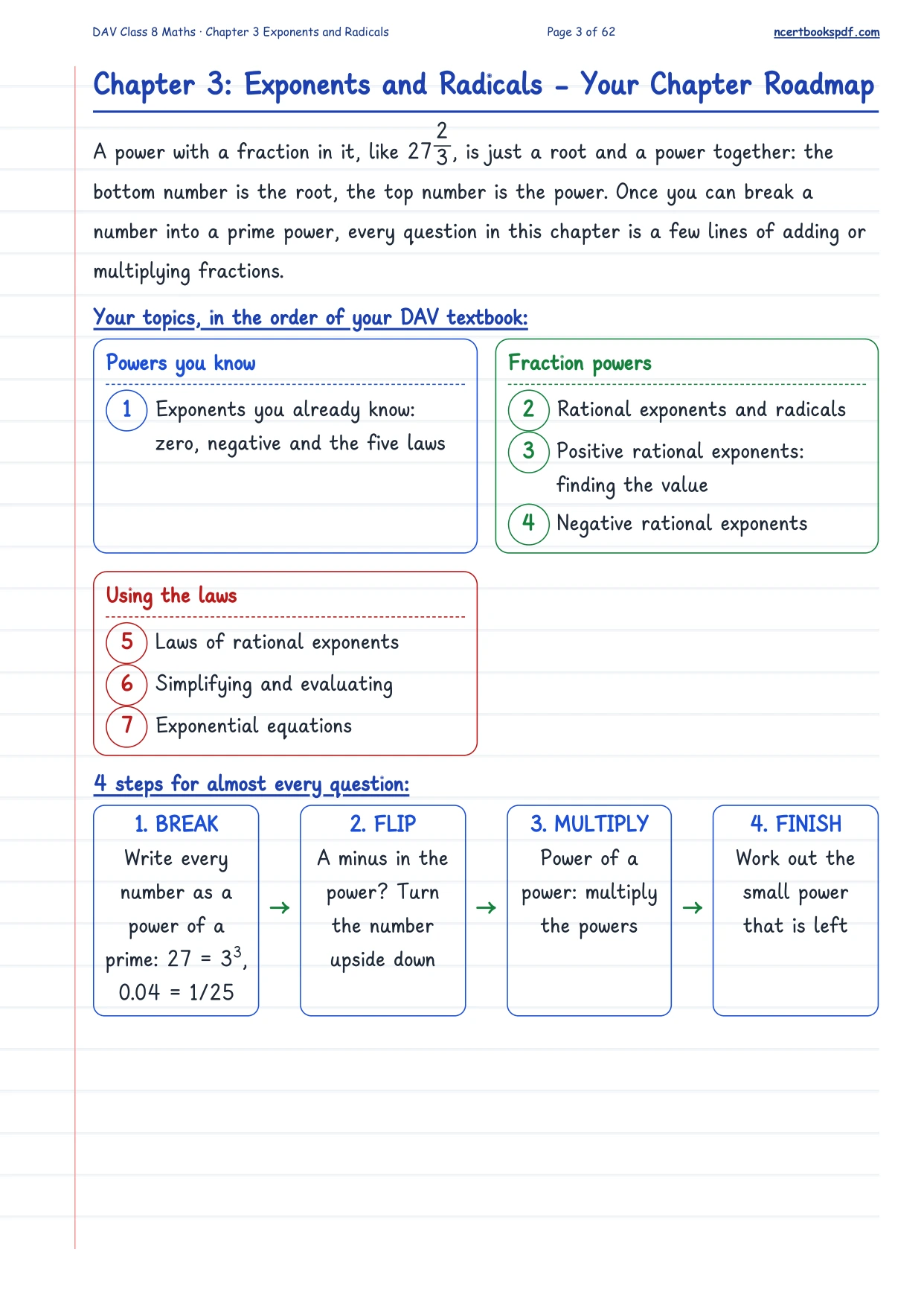
Revise Maths fast: handwritten-style chapter notes
📖 Every chapter in short, neat pages🧠 Diagrams, tables, points to remember⚡ PDF on your email at once
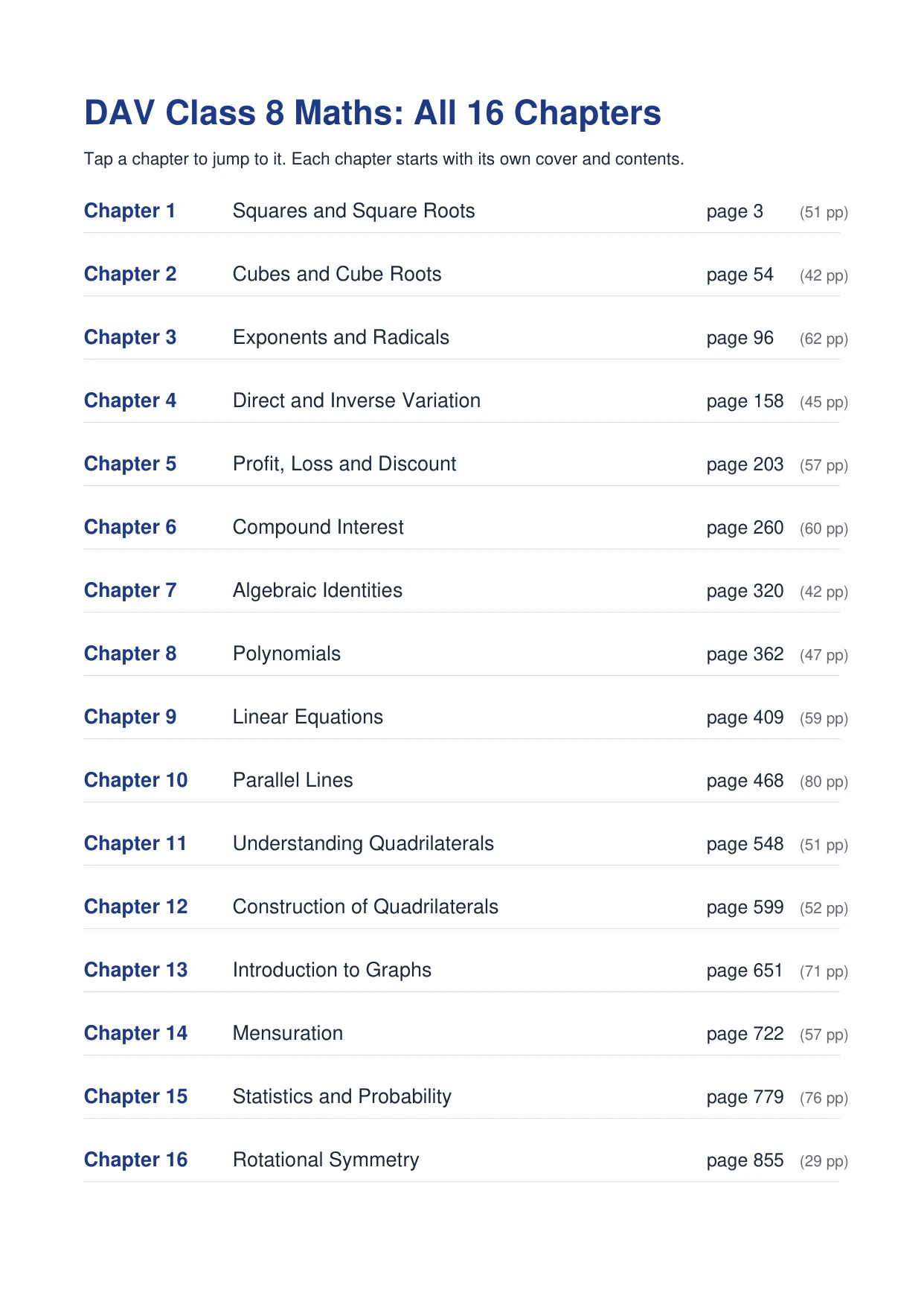
Maths notes: all 16 chapters in one PDF, ₹99

Or one chapter at a time:
Ch 1 · Squares and Square Roots ₹11Ch 2 · Cubes and Cube Roots ₹11Ch 3 · Exponents and Radicals ₹11Ch 4 · Direct and Inverse Variation ₹11Ch 5 · Profit, Loss and Discount ₹11Ch 6 · Compound Interest ₹11Ch 7 · Algebraic Identities ₹11Ch 8 · Polynomials ₹11Ch 9 · Linear Equations ₹11Ch 10 · Parallel Lines ₹11Ch 11 · Understanding Quadrilaterals ₹11Ch 12 · Construction of Quadrilaterals ₹11Ch 13 · Introduction to Graphs ₹11Ch 14 · Mensuration ₹11Ch 15 · Statistics and Probability ₹11Ch 16 · Rotational Symmetry ₹11
Any problem or question about the notes or your payment? Email [email protected]
1Exponents You Already Know: Zero, Negative and the Laws
Q11 markLatest paperAsked in: Annual Exam 2025-26
Assertion (A): If 3m ÷ 3−3 = 35, then m = 2.
Reason (R): (am)n = amn. (A) Both assertion (A) and Reason (R) are true and Reason (R) is the correct explanation of Assertion (A). (B) Both assertion (A) and Reason (R) are true but Reason (R) is not the correct explanation of Assertion (A). (C) Assertion (A) is true but Reason (R) is false. (D) Assertion (A) is false but Reason (R) is true.
Solution
Think: check the Assertion with numbers, check the Reason as a rule, and only then ask: does the Reason explain the Assertion?
Step 1: dividing with the same base: subtract the powers. 3m ÷ 3−3 = 3^(m − (−3)) = 3m + 3.
Step 2: 3m + 3 = 35, so m + 3 = 5 and m = 5 − 3 = 2. A is true.
Step 3: R is a true law, but A needs the division law am ÷ an = am − n, not the power-of-a-power law. So (B).
Check: m = 2: 32 ÷ 3−3 = 9 × 27 = 243 = 35.
Answer: (B) Both are true but R is not the correct explanation of A
Q21 markLatest paperAsked in: Mock Test 2025-26, West Bengal
Assertion (A): (53)6 = 53+6 = 59.
Reason (R): For any integer a, we have am × an = am+n where m, n are rational numbers. (A) Both A and R are true and R is the correct explanation of A. (B) Both A and R are true but R is not the correct explanation of A. (C) A is true but R is false. (D) A is false but R is true.
Solution
Think: check the Assertion with numbers, check the Reason as a rule, and only then ask: does the Reason explain the Assertion?
Step 1: (53)6 is a power of a power: multiply the powers. (53)6 = 53 × 6 = 518, not 59. A is false.
Step 2: R is the multiplication law (same base: add the powers). It is true, it just does not apply to (53)6.
Step 3: so (D).
Check: (53)6 = 53 × 53 × 53 × 53 × 53 × 53: six 3s added, 3 + 3 + 3 + 3 + 3 + 3 = 18.
Answer: (D) A is false but R is true
Q31 markLatest paperAsked in: Periodic Assessment 3, 2025-26
The value of k if (−3)k − 5 × (−3)9 = (−3)7: (A) 5 (B) 7 (C) 3 (D) 9
Solution
Think: same base (−3) on both sides, so add the powers on the left and equate.
Step 1: (−3)k − 5 × (−3)9 = (−3)k − 5 + 9 = (−3)k + 4 (multiplying: add the powers).
Step 2: (−3)k + 4 = (−3)7, so k + 4 = 7 (same base: equate the powers).
Step 3: k = 7 − 4 = 3. (C).
Check: k = 3: powers −2 + 9 = 7.
Answer: (C) 3
Q42 marksLatest paperAsked in: Mock Test 2025-26, West Bengal
If x−1 = −5 × (−4)2, find the value of x.
Solution
Think: work out the right side, then flip both sides (x−1 = 1/x).
Step 1: (−4)2 = −4 × −4 = 16 (even power: plus).
Step 2: −5 × 16 = −80, so x−1 = −80, which means 1/x = −80.
Step 3: flip: x = 1/(−80) = −1/80.
Check: (−1/80)−1 = −80. Yes.
Answer: x = −1/80
Q51 markAsked in: Annual Exam 2023-24
Assertion (A): [(−1/5)4]4 is the reciprocal of (−5)16.
Reason (R): (am)n = amn. (a) Both assertion (A) and reason (R) are true and reason (R) is the correct explanation of assertion (A). (b) Both assertion (A) and reason (R) are true and reason (R) is not the correct explanation of assertion (A). (c) assertion (A) is true but reason (R) is false. (d) assertion (A) is false but reason (R) is the true.
Solution
Think: check the Assertion with numbers, check the Reason as a rule, and only then ask: does the Reason explain the Assertion?
Step 1: [(−1/5)4]4 = (−1/5)4 × 4 = (−1/5)16 (power of a power: multiply the powers, 4 × 4 = 16).
Step 2: (−1/5)16 = 1/(−5)16 (1 over the same number), so it IS the reciprocal of (−5)16. A is true.
Step 3: R is the power-of-a-power law, which is true, and Step 1 used exactly this law. So R explains A: (a).
Check: reciprocal means the product is 1: (−1/5)16 × (−5)16 = (−1/5 × −5)16 = 116 = 1.
Answer: (a) Both are true and R is the correct explanation of A
Q61 markAsked in: Mock Test 2024-25, West Bengal
The value of (−2)−5 is (a) −32 (b) −1/32 (c) 32 (d) 1/32
Solution
Think: the minus in the power means "1 over"; the minus inside the bracket stays because 5 is odd.
Step 1: (−2)−5 = 1/(−2)5 (minus power: 1 over).
Step 2: (−2)5 = −2 × −2 × −2 × −2 × −2 = −32 (five minus signs: odd, so the answer is minus).
Step 3: 1/(−32) = −1/32. (b).
Check: −1/32 × −32 = 1, so −1/32 really is 1 over (−2)5.
Answer: (b) −1/32
Q71 markAsked in: Mock Test 2024-25, West Bengal
Assertion (A): 2−3 ÷ 2−3 = 20.
Reason (R): x−m ÷ x−n = x−mn. (a) Both Assertion (A) and Reason(R) are true and Reason(R) is the correct explanation of Assertion(A). (b) Both Assertion (A) and Reason(R) are true and Reason(R) is not the correct explanation of Assertion(A). (c) Assertion(A) is true but Reason(R) is false. (d) Assertion(A) is false but Reason(R) is true.
Solution
Think: check the Assertion with numbers, check the Reason as a rule, and only then ask: does the Reason explain the Assertion?
Step 1: 2−3 ÷ 2−3 = 2^(−3 − (−3)) = 2−3 + 3 = 20 = 1 (same base: subtract the powers). Also, any number ÷ itself = 1. A is true.
Step 2: the correct law is x−m ÷ x−n = x−m + n = xn − m. The powers are subtracted, not multiplied. R is false.
Step 3: so (c).
Check R with numbers, m = 2, n = 3: 2−2 ÷ 2−3 = 1/4 × 8 = 2, but 2−2 × 3 = 2−6 = 1/64. Not equal.
Answer: (c) Assertion (A) is true but Reason (R) is false
Q81 markAsked in: Annual Exam 2022-23
Evaluate: (8−1 × 53)/2−4
Solution
Think: change each minus power into "1 over", then work out.
Step 1: 8−1 = 1/8 and 53 = 125, so the top is 125/8.
Step 2: 2−4 = 1/16, and dividing by 1/16 is multiplying by 16.
Step 3: 125/8 × 16 = 125 × 2 = 250 (16 ÷ 8 = 2).
Check: with powers of 2: 8−1 ÷ 2−4 = 2−3 ÷ 2−4 = 21 = 2, and 2 × 125 = 250.
Answer: 250
Q91 markAsked in: Annual Exam 2022-23
If 6x = 1, then find the value of (x − 2).
Solution
Think: 1 is "any number to the power 0", so write 1 = 60.
Step 1: 6x = 60, so x = 0 (same base: equate the powers).
Step 2: x − 2 = 0 − 2 = −2.
Check: 60 = 1. Yes.
Answer: −2
Q101 markAsked in: Annual Exam 2022-23
Simplify: (1/2)−2 + (1/3)−2 + (1/4)0
Solution
Think: a fraction with a minus power flips; anything to the power 0 is 1.
Step 1: (1/2)−2 = 22 = 4 (flip, then square).
Step 2: (1/3)−2 = 32 = 9.
Step 3: (1/4)0 = 1.
Step 4: 4 + 9 + 1 = 14.
Check: (1/2)2 = 1/4 and 1 ÷ 1/4 = 4. Yes.
Answer: 14
Q111 markAsked in: Annual Exam 2024-25
3.347 × 10⁻⁶ is equal to: (a) 0.3347000000 (b) 0.003347 (c) 334700 (d) 0.000003347
Solution
Think: × 10−6 means ÷ 106: move the decimal point 6 places to the LEFT.
Step 1: 3.347 → 0.3347 (1) → 0.03347 (2) → 0.003347 (3) → 0.0003347 (4) → 0.00003347 (5) → 0.000003347 (6).
Step 2: so (d).
Check: count the zeros after the point in (d): 5 zeros, then 3 is the 6th digit. A plus power would move the point right instead.
Answer: (d) 0.000003347
Q122 marksAsked in: Annual Exam 2018-19
Simplify: (2−1 × 5−1)−1 ÷ 4−1
Solution
Think: work inside the bracket first, then the outside minus power flips it.
Step 1: 2−1 × 5−1 = 1/2 × 1/5 = 1/10.
Step 2: (1/10)−1 = 10 (flip).
Step 3: 4−1 = 1/4, and 10 ÷ 1/4 = 10 × 4 = 40 (dividing by 1/4 is multiplying by 4).
Check: product law first: 2−1 × 5−1 = 10−1, and (10−1)−1 = 101 = 10. Same.
Answer: 40
2Rational Exponents and Radicals
Q131 markLatest paperAsked in: Second Unit Test 2025-26, West Bengal
If the expression (2/3)2/3 is written in radical form, then the radicand is: (A) (2/3) (B) 2 (C) (2/3)2/3 (D) (2/3)2
Solution
Think: in am/n, the bottom n is the root and the top m stays as a power under the root.
Step 1: (2/3)2/3 = 3sqrt((2/3)2) (bottom 3: cube root; top 2: power).
Step 2: the radicand is the number under the root sign: (2/3)2. (D).
Check: the index is 3 (the small number on the root), and 3 is not one of the radicand choices.
Answer: (D) (2/3)2
3Positive Rational Exponents: Finding the Value
Q141 markLatest paperAsked in: Periodic Assessment 3, 2025-26
What is the value of (142 − 132)5/3 (A) 40 (B) 243 (C) 143 (D) 543
Solution
Think: first the bracket, then the fraction power: cube root first, then power 5.
Step 1: 142 − 132 = 196 − 169 = 27.
Step 2: 275/3 = (33)5/3 = 33 × 5/3 = 35 = 243. (B).
Check: 35 = 3 × 3 × 3 × 3 × 3 = 243.
Answer: (B) 243
Q151 markAsked in: Periodic Test 3, 2024-25, Odisha Zone B & C
Find the value of (271/3 + 641/3)2 (a) 49 (b) 71/3 (c) 71/2 (d) 1/7
Solution
Think: power 1/3 is the cube root. Work out each cube root, add, then square.
Step 1: 271/3 = 3 (3 × 3 × 3 = 27) and 641/3 = 4 (4 × 4 × 4 = 64).
Step 2: 3 + 4 = 7, and 72 = 49. (a).
Check: do not split the bracket: 32 + 42 = 25 is wrong; add first.
Answer: (a) 49
Q161 markAsked in: Annual Exam 2021-22
Simplify: (1251/3 + 2)(1251/3 − 2)
Solution
Think: 1251/3 is the cube root of 125.
Step 1: 1251/3 = 5 (5 × 5 × 5 = 125).
Step 2: (5 + 2)(5 − 2) = 7 × 3 = 21.
Check: with (a + b)(a − b) = a2 − b2: 25 − 4 = 21.
Answer: 21
Q172 marksAsked in: Periodic Assessment 3, 2023-24
Solve: 641/2(641/2 + 50)
Solution
Think: power 1/2 is the square root; power 0 gives 1.
Step 1: 641/2 = 8 (8 × 8 = 64).
Step 2: 50 = 1 (any non-zero number to the power 0).
Step 3: 8 × (8 + 1) = 8 × 9 = 72.
Check: open the bracket: 641/2 + 1/2 + 8 = 64 + 8 = 72.
Answer: 72
4Negative Rational Exponents
Q181 markLatest paperAsked in: Periodic Assessment 3, 2025-26
Find the value of (1691/2 + 811/4)−2 (A) 162 (B) 62500 (C) 258 (D) 1/256
Solution
Think: roots inside the bracket first, then the minus power flips.
Step 1: 1691/2 = 13 (13 × 13 = 169) and 811/4 = 3 (3 × 3 × 3 × 3 = 81).
Step 2: 13 + 3 = 16.
Step 3: 16−2 = 1/162 = 1/256. (D).
Check: (A) 162 forgets the minus sign of the power.
Answer: (D) 1/256
Q192 marksLatest paperAsked in: Annual Exam 2025-26
Evaluate: 64−1/3(641/3 − 642/3)
Solution
Think: 64 = 43, so every cube-root power of 64 is a power of 4.
Step 1: 641/3 = 4, 642/3 = 42 = 16, 64−1/3 = 1/4.
Step 2: 4 − 16 = −12.
Step 3: 1/4 × −12 = −3.
Check: open the bracket: 640 − 641/3 = 1 − 4 = −3.
Answer: −3
Q201 markAsked in: Periodic Test 3, 2024-25, Odisha Zone B & C
The value of 4sqrt(81−3) is (a) 27 (b) 81 (c) 1/27 (d) 1/81
Solution
Think: a 4th root is the power 1/4. Write 81 as 34.
Step 1: 4sqrt(81−3) = 81−3/4 (the root 4 goes to the bottom).
Step 2: 81 = 34, so 81−3/4 = 34 × −3/4 = 3−3.
Step 3: 3−3 = 1/33 = 1/27. (c).
Check: a minus power can never give 27 or 81 here; the answer must be "1 over".
Answer: (c) 1/27
Q212 marksAsked in: Annual Exam 2024-25
Find the value of (13 + 23 + 33)−3/2
Solution
Think: add inside the bracket first, then flip, square root and cube.
Step 1: 13 + 23 + 33 = 1 + 8 + 27 = 36.
Step 2: 36−3/2 = 1/363/2 (minus power: 1 over).
Step 3: 363/2 = (62)3/2 = 63 = 216. So the value is 1/216.
Check: 6 × 6 × 6 = 216.
Answer: 1/216
5Laws of Rational Exponents
Q222 marksLatest paperAsked in: Second Unit Test 2025-26, West Bengal
Evaluate: {[(625)−1/2]−1/4}2
Solution
Think: multiply all three powers first.
Step 1: (−1/2) × (−1/4) × 2 = 2/8 = 1/4.
Step 2: 6251/4 = 5 (5 × 5 × 5 × 5 = 625).
Check: 625 = 54, and 54 × 1/4 = 51 = 5.
Answer: 5
Q231 markAsked in: Annual Exam 2021-22
Simplify: 4x1/5 × 6x4/5 × 5x0
Solution
Think: multiply the numbers; for x (same base) add the powers.
Step 1: 4 × 6 × 5 = 120.
Step 2: x1/5 × x4/5 × x0 = x1/5 + 4/5 + 0 = x5/5 = x1 = x.
Step 3: answer 120x.
Check: x0 = 1, so it changes nothing.
Answer: 120x
Q241 markAsked in: Periodic Assessment 3, 2023-24
The value of [{(1296)−1/2}−1/4]2 is (a) 4 (b) 6 (c) 8 (d) 12
Solution
Think: power of a power of a power: multiply all three powers.
Step 1: (−1/2) × (−1/4) × 2 = 2/8 = 1/4 (minus × minus = plus).
Step 2: 12961/4 = 6 (6 × 6 × 6 × 6 = 36 × 36 = 1296). (b).
Check: 1296 = 64, and 64 × 1/4 = 6.
Answer: (b) 6
Q252 marksAsked in: Mock Test 2023-24, West Bengal
Simplify: (xa/xb)a+b × (xb/xc)b+c × (xc/xa)c+a
Solution
Think: inside each bracket subtract the powers, then multiply by the outside power.
Step 1: (xa/xb)a+b = x^((a − b)(a + b)) = xa2 − b2.
Step 2: in the same way the others are xb2 − c2 and xc2 − a2.
Step 3: add the powers: a2 − b2 + b2 − c2 + c2 − a2 = 0. So x0 = 1.
Check: put a = 2, b = 1, c = 0: x3 × x1 × x−4 = x0 = 1.
Answer: 1
6Simplifying and Evaluating with the Laws
Q262 marksLatest paperAsked in: Mock Test 2025-26, West Bengal
Simplify: (5 × 72 × (125)2/3)/(7 × (25)3/2)
Solution
Think: 125 = 53 and 25 = 52, so every base becomes 5 or 7.
Step 1: 1252/3 = 52 = 25 and 253/2 = 53 = 125.
Step 2: top = 5 × 49 × 25 = 6125; bottom = 7 × 125 = 875.
Step 3: 6125 ÷ 875 = 7.
Check: with powers: 51 + 2 − 3 × 72 − 1 = 50 × 7 = 7.
Answer: 7
Q273 marksLatest paperAsked in: Periodic Assessment 3, 2025-26
Simplify: ((64)−1/6 × (216)−1/3 × (81)1/4)/((512)−1/3 × (16)1/4 × (9)−1/2)
Solution
Think: 64 = 26, 216 = 63, 81 = 34, 512 = 83, 16 = 24, 9 = 32. Work out each part.
Step 1: 64−1/6 = 2−1 = 1/2; 216−1/3 = 6−1 = 1/6; 811/4 = 3. Top = 1/2 × 1/6 × 3 = 3/12 = 1/4.
Step 2: 512−1/3 = 8−1 = 1/8; 161/4 = 2; 9−1/2 = 3−1 = 1/3. Bottom = 1/8 × 2 × 1/3 = 2/24 = 1/12.
Step 3: 1/4 ÷ 1/12 = 1/4 × 12 = 3.
Check: 3 × 1/12 = 1/4. Yes.
Answer: 3
Q281 markAsked in: Annual Exam 2021-22
Solve: 64∛(x9) ÷ ∛(64x6)
Solution
Think: a cube root divides each power by 3.
Step 1: ∛(x9) = x9/3 = x3, so the first part is 64x3.
Step 2: ∛(64x6) = ∛64 × x6/3 = 4x2.
Step 3: 64x3 ÷ 4x2 = (64 ÷ 4) × x3 − 2 = 16x.
Check: x = 1: 64 × 1 ÷ ∛64 = 64 ÷ 4 = 16 = 16 × 1.
Answer: 16x
Q292 marksAsked in: Annual Exam 2022-23
Find the value of: (367/2 − 369/2)/365/2
Solution
Think: there is a minus between the powers on top, so divide each by 365/2 separately.
Step 1: 367/2 ÷ 365/2 = 367/2 − 5/2 = 361 = 36 (dividing: subtract the powers).
Step 2: 369/2 ÷ 365/2 = 369/2 − 5/2 = 362 = 1296.
Step 3: 36 − 1296 = −1260.
Check: common factor: 367/2(1 − 36) ÷ 365/2 = 36 × (−35) = −1260.
Answer: −1260
Q303 marksAsked in: Annual Exam 2023-24
Simplify: ((25)3/2 × (8)−4/3 × (36)−1/2)/((125)2/3 × (27)−2/3)
Solution
Think: write every base as a power (25 = 52, 8 = 23, 36 = 62, 125 = 53, 27 = 33) and work out each part.
Step 1: 253/2 = 53 = 125; 8−4/3 = 2−4 = 1/16; 36−1/2 = 6−1 = 1/6.
Step 2: top = 125 × 1/16 × 1/6 = 125/96.
Step 3: 1252/3 = 52 = 25; 27−2/3 = 3−2 = 1/9. Bottom = 25/9.
Step 4: 125/96 ÷ 25/9 = 125/96 × 9/25 = (125 ÷ 25) × 9/96 = 5 × 9/96 = 45/96 = 15/32.
Check: 15/32 × 25/9 = 375/288 = 125/96 (divide both by 3). Yes.
Answer: 15/32
Q313 marksAsked in: Annual Exam 2021-22
Solve: (2x+4 − 25 × 2x)/(2 × 2x+3) − 2−3
Solution
Think: every term on the fraction holds 2x; take it out and it cancels.
Step 1: top: 2x+4 − 25 × 2x = 2x × 24 − 2x × 25 = 2x(16 − 32) = −16 × 2x.
Step 2: bottom: 2 × 2x+3 = 2x+4 = 16 × 2x.
Step 3: the fraction is −16 × 2x ÷ (16 × 2x) = −1.
Step 4: −1 − 2−3 = −1 − 1/8 = −9/8.
Check: x = 0: (16 − 32)/16 − 1/8 = −1 − 1/8 = −9/8.
Answer: −9/8
Q323 marksAsked in: Annual Exam 2019-20
Simplify: [(9(641/3 + 1251/3)3)1/4]
Solution
Think: cube roots first, add, then the cube, then the 4th root.
Step 1: 641/3 = 4 and 1251/3 = 5, so the bracket is 4 + 5 = 9.
Step 2: 9 × 93 = 94 (multiplying: 1 + 3 = 4).
Step 3: (94)1/4 = 91 = 9.
Check: 94 = 6561 and 9 × 9 × 9 × 9 = 6561.
Answer: 9
Q333 marksAsked in: Annual Exam 2018-19
Find the value of: 5 × 64−1/2(641/2 + 643/2)
Solution
Think: 64 = 82, so the half powers are powers of 8.
Step 1: 64−1/2 = 1/8; 641/2 = 8; 643/2 = 83 = 512.
Step 2: 8 + 512 = 520.
Step 3: 5 × 1/8 × 520 = 5 × 65 = 325 (520 ÷ 8 = 65).
Check: open the bracket: 5 × (640 + 641) = 5 × (1 + 64) = 5 × 65 = 325.
Answer: 325
Q345 marksAsked in: Annual Exam 2024-25
Simplify: [[5{(1/8)−1/3 + (1/27)−1/3}]2]1/4
Solution
Think: flip the fractions with minus powers, take cube roots, then work outwards.
Step 1: (1/8)−1/3 = 81/3 = 2 and (1/27)−1/3 = 271/3 = 3.
Step 2: 2 + 3 = 5, and 5 × 5 = 25.
Step 3: 252 = 625, and 6251/4 = 5 (5 × 5 × 5 × 5 = 625).
Check: 25 = 52, so (52)2 × 1/4 = 51 = 5.
Answer: 5
7Exponential Equations
Q351 markLatest paperAsked in: Annual Exam 2025-26
If 5x = √625, then the value of x is: (A) 1/2 (B) 2 (C) 4 (D) 5
Solution
Think: work out the square root, then write it as a power of 5.
Step 1: √625 = 25 (25 × 25 = 625).
Step 2: 25 = 52, so 5x = 52 and x = 2. (B).
Check: (C) 4 forgets the square root: 54 = 625, not 25.
Answer: (B) 2
Q361 markLatest paperAsked in: Second Unit Test 2025-26, West Bengal
If 102y = 25, then 10−y equals to − (A) −1/5 (B) 1/50 (C) 1/625 (D) 1/5
Solution
Think: 102y is the square of 10y.
Step 1: (10y)2 = 25, so 10y = 5 (10y is always positive).
Step 2: 10−y = 1/10y = 1/5. (D).
Check: a power of 10 is never negative, so (A) is impossible.
Answer: (D) 1/5
Q372 marksLatest paperAsked in: Annual Exam 2025-26
If 9x+2 = 240 + 9x, find the value of x.
Solution
Think: bring the 9x terms together and take 9x out.
Step 1: 9x+2 − 9x = 240, so 9x(92 − 1) = 240 and 80 × 9x = 240.
Step 2: 9x = 240 ÷ 80 = 3.
Step 3: 9 = 32, so 32x = 31, 2x = 1 and x = 1/2.
Check: 91/2 = 3 and 95/2 = 243; 240 + 3 = 243.
Answer: x = 1/2
Q382 marksLatest paperAsked in: Periodic Assessment 3, 2025-26
If 3x−1 = 9 and 4y+2 = 64, find the value of x + y.
Solution
Think: two small equations; solve each one, then add.
Step 1: 9 = 32, so x − 1 = 2 and x = 3.
Step 2: 64 = 43, so y + 2 = 3 and y = 1.
Step 3: x + y = 3 + 1 = 4.
Check: 32 = 9 and 43 = 64.
Answer: 4
Q393 marksLatest paperAsked in: Second Unit Test 2025-26, West Bengal
If 5x + 5x + 5x + 5x + 5x = 625, find the value of x2.
Solution
Think: five equal terms make 5 × 5x = 5x+1.
Step 1: 5x+1 = 625 = 54.
Step 2: x + 1 = 4, so x = 3.
Step 3: x2 = 32 = 9.
Check: 53 = 125 and 5 × 125 = 625.
Answer: 9
Q403 marksLatest paperAsked in: Second Unit Test 2025-26, West Bengal
If (8/3)2x+1 ÷ (3/8)−5 = (3/8)^(−(x+2)) find the value of x.
Solution
Think: 8/3 is 3/8 flipped: 8/3 = (3/8)−1. Make every base 3/8.
Step 1: (8/3)2x+1 = (3/8)−2x−1.
Step 2: (3/8)−2x−1 ÷ (3/8)−5 = (3/8)−2x − 1 + 5 = (3/8)4 − 2x.
Step 3: 4 − 2x = −(x + 2) = −x − 2, so 4 + 2 = 2x − x and x = 6.
Check: x = 6: 4 − 12 = −8 and −(6 + 2) = −8.
Answer: x = 6
Q411 markAsked in: Periodic Test 3, 2024-25, Odisha Zone B & C
If (4/11)x−1 = (11/4)x−5 then value of x is equal to (a) 3 (b) 0 (c) −1 (d) 2
Solution
Think: 11/4 is 4/11 flipped, so 11/4 = (4/11)−1. Then both sides have base 4/11.
Step 1: (11/4)x−5 = (4/11)^(−(x−5)) = (4/11)5−x.
Step 2: equate the powers: x − 1 = 5 − x, so 2x = 6 and x = 3. (a).
Check: x = 3: (4/11)2 and (11/4)−2 = (4/11)2. Equal.
Answer: (a) 3
Q421 markAsked in: Annual Exam 2021-22
Find the value of x: (2/5)−6 × (5/2)8 = (2/5)x
Solution
Think: make both bases 2/5: 5/2 = (2/5)−1.
Step 1: (5/2)8 = (2/5)−8.
Step 2: (2/5)−6 × (2/5)−8 = (2/5)−6 − 8 = (2/5)−14.
Step 3: so x = −14.
Check: (2/5)−14 = (5/2)14 = (5/2)6 × (5/2)8. Yes.
Answer: x = −14
Q431 markAsked in: Annual Exam 2019-20
If 3x = 81, find 2x.
Solution
Think: first find x, then use it in 2x.
Step 1: 81 = 34, so x = 4.
Step 2: 24 = 16.
Check: 3 × 3 × 3 × 3 = 81.
Answer: 16
Q441 markAsked in: Annual Exam 2018-19
Solve for x: 5x−4 = 1
Solution
Think: write 1 as 50.
Step 1: 5x−4 = 50, so x − 4 = 0.
Step 2: x = 4.
Check: 54 − 4 = 50 = 1.
Answer: x = 4
Q451 markAsked in: Annual Exam 2024-25
If √2401 = 7x, then the value of 'x' is (a) 3 (b) 2 (c) 5 (d) 6
Solution
Think: work out the square root, then write it as a power of 7.
Step 1: √2401 = 49 (49 × 49 = 2401).
Step 2: 49 = 72, so x = 2. (b).
Check: 2401 = 74, and the square root halves the power: 4 ÷ 2 = 2.
Answer: (b) 2
Q461 markAsked in: Annual Exam 2024-25
If 5^(3/(2x)) = 125 then the value of 'x' is _____ (a) 2 (b) 1/2 (c) 1 (d) 1/3
Solution
Think: 125 = 53, then equate the powers.
Step 1: 5^(3/(2x)) = 53, so 3/(2x) = 3.
Step 2: 2x = 1, so x = 1/2. (b).
Check: x = 1/2: 3/(2 × 1/2) = 3/1 = 3.
Answer: (b) 1/2
Q471 markAsked in: Mock Test 2023-24, West Bengal
If 2x = √64 then the value of x2 is (a) 2 (b) 9 (c) 3 (d) 4
Solution
Think: find x first, then square it.
Step 1: √64 = 8 = 23, so x = 3.
Step 2: x2 = 32 = 9. (b).
Check: (c) 3 is x itself, not x2.
Answer: (b) 9
Q482 marksAsked in: Periodic Test 3, 2024-25, Odisha Zone B & C; also Mock Test 2023-24, West Bengal
If 9x × 32 × (3−x/2)−2 = 1/27, find x.
Solution
Think: make every base 3: 9 = 32 and 1/27 = 3−3.
Step 1: 9x = 32x; (3−x/2)−2 = 3x (−x/2 × −2 = x).
Step 2: left side = 32x + 2 + x = 33x + 2.
Step 3: 33x + 2 = 3−3, so 3x + 2 = −3, 3x = −5 and x = −5/3.
Check: x = −5/3: 3x + 2 = −5 + 2 = −3.
Answer: x = −5/3
Q492 marksAsked in: Periodic Assessment 3, 2023-24
Find x if 2x + 2x + 2x = 192.
Solution
Think: three equal terms make 3 × 2x.
Step 1: 3 × 2x = 192, so 2x = 192 ÷ 3 = 64.
Step 2: 64 = 26, so x = 6.
Check: 64 + 64 + 64 = 192.
Answer: x = 6
Q502 marksAsked in: Annual Exam 2024-25
If 35x ÷ 3x = 5sqrt(320) Find the value of 'x'
Solution
Think: left side: subtract the powers. Right side: the 5th root divides the power by 5.
Step 1: 35x ÷ 3x = 35x − x = 34x.
Step 2: 5sqrt(320) = 320/5 = 34.
Step 3: 4x = 4, so x = 1.
Check: x = 1: 35 ÷ 3 = 34 = 81.
Answer: x = 1
Q512 marksAsked in: Mock Test 2024-25, West Bengal
If (10/3) × 3x − 3x−1 = 81, find the value of x.
Solution
Think: take out the smaller power 3x−1; 3x = 3 × 3x−1.
Step 1: 10/3 × 3 × 3x−1 − 3x−1 = 10 × 3x−1 − 3x−1 = 9 × 3x−1.
Step 2: 9 × 3x−1 = 81, so 3x−1 = 9 = 32.
Step 3: x − 1 = 2, so x = 3.
Check: x = 3: 10/3 × 27 − 9 = 90 − 9 = 81.
Answer: x = 3
Q522 marksAsked in: Mock Test 2024-25, West Bengal
Find 'x' if (82 − 72)x = 33 × 53.
Solution
Think: work out the bracket first; the right side is a product with the same power.
Step 1: 82 − 72 = 64 − 49 = 15.
Step 2: 33 × 53 = (3 × 5)3 = 153 (product law).
Step 3: 15x = 153, so x = 3.
Check: 153 = 3375 = 27 × 125.
Answer: x = 3
Q533 marksAsked in: Periodic Test 3, 2024-25, Odisha Zone B & C
If 3x+1 = 81 and 4y−2 = 1/64, find the value of y/x − x/y.
Solution
Think: solve for x and y separately, then put them in.
Step 1: 81 = 34, so x + 1 = 4 and x = 3.
Step 2: 1/64 = 4−3, so y − 2 = −3 and y = −1.
Step 3: y/x − x/y = −1/3 − 3/(−1) = −1/3 + 3 = 8/3.
Check: 4−1 − 2 = 4−3 = 1/64. Yes.
Answer: 8/3
Q543 marksAsked in: Annual Exam 2022-23; also Periodic Assessment 3, 2023-24; Annual Exam 2018-19; Mock Test 2023-24, West Bengal
If 4x − 4x−1 = 24, then find the value of x
Solution
Think: take out the smaller power 4x−1 first.
Step 1: 4x = 4x−1 × 4, so 4x−1(4 − 1) = 24 and 3 × 4x−1 = 24.
Step 2: 4x−1 = 8.
Step 3: base 2: 22x − 2 = 23, so 2x − 2 = 3, 2x = 5 and x = 5/2.
Check: x = 5/2: 45/2 = 32 and 43/2 = 8; 32 − 8 = 24.
Answer: x = 5/2
Q553 marksAsked in: Annual Exam 2019-20
If (2/3)x · (3/2)2x = 81/16, then find the value of x.
Solution
Think: 2/3 = (3/2)−1, so everything becomes base 3/2.
Step 1: (2/3)x = (3/2)−x, so the left side = (3/2)−x + 2x = (3/2)x.
Step 2: 81/16 = 34/24 = (3/2)4.
Step 3: (3/2)x = (3/2)4, so x = 4.
Check: x = 4: (2/3)4 × (3/2)8 = (3/2)8 − 4 = (3/2)4 = 81/16.
Answer: x = 4
Q563 marksAsked in: Mock Test 2023-24, West Bengal
If 3x−1 = 9 and 4y+2 = 64, find the value of y/x − x/y.
Solution
Think: solve for x and y first, exactly as in the "x + y" question.
Step 1: 3x−1 = 32, so x = 3. 4y+2 = 43, so y = 1.
Step 2: y/x − x/y = 1/3 − 3/1 = 1/3 − 9/3 = −8/3.
Check: the order matters: x/y − y/x would give +8/3.
Answer: −8/3
Q575 marksAsked in: Annual Exam 2023-24
If 5x−1 + 5x+1 = 130, find the value of x3
Solution
Think: two terms are added, so take out the smaller power 5x−1 first.
Step 1: 5x+1 = 5x−1 × 52 (x + 1 is 2 more than x − 1).
Step 2: 5x−1(1 + 25) = 130, so 26 × 5x−1 = 130 and 5x−1 = 130 ÷ 26 = 5.
Step 3: 5x−1 = 51, so x − 1 = 1 and x = 2.
Step 4: x3 = 23 = 8.
Check: x = 2: 51 + 53 = 5 + 125 = 130.
Answer: 8
Q585 marksAsked in: Annual Exam 2021-22
If (5/2) × 2x − 2x−1 = 16, find the value of x.
Solution
Think: take out 2x; 2x−1 = 2x × 1/2.
Step 1: 2x(5/2 − 1/2) = 16, so 2x × 4/2 = 2 × 2x = 16.
Step 2: 2x = 8 = 23, so x = 3.
Check: x = 3: 5/2 × 8 − 4 = 20 − 4 = 16.
Answer: x = 3