CG Board Class 11 Biology Solutions | NCERT Class 11 Biology (2026-27)
Step-by-step solutions for CG Board Class 11 Biology Chapter 10: Cell Cycle and Cell Division strictly following the prescribed NCERT Class 11 Biology syllabus.
📚 Chapter Overview:
- Board: Chhattisgarh Board (CGBSE / SCERT — NCERT Syllabus)
- Textbook & Chapter: NCERT Class 11 Biology — Chapter 10: Cell Cycle and Cell Division
- Medium: English Medium
📖 Textbook Pages (NCERT / CG Board 2026-27)
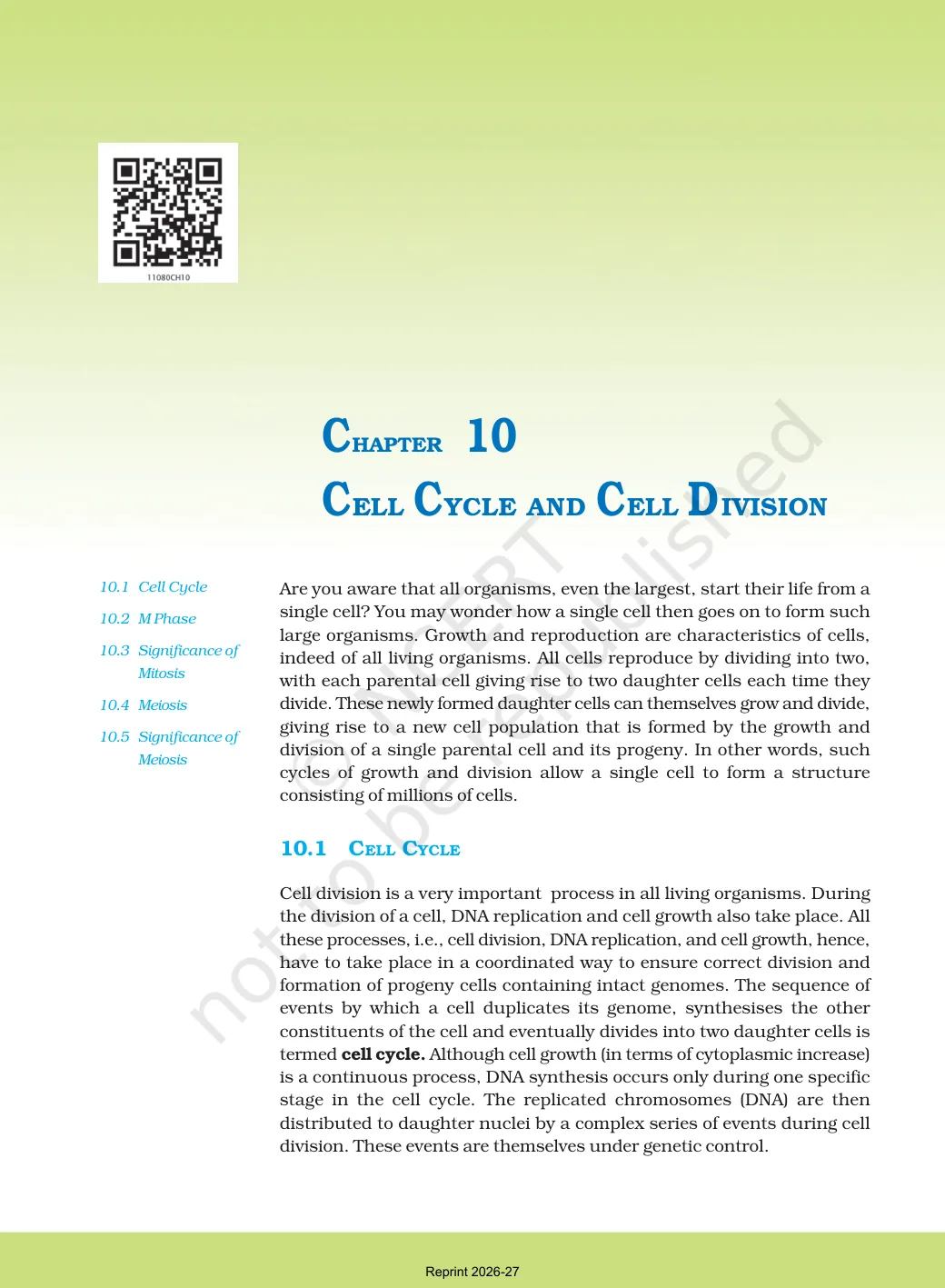
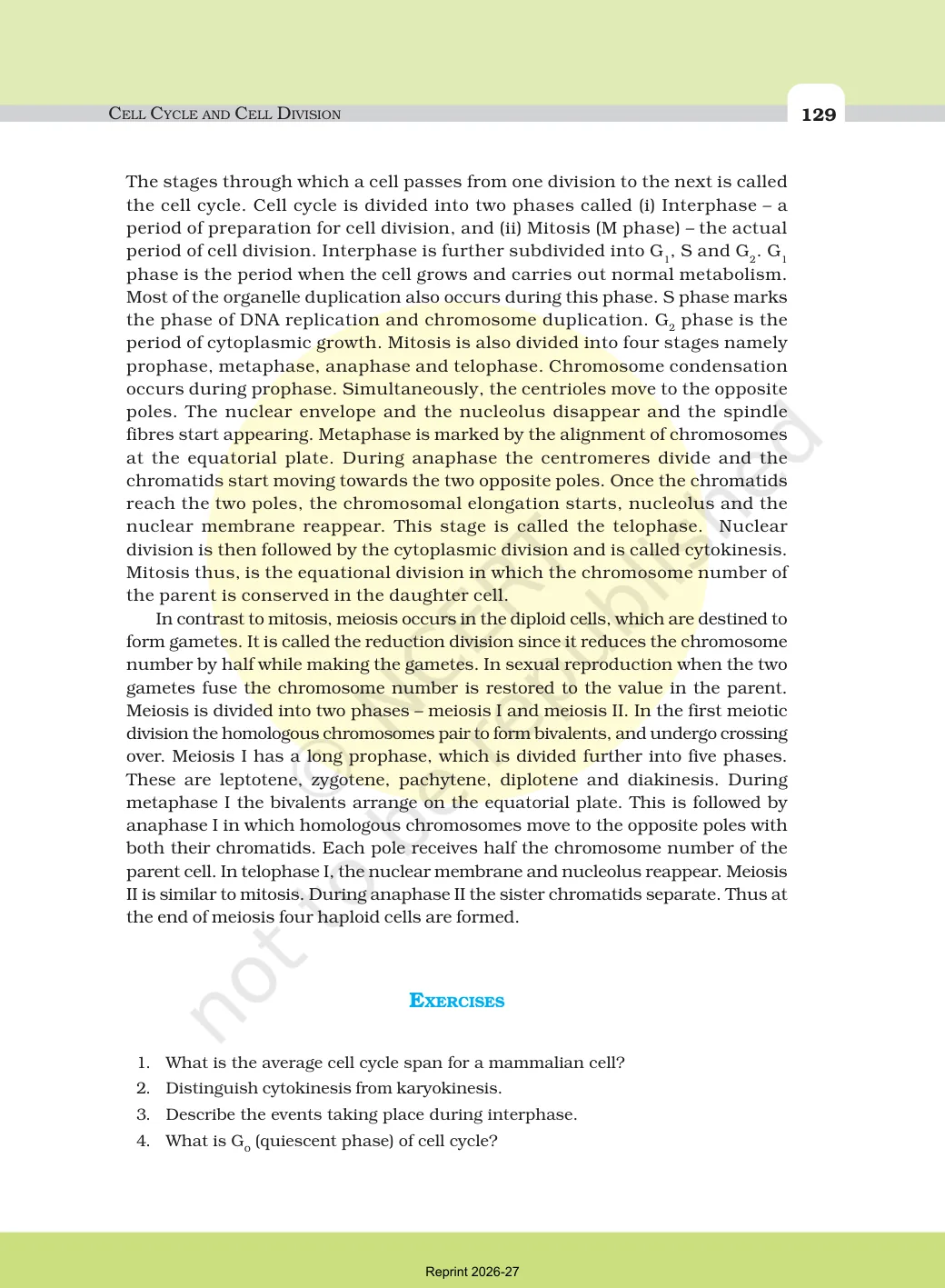
✍️ Chapter 10 Exercise Solutions: Cell Cycle and Cell Division
Exercises
Q1. What is the average cell cycle span for a mammalian cell?
Answer: The average cell cycle span for a typical human (mammalian) cell in culture is approximately 24 hours (with M phase lasting about 1 hour and interphase lasting more than 95% of the cycle).
Q2. Distinguish cytokinesis from karyokinesis.
Answer:
| Feature | Karyokinesis | Cytokinesis |
|---|---|---|
| Meaning | Division of the nucleus | Division of the cytoplasm |
| Timing | Occurs first during M phase (prophase, metaphase, anaphase, telophase) | Follows karyokinesis at the end of telophase |
| Outcome | Produces two daughter nuclei | Produces two separate daughter cells |
Q3. Describe the events taking place during interphase.
Answer: Interphase is the preparatory phase between two successive M phases and consists of three sub-phases:
- G1 phase (Gap 1): The cell is metabolically active and grows continuously, synthesising RNA and proteins, but does not replicate its DNA.
- S phase (Synthesis): DNA replication takes place; the amount of DNA per cell doubles (from 2C to 4C), though the chromosome number remains the same. In animal cells, centriole duplication occurs in the cytoplasm.
- G2 phase (Gap 2): Proteins (such as tubulin) are synthesised in preparation for mitosis while cell growth continues.
Q4. What is Go (quiescent phase) of cell cycle?
Answer: G0 (quiescent stage) is an inactive stage entered by cells (such as heart cells) that exit the G1 phase and do not divide further. Cells in G0 remain metabolically active but no longer proliferate unless called on to do so depending on the requirement of the organism.
Q5. Why is mitosis called equational division?
Answer: Mitosis is called equational division because the number of chromosomes in the parent cell and the resulting daughter cells remains exactly the same (e.g., 2n → 2n).
Q6. Name the stage of cell cycle at which one of the following events occur:
(i) Chromosomes are moved to spindle equator.
(ii) Centromere splits and chromatids separate.
(iii) Pairing between homologous chromosomes takes place.
(iv) Crossing over between homologous chromosomes takes place.
Answer:
- (i) Chromosomes are moved to spindle equator: Metaphase
- (ii) Centromere splits and chromatids separate: Anaphase (of mitosis, or Anaphase II of meiosis)
- (iii) Pairing between homologous chromosomes takes place: Zygotene (of Prophase I of meiosis)
- (iv) Crossing over between homologous chromosomes takes place: Pachytene (of Prophase I of meiosis)
Q7. Describe the following:
(a) synapsis (b) bivalent (c) chiasmata
Draw a diagram to illustrate your answer.
Answer:
- (a) Synapsis: The process of pairing of homologous chromosomes lengthwise during the zygotene stage of Prophase I of meiosis, facilitated by the formation of the synaptonemal complex.
- (b) Bivalent: The complex formed by a pair of synapsed homologous chromosomes (also called a tetrad because it clearly shows four chromatids at pachytene).
- (c) Chiasmata: The X-shaped structures formed at the sites of crossing over, becoming visible during diplotene when the synaptonemal complex dissolves and homologous chromosomes begin to separate except at the crossover points.
Q8. How does cytokinesis in plant cells differ from that in animal cells?
Answer:
| Feature | Animal Cells | Plant Cells |
|---|---|---|
| Mechanism | Cleavage furrow forms in the plasma membrane and deepens centripetally (from periphery to centre) | Cell plate forms in the centre and grows centrifugally (from centre to periphery) |
| Cell wall | Absent; furrowing divides the cell | Rigid cell wall present; cell plate represents the middle lamella between two adjacent cells |
Q9. Find examples where the four daughter cells from meiosis are equal in size and where they are found unequal in size.
Answer:
- Equal in size: Spermatogenesis in human males (produces four equal-sized spermatids) and microsporogenesis in flowering plants (produces four equal-sized microspores).
- Unequal in size: Oogenesis in human females (produces one large ovum and smaller polar bodies) and megasporogenesis in flowering plants (only one megaspore is functional while others degenerate).
Q10. Distinguish anaphase of mitosis from anaphase I of meiosis.
Answer:
| Feature | Anaphase of Mitosis | Anaphase I of Meiosis |
|---|---|---|
| Centromere | Centromeres split | Centromeres do not split |
| What separates | Sister chromatids separate and move to opposite poles | Homologous chromosomes (each with two sister chromatids) separate to opposite poles |
| Chromosome number at poles | Remains same as parent (2n) | Reduced to half (n) |
Q11. List the main differences between mitosis and meiosis.
Answer:
| Feature | Mitosis | Meiosis |
|---|---|---|
| Site of occurrence | Somatic cells (and haploid/diploid cells) | Diploid germ cells (meiocytes) |
| Number of divisions | One nuclear and cytoplasmic division | Two sequential divisions (Meiosis I and Meiosis II) |
| Daughter cells | Two genetically identical diploid cells | Four genetically varied haploid cells |
| Crossing over | Does not occur | Occurs during pachytene of Prophase I |
| Function | Growth, repair, and asexual reproduction | Gamete formation and genetic variation in sexual reproduction |
Q12. What is the significance of meiosis?
Answer:
- Conserves the specific chromosome number of each species across generations in sexually reproducing organisms (halves chromosome number in gametes so fertilisation restores 2n).
- Increases genetic variability in populations through crossing over and independent assortment of chromosomes, which is essential for evolution.
Q13. Discuss with your teacher about
(i) haploid insects and lower plants where cell-division occurs, and
(ii) some haploid cells in higher plants where cell-division does not occur.
Answer: (i) Haploid insects and lower plants: Male honeybees (drones) and lower plants like algae (e.g., Spirogyra, Chlamydomonas) and bryophytes have a haploid body and undergo mitosis to grow and produce gametes.
(ii) Haploid cells in higher plants without division: In angiosperms, cells such as synergids, antipodals, and the egg cell inside the embryo sac are haploid and do not undergo further cell division.
Q14. Can there be mitosis without DNA replication in ‘S’ phase?
Answer: No, normal mitosis cannot occur without DNA replication in the S phase, because each daughter cell must receive an exact, complete copy of the parent cell’s DNA. Without replication, daughter cells would receive incomplete or halved genetic material.
Q15. Can there be DNA replication without cell division?
Answer: Yes. When DNA replicates without subsequent cytokinesis or nuclear division, it results in polyploidy (multiple sets of chromosomes in a single cell) or polytene chromosomes (e.g., in salivary glands of Drosophila).
Q16. Analyse the events during every stage of cell cycle and notice how the following two parameters change
(i) number of chromosomes (N) per cell
(ii) amount of DNA content (C) per cell
Answer: Starting with a diploid cell having chromosome number 2N and DNA content 2C:
| Stage | Chromosome Number (N) | DNA Content (C) |
|---|---|---|
| G1 phase | 2N | 2C |
| S phase | 2N (centromeres do not divide) | Doubles from 2C to 4C |
| G2 phase | 2N | 4C |
| Mitosis (after cytokinesis) | 2N in each daughter cell | 2C in each daughter cell |
| Meiosis I (after telophase I) | N in each daughter cell | 2C in each daughter cell |
| Meiosis II (after telophase II) | N in each daughter cell | C in each daughter cell |