CG Board Class 11 Biology Solutions | NCERT Class 11 Biology (2026-27)
Step-by-step solutions for CG Board Class 11 Biology Chapter 12: Respiration in Plants strictly following the prescribed NCERT Class 11 Biology syllabus.
📚 Chapter Overview:
- Board: Chhattisgarh Board (CGBSE / SCERT — NCERT Syllabus)
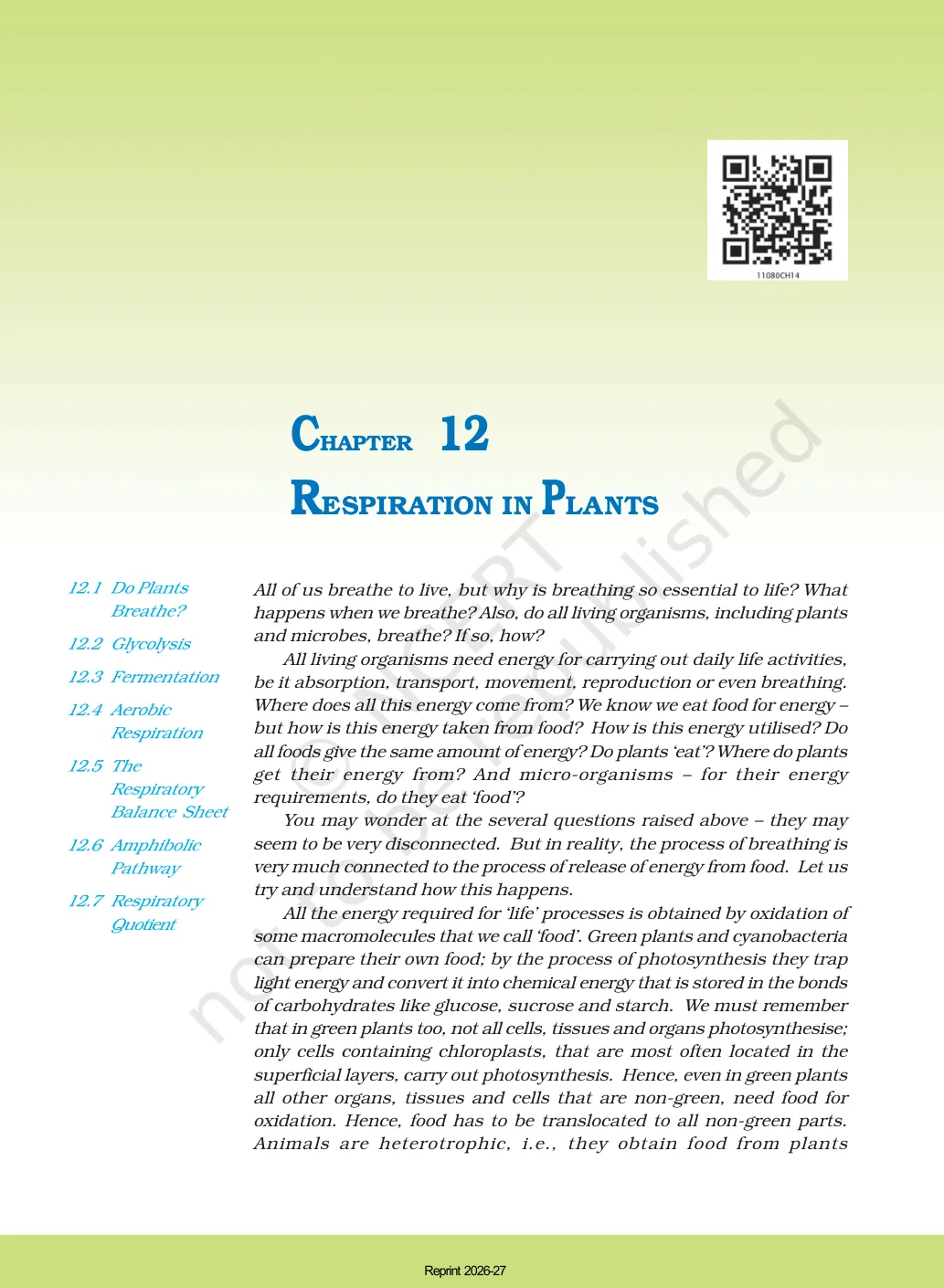
- Textbook & Chapter: NCERT Class 11 Biology — Chapter 12: Respiration in Plants
- Medium: English Medium
📖 Textbook Pages (NCERT / CG Board 2026-27)
✍️ Chapter 12 Exercise Solutions: Respiration in Plants
Exercises
Q1. Differentiate between
(a) Respiration and Combustion
(b) Glycolysis and Krebs’ cycle
(c) Aerobic respiration and Fermentation
Answer: (a) Respiration vs Combustion:
| Feature | Respiration | Combustion |
|---|---|---|
| Nature | Controlled biological oxidation inside living cells | Uncontrolled physico-chemical burning outside cells |
| Energy release | Step-wise release; trapped as ATP | Sudden release as heat and light; no ATP formed |
| Enzymes | Catalysed by specific enzymes at body temperature | No enzymes; requires high ignition temperature |
(b) Glycolysis vs Krebs’ cycle:
| Feature | Glycolysis | Krebs’ Cycle |
|---|---|---|
| Site | Cytoplasm (cytosol) | Mitochondrial matrix |
| Oxygen requirement | Occurs in both aerobic and anaerobic conditions | Occurs only in aerobic respiration |
| Substrate & Product | 1 glucose → 2 pyruvate + 2 ATP + 2 NADH | Acetyl CoA → CO2 + NADH + FADH2 + ATP/GTP |
(c) Aerobic respiration vs Fermentation:
| Feature | Aerobic Respiration | Fermentation |
|---|---|---|
| Oxygen | Required | Not required (anaerobic) |
| Breakdown of glucose | Complete oxidation to CO2 and H2O | Incomplete oxidation to ethanol + CO2 or lactic acid |
| Net ATP yield | 36–38 ATP per glucose molecule | Only 2 ATP per glucose molecule |
Q2. What are respiratory substrates? Name the most common respiratory substrate.
Answer: Respiratory substrates are organic compounds oxidised during cellular respiration to release energy (such as carbohydrates, fats, proteins, and organic acids). Glucose is the most common respiratory substrate.
Q3. Give the schematic representation of glycolysis?
Answer: Glycolysis (EMP pathway) takes place in the cytoplasm and converts 1 molecule of 6-carbon glucose into 2 molecules of 3-carbon pyruvic acid in 10 enzymatic steps:
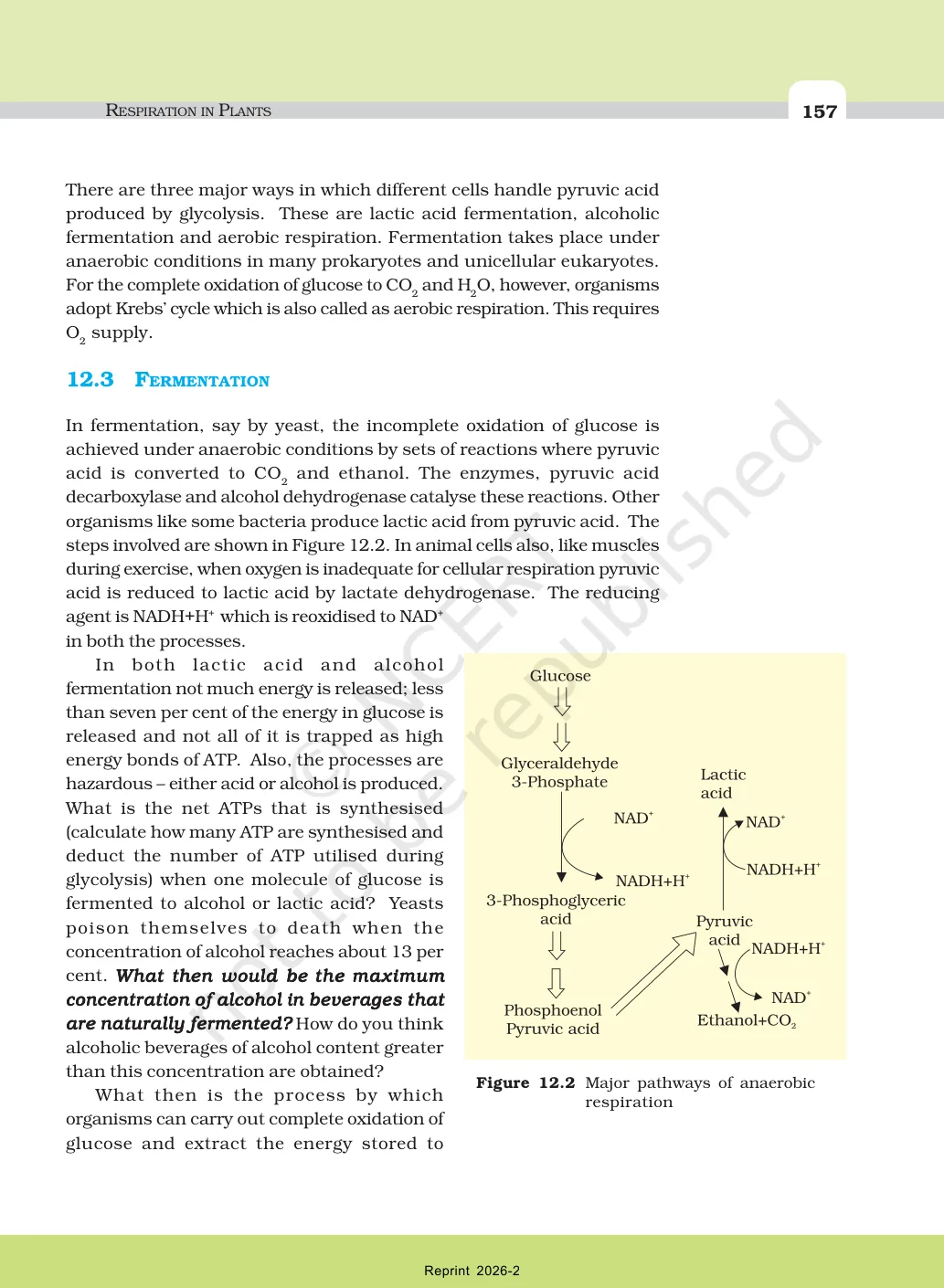
Glucose (6C) → [ATP → ADP] → Glucose-6-phosphate (6C) → Fructose-6-phosphate (6C) → [ATP → ADP] → Fructose-1,6-bisphosphate (6C) → splits into 2 × Triose phosphate [PGAL / DHAP (3C)] → [NAD+ → NADH + H+, +Pi] → 2 × 1,3-bisphosphoglycerate (3C) → [2 ADP → 2 ATP] → 2 × 3-phosphoglycerate (3C) → 2 × 2-phosphoglycerate (3C) → 2 × Phosphoenolpyruvate (PEP, 3C) → [2 ADP → 2 ATP] → 2 × Pyruvic acid (3C).
Q4. What are the main steps in aerobic respiration? Where does it take place?
Answer: Aerobic respiration occurs in two major stages:
- Glycolysis (in cytoplasm): Glucose is broken down to two molecules of pyruvate.
- Link reaction & Krebs’ cycle (in mitochondrial matrix): Pyruvate undergoes oxidative decarboxylation to Acetyl CoA, which enters the tricarboxylic acid (Krebs’) cycle for complete oxidation to CO2.
- Electron Transport System (ETS) and Oxidative Phosphorylation (on inner mitochondrial membrane): Electrons from NADH and FADH2 pass through electron carriers to O2, forming H2O and driving ATP synthesis.
Q5. Give the schematic representation of an overall view of Krebs’ cycle.
Answer: In the mitochondrial matrix: Pyruvate (3C) → Acetyl CoA (2C) + CO2 + NADH. Acetyl CoA (2C) condenses with Oxaloacetic acid (OAA, 4C) to form Citric acid (6C) → Isocitric acid (6C) → [CO2, NADH] → α-ketoglutaric acid (5C) → [CO2, NADH] → Succinyl-CoA (4C) → [GTP/ATP] → Succinic acid (4C) → [FADH2] → Fumaric acid (4C) → Malic acid (4C) → [NADH] → Oxaloacetic acid (4C).
Q6. Explain ETS.
Answer: The Electron Transport System (ETS) is a metabolic pathway located on the inner mitochondrial membrane through which electrons are passed from one carrier to another to molecular oxygen. It comprises four complexes: Complex I (NADH dehydrogenase), Complex II (succinate dehydrogenase), Complex III (cytochrome bc1), and Complex IV (cytochrome c oxidase), with mobile carriers ubiquinone and cytochrome c. As electrons flow down the chain, protons are pumped into the intermembrane space, creating a proton gradient used by Complex V (ATP synthase) to synthesise ATP.
Q7. Distinguish between the following:
(a) Aerobic respiration and Anaerobic respiration
(b) Glycolysis and Fermentation
(c) Glycolysis and Citric acid Cycle
Answer: (a) Aerobic vs Anaerobic respiration: Aerobic respiration uses O2 as the terminal electron acceptor, completely oxidises glucose to CO2 and H2O, and yields 36–38 ATP. Anaerobic respiration occurs without O2, partially oxidises glucose, and yields only 2 ATP.
(b) Glycolysis vs Fermentation: Glycolysis is the universal first stage converting glucose to pyruvate (yields 2 ATP and 2 NADH). Fermentation is the anaerobic conversion of pyruvate to ethanol or lactic acid, regenerating NAD+ without producing additional ATP.
(c) Glycolysis vs Citric acid Cycle: Glycolysis is a linear pathway in the cytoplasm independent of O2; Citric acid (Krebs’) cycle is a cyclic pathway in the mitochondrial matrix that operates only under aerobic conditions and releases CO2.
Q8. What are the assumptions made during the calculation of net gain of ATP?
Answer: The net gain of 38 ATP (or 36 ATP) per glucose molecule assumes: (i) a sequential, orderly pathway where glycolysis, TCA cycle, and ETS follow one another, (ii) NADH synthesised in glycolysis is transferred into mitochondria and undergoes oxidative phosphorylation, (iii) none of the intermediates in the pathway are withdrawn for synthesising any other compound, and (iv) only glucose is being respired.
Q9. Discuss ‘The respiratory pathway is an amphibolic pathway.’
Answer: Traditionally considered purely catabolic because it breaks down substrates to release energy, the respiratory pathway also provides carbon skeletons for biosynthesis (anabolism). For instance, acetyl CoA is withdrawn to synthesise fatty acids and gibberellins, α-ketoglutarate and OAA are used to synthesise amino acids, and succinyl-CoA forms chlorophyll and cytochromes. Because it participates in both breakdown (catabolism) and synthesis (anabolism), it is called an amphibolic pathway.
Q10. Define RQ. What is its value for fats?
Answer: Respiratory Quotient (RQ) is the ratio of the volume of CO2 evolved to the volume of O2 consumed during respiration: RQ = Volume of CO2 evolved / Volume of O2 consumed.
For fats, RQ is less than 1 (approximately 0.7, e.g., for tripalmitin it is 102 / 145 = 0.7).
Q11. What is oxidative phosphorylation?
Answer: Oxidative phosphorylation is the synthesis of ATP from ADP and inorganic phosphate using the energy released during the oxidation-reduction reactions of the electron transport system (driven by the proton gradient across the inner mitochondrial membrane via ATP synthase).
Q12. What is the significance of step-wise release of energy in respiration?
Answer: Step-wise oxidation ensures that energy is not released all at once as destructive heat. Instead, small packets of energy are trapped efficiently in the form of ATP molecules, and the intermediates produced at various steps can be used as precursors for synthesising other biomolecules.