CG Board Class 11 Biology Solutions | NCERT Class 11 Biology (2026-27)
Step-by-step solutions for CG Board Class 11 Biology Chapter 17: Locomotion and Movement strictly following the prescribed NCERT Class 11 Biology syllabus.
📚 Chapter Overview:
- Board: Chhattisgarh Board (CGBSE / SCERT — NCERT Syllabus)
- Textbook & Chapter: NCERT Class 11 Biology — Chapter 17: Locomotion and Movement
- Medium: English Medium
📖 Textbook Pages (NCERT / CG Board 2026-27)
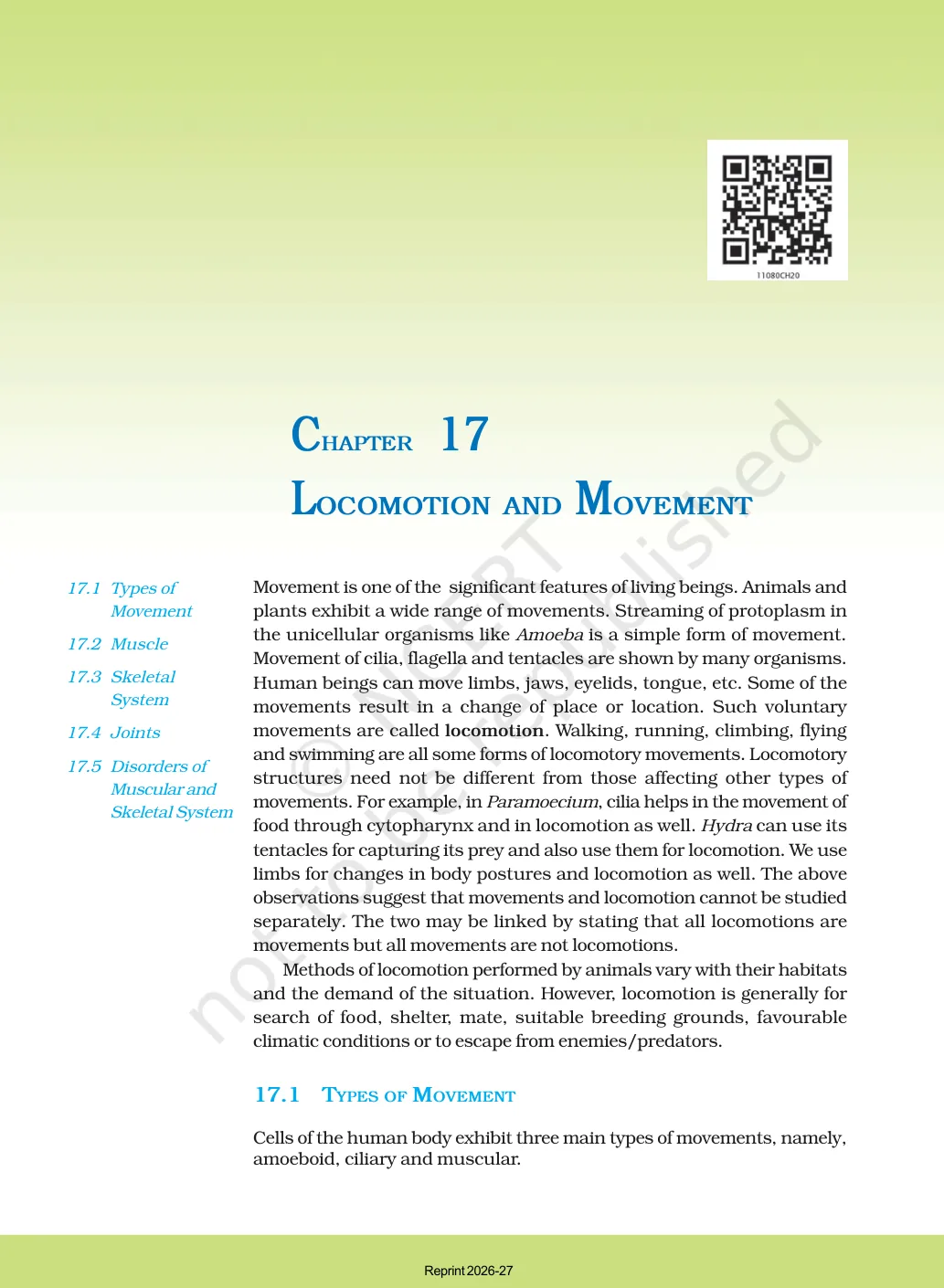
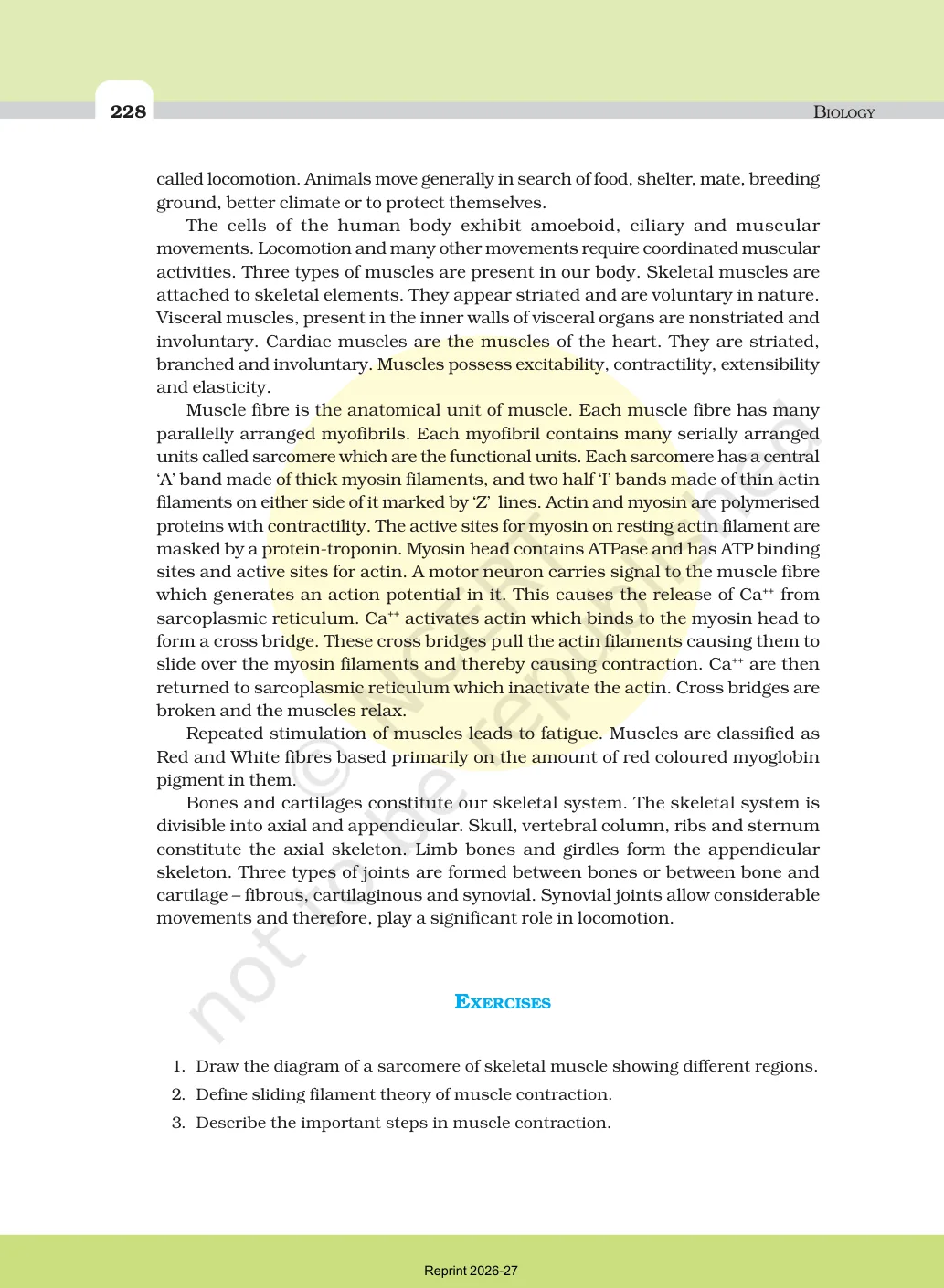
✍️ Chapter 17 Exercise Solutions: Locomotion and Movement
Exercises
Q1. Draw the diagram of a sarcomere of skeletal muscle showing different regions.
Answer: A sarcomere is the functional unit of contraction between two successive Z-lines:
- Z-line: Elastic fibre bisecting the light I-band, to which thin actin filaments are firmly attached.
- I-band (Isotropic/Light band): Contains only thin actin filaments.
- A-band (Anisotropic/Dark band): Contains thick myosin filaments overlapping with thin actin filaments at the ends.
- H-zone: Central part of the A-band not overlapped by thin filaments in a relaxed muscle.
- M-line: Thin fibrous membrane in the middle of the A-band holding thick filaments together.
Q2. Define sliding filament theory of muscle contraction.
Answer: Proposed by H.E. Huxley and A.F. Huxley, the sliding filament theory states that contraction of a muscle fibre takes place by the sliding of the thin (actin) filaments over the thick (myosin) filaments, shortening the sarcomere without any change in the length of the filaments themselves.
Q3. Describe the important steps in muscle contraction.
Answer:
- A neural signal from the CNS reaches the neuromuscular junction and releases acetylcholine, generating an action potential in the sarcolemma.
- The action potential spreads and causes the sarcoplasmic reticulum to release Ca2+ ions into the sarcoplasm.
- Ca2+ binds to troponin on actin filaments, unmasking the active binding sites for myosin.
- Using energy from ATP hydrolysis, the myosin head binds to the exposed active site on actin to form a cross-bridge.
- The myosin head pulls the attached actin filaments towards the centre of the A-band, shortening the sarcomere (contraction).
- A new ATP binds to myosin, breaking the cross-bridge; the cycle repeats until Ca2+ is pumped back into the sarcoplasmic reticulum, causing relaxation.
Q4. Write true or false. If false change the statement so that it is true.
(a) Actin is present in thin filament
(b) H-zone of striated muscle fibre represents both thick and thin filaments.
(c) Human skeleton has 206 bones.
(d) There are 11 pairs of ribs in man.
(e) Sternum is present on the ventral side of the body.
Answer:
- (a) True
- (b) False. Corrected: H-zone of striated muscle fibre represents only thick (myosin) filaments.
- (c) True
- (d) False. Corrected: There are 12 pairs of ribs in man.
- (e) True
Q5. Write the difference between :
(a) Actin and Myosin
(b) Red and White muscles
(c) Pectoral and Pelvic girdle
Answer: (a) Actin vs Myosin: Actin forms thin filaments (with troponin and tropomyosin) and slides over myosin; myosin forms thick filaments with globular heads having ATPase activity and actin-binding sites.
(b) Red vs White muscles:
| Feature | Red Muscles | White Muscles |
|---|---|---|
| Myoglobin & Mitochondria | High myoglobin and numerous mitochondria | Low myoglobin and fewer mitochondria |
| Respiration & Fatigue | Aerobic; resistant to fatigue (sustained activity) | Anaerobic; fatigue quickly (short bursts) |
(c) Pectoral vs Pelvic girdle:
| Feature | Pectoral Girdle | Pelvic Girdle |
|---|---|---|
| Components | 2 halves, each with a clavicle and a scapula | 2 coxal bones (each formed by fusion of ilium, ischium, pubis) |
| Socket | Glenoid cavity (articulates with humerus) | Acetabulum (articulates with femur) |
Q6. Match Column I with Column II :
(a) Smooth muscle — (i) Myoglobin
(b) Tropomyosin — (ii) Thin filament
(c) Red muscle — (iii) Sutures
(d) Skull — (iv) Involuntary
Answer:
- (a) Smooth muscle — (iv) Involuntary
- (b) Tropomyosin — (ii) Thin filament
- (c) Red muscle — (i) Myoglobin
- (d) Skull — (iii) Sutures
Q7. What are the different types of movements exhibited by the cells of human body?
Answer: Human cells exhibit three main types of movement: (1) Amoeboid movement (by macrophages and leucocytes using pseudopodia), (2) Ciliary movement (by cilia lining the trachea and female reproductive tract), and (3) Muscular movement (by limbs, jaws, and tongue).
Q8. How do you distinguish between a skeletal muscle and a cardiac muscle?
Answer:
| Feature | Skeletal Muscle | Cardiac Muscle |
|---|---|---|
| Location | Attached to skeleton | Heart wall only |
| Control | Voluntary | Involuntary |
| Cell structure | Cylindrical, unbranched, multinucleated | Branched, uninucleated, connected by intercalated discs |
Q9. Name the type of joint between the following:-
(a) atlas/axis (b) carpal/metacarpal of thumb (c) between phalanges (d) femur/acetabulum (e) between cranial bones (f) between pubic bones in the pelvic girdle
Answer:
- (a) Atlas/axis: Pivot joint
- (b) Carpal/metacarpal of thumb: Saddle joint
- (c) Between phalanges: Hinge joint
- (d) Femur/acetabulum: Ball and socket joint
- (e) Between cranial bones: Fibrous joint (sutures)
- (f) Between pubic bones in the pelvic girdle: Cartilaginous joint (pubic symphysis)
Q10. Fill in the blank spaces:
(a) All mammals (except a few) have __________ cervical vertebra.
(b) The number of phalanges in each limb of human is __________
(c) Thin filament of myofibril contains 2 ‘F’ actins and two other proteins namely __________ and __________.
(d) In a muscle fibre Ca++ is stored in __________
(e) __________ and __________ pairs of ribs are called floating ribs.
(f) The human cranium is made of __________ bones.
Answer:
- (a) 7
- (b) 14
- (c) tropomyosin, troponin
- (d) sarcoplasmic reticulum
- (e) 11th, 12th
- (f) 8