CG Board Class 11 Biology Solutions | NCERT Class 11 Biology (2026-27)
Step-by-step solutions for CG Board Class 11 Biology Chapter 3: Plant Kingdom strictly following the prescribed NCERT Class 11 Biology syllabus.
📚 Chapter Overview:
- Board: Chhattisgarh Board (CGBSE / SCERT — NCERT Syllabus)
- Textbook & Chapter: NCERT Class 11 Biology — Chapter 3: Plant Kingdom
- Medium: English Medium
📖 Textbook Pages (NCERT / CG Board 2026-27)
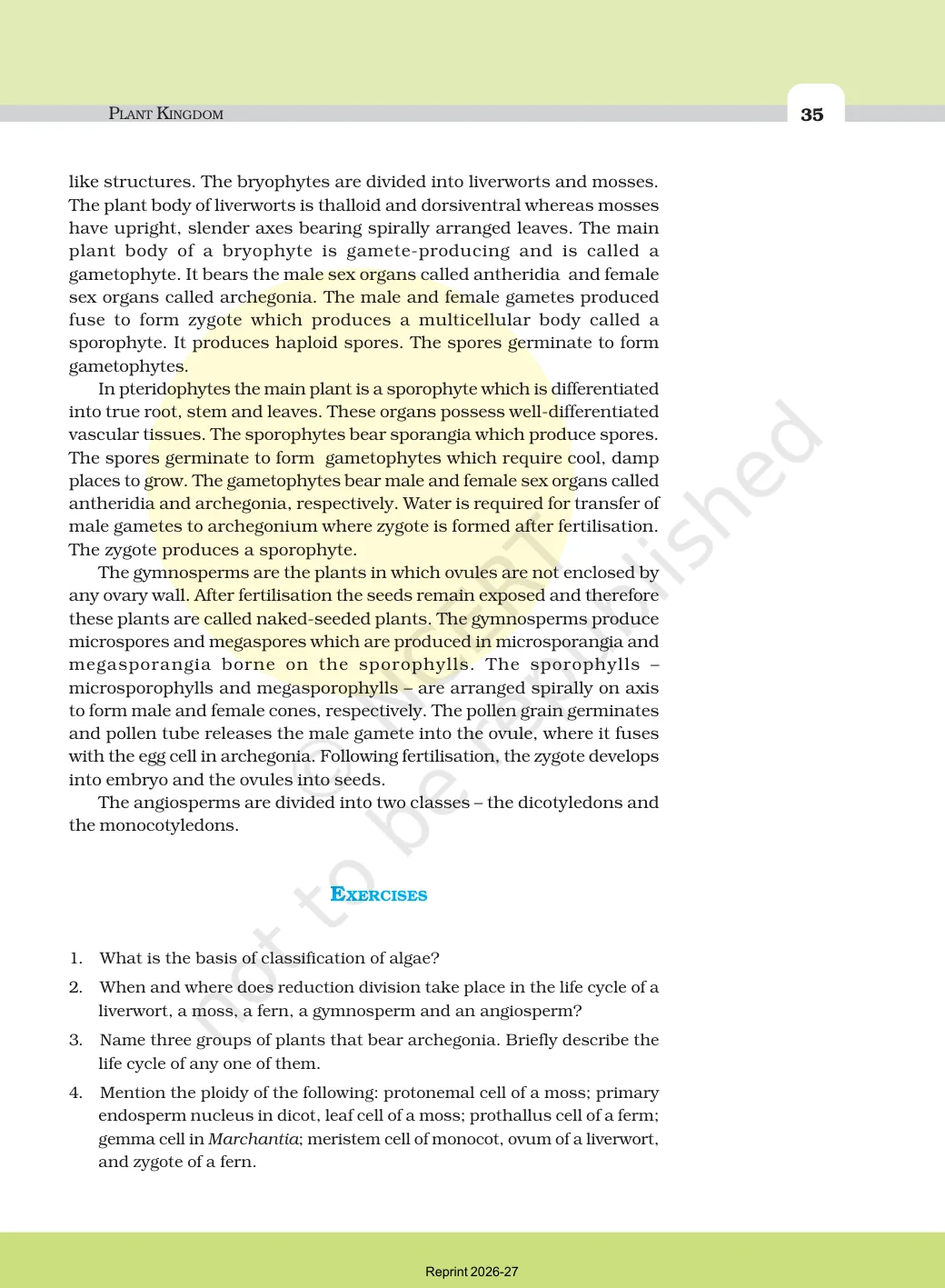
✍️ Chapter 3 Exercise Solutions: Plant Kingdom
Exercises
Q1. What is the basis of classification of algae?
Answer: Algae are classified into three main classes — Chlorophyceae (green algae), Phaeophyceae (brown algae), and Rhodophyceae (red algae) — primarily on the basis of: (i) type of photosynthetic pigments (chlorophylls, carotenoids, phycobilins), (ii) nature of stored food material (starch, laminarin/mannitol, floridean starch), and (iii) composition of the cell wall and number/position of flagella.
Q2. When and where does reduction division take place in the life cycle of a liverwort, a moss, a fern, a gymnosperm and an angiosperm?
Answer:
- Liverwort and Moss: Reduction division (meiosis) occurs in the spore mother cells inside the capsule of the sporophyte to produce haploid spores.
- Fern (Pteridophyte): Meiosis takes place in the spore mother cells within the sporangia borne on sporophylls to form haploid spores.
- Gymnosperm: Meiosis occurs in the microspore mother cells inside microsporangia (male cone) to form pollen grains, and in the megaspore mother cell inside the ovule (female cone) to form haploid megaspores.
- Angiosperm: Meiosis takes place in the microspore mother cells inside anthers to form pollen grains, and in the megaspore mother cell inside the ovule (ovary) to form the haploid megaspore.
Q3. Name three groups of plants that bear archegonia. Briefly describe the life cycle of any one of them.
Answer: The three groups of plants that bear archegonia are Bryophytes, Pteridophytes, and Gymnosperms.
Life cycle of a Moss (Bryophyte): The dominant phase is the haploid gametophyte, consisting of a creeping green protonema stage followed by the leafy stage. The leafy gametophyte bears male sex organs (antheridia, producing biflagellate antherozoids) and female sex organs (archegonia, containing a single egg). Antherozoids swim in water to fuse with the egg, forming a diploid zygote. The zygote develops into a multicellular sporophyte differentiated into foot, seta, and capsule. Inside the capsule, meiosis produces haploid spores that germinate into a new protonema.
Q4. Mention the ploidy of the following: protonemal cell of a moss; primary endosperm nucleus in dicot, leaf cell of a moss; prothallus cell of a fern; gemma cell in Marchantia; meristem cell of monocot, ovum of a liverwort, and zygote of a fern.
Answer:
| Cell / Structure | Ploidy |
|---|---|
| Protonemal cell of a moss | Haploid (n) |
| Primary endosperm nucleus in dicot | Triploid (3n) |
| Leaf cell of a moss | Haploid (n) |
| Prothallus cell of a fern | Haploid (n) |
| Gemma cell in Marchantia | Haploid (n) |
| Meristem cell of monocot | Diploid (2n) |
| Ovum of a liverwort | Haploid (n) |
| Zygote of a fern | Diploid (2n) |
Q5. Write a note on economic importance of algae and gymnosperms.
Answer: Economic importance of Algae: (1) Perform at least half of total CO2 fixation on earth and act as primary producers in aquatic food chains. (2) Edible species like Porphyra, Laminaria, and Sargassum are used as food. (3) Hydrocolloids like algin (from brown algae) and carrageen (from red algae) are used commercially, and agar (from Gelidium and Gracilaria) is used to grow microbes and prepare ice-creams and jellies. (4) Chlorella is a protein-rich unicellular alga used as a food supplement.
Economic importance of Gymnosperms: (1) Conifers like pine, cedar, and fir provide softwood timber for construction, furniture, and paper pulp. (2) Source of resins, turpentine, and medicinal compounds (e.g., ephedrine from Ephedra, taxol from Taxus). (3) Edible seeds such as chilgoza (from Pinus gerardiana) and sago (from Cycas).
Q6. Both gymnosperms and angiosperms bear seeds, then why are they classified separately?
Answer: In gymnosperms, the ovules are not enclosed by any ovary wall and remain exposed both before and after fertilisation, so they produce naked seeds without fruits. In angiosperms, the ovules are enclosed within an ovary, and after fertilisation, the seeds develop inside fruits formed from the ovary wall. Angiosperms also possess true flowers and exhibit double fertilisation, which are absent in gymnosperms.
Q7. What is heterospory? Briefly comment on its significance. Give two examples.
Answer: Heterospory is the phenomenon in which a plant produces two distinct types of spores — smaller microspores and larger megaspores — within separate sporangia.
Significance: The megaspore germinates into a female gametophyte that is retained on the parent sporophyte for variable periods, where the zygote develops into a young embryo. This event is considered a precursor to the seed habit, an important step in plant evolution.
Examples: Selaginella and Salvinia (among pteridophytes), as well as all gymnosperms and angiosperms.
Q8. Explain briefly the following terms with suitable examples:-
(i) protonema (ii) antheridium (iii) archegonium (iv) diplontic (v) sporophyll (vi) isogamy
Answer:
- (i) Protonema: A creeping, green, branched, and frequently filamentous haploid stage formed directly from a germinating spore in mosses (e.g., Funaria, Sphagnum).
- (ii) Antheridium: The multicellular male sex organ in bryophytes and pteridophytes that produces biflagellate or multiflagellate male gametes (antherozoids), e.g., Marchantia.
- (iii) Archegonium: The flask-shaped multicellular female sex organ in bryophytes, pteridophytes, and gymnosperms that encloses a single egg, e.g., Funaria, Cycas.
- (iv) Diplontic: A life cycle pattern in which the diploid sporophyte is the dominant, photosynthetic, independent phase, while the gametophytic phase is represented by single- to few-celled haploid gametophytes (e.g., all seed-bearing plants — gymnosperms and angiosperms, and the alga Fucus).
- (v) Sporophyll: A specialised leaf-like appendage that bears sporangia (e.g., microsporophylls and megasporophylls in Selaginella and Pinus).
- (vi) Isogamy: Sexual reproduction involving the fusion of two gametes that are similar in size, whether flagellated (e.g., Ulothrix) or non-flagellated (e.g., Spirogyra).
Q9. Differentiate between the following:-
(i) red algae and brown algae
(ii) liverworts and moss
(iii) homosporous and heterosporous pteridophyte
Answer: (i) Red algae vs Brown algae:
| Feature | Red Algae (Rhodophyceae) | Brown Algae (Phaeophyceae) |
|---|---|---|
| Major pigments | Chlorophyll a, d, and r-phycoerythrin | Chlorophyll a, c, carotenoids, and fucoxanthin |
| Stored food | Floridean starch | Mannitol and laminarin |
| Cell wall | Cellulose, pectin, and polysulphate esters | Cellulose covered by a gelatinous coating of algin |
| Flagella | Absent | Two unequal, laterally attached flagella |
(ii) Liverworts vs Moss:
| Feature | Liverworts | Moss |
|---|---|---|
| Plant body | Thalloid, dorsiventral, closely appressed to substrate | Erect, slender axes bearing spirally arranged leaf-like structures |
| Protonema stage | Absent; spore directly forms gametophyte | Present; creeping filamentous protonema precedes leafy stage |
| Rhizoids | Unicellular | Multicellular and branched |
(iii) Homosporous vs Heterosporous Pteridophyte:
| Feature | Homosporous Pteridophyte | Heterosporous Pteridophyte |
|---|---|---|
| Types of spores | Produces only one kind of similar-sized spores | Produces two distinct kinds: small microspores and large megaspores |
| Gametophyte | Usually monoecious (bears both antheridia and archegonia) | Dioecious (microspore forms male gametophyte; megaspore forms female gametophyte) |
| Examples | Dryopteris, Equisetum | Selaginella, Salvinia |
Q10. Match the following (column I with column II)
(a) Chlamydomonas — (i) Moss
(b) Cycas — (ii) Pteridophyte
(c) Selaginella — (iii) Algae
(d) Sphagnum — (iv) Gymnosperm
Answer:
- (a) Chlamydomonas — (iii) Algae
- (b) Cycas — (iv) Gymnosperm
- (c) Selaginella — (ii) Pteridophyte
- (d) Sphagnum — (i) Moss
Q11. Describe the important characteristics of gymnosperms.
Answer:
- Ovules are not enclosed by any ovary wall and remain exposed before and after fertilisation, producing naked seeds.
- Include medium-sized trees, tall trees (e.g., Sequoia), and shrubs.
- Roots are generally tap roots, often having fungal associations (mycorrhiza in Pinus) or coralloid roots with nitrogen-fixing cyanobacteria (in Cycas).
- Stems may be unbranched (Cycas) or branched (Pinus, Cedrus); leaves are well adapted to withstand extreme temperature, humidity, and wind (needle-like leaves with thick cuticle and sunken stomata in conifers).
- They are heterosporous, producing haploid microspores and megaspores in sporangia borne on sporophylls arranged spirally into male and female cones/strobili.
- Male and female gametophytes do not have an independent free-living existence.