CG Board Class 11 Biology Solutions | NCERT Class 11 Biology (2026-27)
Step-by-step solutions for CG Board Class 11 Biology Chapter 5: Morphology of Flowering Plants strictly following the prescribed NCERT Class 11 Biology syllabus.
📚 Chapter Overview:
- Board: Chhattisgarh Board (CGBSE / SCERT — NCERT Syllabus)
- Textbook & Chapter: NCERT Class 11 Biology — Chapter 5: Morphology of Flowering Plants
- Medium: English Medium
📖 Textbook Pages (NCERT / CG Board 2026-27)
✍️ Chapter 5 Exercise Solutions: Morphology of Flowering Plants
Exercises
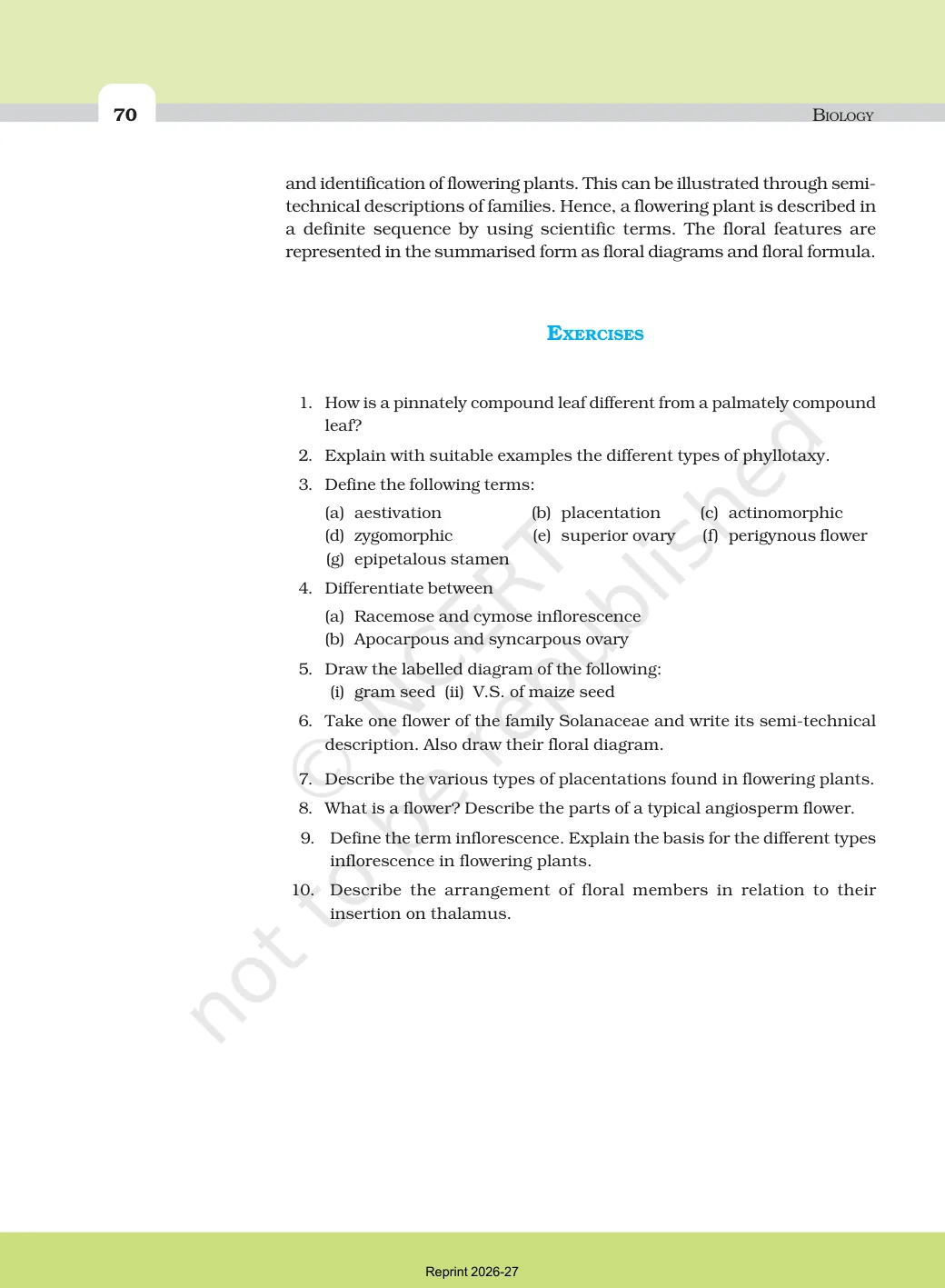
Q1. How is a pinnately compound leaf different from a palmately compound leaf?
Answer:
| Feature | Pinnately Compound Leaf | Palmately Compound Leaf |
|---|---|---|
| Attachment of leaflets | Leaflets are attached along a common central axis called the rachis | Leaflets are attached at a single common point, i.e., the tip of the petiole |
| Appearance | Resembles a feather | Resembles the palm of a hand |
| Example | Neem (Azadirachta indica) | Silk cotton (Bombax) |
Q2. Explain with suitable examples the different types of phyllotaxy.
Answer: Phyllotaxy is the pattern of arrangement of leaves on the stem or branch. It is of three main types:
- Alternate: A single leaf arises at each node in an alternate manner (e.g., china rose, mustard, sunflower).
- Opposite: A pair of leaves arise at each node and lie opposite to each other (e.g., Calotropis, guava).
- Whorled: More than two leaves arise at a node and form a whorl (e.g., Alstonia).
Q3. Define the following terms:
(a) aestivation (b) placentation (c) actinomorphic (d) zygomorphic (e) superior ovary (f) perigynous flower (g) epipetalous stamen
Answer:
- (a) Aestivation: The mode of arrangement of sepals or petals in a floral bud with respect to the other members of the same whorl.
- (b) Placentation: The arrangement of ovules within the ovary.
- (c) Actinomorphic: A flower with radial symmetry that can be divided into two equal radial halves in any radial plane passing through the centre (e.g., mustard, datura, chilli).
- (d) Zygomorphic: A flower with bilateral symmetry that can be divided into two similar halves only in one particular vertical plane (e.g., pea, gulmohur, bean, cassia).
- (e) Superior ovary: An ovary occupying the highest position on the thalamus while the other floral parts (sepals, petals, stamens) are situated below it, as seen in hypogynous flowers (e.g., mustard, china rose).
- (f) Perigynous flower: A flower in which the gynoecium is situated in the centre and other parts of the flower are located on the rim of the thalamus almost at the same level; the ovary is half inferior (e.g., plum, rose, peach).
- (g) Epipetalous stamen: A condition where stamens are attached to the petals (e.g., brinjal).
Q4. Differentiate between
(a) Racemose and cymose inflorescence
(b) Apocarpous and syncarpous ovary
Answer: (a) Racemose vs Cymose inflorescence:
| Feature | Racemose Inflorescence | Cymose Inflorescence |
|---|---|---|
| Growth of main axis | Continues to grow indefinitely (does not terminate in a flower) | Terminates in a flower, hence limited growth |
| Arrangement of flowers | Acropetal succession (older flowers at base, younger at apex) | Basipetal order (older flower at apex, younger below) |
(b) Apocarpous vs Syncarpous ovary:
| Feature | Apocarpous Ovary | Syncarpous Ovary |
|---|---|---|
| Carpels | Multiple carpels are free from one another | Multiple carpels are fused together |
| Examples | Lotus, rose | Mustard, tomato |
Q5. Draw the labelled diagram of the following:
(i) gram seed (ii) V.S. of maize seed
Answer: (i) Structure of Gram Seed (Dicotyledonous): Outermost covering is the seed coat with two layers — outer testa and inner tegmen. A scar called the hilum marks attachment to the fruit, with a small pore (micropyle) above it. Inside, the embryo consists of an embryonal axis (with radicle at one end and plumule at the other) flanked by two fleshy cotyledons storing food.
(ii) V.S. of Maize Seed (Monocotyledonous): The seed coat is membranous and fused with the fruit wall (pericarp). The bulk of the seed is a bulky, starchy endosperm separated from the embryo by a proteinaceous aleurone layer. The embryo sits in a groove at one end and consists of a single large shield-shaped cotyledon called the scutellum, a short axis with a plumule (enclosed in a sheath called coleoptile) and a radicle (enclosed in coleorrhiza).
Q6. Take one flower of the family Solanaceae and write its semi-technical description. Also draw their floral diagram.
Answer: Example: Solanum nigrum (Makoi, Family Solanaceae):
- Habit: Annual herb.
- Inflorescence: Solitary, axillary or cymose.
- Flower: Bisexual, actinomorphic.
- Calyx: Five sepals, united (gamosepalous), persistent, valvate aestivation.
- Corolla: Five petals, united (gamopetalous), valvate aestivation.
- Androecium: Five stamens, epipetalous, alternate with petals.
- Gynoecium: Bicarpellary, obligately placed, syncarpous, ovary superior, bilocular, placenta swollen with many ovules, axile placentation.
- Fruit & Seed: Berry; many endospermic seeds.
- Floral Formula: ⊕ ⚥ K(5) C(5) A5 G(2) (with an arc linking C and A for epipetalous condition and a line under G for superior ovary).
- Floral Diagram description: Mother axis at top; outer whorl of 5 united sepals (valvate); inner whorl of 5 united petals (valvate); 5 epipetalous stamens alternating with petals; central obliquely placed bilocular syncarpous ovary with swollen axile placenta bearing numerous ovules.
Q7. Describe the various types of placentations found in flowering plants.
Answer:
- Marginal: Placenta forms a ridge along the ventral suture of the ovary and ovules are borne on this ridge in two rows (e.g., pea).
- Axile: Placenta is axial and ovules are attached to it in a multilocular ovary (e.g., china rose, tomato, lemon).
- Parietal: Ovules develop on the inner wall of the ovary or on peripheral parts; ovary is one-chambered but may become two-chambered due to a false septum (e.g., mustard, Argemone).
- Free central: Ovules are borne on a central axis and septa are absent (e.g., Dianthus, primrose).
- Basal: Placenta develops at the base of the ovary and a single ovule is attached to it (e.g., sunflower, marigold).
Q8. What is a flower? Describe the parts of a typical angiosperm flower.
Answer: A flower is a modified shoot meant for sexual reproduction in angiosperms. A typical flower has four whorls arranged successively on the swollen end of the stalk (thalamus or receptacle):
- Calyx: Outermost whorl made of green leaf-like sepals that protect the flower in the bud stage.
- Corolla: Composed of brightly coloured petals that attract insects for pollination.
- Androecium: Male reproductive whorl composed of stamens; each stamen has a stalk (filament) and a bilobed anther producing pollen grains.
- Gynoecium: Female reproductive whorl made of one or more carpels; each carpel consists of a basal swollen ovary (containing ovules), an elongated style, and a receptive tip called the stigma.
Q9. Define the term inflorescence. Explain the basis for the different types inflorescence in flowering plants.
Answer: Inflorescence is the arrangement of flowers on the floral axis. It is classified into two major types based on whether the apex gets converted into a flower or continues to grow:
- Racemose: The main axis continues to grow indefinitely and flowers are borne laterally in acropetal succession (older flowers at the base, younger at the tip).
- Cymose: The main axis terminates in a flower, limiting its growth, and flowers are borne in basipetal order (older flower at the tip, younger below).
Q10. Describe the arrangement of floral members in relation to their insertion on thalamus.
Answer: Based on the position of calyx, corolla, and androecium in respect of the ovary on the thalamus, flowers are of three types:
| Type | Position of Floral Parts & Ovary | Examples |
|---|---|---|
| Hypogynous | Gynoecium occupies the highest position; other parts are situated below it. Ovary is superior. | Mustard, china rose, brinjal |
| Perigynous | Gynoecium is in the centre; other parts are on the rim of the thalamus at the same level. Ovary is half inferior. | Plum, rose, peach |
| Epigynous | Margin of thalamus grows upward enclosing the ovary completely and fusing with it; other parts arise above the ovary. Ovary is inferior. | Guava, cucumber, ray florets of sunflower |