CG Board Class 11 Biology Solutions | NCERT Class 11 Biology (2026-27)
Step-by-step solutions for CG Board Class 11 Biology Chapter 8: Cell: The Unit of Life strictly following the prescribed NCERT Class 11 Biology syllabus.
📚 Chapter Overview:
- Board: Chhattisgarh Board (CGBSE / SCERT — NCERT Syllabus)
- Textbook & Chapter: NCERT Class 11 Biology — Chapter 8: Cell: The Unit of Life
- Medium: English Medium
📖 Textbook Pages (NCERT / CG Board 2026-27)
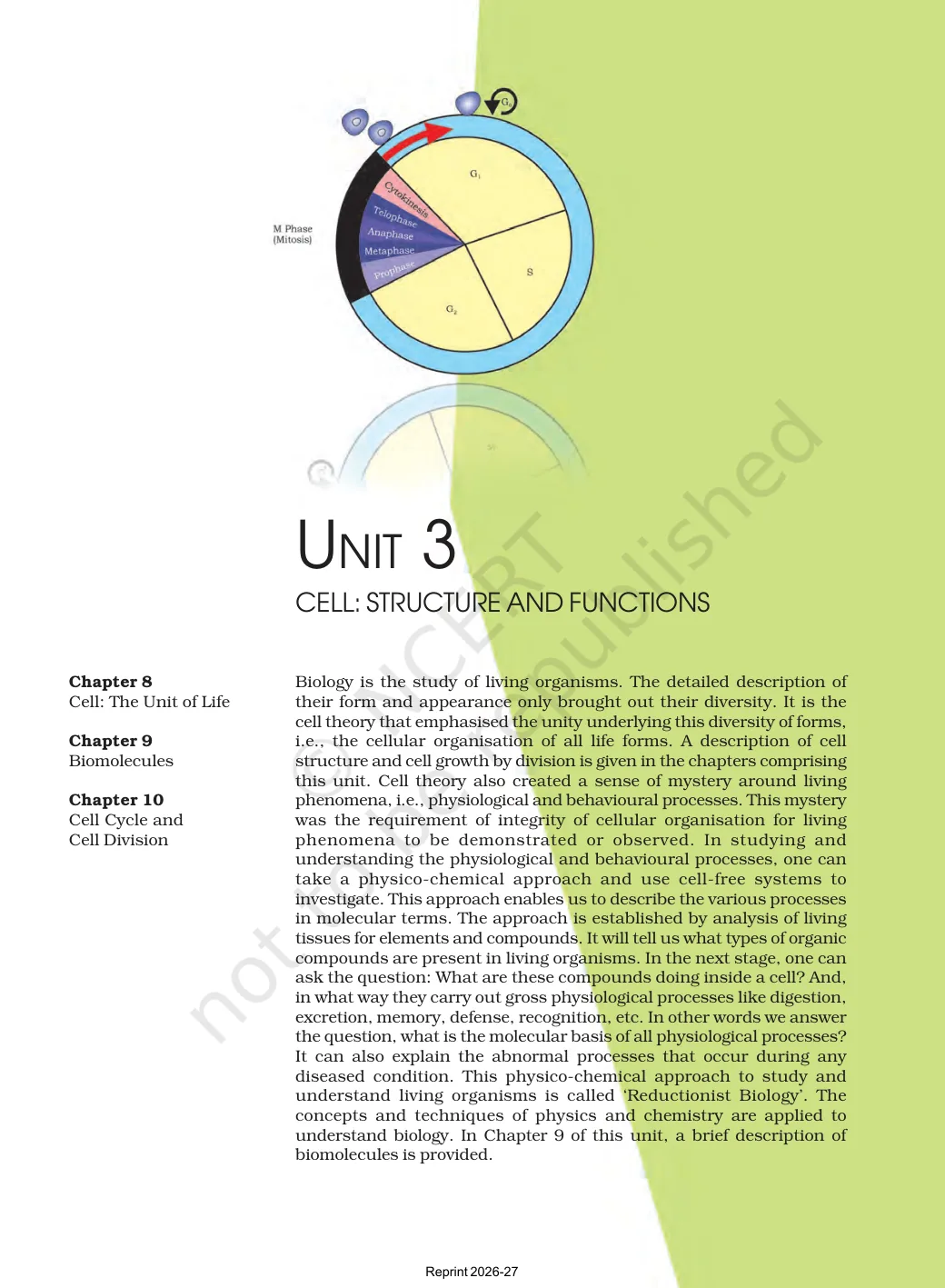

✍️ Chapter 8 Exercise Solutions: Cell: The Unit of Life
Exercises
Q1. Which of the following is not correct?
(a) Robert Brown discovered the cell.
(b) Schleiden and Schwann formulated the cell theory.
(c) Virchow explained that cells are formed from pre-existing cells.
(d) A unicellular organism carries out its life activities within a single cell.
Answer: (a) Robert Brown discovered the cell is not correct. Robert Hooke discovered the cell (in 1665), whereas Robert Brown discovered the nucleus (in 1831).
Q2. New cells generate from
(a) bacterial fermentation
(b) regeneration of old cells
(c) pre-existing cells
(d) abiotic materials
Answer: (c) pre-existing cells (Omnis cellula-e cellula, as explained by Rudolf Virchow).
Q3. Match the following
(a) Cristae — (i) Flat membranous sacs in stroma
(b) Cisternae — (ii) Infoldings in mitochondria
(c) Thylakoids — (iii) Disc-shaped sacs in Golgi apparatus
Answer:
- (a) Cristae — (ii) Infoldings in mitochondria
- (b) Cisternae — (iii) Disc-shaped sacs in Golgi apparatus
- (c) Thylakoids — (i) Flat membranous sacs in stroma
Q4. Which of the following is correct:
(a) Cells of all living organisms have a nucleus.
(b) Both animal and plant cells have a well defined cell wall.
(c) In prokaryotes, there are no membrane bound organelles.
(d) Cells are formed de novo from abiotic materials.
Answer: (c) In prokaryotes, there are no membrane bound organelles.
Q5. What is a mesosome in a prokaryotic cell? Mention the functions that it performs.
Answer: A mesosome is a special membranous structure formed by the extensions of the plasma membrane into the prokaryotic cell, appearing in the form of vesicles, tubules, and lamellae.
Functions: It helps in cell wall formation, DNA replication and distribution to daughter cells, respiration, secretion processes, and increasing the surface area of the plasma membrane and enzymatic content.
Q6. How do neutral solutes move across the plasma membrane? Can the polar molecules also move across it in the same way? If not, then how are these transported across the membrane?
Answer: Neutral solutes move across the plasma membrane by simple diffusion along the concentration gradient (from higher to lower concentration).
No, polar molecules cannot pass through the nonpolar lipid bilayer in the same way. They require a carrier protein of the membrane to facilitate their transport across the membrane (facilitated diffusion), or energy-dependent carrier proteins (active transport, using ATP, e.g., Na+/K+ pump) when moving against the concentration gradient.
Q7. Name two cell-organelles that are double membrane bound. What are the characteristics of these two organelles? State their functions and draw labelled diagrams of both.
Answer: The two double membrane-bound cell organelles are Mitochondria and Chloroplasts.
- Mitochondria: Sausage-shaped or cylindrical organelles with an outer smooth membrane and an inner membrane folded into cristae, enclosing a dense matrix. They contain circular DNA, RNA, and 70S ribosomes. Function: Sites of aerobic respiration; produce cellular energy in the form of ATP (‘power houses’ of the cell).
- Chloroplasts: Lens-shaped or oval organelles found in plants and euglenoids. Enclosed by a double membrane, the inner space (stroma) contains flattened membranous sacs called thylakoids stacked into grana, interconnected by stroma lamellae, along with circular DNA and 70S ribosomes. Function: Trap solar energy and synthesise carbohydrates during photosynthesis.
Q8. What are the characteristics of prokaryotic cells?
Answer:
- Lack a well-defined membrane-bound nucleus; genetic material is naked circular DNA (genomic DNA) plus small circular plasmids.
- Lack membrane-bound organelles (such as mitochondria, ER, Golgi bodies); only 70S ribosomes are present.
- Possess a chemically complex cell envelope consisting of glycocalyx, cell wall (except in Mycoplasma), and plasma membrane.
- Plasma membrane infoldings form mesosomes; reserve materials are stored as inclusion bodies.
Q9. Multicellular organisms have division of labour. Explain.
Answer: In multicellular organisms, different groups of cells specialise to perform specific functions. Similar cells group together to form tissues, tissues form organs, and organs form organ systems (such as digestive, respiratory, and circulatory systems). Each system performs a dedicated task efficiently, ensuring the coordinated survival of the organism as a whole.
Q10. Cell is the basic unit of life. Discuss in brief.
Answer: All living organisms are composed of cells and products of cells. A single cell is capable of independent existence and performing all essential functions of life — metabolism, growth, response to stimuli, and reproduction. Anything less than a complete structure of a cell does not ensure independent living; hence, the cell is the fundamental structural and functional unit of all living organisms.
Q11. What are nuclear pores? State their function.
Answer: Nuclear pores are minute openings formed by the fusion of the two membranes of the nuclear envelope at several places. They serve as passages through which movement of RNA and protein molecules takes place in both directions between the nucleus and the cytoplasm.
Q12. Both lysosomes and vacuoles are endomembrane structures, yet they differ in terms of their functions. Comment.
Answer: Although both belong to the endomembrane system and are single-membrane bound, their functions differ:
- Lysosomes: Membrane-bound vesicular structures formed by packaging in the Golgi apparatus, rich in hydrolytic enzymes (lipases, proteases, carbohydrases) active at acidic pH. They carry out intracellular digestion of macromolecules, worn-out organelles, and engulfed pathogens.
- Vacuoles: Bound by a single membrane called the tonoplast, they store water, sap, excretory products, and other materials not useful for the cell. In plants, they maintain cell turgidity; in Amoeba, contractile vacuoles aid osmoregulation and excretion.
Q13. Describe the structure of the following with the help of labelled diagrams.
(i) Nucleus (ii) Centrosome
Answer: (i) Nucleus: Bounded by a double-layered nuclear envelope with a perinuclear space and interrupted by nuclear pores. Inside lies the nucleoplasm containing chromatin (DNA + histone proteins + non-histone proteins + RNA) and one or more spherical, non-membranous nucleoli (sites of active rRNA synthesis).
(ii) Centrosome: An organelle usually containing two cylindrical structures called centrioles, lying perpendicular to each other and surrounded by amorphous pericentriolar materials. Each centriole has a cartwheel-like organisation made of nine evenly spaced peripheral triplets of tubulin fibrils linked to a central proteinaceous hub via radial spokes.
Q14. What is a centromere? How does the position of centromere form the basis of classification of chromosomes. Support your answer with a diagram showing the position of centromere on different types of chromosomes.
Answer: A centromere is the primary constriction on a chromosome to which two disc-shaped structures called kinetochores are attached. Based on the position of the centromere, chromosomes are classified into four types:
| Type of Chromosome | Position of Centromere | Arm Lengths |
|---|---|---|
| Metacentric | Middle of the chromosome | Two equal arms |
| Sub-metacentric | Slightly away from the middle | One shorter arm and one longer arm |
| Acrocentric | Close to one end | One extremely short arm and one very long arm |
| Telocentric | Terminal (at the very tip) | Only one arm visible |