CG Board Class 11 Business Studies Solutions | NCERT Class 11 Business Studies (2026-27)
Step-by-step solutions for CG Board Class 11 Business Studies Chapter 2: Forms of Business Organisation strictly following the prescribed NCERT Class 11 Business Studies syllabus.
📚 Chapter Overview:
- Board: Chhattisgarh Board (CGBSE / SCERT — NCERT Syllabus)
- Textbook & Chapter: NCERT Class 11 Business Studies — Chapter 2: Forms of Business Organisation
- Medium: English Medium
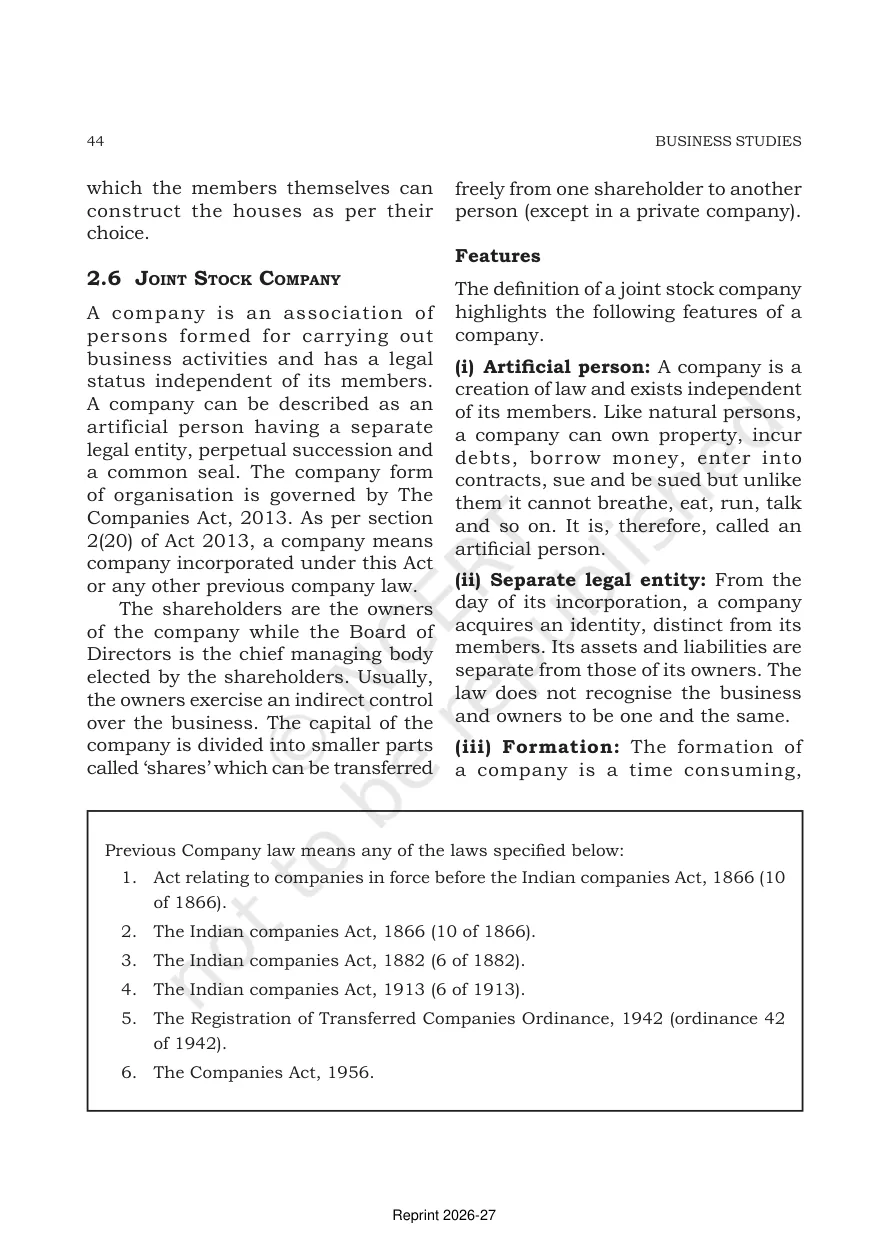
📖 Textbook Pages (NCERT / CG Board 2026-27)

✍️ Chapter 2 Exercise Solutions: Forms of Business Organisation
Exercises
Short Answer Questions
In a Joint Hindu Family (JHF) business, a minor becomes a member (coparcener) by birth and enjoys equal ownership rights in the ancestral property, with liability limited to his/her share in the business. In a partnership firm, a minor cannot become a full-fledged partner because a minor is incompetent to enter into a valid contract; however, a minor can be admitted only to the benefits of an existing partnership with the mutual consent of all partners, and his/her liability is limited to the capital contributed.
2. If registration is optional, why do partnership firms willingly go through this legal formality and get themselves registered? Explain.
Although registration of a partnership firm is optional under the Indian Partnership Act, 1932, firms willingly register because an unregistered firm suffers from serious legal disabilities:
- A partner of an unregistered firm cannot file a suit against the firm or other partners.
- The firm cannot file a suit against third parties to enforce its rights.
- The firm cannot file a case against any of its partners.
Registration provides legal protection and credibility in business dealings.
3. State the important privileges available to a private company.
Important privileges of a private company over a public company are:
- Can be formed by only 2 members (compared to 7 in a public company).
- No need to issue a prospectus as public is not invited to subscribe to shares.
- Allotment of shares can be done without receiving minimum subscription, and business can start immediately after receiving the Certificate of Incorporation.
- Needs only 2 directors (compared to 3 in a public company).
- Not required to maintain an index of members.
4. How does a cooperative society exemplify democracy and secularism? Explain.
A cooperative society exemplifies democracy because it follows the principle of “one man, one vote” irrespective of the amount of capital contributed by each member; the managing committee is elected democratically by all members. It exemplifies secularism because its membership is open to all persons having a common interest, regardless of religion, caste, creed, or gender.
5. What is meant by ‘partner by estoppel’? Explain.
A partner by estoppel is a person who is not actually a partner in a firm, but by his/her own initiative, conduct, or behaviour gives an impression to others that he/she is a partner of the firm. Such a person is held liable for the debts of the firm to third parties who gave credit to the firm on the faith of that representation, because in the eyes of the law he/she is considered a partner.
6. Briefly explain the following terms in brief.
(a) Perpetual succession (b) Common seal (c) Karta (d) Artificial person
- (a) Perpetual succession: A company is created by law and can be ended only by law through winding up. Its existence is not affected by the death, insolvency, or exit of any member—”members may come and members may go, but the company continues to exist.”
- (b) Common seal: Since a company is an artificial person and cannot sign documents itself, it uses a common seal as its official signature, affixed on important documents to bind the company.
- (c) Karta: The eldest member of a Joint Hindu Family who heads, manages, and controls the Joint Hindu Family business. The Karta has unlimited liability and sole decision-making authority.
- (d) Artificial person: A company is called an artificial person because it is created by law and exists independently of its members. Like a natural person, it can own property, enter into contracts, sue and be sued, but it cannot breathe, eat, or talk.
Long Answer Questions
1. What do you understand by a sole proprietorship firm? Explain its merits and limitation?
Meaning: A sole proprietorship is a form of business organisation that is owned, managed, and controlled by a single individual who receives all profits and bears all risks.
Merits:
- Quick decision making: Sole proprietor enjoys complete freedom without needing to consult others.
- Confidentiality of information: Business secrets are easily maintained as accounts need not be published.
- Direct incentive: Sole recipient of all profits, motivating hard work.
- Sense of accomplishment: Personal satisfaction of being responsible for success.
- Ease of formation and closure: Minimum legal formalities required to start or close.
Limitations:
- Limited resources: Capital is limited to personal savings and borrowing capacity.
- Limited life of a business concern: Death, insanity, or illness of the owner directly affects continuity.
- Unlimited liability: Personal assets of the owner can be used to pay business debts if business assets are insufficient.
- Limited managerial ability: One person may not possess expertise in all areas like finance, marketing, and production.
2. Why is partnership considered by some to be a relatively unpopular form of business ownership? Explain the merits and limitations of partnership.
Partnership is sometimes considered less popular for large enterprises due to unlimited liability, limited capital, risk of conflicts among partners, and lack of continuity. However, it has distinct merits and limitations:
Merits:
- Ease of formation and closure: Formed easily through an agreement without complex legal formalities.
- Balanced decision making: Partners can specialise in different functions, reducing errors.
- More funds: Capital is contributed by multiple partners, enabling larger operations than sole proprietorship.
- Sharing of risks: Losses are shared among all partners, reducing individual burden.
- Secrecy: Not legally required to publish accounts or reports.
Limitations:
- Unlimited liability: Partners are jointly and individually liable to repay business debts even from personal assets.
- Limited resources: Restriction on maximum number of partners limits capital for very large projects.
- Possibility of conflicts: Differences in opinion may lead to disputes and deadlock.
- Lack of continuity: Death, retirement, insolvency, or insanity of a partner can end the firm.
- Lack of public confidence: Absence of mandatory publication of financial reports reduces public trust.
3. Why is it important to choose an appropriate form of organisation? Discuss the factors that determine the choice of form of organisation.
Choosing an appropriate form of business organisation is vital because each form has different legal requirements, liability, capital-raising capacity, and continuity, which directly affect survival and growth.
Factors determining choice:
- Cost and ease in setting up: Sole proprietorship is least expensive and easiest; company formation is lengthy and costly.
- Liability: Sole proprietorship and partnership carry unlimited liability, whereas companies and cooperatives offer limited liability.
- Continuity: Companies and cooperatives enjoy perpetual succession; sole proprietorship and partnership are affected by owner’s death or insolvency.
- Management ability: A company can hire professional experts, while a sole proprietor has limited managerial capacity.
- Capital considerations: Companies can raise huge capital from the public; sole proprietorships have limited funds.
- Degree of control: Sole proprietorship gives complete control; in a company, ownership and management are separated.
- Nature of business: Personalised services suit sole proprietorship/partnership, while large-scale manufacturing suits a company.
4. Discuss the characteristics, merits and limitation of cooperative form of organisation. Also describe briefly different types of cooperative societies.
Characteristics: Voluntary membership, legal status (compulsory registration), limited liability, democratic control (“one man, one vote”), and service motive.
Merits: Equality in voting status, limited liability, stable existence, economy in operations (eliminating middlemen), support from government, and ease of formation.
Limitations: Limited resources, inefficiency in management (honorary/untrained office-bearers), lack of secrecy, government control, and differences of opinion among members.
Types of Cooperative Societies:
- Consumer’s cooperative societies: Protect consumers from middlemen by supplying quality goods at reasonable prices.
- Producer’s cooperative societies: Protect small producers by supplying inputs and marketing their output.
- Marketing cooperative societies: Help small producers sell their products profitably through pooled marketing functions.
- Farmer’s cooperative societies: Protect farmers’ interests by providing quality seeds, fertilisers, machinery, and modern techniques.
- Credit cooperative societies: Provide easy credit on reasonable terms to members, protecting them from moneylenders.
- Cooperative housing societies: Help people with limited income construct or buy houses at reasonable costs.
5. Distinguish between a Joint Hindu family business and partnership.
| Basis | Joint Hindu Family Business | Partnership |
|---|---|---|
| Governing Act | Hindu Law (Hindu Succession Act, 1956) | Indian Partnership Act, 1932 |
| Mode of creation | By birth in the family | By agreement (contract) among partners |
| Management | Managed solely by the Karta | Managed by all partners or any of them acting for all |
| Liability | Karta has unlimited liability; other coparceners have limited liability | All partners have unlimited liability (joint and several) |
| Number of members | Minimum 2; no maximum limit | Minimum 2; maximum 50 (as per Companies Rules, 2014) |
| Minor’s position | A minor is a member by birth | A minor cannot be a full partner; can only be admitted to benefits |
| Continuity | Continues even after the death of the Karta (next eldest becomes Karta) | Dissolved on death, insolvency, or retirement of a partner unless agreed otherwise |
6. Despite limitations of size and resources, many people continue to prefer sole proprietorship over other forms of organisation? Why?
Many entrepreneurs still prefer sole proprietorship because:
- Ease of formation and closure: Minimal legal formalities and low start-up cost.
- Direct incentive: The owner keeps 100% of the profits, providing strong motivation.
- Complete control and quick decisions: No need to consult partners or shareholders.
- Secrecy: No legal obligation to publish financial accounts.
- Personal touch: Ideal for small-scale, personalised services (e.g., salons, grocery shops, tailoring) where direct customer contact matters.
Application Questions
1. In which form of organisation is a trade agreement made by one owner binding on the others? Give reasons to support your answer.
In a Partnership firm, a trade agreement made by one partner (owner) in the normal course of business is binding on all other partners. This is because of the principle of mutual agency: every partner is both an agent and a principal for the other partners, so an act of one partner binds the firm and all co-partners.
2. The business assets of an organisation amount to Rs. 50,000 but the debts that remain unpaid are Rs. 80,000. What course of action can the creditors take if:
(a) The organisation is a sole proprietorship firm
(b) The organisation is a partnership firm with Anthony and Akbar as partners. Which of the two partners can the creditors approach for repayment of debt? Explain giving reasons
The shortfall of debt over business assets is ₹80,000 − ₹50,000 = ₹30,000.
(a) Sole proprietorship firm: Due to unlimited liability, creditors can claim the remaining ₹30,000 from the personal property/assets of the sole proprietor.
(b) Partnership firm (Anthony and Akbar): Due to unlimited, joint, and several liability of partners, creditors can approach either Anthony or Akbar individually, or both of them jointly, to recover the remaining ₹30,000 from their personal assets. If one partner pays the full ₹30,000, he can later recover the proportionate share from the other partner.
3. Kiran is a sole proprietor… she is wondering whether she should form a company to better manage the business. She also has plans to open branches countrywide.
(a) Explain two benefits of remaining a sole proprietor
(b) Explain two benefits of converting to a joint stock company
(c) What role will her decision to go nationwide play in her choice of form of the organisation?
(d) What legal formalities will she have to undergo to operate business as a company?
(a) Two benefits of remaining a sole proprietor:
- Quick decision making and full control: Kiran can take immediate decisions without consulting anyone.
- Direct incentive and secrecy: She enjoys all profits and does not have to disclose accounts publicly.
(b) Two benefits of converting to a joint stock company:
- Limited liability: Her personal assets will be protected, as liability is limited to unpaid share capital.
- Scope for expansion and professional management: She can raise large capital from investors/banks and hire specialised managers for nationwide branches.
(c) Role of nationwide expansion: Expanding countrywide requires large financial resources, professional management across regions, and perpetual continuity—none of which a sole proprietorship can easily support. Thus, her decision to go nationwide strongly favours converting into a Joint Stock Company.
(d) Legal formalities to operate as a company: Under the Companies Act, 2013, Kiran must complete: (i) Promotion (conceiving the idea, reserving name), (ii) Incorporation (preparing Memorandum of Association, Articles of Association, consent of directors, statutory declaration, paying fees, and obtaining the Certificate of Incorporation from the Registrar of Companies), and (iii) Capital Subscription (if forming a public company, getting SEBI approval, issuing prospectus, receiving minimum subscription, and allotting shares).
Projects & Assignments
Projects & Assignments: (a)–(e) Study of neighbourhood stores, JHF, partnerships, cooperatives, companies; and Assignment: Partnership Deed for Sonam and Sameer (District Kangra, HP)
Project Guidance: For the field studies (a)–(e), compare each organisation on nature of business, capital employed, number of employees, decision-making pattern, and reason for choosing that form.
Partnership Deed for Sonam and Sameer: To avoid future disputes in their food processing business in Kangra, their written Partnership Deed should specify: (1) Name of the firm and partners, (2) Nature and location of business, (3) Capital contributed by Sonam and Sameer, (4) Profit and loss sharing ratio, (5) Duties, rights, and salaries/drawings of partners, (6) Interest on capital and drawings, (7) Procedure for admission, retirement, or dissolution, and (8) Method of resolving disputes (arbitration).