CG Board Class 11 Economics Solutions | NCERT Class 11 Economics (Indian Economic Dev. & Statistics) (2026-27)
Step-by-step solutions for CG Board Class 11 Economics Chapter 1: Indian Economy on the Eve of Independence strictly following the prescribed NCERT Class 11 Economics (Indian Economic Dev. & Statistics) syllabus.
📚 Chapter Overview:
- Board: Chhattisgarh Board (CGBSE / SCERT — NCERT Syllabus)
- Textbook & Chapter: NCERT Class 11 Economics (Indian Economic Dev. & Statistics) — Chapter 1: Indian Economy on the Eve of Independence
- Medium: English Medium
📖 Textbook Pages (NCERT / CG Board 2026-27)
✍️ Chapter 1 Exercise Solutions: Indian Economy on the Eve of Independence
Exercises
Q1. What was the focus of the economic policies pursued by the colonial government in India? What were the impacts of these policies?
Answer: The colonial government’s economic policies focused on protecting and promoting the economic interests of Britain rather than developing the Indian economy. They aimed to turn India into a supplier of raw materials for Britain’s expanding modern industries and a captive market for finished British manufactured goods.
Impacts: India’s traditional handicraft industries were ruined, agriculture stagnated with low productivity, industrial growth remained lopsided and minimal, per capita income grew at less than 0.5% per year, and widespread poverty and unemployment persisted.
Q2. Name some notable economists who estimated India’s per capita income during the colonial period.
Answer: Notable estimators of India’s national and per capita income during the colonial period were Dadabhai Naoroji, William Digby, Findlay Shirras, V.K.R.V. Rao (whose estimates were considered very significant), and R.C. Desai.
Q3. What were the main causes of India’s agricultural stagnation during the colonial period?
Answer:
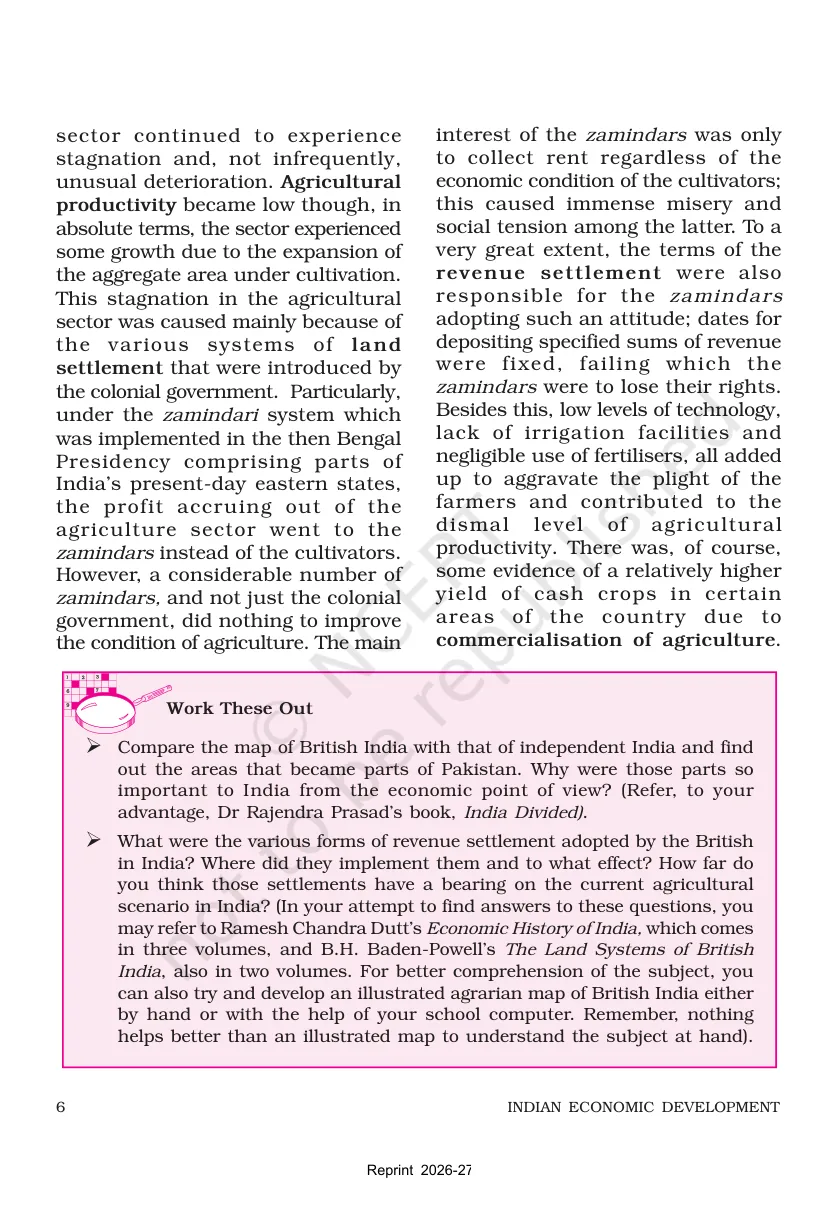
- Exploitative land settlement systems: Especially the zamindari system in Bengal Presidency, where zamindars extracted high lagaan (rent) without investing in land improvement.
- Low level of technology and lack of irrigation: Dependence on monsoon rainfall, negligible use of fertilisers, and outdated tools kept productivity low.
- Commercialisation of agriculture: Farmers were forced or induced to grow cash crops (indigo, cotton, jute) for British industries instead of food crops, worsening food insecurity.
- Lack of investment: Neither the colonial state nor zamindars invested in flood control, drainage, or soil improvement, and Partition further hit fertile jute- and wheat-growing areas.
Q4. Name some modern industries which were in operation in our country at the time of independence.
Answer: At the time of independence, India had cotton textile mills (mainly in Maharashtra and Gujarat), jute mills (concentrated in Bengal), the Tata Iron and Steel Company (TISCO, incorporated in 1907 at Jamshedpur), and a few sugar, cement, and paper mills.
Q5. What was the two-fold motive behind the systematic de-industrialisation effected by the British in pre-independent India?
Answer: The British pursued systematic de-industrialisation with a two-fold motive:
- To reduce India to the status of a mere exporter of important raw materials for the upcoming modern industries in Britain.
- To turn India into a sprawling market for the finished products of those British industries, ensuring their continued expansion at Britain’s advantage.
Q6. The traditional handicrafts industries were ruined under the British rule. Do you agree with this view? Give reasons in support of your answer.
Answer: Yes. India’s world-famous handicraft industries declined rapidly under British rule because:
- Discriminatory tariff policy: Britain allowed duty-free import of British machine-made goods into India while imposing heavy duties on Indian handicrafts exported to Britain.
- Competition from machine-made goods: Cheap, mass-produced British textiles and goods undercut handmade Indian products.
- Loss of royal patronage: The disappearance of princely courts and Indian nobility removed major buyers of fine handicrafts.
- Creation of a new class: Westernised urban elites increasingly preferred imported British goods.
Q7. What objectives did the British intend to achieve through their policies of infrastructure development in India?
Answer: The British developed railways, ports, water transport, posts, and telegraphs not to provide basic amenities to Indians, but to serve colonial interests:
- Roads: Built to mobilise the British army within India and transport raw materials from the countryside to the nearest railway station or port for export to England.
- Railways (introduced in 1850): Enabled faster movement of troops and raw materials from the interior to ports and widened the market for British manufactured goods.
- Posts and Electric Telegraph: Maintained law and order and improved administrative and military communication across the colony.
Q8. Critically appraise some of the shortfalls of the industrial policy pursued by the British colonial administration.
Answer:
- No modern industrial base: De-industrialisation destroyed traditional handicrafts without building a commensurate modern industrial sector.
- Lack of capital goods industries: There were hardly any capital goods industries (making machine tools and heavy machinery) to support further industrialisation.
- Small share in GDP: Growth rate of the new industrial sector and its contribution to GDP remained very small.
- Limited public sector role: State participation was confined mostly to railways, power generation, communications, ports, and some departmental undertakings.
Q9. What do you understand by the drain of Indian wealth during the colonial period?
Answer: The drain of Indian wealth refers to the unilateral transfer of India’s economic surplus to Britain without any commensurate economic or material return. Although India consistently generated a large export surplus, the surplus did not bring gold or silver into India; instead, it was used to pay for expenses incurred by a British-run office in London, war expenses fought by the British government, and imports of invisible services.
Q10. Which is regarded as the defining year to mark the demographic transition from its first to the second decisive stage?
Answer: The year 1921 is regarded as the defining year (‘Year of Great Divide’) marking the demographic transition from the first stage (high birth rate and high death rate) to the second stage (high birth rate and declining death rate) in India.
Q11. Give a quantitative appraisal of India’s demographic profile during the colonial period.
Answer: Key demographic indicators during the colonial period showed extreme backwardness:
| Indicator | Colonial Period Figure |
|---|---|
| Overall Literacy Rate | Less than 16% (female literacy was negligibly low at about 7%) |
| Infant Mortality Rate | About 218 per thousand live births (compared to 28 per thousand later) |
| Life Expectancy at Birth | Very low — about 32 years (compared to 70 years later) |
| Overall Mortality Rate | Very high due to frequent famines and water- and air-borne diseases |
Q12. Highlight the salient features of India’s pre-independence occupational structure.
Answer:
- Dominance of agriculture: The agricultural sector accounted for the largest share of the workforce at 70–75%.
- Small manufacturing and services share: Manufacturing accounted for only about 10% and services for 15–20% of the workforce.
- Regional variation: Parts of the Madras Presidency (present-day Tamil Nadu, Andhra Pradesh, Kerala, Karnataka), Bombay, and Bengal saw a slight decline in agricultural dependence and a rise in manufacturing and services, whereas states like Orissa, Rajasthan, and Punjab saw an increase in the agricultural workforce.
Q13. Underscore some of India’s most crucial economic challenges at the time of independence.
Answer: At independence, India faced severe structural challenges:
- Stagnant and backward agriculture: Low productivity, disguised unemployment, and dependence on monsoon, worsened by Partition.
- Weak industrial base: Absence of capital goods industries and ruined traditional handicrafts.
- Inadequate infrastructure: Shortage of all-weather rural roads, power, and social infrastructure.
- Mass poverty and poor human development: High illiteracy (>84%), high infant mortality, low life expectancy (32 years), and widespread unemployment.
Q14. When was India’s first official census operation undertaken?
Answer: India’s first official census operation was undertaken in the year 1881 (and thereafter conducted every ten years).
Q15. Indicate the volume and direction of trade at the time of independence.
Answer: Volume and composition: India became an exporter of primary products (raw silk, cotton, wool, sugar, indigo, jute) and an importer of finished consumer goods (cotton, silk, woollen clothes) and light capital goods from Britain.
Direction: Britain maintained monopoly control over India’s foreign trade—more than half of India’s foreign trade was restricted to Britain, while the remaining share was allowed with a few countries like China, Ceylon (Sri Lanka), and Persia (Iran). The opening of the Suez Canal in 1869 further intensified British control.
Q16. Were there any positive contributions made by the British in India? Discuss.
Answer: While British rule was driven by colonial self-interest, a few incidental positive developments emerged:
- Railways and communication: Railways (1850), posts, and telegraphs broke geographical and cultural barriers and enabled long-distance travel and market integration.
- Unified administration and legal system: Established an organised civil service, census operations (1881), and a unified monetary and administrative framework.
- Commercialisation and modern industries: Exposed India to modern banking, corporate enterprise (e.g., TISCO), and commercial agriculture, though their benefits were largely skewed toward colonial interests.