CG Board Class 11 Economics Solutions | NCERT Class 11 Economics (Indian Economic Dev. & Statistics) (2026-27)
Step-by-step solutions for CG Board Class 11 Economics Chapter 6: Employment: Growth, Informalisation and Other Issues strictly following the prescribed NCERT Class 11 Economics (Indian Economic Dev. & Statistics) syllabus.
📚 Chapter Overview:
- Board: Chhattisgarh Board (CGBSE / SCERT — NCERT Syllabus)
- Textbook & Chapter: NCERT Class 11 Economics (Indian Economic Dev. & Statistics) — Chapter 6: Employment: Growth, Informalisation and Other Issues
- Medium: English Medium
📖 Textbook Pages (NCERT / CG Board 2026-27)

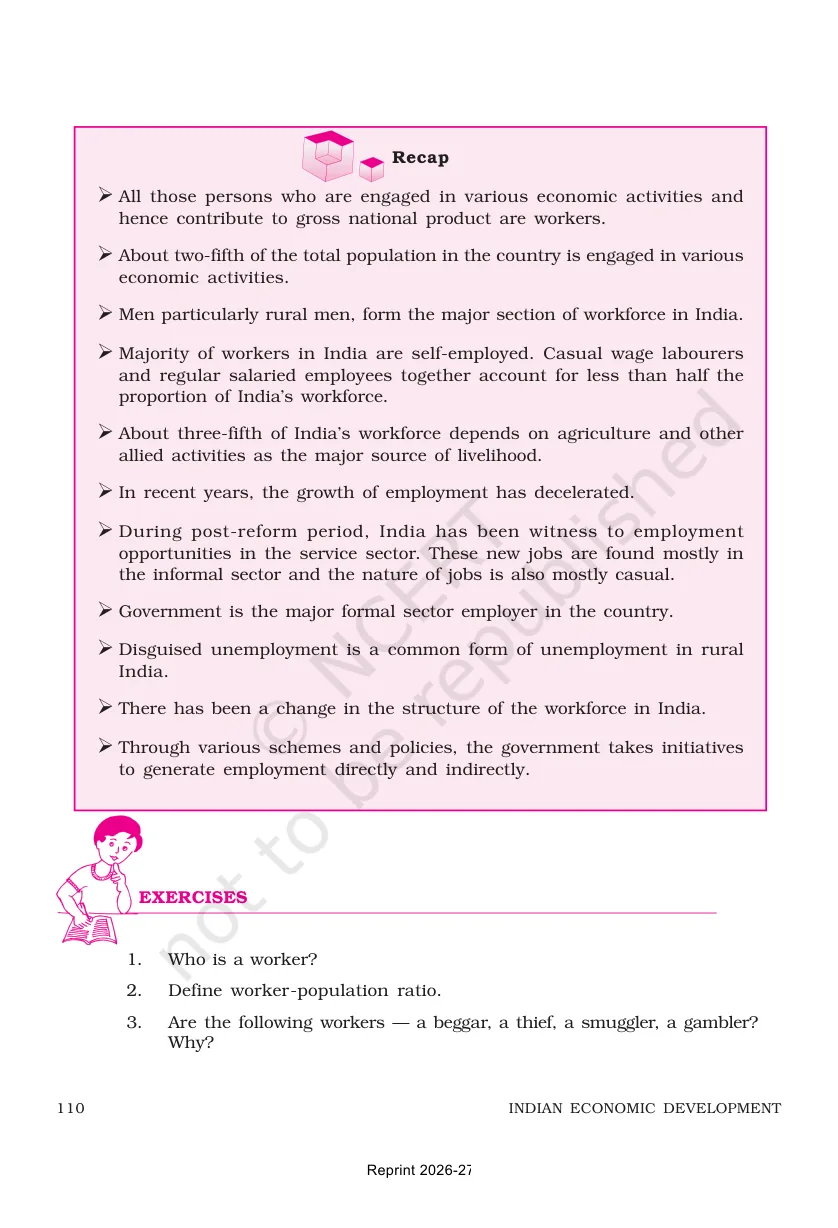
✍️ Chapter 6 Exercise Solutions: Employment: Growth, Informalisation and Other Issues
Exercises
Q1. Who is a worker?
Answer: A worker is any person who is engaged in an economic activity that contributes to the Gross National Product (GNP) of the country—including self-employed persons, regular salaried employees, casual wage labourers, and even those temporarily absent from work due to illness or festivals.
Q2. Define worker-population ratio.
Answer: Worker-Population Ratio (WPR) is an indicator used to analyse the employment situation in a country. It is defined as the percentage of the total population actively engaged in economic activities:
Worker-Population Ratio = (Total Number of Workers / Total Population) × 100.
Q3. Are the following workers — a beggar, a thief, a smuggler, a gambler? Why?
Answer: No. A beggar, a thief, a smuggler, and a gambler are not considered workers because their activities are either non-productive transfers (begging) or illegal/anti-social activities (theft, smuggling, gambling) that do not contribute to the legal production of goods and services in Gross National Product (GNP).
Q4. Find the odd man out (i) owner of a saloon (ii) a cobbler (iii) a cashier in Mother Dairy or Milk Cooperative Society of your area (iv) a tuition master (v) transport operator (vi) construction worker.
Answer: (iii) A cashier in Mother Dairy or Milk Cooperative Society is the odd man out because he/she is a regular salaried employee in the formal/organised sector, whereas the others are self-employed or casual informal workers (note: (vi) construction worker is also a casual wage labourer, while (i), (ii), (iv), (v) are self-employed; among all, the cashier is the only regular salaried employee in a cooperative/formal enterprise).
Q5. The newly emerging jobs are found mostly in the ____________ sector (service/manufacturing).
Answer: service sector.
Q6. An establishment with four hired workers is known as ____________ (formal/informal) sector establishment.
Answer: informal sector establishment (establishments employing fewer than 10 hired workers belong to the informal sector).
Q7. Raj is going to school. When he is not in school, you will find him working in his farm. Can you consider him as a worker? Why?
Answer: Yes, Raj can be considered a worker because he is contributing to agricultural production (an economic activity counted in GNP) during his non-school hours, even though he is a student.
Q8. Compared to urban women, more rural women are found working. Why?
Answer: More rural women work compared to urban women because:
- Economic necessity: Widespread rural poverty forces women to work in agriculture and allied activities to supplement low family incomes.
- Low educational barriers: Rural farm work does not require formal degrees, whereas urban jobs often demand higher qualifications and specialised skills.
- Cultural factors: In urban areas, higher male earnings often discourage women from taking up low-paid jobs.
Q9. Meena is a housewife. Besides taking care of household chores, she works in the cloth shop which is owned and operated by her husband. Can she be considered as a worker? Why?
Answer: Yes, Meena is considered a worker (specifically, an unpaid family worker in a household enterprise) because working in her husband’s cloth shop is an economic activity that contributes to the production/distribution of goods and GNP—even though her household chores alone are not counted as economic activity.
Q10. Find the odd man out (i) rickshaw puller who works under a rickshaw owner (ii) mason (iii) mechanic shop worker (iv) shoeshine boy.
Answer: (iv) Shoeshine boy is the odd man out because he is self-employed (working on his own account), whereas the rickshaw puller working under an owner, the mason, and the mechanic shop worker are hired/wage workers.
Q11. The following table shows distribution of workforce in India for the year 1972-73. Analyse it and give reasons for the nature of workforce distribution. (Rural: Male 125, Female 69, Total 195; Urban: Male 32, Female 7, Total 39, in millions)
Answer: Analysis:
- Total workforce in 1972–73 was 234 million, of which 195 million (83.3%) lived in rural areas and only 39 million (16.7%) in urban areas—reflecting India’s predominantly agrarian economy.
- Male workers (157 million) far outnumbered female workers (76 million) in both rural and urban areas due to lower female literacy, social norms, and non-recognition of domestic work as economic activity.
- Rural female participation (69 million) was much higher than urban female participation (7 million) because rural poverty pushed women into farm labour.
Q12. The following table shows the population and worker population ratio for India in 1999-2000. Can you estimate the workforce (urban and total) for India?
Answer:
| Region | Estimates of Population (in crores) | Worker Population Ratio (%) | Estimated No. of Workers (in crores) |
|---|---|---|---|
| Rural | 71.88 | 41.9 | (71.88 × 41.9) / 100 = 30.12 |
| Urban | 28.52 | 33.7 | (28.52 × 33.7) / 100 = 9.61 |
| Total | 100.40 | 39.5 | (100.40 × 39.5) / 100 = 39.66 |
Estimated Urban Workforce = 9.61 crores; Estimated Total Workforce = 39.66 crores.
Q13. Why are regular salaried employees more in urban areas than in rural areas?
Answer: Urban areas have a concentration of factories, offices, banks, schools, hospitals, and corporate enterprises that require continuous, skilled labour on fixed monthly salaries. Rural areas are dominated by seasonal agriculture and small family farms, where self-employment and casual daily-wage labour are the norm.
Q14. Why are less women found in regular salaried employment?
Answer: Fewer women are in regular salaried employment because:
- Regular salaried jobs require higher education and technical skills, where women historically lag due to gender gaps in schooling.
- Lack of safe transport, childcare facilities, and flexible hours, along with social restrictions on mobility, limit women’s entry into formal jobs.
Q15. Analyse the recent trends in sectoral distribution of workforce in India.
Answer: Over recent decades, India’s workforce has gradually shifted away from the primary sector (agriculture and allied activities) toward the secondary (manufacturing, construction) and tertiary (services) sectors. Agriculture’s share of employment fell from about 74% in 1972–73 to under 45–50% in recent years, while construction, trade, transport, and services absorbed a growing share of workers—though many new jobs are casual or informal.
Q16. Compared to the 1970s, there has hardly been any change in the distribution of workforce across various industries. Comment.
Answer: This statement is only partially true. In the 1970s, around 74% of the workforce depended on agriculture; by recent decades, that share has fallen substantially (below 50%), with notable increases in construction, trade, transport, and services. However, the shift has been slow compared to the rapid fall in agriculture’s share of GDP, and self-employment plus casualisation remain high.
Q17. Do you think that during 1950-2010 employment generated in the country is commensurate with the growth of GDP in India? How?
Answer: No. Especially from the late 1990s onward, India experienced jobless growth—GDP grew rapidly (at 6–8% per annum) while employment growth lagged behind (often under 1–2% per year). Growth was led by capital-intensive manufacturing and high-skill services rather than labour-intensive sectors, leaving millions in low-productivity informal work.
Q18. Is it necessary to generate employment in the formal sector rather than in the informal sector? Why?
Answer: Yes. Formal sector workers enjoy job security, regular wages, paid leave, maternity benefits, pensions, and social security protections (provident fund, health insurance), as well as the right to form trade unions. Informal sector workers lack these protections, face income insecurity, and are vulnerable to exploitation. Expanding formal employment raises living standards and economic stability.
Q19. Victor is able to get work only for two hours in a day. Rest of the day, he is looking for work. Is he unemployed? Why? What kind of jobs could persons like Victor be doing?
Answer: Strictly speaking under standard definitions, Victor is classified as underemployed (or visibly underemployed, not completely unemployed, since he works 2 hours a day), though he is seeking full-time work for the rest of the day.
Persons like Victor typically do part-time or casual jobs such as newspaper delivery, milk/tiffin delivery, part-time cleaning, loading/unloading, or gig/courier work.
Q20. You are residing in a village. If you are asked to advice the village panchayat, what kinds of activities would you suggest for the improvement of your village which would also generate employment.
Answer:
- Water conservation and minor irrigation: Desilting ponds, building check dams, and rainwater harvesting (which also boost farm output).
- Rural connectivity and infrastructure: Building all-weather roads, drainage, and storage godowns.
- Allied and non-farm enterprises: Dairy farming, poultry, fisheries, agro-processing, beekeeping, and local handicrafts.
- Skill training and digital centres: Setting up vocational training and common service centres for rural youth.
Q21. Who is a casual wage labourer?
Answer: A casual wage labourer is a worker who is not hired on a permanent or regular basis and receives daily wages only for the days worked, without job security or social security benefits (e.g., construction workers, agricultural daily-wage labourers).
Q22. How will you know whether a worker is working in the informal sector?
Answer: A worker belongs to the informal sector if they work in a private enterprise employing fewer than 10 hired workers (including self-employed farmers, street vendors, domestic helpers, and small shop workers), and do not receive social security benefits like provident fund, gratuity, or paid leave.