CG Board Class 11 English Solutions | NCERT Class 11 English (Hornbill & Snapshots) (2026-27)
Step-by-step solutions for CG Board Class 11 English Chapter 6: Father to Son (Reading & Writing Skills) strictly following the prescribed NCERT Class 11 English (Hornbill & Snapshots) syllabus.
📚 Chapter Overview:
- Board: Chhattisgarh Board (CGBSE / SCERT — NCERT Syllabus)
- Textbook & Chapter: NCERT Class 11 English (Hornbill & Snapshots) — Chapter 6: Father to Son (Reading & Writing Skills)
- Medium: English Medium
📖 Textbook Pages (NCERT / CG Board 2026-27)
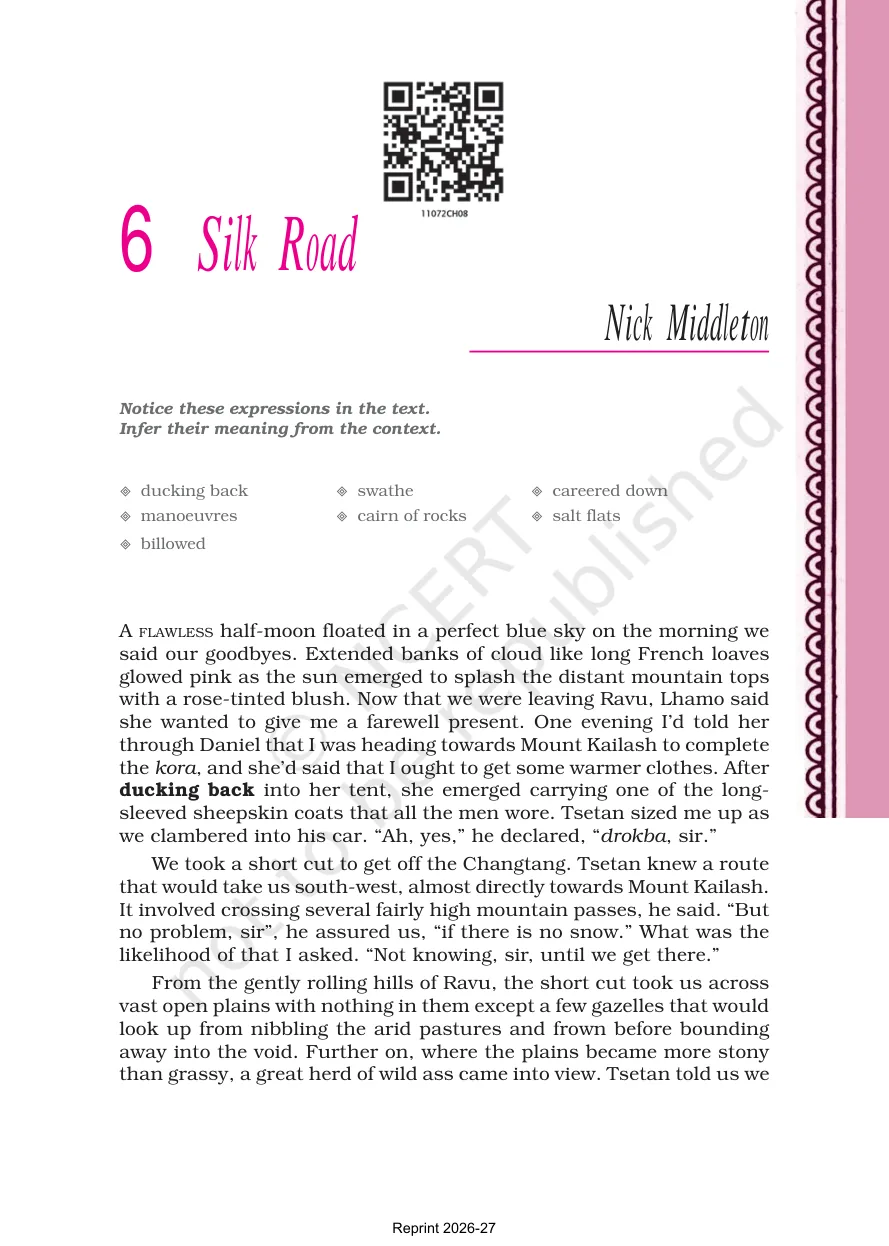

✍️ Chapter 6 Exercise Solutions: Father to Son (Reading & Writing Skills)
Exercises
Understanding the Text (Silk Road)
Q1. Give reasons for the following statements: (1) The article has been titled ‘Silk Road.’ (2) Tibetan mastiffs were popular in China’s imperial courts. (3) The author’s experience at Hor was in stark contrast to earlier accounts of the place. (4) The author was disappointed with Darchen. (5) The author thought that his positive thinking strategy worked well after all.
Answer:
- The title refers to the ancient overland trade network connecting China with the West across Central Asia and Tibet, along which the author travels toward Mount Kailash.
- Tibetan mastiffs were huge, fearless, shaggy black guard dogs prized in China’s imperial courts as hunting dogs brought along the Silk Road as tribute from Tibet.
- Earlier travellers like Ekai Kawaguchi and Sven Hedin were deeply moved to tears by the sacred beauty of Lake Manasarovar at Hor, whereas the author found Hor to be a grim, dusty, miserable town full of accumulated refuse and no vegetation.
- Darchen was dusty, partially derelict, and deserted in the off-season; moreover, the author suffered severe cold and sinus congestion, and found no pilgrims to accompany him on the kora.
- Just when he felt stranded, he met Norbu—an English-speaking Tibetan academic who also wanted to do the kora—giving him an ideal companion.
Q2. Briefly comment on: (1) The purpose of the author’s journey to Mount Kailash. (2) The author’s physical condition in Darchen. (3) The author’s meeting with Norbu. (4) Tsetan’s support during the journey. (5) ‘As a Buddhist, he told me, he knew that it didn’t really matter if I passed away, but he thought it would be bad for business.’
Answer:
- Nick Middleton travelled to Mount Kailash to complete the sacred kora (circumambulation) as part of his academic and travelogue exploration.
- At high altitude in Darchen, he developed a severe cold and blocked nostrils, struggled to breathe when lying down, and stayed awake fearing he might not wake up until a Tibetan doctor gave him herbal medicine.
- At Darchen’s only café, he met Norbu, a Beijing-based Tibetan scholar who had written papers on the Kailash kora but never done it himself; they teamed up enthusiastically.
- Tsetan drove skilfully over icy mountain passes, navigated snow-blocked tracks, cared for the author when he fell ill, and took him to the Darchen medical college before returning to Lhasa.
- Tsetan’s remark blends dry humour with Buddhist philosophy: death is part of rebirth for a Buddhist, yet losing a foreign tourist client would hurt his livelihood.
Talking about the Text, Thinking about Language & Working with Words
Q1. Talking about the Text & Thinking about Language: (1) Hill-folk behaviour, difficult journeys, legends vs reality. (2) Tsetan’s English, ‘through Daniel/Tsetan’, and meanings of kora, drokba, kyang.
Answer: Talking about the text: Hill-folk are resilient, hospitable, and practical in harsh terrain; travellers endure difficult journeys for spiritual fulfilment and self-discovery; legendary accounts often romanticise places that in reality are harsh and dusty.
Language: Tsetan picked up functional, colloquial English from guiding foreign tourists. Phrases like ‘through Daniel’ and ‘through Tsetan’ show reliance on interpreters. Tibetan words: kora (sacred circumambulation/pilgrimage circuit), drokba (Tibetan nomadic herder), kyang (Tibetan wild ass).
Q2. Working with Words & Noticing Form: Explain adjectives in phrases, and write sentences using ‘have + object + past participle’.
Answer: Adjectives: shaggy monsters (huge, long-haired mastiffs); brackish lakes (salty lakes); rickety table (shaky, worn-out table); hairpin bend (sharp U-shaped mountain turn); rudimentary general stores (basic, poorly stocked shops).
‘Have them fixed’ structure: (1) I need to have my bicycle repaired. (2) She had her hair cut yesterday. (3) We will have the roof painted before monsoon. (4) He had his watch mended. (5) They are having the house cleaned.
Poem: Father to Son — Think it Out
Q1. Does the poem talk of an exclusively personal experience or is it fairly universal?
Answer: Although autobiographical in tone, the poem expresses a universal experience—the generation gap and painful communication breakdown that often develops between parents and growing children.
Q2. How is the father’s helplessness brought out in the poem?
Answer: The father’s helplessness is shown through his admission that he does not understand his own son despite living under the same roof for years, his failed attempts to rebuild the bond from childhood, and his willingness to forgive his ‘prodigal’ son just to restore love.
Q3. Identify the phrases and lines that indicate distance between father and son.
Answer: Lines indicating distance: ‘I do not understand this child’, ‘I know nothing of him’, ‘We speak like strangers, there’s no sign of understanding in the air’, ‘Yet what he loves I cannot share’, ‘Silence surrounds us’, and ‘make and move his world’.
Q4. Does the poem have a consistent rhyme scheme?
Answer: Yes, each six-line stanza follows a consistent abbaba rhyme scheme (e.g., Stanza 1: child / now / know / build / how / killed → a b b a b a).