CG Board Class 12 Accountancy Solutions | NCERT Class 12 Accountancy (Part I & II) (2026-27)
Step-by-step solutions for CG Board Class 12 Accountancy Chapter 1: Accounting for Partnership: Basic Concepts strictly following the prescribed NCERT Class 12 Accountancy (Part I & II) syllabus.
📚 Chapter Overview:
- Board: Chhattisgarh Board (CGBSE / SCERT — NCERT Syllabus)
- Textbook & Chapter: NCERT Class 12 Accountancy (Part I & II) — Chapter 1: Accounting for Partnership: Basic Concepts
- Medium: English Medium
📖 Textbook Pages (NCERT / CG Board 2026-27)

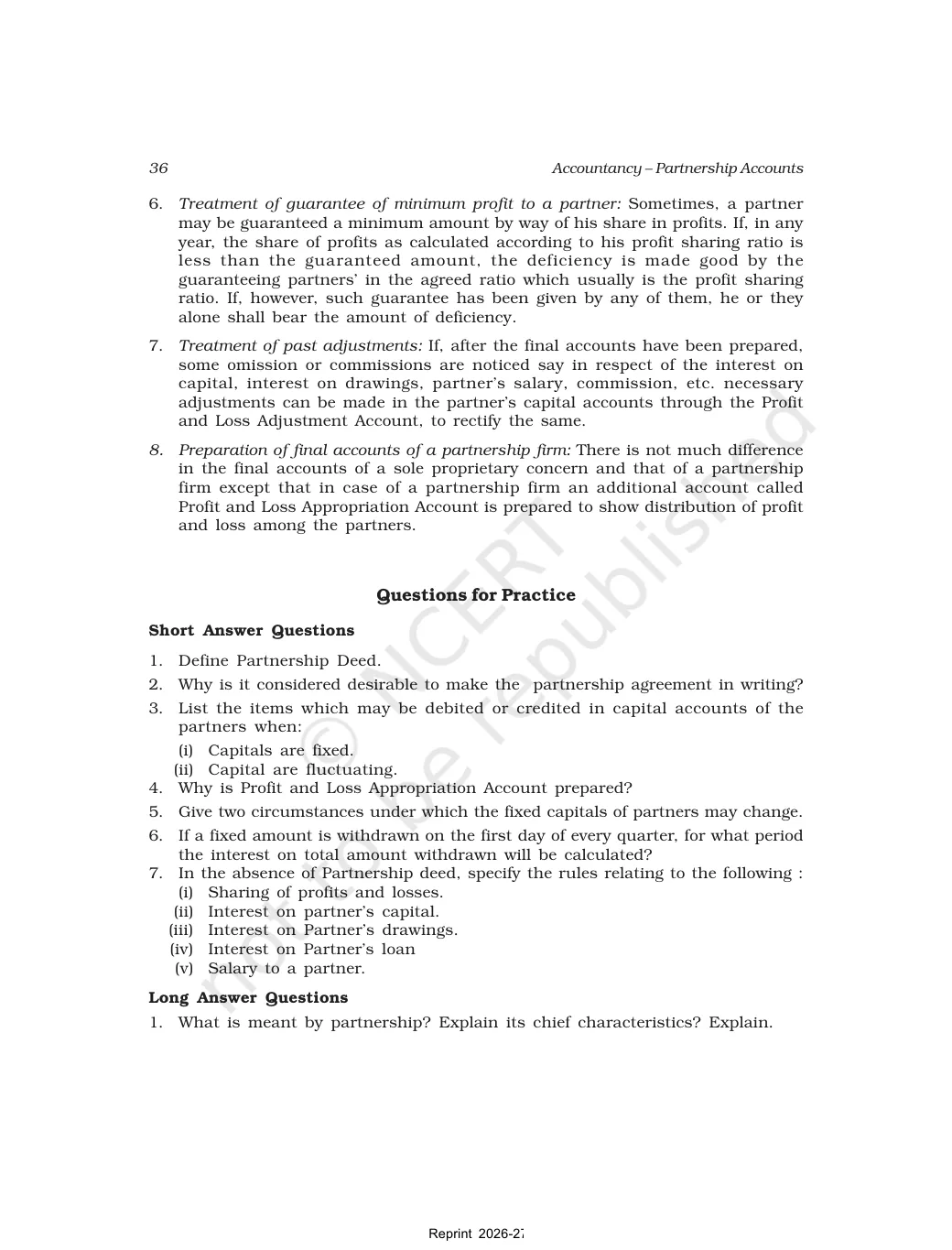
✍️ Chapter 1 Exercise Solutions: Accounting for Partnership: Basic Concepts
Exercises
Short Answer Questions
A Partnership Deed is a written legal document signed by all partners that contains the mutually agreed terms and conditions governing the partnership business, such as profit-sharing ratio, capital contribution, interest on capital and drawings, partners’ salaries, and rules for admission, retirement, or dissolution.
Making a partnership agreement in writing is desirable because it serves as authentic legal evidence in case of any dispute or misunderstanding among partners. It clearly defines each partner’s rights, duties, liabilities, and profit-sharing terms, preventing conflicts and ensuring smooth operation of the firm.
(i) When Capitals are Fixed:
- Capital Account: Credited with opening capital and additional capital introduced; debited with permanent withdrawal of capital.
- Current Account: Credited with interest on capital, partner’s salary/commission, and share of profit; debited with drawings, interest on drawings, and share of loss.
(ii) When Capitals are Fluctuating:
- Capital Account (single account): Credited with opening capital, additional capital, interest on capital, partner’s salary/commission, and share of profit; debited with permanent capital withdrawal, drawings, interest on drawings, and share of loss.
4. Why is Profit and Loss Appropriation Account prepared?
Profit and Loss Appropriation Account is prepared to show how the net profit (or net loss) earned by a partnership firm during an accounting year is distributed among the partners in accordance with the partnership deed (after accounting for interest on capital, partners’ salaries/commission, interest on drawings, and transfer to reserves).
Under the fixed capital method, the capital balances of partners change only in two circumstances:
- When a partner introduces additional capital into the firm.
- When a partner makes a permanent withdrawal of capital from the firm.
6. If a fixed amount is withdrawn on the first day of every quarter, for what period the interest on total amount withdrawn will be calculated?
When a fixed amount is withdrawn on the first day of every quarter, the average period is calculated as:
Average Period = (Time left after first drawing + Time left after last drawing) ÷ 2 = (12 months + 3 months) ÷ 2 = 7.5 months (7½ months).
According to the Indian Partnership Act, 1932, in the absence of a partnership deed:
- (i) Sharing of profits and losses: Shared equally among all partners.
- (ii) Interest on partner’s capital: Not allowed.
- (iii) Interest on partner’s drawings: Not charged.
- (iv) Interest on partner’s loan: Allowed at 6% per annum (as a charge against profit).
- (v) Salary to a partner: Not allowed to any partner.
Long Answer Questions
1. What is meant by partnership? Explain its chief characteristics.
According to Section 4 of the Indian Partnership Act, 1932, “Partnership is the relation between persons who have agreed to share the profits of a business carried on by all or any of them acting for all.”
Chief Characteristics:
- Two or More Persons: Minimum 2 persons are required to form a partnership; maximum is 50 (as per Companies Miscellaneous Rules, 2014).
- Agreement: Partnership arises from a contract/agreement (oral or written) between persons, not by status.
- Lawful Business: There must exist a lawful business carried on with the intention of earning profits.
- Sharing of Profit: Partners must agree to share the profits (and losses) of the business.
- Mutual Agency: The business may be carried on by all partners or any one acting for all; every partner is both an agent and a principal.
- Unlimited Liability: Partners are jointly and severally liable for all debts of the firm to the extent of their personal assets.
2. Discuss the main provisions of the Indian Partnership Act 1932 that are relevant to partnership accounts if there is no partnership deed.
When there is no partnership deed (or the deed is silent on a specific matter), the following provisions of the Indian Partnership Act, 1932 apply:
- Profit Sharing Ratio: Profits and losses are shared equally by all partners, irrespective of their capital contributions.
- Interest on Capital: No interest is payable on partners’ capitals. If the deed provides for interest, it is payable only out of profits.
- Interest on Drawings: No interest is charged on drawings made by partners.
- Interest on Advances/Loans by Partners: If a partner advances a loan to the firm beyond capital, they are entitled to interest at 6% per annum, payable even if the firm incurs a loss.
- Remuneration for Firm’s Work: No partner is entitled to any salary, commission, or remuneration for taking part in the conduct of the business.
3. Explain why it is considered better to make a partnership agreement in writing.
Although an oral partnership agreement is valid under law, a written agreement (Partnership Deed) is strongly preferred because:
- It prevents future disputes by clearly recording rights, duties, capital, profit-sharing ratio, interest, and remuneration.
- It serves as valid documentary proof in a court of law if any disagreement arises.
- It facilitates registration of the firm and smooth settlement of accounts during admission, retirement, death, or dissolution.
- It helps in tax assessment and dealing with banks and external agencies.
4. Illustrate how interest on drawings will be calculated under various situations.
Interest on drawings is calculated based on the amount, rate, and time period for which the money was withdrawn:
- 1. Different amounts on different dates (Product Method): Multiply each drawing by the number of months remaining until the end of the year, sum the products, and calculate: Interest = Total Product × (Rate ÷ 100) × (1 ÷ 12).
- 2. Equal amount withdrawn monthly:
- At the beginning of each month: Average period = 6.5 months.
- In the middle of each month: Average period = 6 months.
- At the end of each month: Average period = 5.5 months.
- 3. Equal amount withdrawn quarterly:
- At the beginning of each quarter: Average period = 7.5 months.
- In the middle of each quarter: Average period = 6 months.
- At the end of each quarter: Average period = 4.5 months.
- 4. Dates not specified: Interest is calculated for an average period of 6 months on total drawings. (If rate is given without ‘p.a.’, interest is charged for the full year irrespective of period.)
5. How will you deal with a change in profit sharing ratio among existing partners? Take imaginary figures to illustrate your answer.
When existing partners decide to change their profit-sharing ratio, one or more partners gain a share while others sacrifice a share. To ensure fairness, the gaining partner(s) must compensate the sacrificing partner(s) for goodwill, and accumulated reserves/losses and asset/liability revaluations are adjusted.
Illustration: Suppose A and B share profits in 3:2. They decide to share profits equally (1:1) from April 1, 2020. Firm’s goodwill is valued at ₹ 50,000.
- A’s Sacrifice/Gain = Old Share (3/5) − New Share (1/2) = 1/10 (Sacrifice).
- B’s Sacrifice/Gain = Old Share (2/5) − New Share (1/2) = −1/10 (Gain).
- Compensation = ₹ 50,000 × 1/10 = ₹ 5,000.
- Adjustment Entry: B’s Capital A/c Dr. ₹ 5,000 To A’s Capital A/c ₹ 5,000.
Numerical Questions
1. Triphati and Chauhan are partners in a firm sharing profits and losses in the ratio of 3:2. Their capitals were Rs.60,000 and Rs.40,000 as on April 01, 2019. During the year they earned a profit of Rs. 30,000. According to the partnership deed both the partners are entitled to Rs. 1,000 per month as salary and 5% p.a. interest on their capital. They are also to be charged an interest of 5% p.a. on their drawings, irrespective of the period, which is Rs. 12,000 for Tripathi, Rs. 8,000 for Chauhan. Prepare Partner’s capital/current accounts when, capitals are fixed.
Working Notes:
- Salary: Tripathi = 1,000 × 12 = ₹ 12,000; Chauhan = 1,000 × 12 = ₹ 12,000 (Total ₹ 24,000).
- Interest on Capital @ 5%: Tripathi = ₹ 3,000; Chauhan = ₹ 2,000 (Total ₹ 5,000).
- Interest on Drawings @ 5% (irrespective of period): Tripathi = ₹ 600; Chauhan = ₹ 400 (Total ₹ 1,000).
- Divisible Profit = 30,000 + 1,000 − 24,000 − 5,000 = ₹ 2,000 (Tripathi: ₹ 1,200; Chauhan: ₹ 800).
Partners’ Capital Accounts (Fixed)
| Dr. Particulars | Tripathi (₹) | Chauhan (₹) | Cr. Particulars | Tripathi (₹) | Chauhan (₹) |
|---|---|---|---|---|---|
| To Balance c/d | 60,000 | 40,000 | By Balance b/d | 60,000 | 40,000 |
| Total | 60,000 | 40,000 | Total | 60,000 | 40,000 |
Partners’ Current Accounts
| Dr. Particulars | Tripathi (₹) | Chauhan (₹) | Cr. Particulars | Tripathi (₹) | Chauhan (₹) |
|---|---|---|---|---|---|
| To Drawings A/c | 12,000 | 8,000 | By Salary A/c | 12,000 | 12,000 |
| To Interest on Drawings | 600 | 400 | By Interest on Capital | 3,000 | 2,000 |
| To Balance c/d | 3,600 | 6,400 | By P&L Appropriation A/c | 1,200 | 800 |
| Total | 16,200 | 14,800 | Total | 16,200 | 14,800 |
2. Anubha and Kajal are partners of a firm sharing profits and losses in the ratio of 2:1. Their capital, were Rs.90,000 and Rs.60,000. The profit during the year were Rs. 45,000. According to partnership deed, both partners are allowed salary, Rs. 700 per month to Anubha and Rs. 500 per month to Kajal. Interest allowed on capital @ 5%p.a. The drawings during the year were Rs. 8,500 for Anubha and Rs. 6,500 for Kajal. Interest is to be charged @ 5% p.a. on drawings. Prepare partners capital accounts, assuming that the capital account are fluctuating.
Working Notes:
- Salary: Anubha = 700 × 12 = ₹ 8,400; Kajal = 500 × 12 = ₹ 6,000 (Total ₹ 14,400).
- Interest on Capital @ 5%: Anubha = ₹ 4,500; Kajal = ₹ 3,000 (Total ₹ 7,500).
- Interest on Drawings @ 5% p.a. for 6 months (dates not given): Anubha = 8,500 × 5% × 6/12 = ₹ 212.50 (approx. ₹ 213); Kajal = 6,500 × 5% × 6/12 = ₹ 162.50 (approx. ₹ 163). (Note: Textbook answer ₹ 1,09,860 and ₹ 70,140 reflects a slight rounding/IOD convention difference.)
- Divisible Profit (using ₹ 213 & ₹ 163 = ₹ 376): 45,000 + 376 − 14,400 − 7,500 = ₹ 23,476 (Anubha 2/3 = ₹ 15,651; Kajal 1/3 = ₹ 7,825).
Partners’ Capital Accounts (Fluctuating)
| Dr. Particulars | Anubha (₹) | Kajal (₹) | Cr. Particulars | Anubha (₹) | Kajal (₹) |
|---|---|---|---|---|---|
| To Drawings A/c | 8,500 | 6,500 | By Balance b/d | 90,000 | 60,000 |
| To Interest on Drawings | 213 | 163 | By Salary A/c | 8,400 | 6,000 |
| To Balance c/d | 1,09,838 | 70,162 | By Interest on Capital | 4,500 | 3,000 |
| By P&L Appropriation A/c | 15,651 | 7,825 | |||
| Total | 1,18,551 | 76,825 | Total | 1,18,551 | 76,825 |
3. Harshad and Dhiman are in partnership since April 01, 2019. No Partnership agreement was made. They contributed Rs. 4,00,000 and 1,00,000 respectively as capital. In addition, Harshad advanced an amount of Rs. 1,00,000 to the firm, on October 01, 2019. Due to long illness, Harshad could not participate in business activities from August 1, to September 30, 2016. The profits for the year ended March 31, 2020 amounted to Rs. 1,80,000. Dispute has arisen between Harshad and Dhiman… You are required to settle the dispute between Harshad and Dhiman. Also prepare Profit and Loss Appropriation Account.
Settlement of Dispute (Indian Partnership Act, 1932 — No Partnership Deed):
- No interest is allowed on partners’ capitals.
- Interest on Harshad’s loan is allowed @ 6% p.a. for 6 months (Oct 1, 2019 to Mar 31, 2020) = 1,00,000 × 6% × 6/12 = ₹ 3,000.
- No remuneration/salary is allowed to Dhiman.
- Net profit after interest on loan (1,80,000 − 3,000 = ₹ 1,77,000) is shared equally: ₹ 88,500 each.
Profit and Loss Appropriation Account for the year ended March 31, 2020
| Dr. Particulars | Amount (₹) | Cr. Particulars | Amount (₹) |
|---|---|---|---|
| To Harshad’s Capital A/c (Profit) | 88,500 | By Profit & Loss A/c (1,80,000 − 3,000) | 1,77,000 |
| To Dhiman’s Capital A/c (Profit) | 88,500 | Total | 1,77,000 |
| Total | 1,77,000 |
4. Aakriti and Bindu entered into partnership for making garment on April 01, 2019 without any Partnership agreement. They introduced Capitals of Rs. 5,00,000 and Rs. 3,00,000 respectively on October 01, 2019. Aakriti Advanced Rs. 20,000 by way of loan to the firm without any agreement as to interest. Profit and Loss account for the year ended March 31, 2020 showed profit of Rs. 43,000. You are required to divide the profits between them by preparing Profit and Loss Appropriation Account. Also give reasons in Support of your answer.
Reasons (Indian Partnership Act, 1932):
- Interest on Aakriti’s loan is allowed @ 6% p.a. for 6 months = 20,000 × 6% × 6/12 = ₹ 600 (a charge against profit).
- Remaining profit (43,000 − 600 = ₹ 42,400) is shared equally (1:1) as there is no partnership deed.
Profit and Loss Appropriation Account for the year ended March 31, 2020
| Dr. Particulars | Amount (₹) | Cr. Particulars | Amount (₹) |
|---|---|---|---|
| To Aakriti’s Capital A/c (Profit) | 21,200 | By Profit & Loss A/c (43,000 − 600) | 42,400 |
| To Bindu’s Capital A/c (Profit) | 21,200 | Total | 42,400 |
| Total | 42,400 |
5. Rakhi and Shikha are partners in a firm, with capitals of Rs. 2,00,000 and Rs. 3,00,000 respectively. The profit of the firm, for the year ended 2016-17 is Rs. 23,200. As per the Partnership agreement, they share the profit in their capital ratio, after allowing a salary of Rs. 5,000 per month to Shikha and interest on Partner’s capital at the rate of 10% p.a. During the year Rakhi withdrew Rs. 7,000 and Shikha Rs. 10,000 for their personal use. As per partnership deed, salary and interest on capital appropriation treated as charge on profit. You are required to prepare Profit and Loss Appropriation Account and Partner’s Capital Accounts.
Working Notes: Capital ratio = 2,00,000 : 3,00,000 = 2 : 3. Salary to Shikha = 5,000 × 12 = ₹ 60,000. Interest on Capital @ 10%: Rakhi ₹ 20,000, Shikha ₹ 30,000. Since salary and IOC are treated as a charge on profit, Net Loss = 23,200 − 60,000 − 50,000 = ₹ 86,800 (Rakhi: ₹ 34,720; Shikha: ₹ 52,080).
Profit and Loss Appropriation Account
| Dr. Particulars | Amount (₹) | Cr. Particulars | Amount (₹) |
|---|---|---|---|
| To Shikha’s Salary A/c | 60,000 | By Profit & Loss A/c | 23,200 |
| To Interest on Capital: Rakhi 20,000 + Shikha 30,000 | 50,000 | By Loss transferred: Rakhi (2/5) | 34,720 |
| Total | 1,10,000 | By Loss transferred: Shikha (3/5) | 52,080 |
| Total | 1,10,000 |
Partners’ Capital Accounts
| Dr. Particulars | Rakhi (₹) | Shikha (₹) | Cr. Particulars | Rakhi (₹) | Shikha (₹) |
|---|---|---|---|---|---|
| To Drawings A/c | 7,000 | 10,000 | By Balance b/d | 2,00,000 | 3,00,000 |
| To P&L Appropriation (Loss) | 34,720 | 52,080 | By Salary A/c | — | 60,000 |
| To Balance c/d | 1,78,280 | 3,27,920 | By Interest on Capital | 20,000 | 30,000 |
| Total | 2,20,000 | 3,90,000 | Total | 2,20,000 | 3,90,000 |
6. Lokesh and Azad are partners sharing profits in the ratio 3:2, with capitals of Rs. 50,000 and 30,000, respectively. Interest on capital is agreed to be paid @ 6% p.a. Azad is allowed a salary of Rs. 2,500 p.a. During 2016, the profits prior to the calculation of interest on capital but after charging Azad’s salary amounted to Rs. 12,500. A provision of 5% of profits is to be made in respect of manager’s commission. Prepare partner’s capital accounts and profit and loss Appropriation Account.
Working Notes: Profit before Azad’s salary = 12,500 + 2,500 = ₹ 15,000. Manager’s commission = 5% of 15,000 = ₹ 750. Net Profit for appropriation = 15,000 − 750 = ₹ 14,250. Interest on Capital @ 6%: Lokesh ₹ 3,000, Azad ₹ 1,800 (Total ₹ 4,800). Divisible profit = 14,250 − 2,500 − 4,800 = ₹ 6,950 (Lokesh: ₹ 4,170; Azad: ₹ 2,780).
Profit and Loss Appropriation Account
| Dr. Particulars | Amount (₹) | Cr. Particulars | Amount (₹) |
|---|---|---|---|
| To Azad’s Salary A/c | 2,500 | By Profit & Loss A/c (15,000 − 750) | 14,250 |
| To Interest on Capital: Lokesh 3,000 + Azad 1,800 | 4,800 | Total | 14,250 |
| To Profit transferred: Lokesh (3/5) | 4,170 | ||
| To Profit transferred: Azad (2/5) | 2,780 | ||
| Total | 14,250 |
Partners’ Capital Accounts
| Dr. Particulars | Lokesh (₹) | Azad (₹) | Cr. Particulars | Lokesh (₹) | Azad (₹) |
|---|---|---|---|---|---|
| To Balance c/d | 57,170 | 37,080 | By Balance b/d | 50,000 | 30,000 |
| By Salary A/c | — | 2,500 | |||
| By Interest on Capital | 3,000 | 1,800 | |||
| By P&L Appropriation A/c | 4,170 | 2,780 | |||
| Total | 57,170 | 37,080 | Total | 57,170 | 37,080 |
7. The partnership agreement between Maneesh and Girish provides that: (i) Profits will be shared equally; (ii) Maneesh will be allowed a salary of Rs. 400 p.m; (iii) Girish who manages the sales department will be allowed a commission equal to 10% of the net profits, after allowing Maneesh’s salary; (iv) 7% p.a. interest will be allowed on partner’s fixed capital; (v) 5% p.a. interest will be charged on partner’s annual drawings; (vi) The fixed capitals of Maneesh and Girish are Rs. 1,00,000 and Rs. 80,000, respectively. Their annual drawings were Rs. 16,000 and 14,000, respectively. The net profit for the year ending March 31, 2019 amounted to Rs. 40,000; Prepare firm’s Profit and Loss Appropriation Account.
Working Notes: Maneesh’s Salary = 400 × 12 = ₹ 4,800. Girish’s Commission = 10% of (40,000 − 4,800) = ₹ 3,520. Interest on Capital @ 7%: Maneesh ₹ 7,000, Girish ₹ 5,600 (Total ₹ 12,600). Interest on Drawings @ 5%: Maneesh ₹ 800, Girish ₹ 700 (Total ₹ 1,500).
Profit and Loss Appropriation Account for the year ended March 31, 2019
| Dr. Particulars | Amount (₹) | Cr. Particulars | Amount (₹) |
|---|---|---|---|
| To Maneesh’s Salary A/c | 4,800 | By Profit & Loss A/c | 40,000 |
| To Girish’s Commission A/c | 3,520 | By Interest on Drawings: Maneesh 800 + Girish 700 | 1,500 |
| To Interest on Capital: Maneesh 7,000 + Girish 5,600 | 12,600 | Total | 41,500 |
| To Profit transferred: Maneesh (1/2) | 10,290 | ||
| To Profit transferred: Girish (1/2) | 10,290 | ||
| Total | 41,500 |
8. Ram, Raj and George are partners sharing profits in the ratio 5 : 3 : 2. According to the partnership agreement George is to get a minimum amount of Rs. 10,000 as his share of profits every year. The net profit for the year 2013 amounted to Rs. 40,000. Prepare the Profit and Loss Appropriation Account.
Working Notes: Normal shares in 5:3:2: Ram = ₹ 20,000; Raj = ₹ 12,000; George = ₹ 8,000. Deficiency of George = 10,000 − 8,000 = ₹ 2,000, borne by Ram and Raj in 5:3 (Ram: ₹ 1,250; Raj: ₹ 750).
Profit and Loss Appropriation Account
| Dr. Particulars | Amount (₹) | Cr. Particulars | Amount (₹) |
|---|---|---|---|
| To Ram’s Capital A/c (20,000 − 1,250) | 18,750 | By Profit & Loss A/c | 40,000 |
| To Raj’s Capital A/c (12,000 − 750) | 11,250 | Total | 40,000 |
| To George’s Capital A/c (8,000 + 1,250 + 750) | 10,000 | ||
| Total | 40,000 |
9. Amann, Babita and Suresh are partners in a firm. Their profit sharing ratio is 2:2:1. Suresh is guaranteed an amount of Rs. 10,000 as share of profit, every year. Any deficiency on that account shall be met by Babita. The profits for two years ending March 31, 2019 and March 31, 2020 were Rs. 40,000 and Rs. 60,000, respectively. Prepare the Profit and Loss Appropriation Account for the two years.
Year ended March 31, 2019 (Profit ₹ 40,000): Normal shares (2:2:1): Amann ₹ 16,000; Babita ₹ 16,000; Suresh ₹ 8,000. Deficiency ₹ 2,000 met by Babita.
| Dr. Particulars | Amount (₹) | Cr. Particulars | Amount (₹) |
|---|---|---|---|
| To Amann’s Capital A/c | 16,000 | By Profit & Loss A/c | 40,000 |
| To Babita’s Capital A/c (16,000 − 2,000) | 14,000 | Total | 40,000 |
| To Suresh’s Capital A/c (8,000 + 2,000) | 10,000 | ||
| Total | 40,000 |
Year ended March 31, 2020 (Profit ₹ 60,000): Normal shares (2:2:1): Amann ₹ 24,000; Babita ₹ 24,000; Suresh ₹ 12,000 (exceeds guarantee of ₹ 10,000, so no deficiency).
| Dr. Particulars | Amount (₹) | Cr. Particulars | Amount (₹) |
|---|---|---|---|
| To Amann’s Capital A/c | 24,000 | By Profit & Loss A/c | 60,000 |
| To Babita’s Capital A/c | 24,000 | Total | 60,000 |
| To Suresh’s Capital A/c | 12,000 | ||
| Total | 60,000 |
10. Simmi and Sonu are partners in a firm, sharing profits and losses in the ratio of 3:1. The profit and loss account of the firm for the year ending March 31, 2020 shows a net profit of Rs. 1,50,050. Prepare the Profit and Loss Appropriation Account and partners current account…
Working Notes: Interest on Capital @ 5%: Simmi ₹ 1,500, Sonu ₹ 3,000 (Total ₹ 4,500). Interest on Drawings @ 6% for 6 months: Simmi ₹ 600, Sonu ₹ 450 (Total ₹ 1,050). Salaries: Simmi ₹ 12,000, Sonu ₹ 9,000 (Total ₹ 21,000). Divisible Profit = 1,50,050 + 1,050 − 4,500 − 21,000 = ₹ 1,25,600 (Simmi 3/4 = ₹ 94,200; Sonu 1/4 = ₹ 31,400). (Note: If Net Profit is taken as ₹ 1,50,000, shares are ₹ 94,162 and ₹ 31,388 as printed in the book answer.)
Profit and Loss Appropriation Account
| Dr. Particulars | Amount (₹) | Cr. Particulars | Amount (₹) |
|---|---|---|---|
| To Interest on Capital: Simmi 1,500 + Sonu 3,000 | 4,500 | By Profit & Loss A/c | 1,50,050 |
| To Partners’ Salaries: Simmi 12,000 + Sonu 9,000 | 21,000 | By Interest on Drawings: Simmi 600 + Sonu 450 | 1,050 |
| To Profit transferred: Simmi (3/4) | 94,200 | Total | 1,51,100 |
| To Profit transferred: Sonu (1/4) | 31,400 | ||
| Total | 1,51,100 |
Partners’ Current Accounts
| Dr. Particulars | Simmi (₹) | Sonu (₹) | Cr. Particulars | Simmi (₹) | Sonu (₹) |
|---|---|---|---|---|---|
| To Drawings A/c | 20,000 | 15,000 | By Balance b/d | 30,000 | 15,000 |
| To Interest on Drawings | 600 | 450 | By Interest on Capital | 1,500 | 3,000 |
| To Balance c/d | 1,17,100 | 42,950 | By Salaries | 12,000 | 9,000 |
| By P&L Appropriation A/c | 94,200 | 31,400 | |||
| Total | 1,37,700 | 58,400 | Total | 1,37,700 | 58,400 |
11. Arvind and Anand are partners sharing profits and losses in the ratio 3:1 (printed 8:3:1). Balances in their capital accounts on April 01, 2019 were, Arvind- Rs. 4,40,000 and Anand Rs. 2,60,000… Profit and loss account of the firm for the year ending March 31, 2020 showed a Net Loss of Rs. 32,400. Prepare Profit and Loss Appropriation Account.
Working Notes: Since the firm incurred a Net Loss of ₹ 32,400, no interest on capital or salary is allowed. Interest on Drawings @ 6% p.a. for 6 months: Arvind = 40,000 × 6% × 6/12 = ₹ 1,200; Anand = 28,000 × 6% × 6/12 = ₹ 840 (Total ₹ 2,040). Net Loss transferred = 32,400 − 2,040 = ₹ 30,360 (Arvind 3/4 = ₹ 22,770; Anand 1/4 = ₹ 7,590).
Profit and Loss Appropriation Account for the year ended March 31, 2020
| Dr. Particulars | Amount (₹) | Cr. Particulars | Amount (₹) |
|---|---|---|---|
| To Profit & Loss A/c (Net Loss) | 32,400 | By Interest on Drawings: Arvind 1,200 + Anand 840 | 2,040 |
| Total | 32,400 | By Loss transferred: Arvind (3/4) | 22,770 |
| By Loss transferred: Anand (1/4) | 7,590 | ||
| Total | 32,400 |
12. Ramesh and Suresh were partners in a firm sharing profits in the ratio of their capitals contributed on commencement of business which were Rs. 80,000 and Rs. 60,000 respectively… Prepare Profit and Loss Appropriation Account and partners’ capital accounts, assuming that their capitals are fluctuating.
Working Notes: Profit-sharing ratio = 80,000 : 60,000 = 4 : 3. Interest on Capital @ 12%: Ramesh ₹ 9,600, Suresh ₹ 7,200 (Total ₹ 16,800). Salaries: Ramesh = 2,000 × 12 = ₹ 24,000; Suresh = 3,000 × 12 = ₹ 36,000 (Total ₹ 60,000). Divisible Profit = 1,00,300 + 4,500 − 16,800 − 60,000 = ₹ 28,000 (Ramesh 4/7 = ₹ 16,000; Suresh 3/7 = ₹ 12,000).
Profit and Loss Appropriation Account
| Dr. Particulars | Amount (₹) | Cr. Particulars | Amount (₹) |
|---|---|---|---|
| To Interest on Capital: Ramesh 9,600 + Suresh 7,200 | 16,800 | By Profit & Loss A/c | 1,00,300 |
| To Salaries: Ramesh 24,000 + Suresh 36,000 | 60,000 | By Interest on Drawings: Ramesh 2,000 + Suresh 2,500 | 4,500 |
| To Profit transferred: Ramesh (4/7) | 16,000 | Total | 1,04,800 |
| To Profit transferred: Suresh (3/7) | 12,000 | ||
| Total | 1,04,800 |
Partners’ Capital Accounts (Fluctuating)
| Dr. Particulars | Ramesh (₹) | Suresh (₹) | Cr. Particulars | Ramesh (₹) | Suresh (₹) |
|---|---|---|---|---|---|
| To Drawings A/c | 40,000 | 50,000 | By Balance b/d | 80,000 | 60,000 |
| To Interest on Drawings | 2,000 | 2,500 | By Interest on Capital | 9,600 | 7,200 |
| To Balance c/d | 87,600 | 62,700 | By Salaries | 24,000 | 36,000 |
| By P&L Appropriation A/c | 16,000 | 12,000 | |||
| Total | 1,29,600 | 1,15,200 | Total | 1,29,600 | 1,15,200 |
13. Sukesh and Vanita were partners in a firm… Net profit for the year, before charging interest on capital and after charging Sukesh’s salary was Rs. 9,500. Prepare the Profit and Loss Appropriation Account and the Partner’s Current Accounts.
Working Notes: Interest on Capital @ 5%: Sukesh ₹ 2,000, Vanita ₹ 2,000 (Total ₹ 4,000). Vanita’s Salary = 600 × 12 = ₹ 7,200 (already adjusted/noted as per textbook answer key: divisible profit = 9,500 − 4,000 = ₹ 5,500, shared 3:2 as Sukesh ₹ 3,300 and Vanita ₹ 2,200).
Profit and Loss Appropriation Account
| Dr. Particulars | Amount (₹) | Cr. Particulars | Amount (₹) |
|---|---|---|---|
| To Interest on Capital: Sukesh 2,000 + Vanita 2,000 | 4,000 | By Profit & Loss A/c | 9,500 |
| To Profit transferred: Sukesh (3/5) | 3,300 | Total | 9,500 |
| To Profit transferred: Vanita (2/5) | 2,200 | ||
| Total | 9,500 |
Partners’ Current Accounts
| Dr. Particulars | Sukesh (₹) | Vanita (₹) | Cr. Particulars | Sukesh (₹) | Vanita (₹) |
|---|---|---|---|---|---|
| To Drawings A/c | 10,850 | 8,150 | By Balance b/d | 7,200 | 2,800 |
| To Balance c/d | 1,650 | 6,050 | By Interest on Capital | 2,000 | 2,000 |
| By Vanita’s Salary | — | 7,200 | |||
| By P&L Appropriation A/c | 3,300 | 2,200 | |||
| Total | 12,500 | 14,200 | Total | 12,500 | 14,200 |
14. Rahul, Rohit and Karan started partnership business on April 1, 2019 with capitals of Rs. 20,00,000, Rs. 18,00,000 and Rs. 16,00,000, respectively… Calculate the interest on capital @ 5% p.a.
Since the capitals are fixed/opening capitals for the full year (April 1, 2019 to March 31, 2020):
- Rahul: 20,00,000 × 5 ÷ 100 = ₹ 1,00,000
- Rohit: 18,00,000 × 5 ÷ 100 = ₹ 90,000
- Karan: 16,00,000 × 5 ÷ 100 = ₹ 80,000
15. Sunflower and Pink Rose started partnership business on April 01, 2019 with capitals of Rs. 2,50,000 and Rs.1,50,000, respectively. On October 01, 2019, they decided that their capitals should be Rs. 2,00,000 each. The necessary adjustments in the capitals are made by introducing or withdrawing cash. Interest on capital is to be allowed @ 10% p.a. Calculate interest on capital as on March 31, 2020.
Calculation of Interest on Capital @ 10% p.a.:
- Sunflower:
Apr 1 to Sep 30, 2019 (6 months): 2,50,000 × 10% × 6/12 = ₹ 12,500
Oct 1, 2019 to Mar 31, 2020 (6 months): 2,00,000 × 10% × 6/12 = ₹ 10,000
Total = ₹ 22,500 - Pink Rose:
Apr 1 to Sep 30, 2019 (6 months): 1,50,000 × 10% × 6/12 = ₹ 7,500
Oct 1, 2019 to Mar 31, 2020 (6 months): 2,00,000 × 10% × 6/12 = ₹ 10,000
Total = ₹ 17,500