Find easy and accurate NCERT Solutions for Class 9 English (Kaveri) Chapter 1: How I Taught My Grandmother to Read & Bharat Our Land for the 2026–27 session. This chapter covers How I Taught My Grandmother to Read (Sudha Murty) and Bharat Our Land (Subramania Bharati). All textbook questions, warm-up exercises, word meanings, grammar, speaking, and writing activities are answered in simple words so that Class 9 students can easily understand, remember, and write them in their school exams.
📖 What You Will Learn in Chapter 1:
Here you will find step-by-step answers to every exercise in Chapter 1: How I Taught My Grandmother to Read & Bharat Our Land. The answers are written in clear, simple language to help you understand the stories and poems, learn new words, and score high marks in your school tests and exams.
NCERT Class 9 English Kaveri Chapter 1 Textbook Solutions
How I Taught My Grandmother to Read — Reflect and Respond
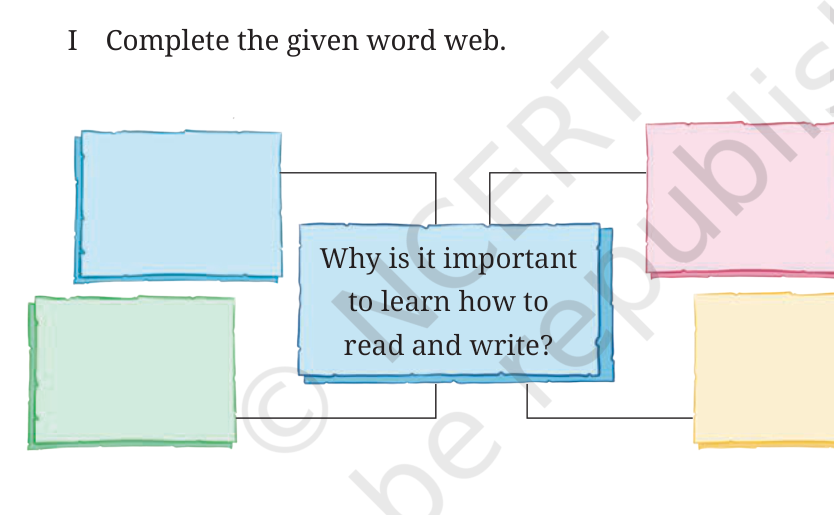
Q1. Complete the given word web: Why is it important to learn how to read and write?
Answer:
– Independence & Self-Reliance: It allows a person to read letters, sign documents, and travel without depending on others.
– Knowledge & Education: It opens up the world of books, newspapers, and lifelong learning.
– Dignity & Self-Respect: It gives a person confidence and respect in society.
– Informed Decisions: It helps a person manage daily work, finances, and healthcare wisely.
Q2. Read the questions given below and share your answers with your classmates and teacher.
(i) Which language(s) do your grandparents or elderly relatives speak?
Answer: My grandparents speak Kannada and Hindi.
(ii) How do they spend their time? How do you spend time with them?
Answer: My grandparents spend their time reading newspapers, visiting the temple, tending to the garden, and chatting with neighbours. I spend time with them by listening to their childhood stories, reading out news articles to them in the evening, and taking short walks together after dinner.
(iii) What is your favourite experience with them?
Answer: My favourite experience with my grandparents is sitting on the open terrace on summer nights while my grandmother shares inspiring moral stories and serves homemade traditional sweets.
(iv) What is something that the elderly in your family cannot do easily but enjoy watching you do?
Answer: The elderly in my family find it difficult to use modern digital devices like smartphones and laptops, but they really enjoy watching me make video calls to distant relatives or play digital educational games.
Q3. Read the following passage. Match the highlighted words with their meanings given in the box below.
The casting for the (i) protagonist of our school’s annual play was done after a lot of (ii) debate as many good actors had auditioned for the role. We had decided to present an (iii) episode from an inspirational story. It was a life story of a group of children who worked with the (iv) community to spread literacy. Every day, we reached school early to practise with (v) concentration. We waited (vi) eagerly for the final presentation. All of us played our roles in a very (vii) convincing manner as our theatre teacher had (viii) guided us well.
Answer:
1. (i) protagonist — 7. main character
2. (ii) debate — 4. discussion
3. (iii) episode — 5. a part of a story
4. (iv) community — 3. people living in one particular area
5. (v) concentration — 6. focus
6. (vi) eagerly — 1. excitedly
7. (vii) convincing — 2. believable
8. (viii) guided — 8. directed
How I Taught My Grandmother to Read — Check Your Understanding (Part I)
Q1. Complete the cause and effect table given below based on Part I of the story. Share your answers with your classmates and teacher.
Answer:
1. Cause: (i) The morning papers arrived late in the day and weekly magazines would come one day late.
Effect: All the villagers waited eagerly for the bus that brought the papers, weekly magazines, and post.
2. Cause: The grandmother, Krishtakka, never went to school.
Effect: (ii) She could not read the text of the weekly magazine on her own.
3. Cause: (iii) The grandmother identified herself with the novel’s protagonist in Kashi Yatre who wanted to go to Kashi.
Effect: She was deeply interested in the story and discussed it with her friends.
4. Cause: The narrator went to a wedding for a week.
Effect: (iv) The grandmother could not know what happened next in Kashi Yatre and felt helpless and dependent.
5. Cause: (v) In those days, people never considered education essential for girls.
Effect: The grandmother never went to school.
6. Cause: The grandmother regretted not going to school.
Effect: (vi) She made sure that her children and grandchildren studied well.
Q2. Do you think the narrator expected to see her grandmother in tears when she returned to the village? If yes, why? If no, why not?
Answer: No, the narrator did not expect to see her grandmother in tears. The narrator was surprised because she had never seen her grandmother cry even in the most difficult situations, as her grandmother was usually strong-willed and always smiling.
Q3. How might the narrator help her grandmother to fulfil her desire to learn to read and write?
Answer: The narrator can help her grandmother by becoming her teacher, starting with the Kannada alphabet. She can give her daily lessons, assign homework for reading and writing, and guide her patiently until she can read independently.
How I Taught My Grandmother to Read — Check Your Understanding (Part II)
Q1. State whether the following sentences are true or false. Share your answers with your classmates and teacher.
Answer:
1. The grandmother wanted to learn the Kannada alphabet to gain independence. — True
2. The grandmother asked someone in the village to read Kashi Yatre to her while the narrator was away. — False
Corrected statement: The grandmother did not ask anyone in the village to read to her because she felt too embarrassed to do so.
3. The narrator was the grandmother’s first teacher and taught her how to read Kannada. — True
4. The grandmother believed that there was no age limit for learning. — True
5. The grandmother touched the narrator’s feet as a mark of respect for her as a teacher. — True
6. The narrator was disappointed with the progress her grandmother made in learning to read. — False
Corrected statement: The narrator was extremely proud and happy with her grandmother’s progress as she passed her reading test with flying colours.
How I Taught My Grandmother to Read — Critical Reflection
Q1. Read the extract given below and answer the questions that follow.
When I came back to my village, I saw my grandmother in tears. I was surprised, for I had never seen her cry even in the most difficult situations. What had happened? I was worried.
‘Avva, is everything all right? Are you okay?’
I used to call her Avva, which means mother in the Kannada spoken in north Karnataka.
She nodded but did not reply. I did not understand and forgot about it. In the night, after dinner, we were sleeping in the open terrace of our house. It was a summer night and there was a full moon. Avva came and sat next to me. Her affectionate hands touched my forehead.
(i) Complete the following sentence with the appropriate option.
The phrase ‘never seen her cry in the most difficult situations’ tells us that the grandmother was ________________________.
A. strong-willed
B. understanding
C. considerate
D. bold
Answer: Option A. strong-willed
Reason: This phrase highlights her emotional strength and ability to stay calm and resilient during tough circumstances.
(ii) Complete the following with the correct option from those given in the brackets.
Grandmother did not reply when the narrator asked if she was alright because she might have been too ________________________ (emotional/tired) to respond.
Answer: emotional
(iii) Identify the clue from the extract that indicates a rural setting with traditional customs.
Answer: Calling the grandmother ‘Avva’ (meaning mother in north Karnataka Kannada) and sleeping outdoors on the open terrace of the house on a summer night indicate a traditional rural setting.
(iv) Which lines of the extract establish a tender atmosphere?
Answer: The lines “Avva came and sat next to me. Her affectionate hands touched my forehead” establish a tender atmosphere.
(v) Which of the following aspect is NOT emphasised in the given extract?
A. the emotional turmoil of the grandmother
B. the affectionate bond between the narrator and her grandmother
C. the grandmother’s regret over her lack of education
D. the narrator’s concern for her grandmother
Answer: Option C. the grandmother’s regret over her lack of education
Reason: The extract focuses on her immediate emotional state on the terrace, whereas her specific regret about not going to school is discussed in detail later.
Q2. Read the extract given below and answer the questions that follow.
‘I have decided I want to learn the Kannada alphabet from tomorrow onwards. I will work very hard. I will keep Saraswati Puja day during Dassara as the deadline. That day I should be able to read a novel on my own. I want to be independent.’
I saw the determination on her face. Yet I laughed at her.
‘Avva, at this age of sixty-two you want to learn the alphabet? All your hair is grey, your hands are wrinkled, you wear spectacles and you work so much in the kitchen…’
Childishly I made fun of the old lady. But she just smiled.
‘For a good cause if you are determined, you can overcome any obstacle. I will work harder than anybody but I will do it. For learning there is no age bar.’
(i) What does the grandmother’s statement, “I want to be independent,” reveal about her character?
A. She wanted to be literate.
B. She desires self-sufficiency.
C. She wants to prove her intelligence to others.
D. She feels pressured by society to learn.
Answer: Option B. She desires self-sufficiency.
Reason: Her wish to read without asking anyone for help reflects her deep desire for self-reliance and dignity.
(ii) Fill in the blank with the appropriate option from those given in brackets.
The grandmother’s determination shows that learning has no ___________________. (age limit/gender bias/cultural barriers)
Answer: age limit
(iii) Complete the following with a suitable reason.
The narrator laughs at her grandmother’s decision to learn the alphabet at the age of sixty-two because ___________________.
Answer: she childishly thought that an elderly woman with grey hair, wrinkled hands, spectacles, and heavy household chores was too old to start learning the alphabet.
(iv) List any two qualities displayed by the grandmother.
Answer:
1. Strong determination and willpower
2. Humility and respect for learning
(v) How can we say that the narrator is making assumptions about her grandmother?
Answer: The narrator assumes that physical aging and routine household work make a person incapable of learning new skills like reading.
Q3. Why do you think the grandmother felt embarrassed to ask someone else to read to her while the narrator was away?
Answer: The grandmother felt embarrassed because she did not want to reveal her inability to read to outsiders in the village. Asking others made her feel helpless and dependent despite being financially well-off, which hurt her self-respect.
Q4. Why does the narrator initially laugh at her grandmother’s determination to learn at the age of sixty-two?
Answer: The narrator laughed out of childish innocence and conventional thinking. She believed that learning the alphabet was meant for small children, and that an elderly person with grey hair, spectacles, and household responsibilities could not start schooling at sixty-two.
Q5. What significance does the story of Kashi Yatre have in both the grandmother’s life and the story?
Answer: Kashi Yatre serves as the primary catalyst for the grandmother’s transformation. Just like the protagonist in the novel who sacrifices her trip to Kashi for an orphan girl’s happiness, the grandmother had devoted her life to her family. Identifying with the protagonist created an intense desire in her to read the story herself, inspiring her to overcome illiteracy and become independent.
Q6. What does the grandmother’s desire to learn the Kannada alphabet reflect about her?
Answer: Her desire reflects her firm determination, open-mindedness, and self-respect. It shows that she values personal independence over money and believes that age is never a barrier to self-improvement and education.
Q7. What lessons can we infer from the grandmother’s action of touching the narrator’s feet?
Answer:
1. A teacher deserves respect irrespective of age or gender.
2. True learning creates deep humility and gratitude in a student.
3. Expressing respect towards a teacher elevates the dignity of education.
Q8. What does the following line tell us about the broader theme of the story?
‘For a good cause if you are determined, you can overcome any obstacle.’
Answer: This line highlights the central theme that strong determination and hard work can overcome any barrier, including advanced age, social expectations, and lack of early educational opportunities.
Q9. How effectively does the story highlight the value of education in supporting personal independence?
Answer: The story illustrates that wealth without education leaves a person feeling helpless and dependent on others. Literacy gives an individual the power to read, understand, and function independently, restoring their confidence and dignity in society.
How I Taught My Grandmother to Read — Vocabulary and Structures in Context
Q1. Match the binomials in Column 1 with their meanings in Column 2.
Answer:
1. sink or swim — (vii) succeed or fail without help
2. on and off — (v) sometimes, occasionally
3. mix and match — (i) put different things together to get a range of possibilities
4. all or nothing — (viii) something to be done completely or not at all
5. part and parcel — (ii) complete part of or belong to
6. pick and choose — (iii) choose only the best (things, people, etc.)
7. sooner or later — (iv) at sometime in the future
8. leaps and bounds — (vi) increase or develop very quickly
Q2. Use any five of the above binomials in sentences of your own.
Answer:
1. part and parcel: Hard work is part and parcel of achieving success in examinations.
2. sooner or later: Sooner or later, truth always prevails over falsehood.
3. leaps and bounds: Her confidence improved by leaps and bounds after she started reading books.
4. sink or swim: When sent to the new hostel, he had to sink or swim on his own.
5. mix and match: You can mix and match different clothes to create a stylish outfit.
Q3. Make words by adding the suitable prefixes given in the box (un, im, dis, in, mis, extra) to the words from the text in Column 1. Write the prefixed words in Column 2.
Answer:
1. popular — (i) unpopular
2. belief — (ii) disbelief
3. important — (iii) unimportant
4. respect — (iv) disrespect
5. correct — (v) incorrect
6. continue — (vi) discontinue
7. understand — (vii) misunderstand
8. ordinary — (viii) extraordinary
9. interesting — (ix) uninteresting
10. possible — (x) impossible
Q4. Identify any five words with prefixes from the story and make sentences using each.
Answer:
1. unhappy: She was unhappy when she could not read the magazine on her own.
2. unusual: It was an unusual sight to see the strong grandmother crying on the terrace.
3. unfortunately: Unfortunately, the popular author died at a very young age.
4. irrespective: A teacher must be respected irrespective of age and gender.
5. independent: Learning to read made the grandmother completely independent.
Q5. Match the idioms related to ‘learning’ given in Column 1 with their meanings in Column 2.
Answer:
1. to hit the books — (iii) to study seriously
2. to draw a blank — (v) to be unable to remember
3. to learn the ropes — (vi) to understand how to do an activity
4. to rack one’s brain — (ii) to think very hard
5. to learn by heart — (i) to memorise something
6. burn the midnight oil — (iv) to study or work late into the night
Q6. Use these idioms in sentences of your own.
Answer:
1. hit the books: Examinations are starting next week, so it is time to hit the books.
2. draw a blank: When asked about the complex formula, he drew a blank.
3. learn the ropes: The new intern took a few days to learn the ropes of office work.
4. rack one’s brain: I had to rack my brain for an hour to solve the tricky riddle.
5. learn by heart: The grandmother could listen to the story once and learn the text by heart.
6. burn the midnight oil: Students often burn the midnight oil before their final board exams.
Q7. Fill in the blanks with simple past and past perfect tense form of the verbs given in brackets.
Answer:
A. When the delegates arrived at the conference, the keynote speaker had already begun the session.
B. After the students had learned how to identify fake news online, they started verifying information before sharing it.
C. Before Kiran started using digital payment platforms, she had ensured her understanding of online fraud prevention.
D. By the time Varun recognised the importance of budgeting, he had exhausted most of his savings.
E. When Raghu logged in to the cybersecurity webinar, the instructor had already discussed the importance of strong passwords.
Q8. Fill in the blanks with the correct form of verbs given in brackets.
Answer:
Last year, my parents and I A. took a financial planning course. When we B. reviewed our expenses, we realised we C. had spent too much on unnecessary purchases. After my parents D. had discussed ways to save, I E. opened a savings account. By the time we F. set our budget, the course G. had already introduced investment strategies. We H. hurried to take notes, but many participants I. had completed their financial plans. Despite that, we J. enjoyed learning how to manage money wisely.
How I Taught My Grandmother to Read — Listen and Respond
Q1. Complete the following sentences with one to three exact words based on the talk on digital literacy.
Answer:
1. Literacy these days includes the ability to use digital technology.
2. Digital literacy is also about protecting personal data.
3. Digital literacy enables the elderly to access online services.
4. Digital literacy encourages using the internet safely by helping us recognise fake news and online scams.
5. The National Digital Literacy Mission helps people across the country by imparting digital literacy training.
How I Taught My Grandmother to Read — Speaking Activity
Q1. Choose your topic and speak ‘for’ and ‘against’ for not more than one minute each.
Topic 1: It is important to learn a new language apart from your mother tongue.
Topic 2: Learning can happen only when you are young.
Answer:
Model Speech for Topic 2: Learning can happen only when you are young.
For the motion (1 minute):
Respected teacher and dear friends, I stand before you to speak for the motion that learning can happen only when you are young. During youth, our brain possesses high plasticity, allowing us to absorb complex concepts, languages, and technical skills easily. Young individuals have fewer family and professional obligations, providing them with dedicated time and energy for continuous education. Early learning builds the foundational cognitive abilities that shape our lifelong intellectual growth. Therefore, youth is the prime and most natural age for effective learning.
Against the motion (1 minute):
Now, switching sides, I speak against the motion that learning can happen only when you are young. Education is a lifelong journey with no age bar. Mature adults and elderly individuals bring rich life experiences, patience, and strong determination that enhance their learning capacity. As seen in Sudha Murty’s story, a sixty-two-year-old grandmother learned to read Kannada confidently through sheer willpower. Determination and passion, rather than physical age, dictate a person’s ability to acquire new knowledge.
How I Taught My Grandmother to Read — Writing Task
Q1. As a socially responsible citizen, write a letter to the Editor of a local newspaper emphasising the importance of student participation in adult literacy camps.
Answer:
Examination Hall, ABC School,
City X
9 October 2026
The Editor,
The Daily Express,
City X
Subject: Importance of Student Participation in Adult Literacy Camps
Sir/Madam,
Through the columns of your esteemed newspaper, I wish to draw the attention of the public and educational authorities towards the pivotal role students can play in promoting adult literacy across our nation.
Illiteracy remains a major barrier to social progress, leaving many elderly citizens dependent and helpless in their daily activities. Students possess enthusiasm, updated knowledge, and patience, making them effective volunteer teachers. Participating in adult literacy drives allows students to develop empathy, civic responsibility, and leadership qualities while bridging the generational gap within their communities.
To encourage volunteerism, schools and social organisations should establish structured adult literacy clubs. Awareness campaigns, workshops, and recognition certificates can motivate youth to participate actively. Empowering an adult with literacy brings immense dignity to the individual and strengthens our democracy as a whole.
Yours truly,
Social Responsibility Club Coordinator
How I Taught My Grandmother to Read — Learning Beyond the Text
Q1. Complete the given table with words from any five Indian languages for family relations.
Answer:
| Relation | Kannada | Hindi | Tamil | Bengali | Marathi |
|---|---|---|---|---|---|
| :— | :— | :— | :— | :— | :— |
| Grandmother | *Avva* / *Aajji* | *Dadi* / *Nani* | *Patti* | *Thakurma* | *Aaji* |
| Grandfather | *Thatha* | *Dada* / *Nana* | *Thatha* | *Thakurda* | *Ajoba* |
| Mother | *Amma* | *Maa* | *Amma* | *Maa* | *Aai* |
| Father | *Appa* | *Papa* / *Pitaji* | *Appa* | *Baba* | *Baba* |
| Sister | *Akka* / *Thangi* | *Behan* / *Didi* | *Akka* / *Thangai* | *Didi* | *Tai* |
| Brother | *Anna* / *Thamma* | *Bhai* | *Annan* / *Thambi* | *Dada* / *Bhai* | *Bhau* |
Q2. Talk to your grandparents and find out which book or magazine they enjoy reading. Buy a copy of it and present it to them as a gift.
Answer:
Activity Steps and Observation:
1. Interviewed my grandmother to ask about her favorite childhood author and publication.
2. She mentioned that she loved reading spiritual stories in the Kalyan magazine and classical novels in Kannada/Hindi.
3. Purchased a large-print anniversary edition of the magazine from the local bookshop.
4. Gifted it to her on her birthday.
Expected Result: She felt immensely touched, happy, and respected, expressing gratitude for the thoughtful gesture.
Bharat Our Land — Warm-up
Q1. Recall the lines of the National Anthem and complete the table given below with the names of the states, mountain ranges, and rivers mentioned in it.
Answer:
| States / Provinces | Mountain Ranges | Rivers |
|---|---|---|
| :— | :— | :— |
| Punjab | Vindhya | Yamuna |
| Sindhu | Himachal (Himalayas) | Ganga |
| Gujarat | ||
| Maratha | ||
| Dravida | ||
| Utkala | ||
| Banga |
Q2. Work in pairs. Discuss what the words ‘जय हे’ (Jaya he) in the last two lines of the National Anthem convey. Share your answer with your classmates and teacher.
Answer: The phrase ‘जय हे’ (Jaya he) translates to “Victory to Thee.” It conveys deep reverence, patriotic devotion, and a triumphant celebration of the eternal glory and unity of the nation.
Q3. Read the underlined words in the given lines of the poem. Choose the odd one out that does not correspond with the meaning of the underlined word.
Answer:
1. She’s peerless, let’s praise her! — valuable (Peerless means unmatched or incomparable.)
2. Many a sage has sanctified this land. — applauded (Sanctified means blessed or purified.)
3. And here all auspicious things are found. — fantastic (Auspicious means fortunate or favourable.)
4. Of hoary antiquity is Bharat — recent past (Hoary antiquity refers to ancient times or time immemorial.)
Bharat Our Land — Check Your Understanding
Q1. Fill in the blanks by choosing appropriate words from the box given below to complete the summary of the poem.
Box words: warriors, peerless, Upanishads, Ganga, Buddha, Himavant, sages, praise, historical greatness, Brahma-knowledge
Answer:
The poem is a tribute to India, celebrating its natural beauty, spiritual heritage, and 1. historical greatness. The poet praises the 2. Himavant, describing it as mighty and unparalleled. The 3. Ganga is depicted as generous and graceful, while the 4. Upanishads are honoured as sacred and unmatched. The poem highlights the contributions of 5. warriors and 6. sages who have enriched the land with their bravery and wisdom. It also acknowledges the presence of 7. Brahma-knowledge and the teachings of 8. Buddha, highlighting India’s deep-rooted spiritual and philosophical traditions. The poet repeatedly asserts that India is 9. peerless, urging everyone to 10. praise her.
Q2. Complete the following features about the poem.
Answer:
1. The impact on the readers (mood): Inspires deep patriotism, admiration, pride, and reverence.
2. The poet’s attitude (tone): Devotional, celebratory, grand, and proud.
3. The rhyme scheme: Irregular rhyming structure with a repeating refrain (ABCB / free verse pattern).
4. Examples of personification:
– “The generous Ganga” (giving human quality of generosity to a river)
– “this sunny golden land — she’s peerless, let’s praise her!” (referring to the land as ‘she’)
Q3. What is the impact of the refrain, ‘she’s peerless, let’s praise her!’?
Answer: The refrain reinforces the central theme of India’s absolute uniqueness and glory. It creates a rhythmic, musical cadence while repeatedly evoking a sense of collective national pride and devotion in the reader.
Q4. Complete the following sentence appropriately.
India is metaphorically described as ‘this sunny golden land,’ suggesting that it is _________________________.
Answer: rich, radiant, prosperous, and blessed with warmth and abundance.
Q5. Match the symbols in Column 1 to what they suggest in Column 2.
Answer:
1. Himavant — (v) strength and permanence
2. Ganga — (iii) purity and generosity
3. Upanishads — (ii) spiritual and philosophical legacy
4. Gallant warriors and sages — (vi) courage and wisdom
5. Brahma-knowledge and Buddha’s Dhamma — (i) knowledge and enlightenment
6. Sunny golden land — (iv) richness and glory
Q6. The poet uses imagery (descriptive language to create vivid mental pictures that appeal to the senses). Give any two examples from the poem.
Answer:
1. Visual Imagery: “The mighty Himavant is ours”, “sunny golden land”
2. Auditory / Tactile Imagery: “The divinest music has been heard here”, “generous Ganga… her grace”
Q7. What is the impact of the use of hyphens in the first stanza? Select the options that are true.
1. Creates deliberate pauses to reinforce the sense of admiration and pride
2. Emphasises the contrast between India’s strengths and weaknesses
3. Lends to the lyrical quality giving it a measured, chant-like rhythm
4. Suggests hesitation or uncertainty in the poet’s claims about India
5. Presents a key element of India’s greatness before the hyphen and makes a strong assertion about its uniqueness after the hyphen
Answer: Options 1, 3, and 5 are true.
Q8. Identify examples from the poem that correspond to hyperbole.
Answer:
1. “there’s no equal anywhere on earth”
2. “which other river can match her grace?”
3. “what scriptures else to name with them?”
Q9. Identify examples from the poem that correspond to it being an ode.
Answer:
1. Formal, elevated praise for the nation: “She’s peerless, let’s praise her!”
2. Celebration of extraordinary features: “mighty Himavant”, “sacred Upanishads”, “divinest music”.
Q10. Read the explanations and identify the matching allusions from the poem for the following.
Answer:
1. An allusion to the ancient Indian scriptures that form the philosophical core and symbolise deep wisdom and enlightenment: “The sacred Upanishads”
2. An allusion to the concept of spiritual knowledge associated with self-realisation and ultimate truth: “Brahma-knowledge”
3. An allusion to Gautama Buddha’s teachings, which include compassion, non-violence, and enlightenment: “the Buddha preached his dhamma here”
Bharat Our Land — Critical Reflection
Q1. Read the extract given below and answer the questions that follow.
The mighty Himavant is ours — there’s no equal anywhere on earth.
The generous Ganga is ours — which other river can match her grace?
The sacred Upanishads are ours — what scriptures else to name with them?
1. Complete the sentence. The word ‘mighty’ refers to the immense grandeur, height, and strength of the Himavant.
2. Choose the correct option to complete the sentence given below. The question mark at the end of the fourth and sixth line of the extract is used to __________.
(i) show doubt and uncertainty
(ii) emphasise a point
(iii) highlight confusion and hesitation
(iv) reveal inquiry and curiosity
Answer: Option (ii) emphasise a point
Reason: They are rhetorical questions designed to assert strongly that no other river or scripture can match India’s Ganga or Upanishads.
3. The poet uses the word ‘generous’ to describe the Ganga. Why?
Answer: The Ganga is described as generous because her fertile waters nourish millions of people, support agriculture, and continuously give life and prosperity to the land without seeking anything in return.
4. Why has the movement of the river been described as graceful?
Answer: The movement of the river is described as graceful because the flowing Ganga winds elegantly across the vast plains, embodying serenity, natural beauty, and majesty.
5. Fill in the blank with the correct option from the words given in the brackets.
The poet is implying that the Upanishads are unmatched (unmatched/abundant) in their wisdom and spiritual depth.
Answer: unmatched
Q2. How does the poem reflect a strong connection to cultural identity and heritage?
Answer: The poem connects deeply to Indian heritage by invoking sacred geographical features like Himavant and Ganga, ancient scriptures like the Upanishads, noble traditions of warriors and sages, and spiritual legacies of Brahma-knowledge and Buddha’s Dhamma.
Q3. What can you infer about the poet’s attitude towards India from the repeated phrase ‘she’s peerless, let’s praise her!’?
Answer: The repeated phrase reveals the poet’s immense pride, reverent devotion, and unconditional admiration for India. It shows that he views the motherland as supreme and incomparable.
Q4. What does the line ‘many a sage has sanctified this land’ suggest about India’s spiritual heritage?
Answer: It suggests that India’s land is morally and spiritually purified through the teachings, noble lives, and penance of countless holy sages throughout history.
Q5. How does the poet connect warriors and music to India’s greatness?
Answer: The poet highlights that India excels in both physical valour and artistic refinement. Gallant warriors protect the nation’s freedom with bravery, while divine music enriches its sublime cultural life.
Q6. How does this poem foster a sense of national pride?
Answer: The poem fosters national pride by reminding citizens of India’s incomparable natural beauty, rich spiritual scriptures, brave historical figures, and timeless philosophical wisdom.
Bharat Our Land — Vocabulary in Context
Q1. Complete the table by choosing words from the poem.
Answer:
| Suffix | Meaning | Examples |
|---|---|---|
| :— | :— | :— |
| -ous | full of, having the qualities of | generous / auspicious |
| -ity | the state of being very old or ancient | antiquity |
| -est | superlative form | divinest |
| -less | without something | peerless |
Q2. Complete the following table by adding a different suffix to form new words. Also, create a sentence using the created word.
Answer:
1. Suffix `-ive`: act — active
Sentence: She takes an active interest in class discussions.
2. Suffix `-ment`: develop — development
Sentence: Education is crucial for the overall development of a country.
3. Suffix `-ed`: sanctify — sanctified
Sentence: Sages have sanctified this holy land.
Bharat Our Land — Listen and Respond
Q1. Write the speaker number for the two pictures given based on the audio text on travel destinations.
Answer:
1. Picture 1 (Snowy Mountains): Speaker No. 3
2. Picture 2 (Arid Desert): Speaker No. 1
Q2. Match the given statements to the speaker.
Answer:
1. The green surroundings look beautiful visually. — Speaker 2
2. The group visits make even the difficult areas seem easy. — Speaker 3
3. The quietness of the environment here leads to a peaceful experience. — Speaker 4
4. The risk and thrill in such an area is what is most appealing. — Speaker 3
5. The dry expanse promises to appeal to the spirit of exploration. — Speaker 1
6. The sight of such beauty is very inviting and has to be captured. — Speaker 2
Bharat Our Land — Speaking Activity
Q1. Speak about the aspects of your village/town/city that you feel are an asset.
Answer:
Model Presentation:
My hometown, Mysore, is a remarkable heritage asset. Geographically, it is nestled near the serene Chamundi Hills, giving us a pleasant climate throughout the year. Culturally, it is famous for the historic Mysore Palace and the vibrant Dasara festival, which showcases our traditional art and architecture. The rich historical legacy of Mysore fosters a strong sense of pride and community bond among all residents.
Bharat Our Land — Writing Task
Q1. Write a paragraph about a place that you have visited which has stayed in your memory.
Answer:
Last summer, I visited Shimla with my family. We traveled by train to Chandigarh and then took the historic toy train to Shimla, enjoying the scenic mountain views. We booked a comfortable stay at a local cottage near the Mall Road. During our stay, we went trekking up Jakhoo Hill, explored local handicrafts, and enjoyed long evening walks surrounded by tall pine trees. The serene natural beauty, fresh mountain air, and joyous time spent with family made this journey an unforgettable memory.
Bharat Our Land — Learning Beyond the Text
Q1. Search for poems or songs dedicated to India in your regional language. Share them with your classmates and explain their meaning.
Answer:
Model Answer:
“Koti Kanti Gayana” / “Jaya Bharata Jananiya Tanujate” by Kuvempu in Kannada celebrates India as the divine motherland and Karnataka as her worthy daughter. It highlights the harmonious coexistence of different faiths, rivers, and traditions across India.
Q2. In groups of six, prepare an interdisciplinary project on India’s major geographical features.
Answer:
Model Project Outline:
1. Mountains (Himalayas): Northern region; provides fresh water, acts as a climatic barrier, and protects borders. Languages spoken: Hindi, Pahari, Nepali.
2. Rivers (Ganga): Northern plains; provides fertile soil for agriculture and drinking water. Languages spoken: Hindi, Bengali.
3. Deserts (Thar Desert): Western region (Rajasthan); rich in solar energy, mineral resources, and colorful folk culture. Languages spoken: Rajasthani, Hindi.
4. Valleys (Kangra Valley): Himachal Pradesh; famous for tea gardens and tourism. Languages spoken: Kangri, Hindi.
5. Islands (Andaman and Nicobar Islands): Bay of Bengal; strategic naval position and rich marine biodiversity. Languages spoken: Nicobarese, Bengali, Hindi.
6. Plateaus (Deccan Plateau): Southern India; rich in black soil and mineral deposits. Languages spoken: Telugu, Kannada, Marathi, Tamil.
More Class 9 English Kaveri Chapters & Study Resources
- ➡️ Next: Chapter 2: The Pot Maker & Gifts of Grace: Honouring Our Vocations
- 📚 All Class 9 NCERT Books: Class 9 NCERT Books (2026–27)
- 📖 Full Library: All NCERT Books PDF (Class 1–12)
Frequently Asked Questions (FAQs)
Q1: What stories and poems are included in Class 9 English Kaveri Chapter 1?
Ans: Chapter 1 includes How I Taught My Grandmother to Read (Sudha Murty) and Bharat Our Land (Subramania Bharati), along with textbook comprehension questions, vocabulary exercises, and writing activities.
Q2: Are these solutions easy for Class 9 students to learn?
Ans: Yes. All answers are written in simple, clear English using direct points and explanations from the official NCERT textbook, making them easy to learn and write in school exams.