Step-by-step answers on this page: Class- 8 Chapter 13 Synthetic Fibres and Plastics, Class- 8 DAV Science Solutions.
DAV Class- 8 Synthetic Fibres and Plastics Question and Answer
Something To Know
A. Fill in the blanks.
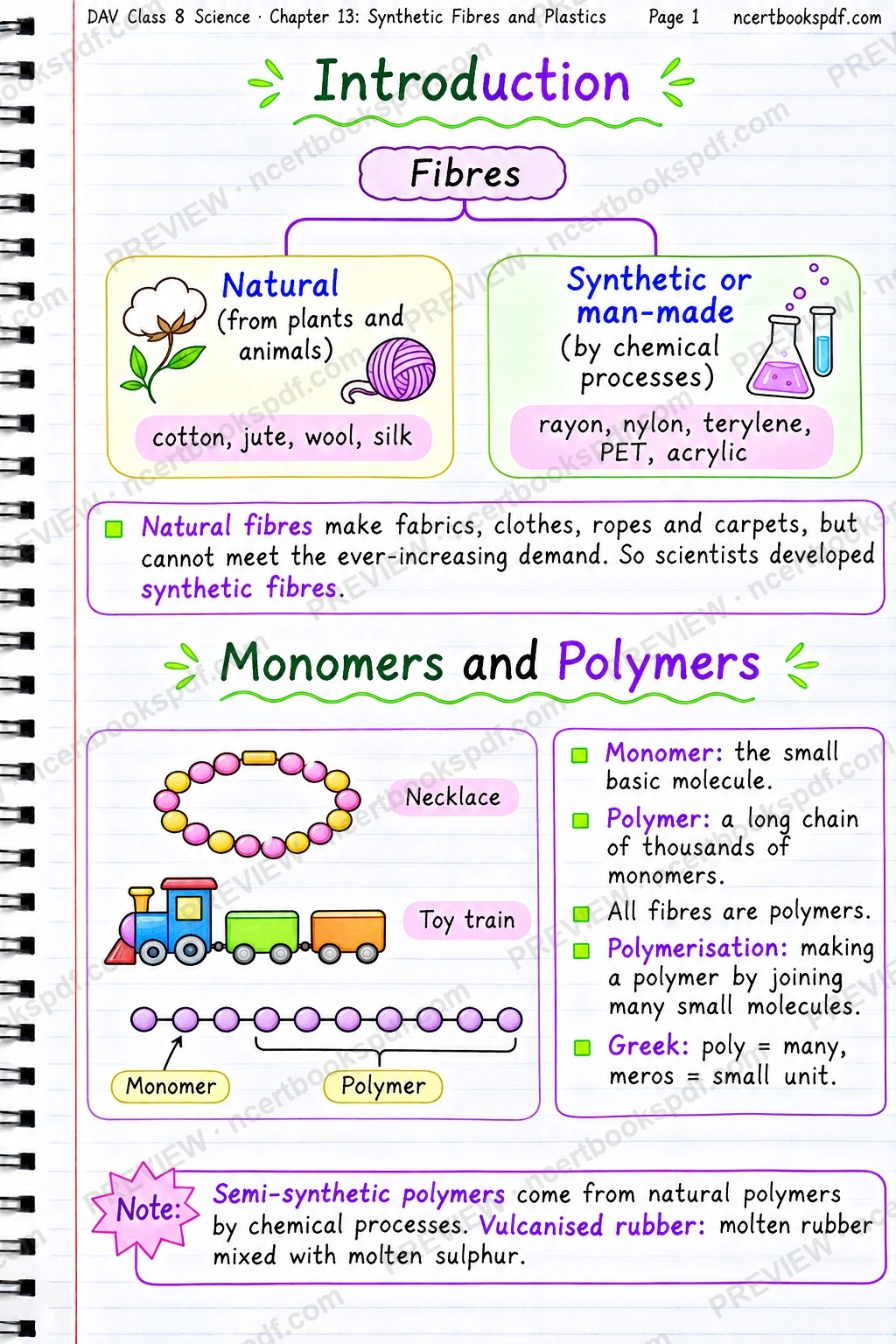
1. _______ and _______ are examples of natural fibres.
2. The simplest molecule of a polymer is known as a _______.
3. Rayon is also known as a _______ fibre.
4. Nylon is a _______ fibre.
5. _______ plastics cannot be remoulded again on heating.
Ans. 1. Cotton, silk 2. monomer 3. regenerated 4. synthetic 5. Thermosetting : 1.
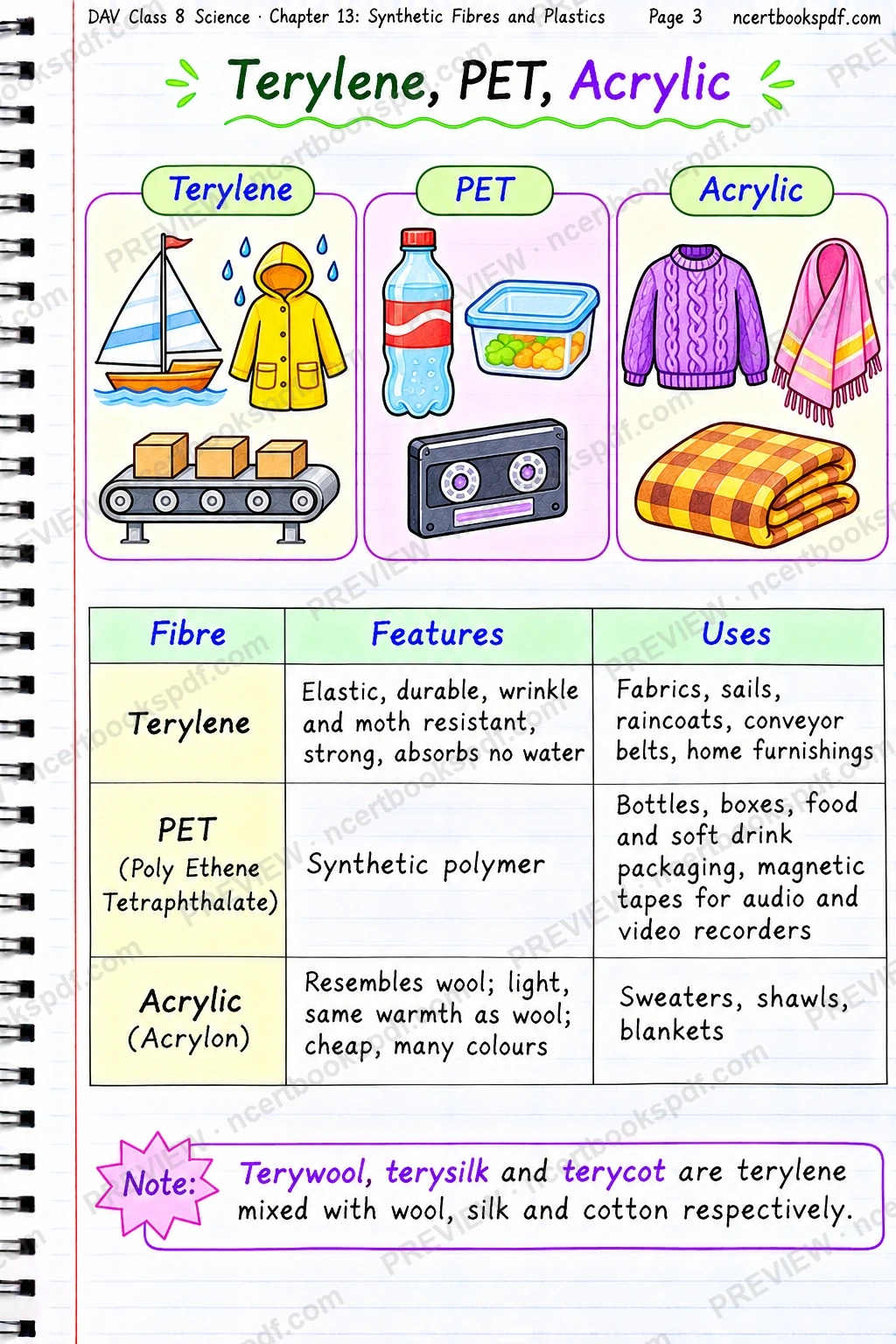
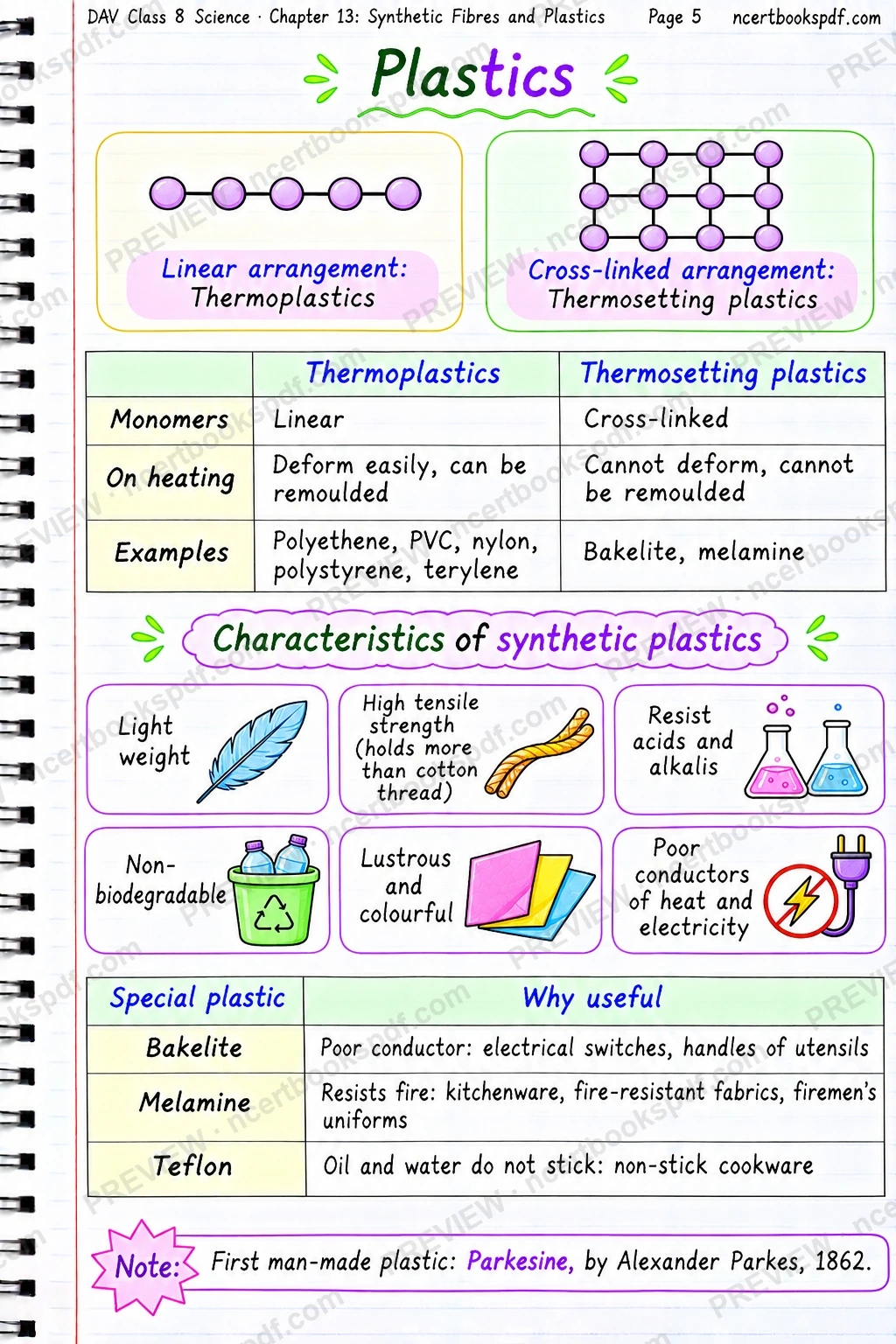
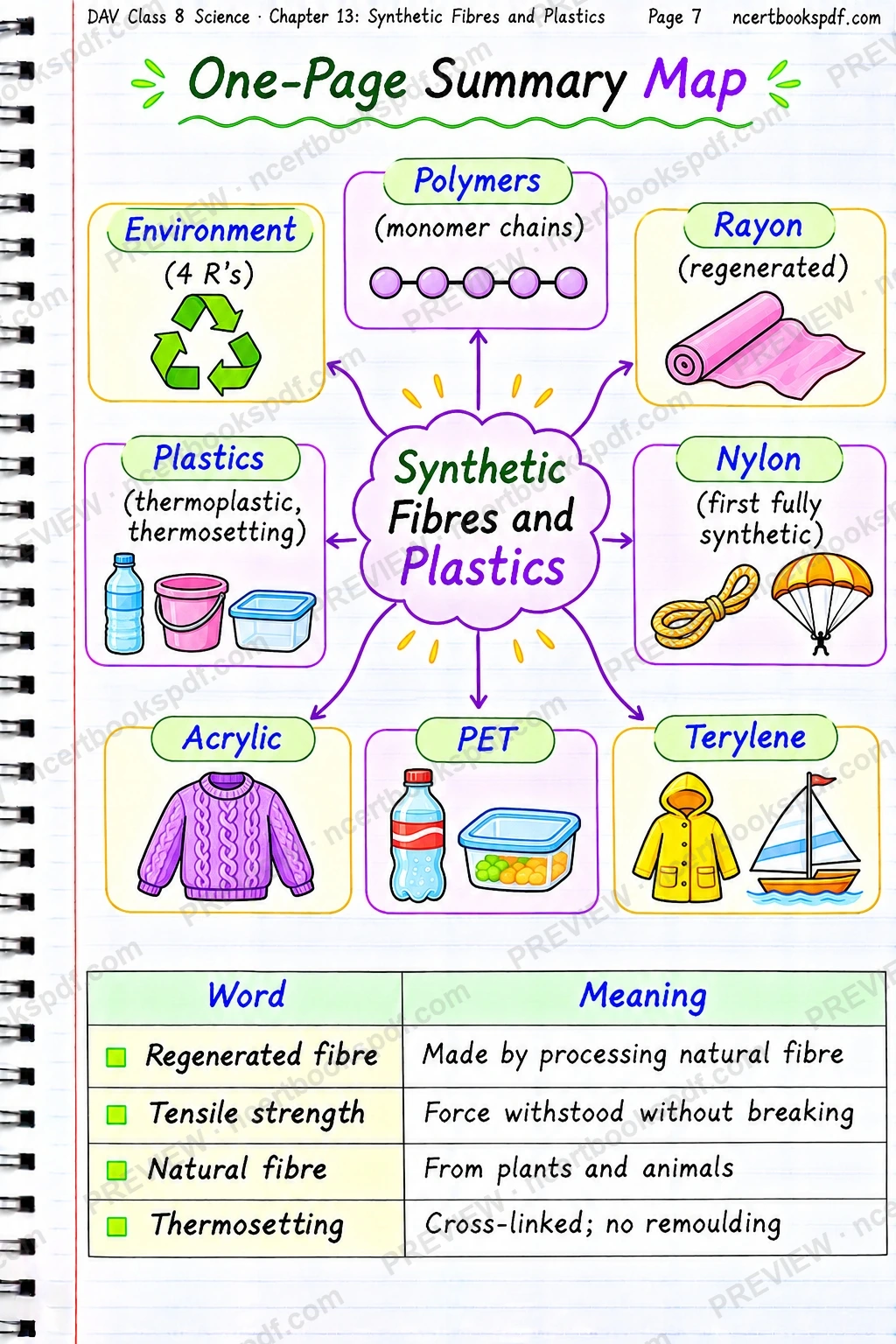
Synthetic Fibres and Plastics — Handwritten Notes & Mind Maps
Any problem or question about the notes or your payment? Email [email protected]
B. State true or false for the following statements:
1.Natural fibres are highly resistant to the effects of chemicals like acids and alkalis.
2. Synthetic fibres absorb very little water.
3. Thermoplastics can be easily remoulded on heating.
4. The plastic, used for insulating electrical wires, is teflon.
5. All types of plastics are biodegradable.
Ans. 1. False 2. True 3. True 4. False 5. False
C. Tick the correct Option:
1.The correct choice, for the box, in the following sequence is—
Ans. Bakelite
2. Which of the following is also known as the ‘wonder polymer’?
Ans. Nylon
3. A highly durable synthetic fibre used for making parachutes and ropes for rock climbing and fishing nets, is—
Ans. Nylon
4. Which of the following is NOT one of the characteristics of synthetic fibres?
Ans. Biodegradable.
5. Melamine is a thermosetting plastic; for it one can say that—
Ans. It has a cross-linked arrangement of molecules.
6. Which of the following is a correct statement about synthetic plastics?
Ans. Synthetic plastics have quite high tensile strengths.
D. Answer the following questions in brief.
1.Define the term ‘Synthetic Fibres’
Ans. Man-Made fibre is called synthetic fibre.
2.Write two uses of Rayon
Ans. Rayon is used in textile industry for making clothing like sarees, blouses, dresses, socks. Rayon is also used in making ropes for mountaineering.
3.Name two to three articles that can be made from nylon.
Ans. Shoes,Socks and Bags
4.Why are clothes made from synthetic fibres uncomfortable in summer?
Ans. The clothes made up of synthetic fibres are not suitable for wearing during hot summer weather as these clothes are extremely fine and do not have sufficient pores for the sweat to come out, evaporate and cool our body. Due to this, clothes made up of synthetic fibres make us feel hot and uncomfortable during summer.
5.Give two examples each of the thermoplastics and thermosetting plastics?
Ans.
| Thermosetting Plastics | Melamine, Bakelite |
| Thermoplastics | Polythene ,PVC |
E. Answer the following questions.
1. How is a ‘regenerated fibre’ different from a true synthetic fibre? Give one example of each of these two types of fibres.
Ans. When a fibre is made from processing of natural fibres, it is called regenerated fibres. But a true synthetic fibre is not made from natural fibres. Rayon is a regenerated fibre, while nylon is a true synthetic fibre.
2. Why do clothes made of nylon last longer?
Ans. Nylon is highly durable and strong. It does not get affected by acids or alkalis. Due to this, nylon clothes last longer.
3. Write two points of differences between thermosetting plastics and thermoplastics.
Ans.
| Thermoplastics | Thermosetting |
| Thermoplastics have linear arrangement of molecules. | Thermosetting plastics have cross-linked arrangement of molecules. |
| Thermoplastic can be deformed easily on heating and can be remoulded into new shape. | Thermosetting plastics cannot be deformed on heating. |
4. State any three advantages of synthetic fibres.
Ans. Following are the three advantages of synthetic fibres:
| They are durable |
| They are strong |
| They are resistant to action by acids and alkalis. |
5. Give your views on the following: ‘Excessive use of plastics is a threat to environment’.
Ans. The majority of plastics are not recyclable. Plastic is also non-biodegradable. As a result, plastic garbage continues to accumulate in our environment. It depletes the soil’s fertility. It causes harm to stray animals. As a consequence, over usage of plastics poses a risk to the environment.
6. Why is Bakelite a good choice for making electrical switches and handles of cooking utensils?
Ans. Bakelite is a heat-resistant material. It is a poor heat and electrical conductor. Bakelite is thus an excellent material for electrical switches and cooking utensil handles.
Value-Based Questions
Ankita is a keen and observant student of Science. She felt concerned when she noticed that the lady, who had joined their household for working in their kitchen, was wearing a nylon saree. She told her mother about the danger of using such a saree in the kitchen. Her mother immediately bought two cotton sarees for that lady and politely advised her to wear them only while working in the kitchen.
1. State the values displayed by Ankita and her mother.
Answer:
• Values displayed by Ankita: Scientific awareness, keen observation, alertness, and caring attitude towards others’ safety.
• Values displayed by her mother: Empathy, kindness, generosity, prompt action, and practical safety consciousness.
2. Give reason(s) that make it unsafe to use a nylon saree in the kitchen.
Answer: Nylon is a synthetic polymer fibre that readily melts upon heating. If a nylon saree accidentally catches fire from a gas stove flame, the melting synthetic fabric shrinks and sticks firmly to the body and skin of the wearer. This results in severe, deep, and extremely painful burns that are hard to treat. In contrast, natural cotton fabrics do not melt, burn smoothly to ash, and do not adhere to human skin.
3. Have a ‘group discussion’ in which different students give their suggestions/opinion about making the kitchen a ‘safe working place’.
Answer: Key recommendations to make the kitchen a safe working place:
1. Wear Cotton Clothes: Always wear fitted cotton clothing or a cotton apron while cooking; avoid loose-fitting synthetic garments, scarves, or nylon dupattas near open fire.
2. Periodic Gas Appliance Inspection: Regularly inspect the LPG cylinder, rubber hose pipe, regulator, and burner valves for any leaks. Turn off the cylinder regulator knob at night or when away.
3. Proper Ventilation: Keep windows open or operate an exhaust fan/kitchen chimney to ensure continuous air exchange and prevent accumulation of flammable gas fumes.
4. Fire Safety Measures: Keep an active fire extinguisher, fire blanket, and sand bucket accessible near the kitchen entrance.
5. Safe Handling of Cookware: Always use insulated silicone gloves or sturdy metal tongs to lift hot pans, never cloth ends or synthetic rags.
6. Keep Inflammables Away: Do not store plastic containers, paper towels, spray cans, or flammable oils directly adjacent to the gas burners.
Something To Do
1. Take three big plastic containers. In the first, add a few pieces from a polythene bag and fill it with garden soil. In the second, add pieces of paper and fill it with garden soil. In the third, add vegetable waste from your kitchen and fill it with garden soil. Keep the three containers on the roof and water them for 7-10 days. Check after 10 days and find out which material undergoes decomposition faster. Make a project report on the above activity.
Answer (Activity / Project Report):
• Observation: After 10 days, the vegetable waste in Container 3 decomposes almost completely into dark organic manure. The paper pieces in Container 2 show partial microbial decay and softening. The polythene bag pieces in Container 1 remain completely unchanged and unaffected.
• Conclusion: Vegetable peels and paper are biodegradable organic materials that soil microorganisms decompose readily. Polythene and plastics are non-biodegradable synthetic polymers that resist bacterial action for hundreds of years.
2. Visit a few families in your neighbourhood and enquire about the kind of clothes they use, the reason for their choice and advantages of using them. Make a short report on your ‘findings’.
Answer (Survey Summary): Most surveyed households reported preferring 100% cotton garments for everyday summer wear and kitchen chores because cotton is breathable, absorbs sweat, and is fire-safe. During rainy weather, workouts, and winters, synthetic and blended fabrics (polyester, acrylic wool, nylon) are preferred for their wrinkle-free nature, high durability, light weight, and quick-drying properties.
3. Design posters, with ‘catchy slogans’ and ‘relevant pictures’, to spread awareness about the judicious use of plastics.
Answer (Slogans for Awareness Poster):
• “Say NO to Single-Use Plastic — Protect Earth, Make Future Fantastic!”
• “Refuse what you cannot Reuse: Save oceans and wildlife from Plastic Abuse!”
• “Carry your own Cloth or Jute Bag — Be a Proud Eco-Champion!”
Value Based Questions (VBQs)
Question:
Mrs. Sharma went to the market for grocery shopping along with her daughter, Ananya. When the shopkeeper offered them single-use polythene bags to carry the vegetables and groceries, Mrs. Sharma politely refused and took out reusable cloth and jute bags from her handbag. During the shopping, Ananya also noticed people buying crackers for Diwali and reminded her mother about wearing cotton clothes instead of synthetic clothes while lighting lamps and fireworks.
1. State any two values displayed by Mrs. Sharma.
Answer:
• Environmental Consciousness: She showed deep care for the environment by saying no to single-use polythene bags that cause land and water pollution.
• Civic Responsibility & Role Modelling: She set a positive example for her daughter and the society by adopting sustainable, eco-friendly habits in daily life.
2. Why should the use of polythene bags be discouraged? Give two reasons.
Answer:
• Non-biodegradable Nature: Polythene bags do not decompose naturally and remain in the soil for hundreds of years. They choke city drains, cause waterlogging during rains, and pollute soil and water bodies.
• Hazard to Animals: Stray animals often swallow discarded polythene bags containing leftover food waste from garbage heaps. The plastic gets stuck in their respiratory or digestive tract, leading to choking and even death.
3. Why did Ananya suggest wearing cotton clothes instead of synthetic clothes while lighting lamps or bursting crackers?
Answer:
Synthetic fibres (like nylon, polyester, and acrylic) melt on heating. If they catch fire, the fabric melts and sticks tightly to the body of the person wearing them, causing severe and deep burn injuries. Cotton clothes, being natural fibres, do not melt upon catching fire and are much safer to wear near heat, fire, or kitchen stoves.
4. Mention the 4-R principle that we should practice to minimize plastic waste.
Answer:
The 4-R principle stands for:
• Reduce: Minimize the purchase and use of disposable plastic items.
• Reuse: Use plastic containers, jars, and bags repeatedly instead of throwing them away after single use.
• Recycle: Segregate and send plastic waste to recycling units to make new useful products.
• Recover: Convert non-recyclable plastic waste into energy or other usable materials through proper scientific processes.
Other Related Chapters
- Chapter 1 | The Cell – Its Structure and Functions | Class- 8 DAV Science
- Chapter 2 | Microorganisms: Friends or Foes | Class- 8 DAV Science
- Chapter 3| Metals and Non-Metals| Class- 8 DAV Science
- Chapter 4| Force and Pressure | Class- 8 DAV Science
- Chapter 5| Friction | Class- 8 DAV Science
- Chapter 6| Sources of Energy | Class- 8 DAV Science
- Chapter 7| Combustion | Class- 8 DAV Science
- Chapter 8| Conservation of Plants and Animals | Class- 8 DAV Science
- Chapter 9| Crop Production and Its Management | Class- 8 DAV Science
- Chapter 10| Refraction and Dispersion of Light | Class- 8 DAV Science
- Chapter 11| The Human Eye | Class- 8 DAV Science
- Chapter 12| Sound | Class- 8 DAV Science
- Chapter 13| Synthetic Fibres and Plastics | Class- 8 DAV Science
- Chapter 14| Reproduction in Animals | Class- 8 DAV Science
- Chapter 15| Reaching the Age of Adolescence | Class- 8 DAV Science
- Chapter 16| Electric Current and Its Chemical Effects | Class- 8 DAV Science
- Chapter 17| Stars and Solar System | Class- 8 DAV Science
- Chapter 18| Earthquakes | Class- 8 DAV Science
- Chapter 19 | Pollution of Air | Class- 8 DAV Science
- Chapter 20 | Pollution of Water | Class- 8 DAV Science