CG Board Class 11 Chemistry Solutions | NCERT Class 11 Chemistry (Part I & II) (2026-27)
Step-by-step solutions for CG Board Class 11 Chemistry Chapter 5: Thermodynamics strictly following the prescribed NCERT Class 11 Chemistry (Part I & II) syllabus.
📚 Chapter Overview:
- Board: Chhattisgarh Board (CGBSE / SCERT — NCERT Syllabus)
- Textbook & Chapter: NCERT Class 11 Chemistry (Part I & II) — Chapter 5: Thermodynamics
- Medium: English Medium
📖 Textbook Pages (NCERT / CG Board 2026-27)
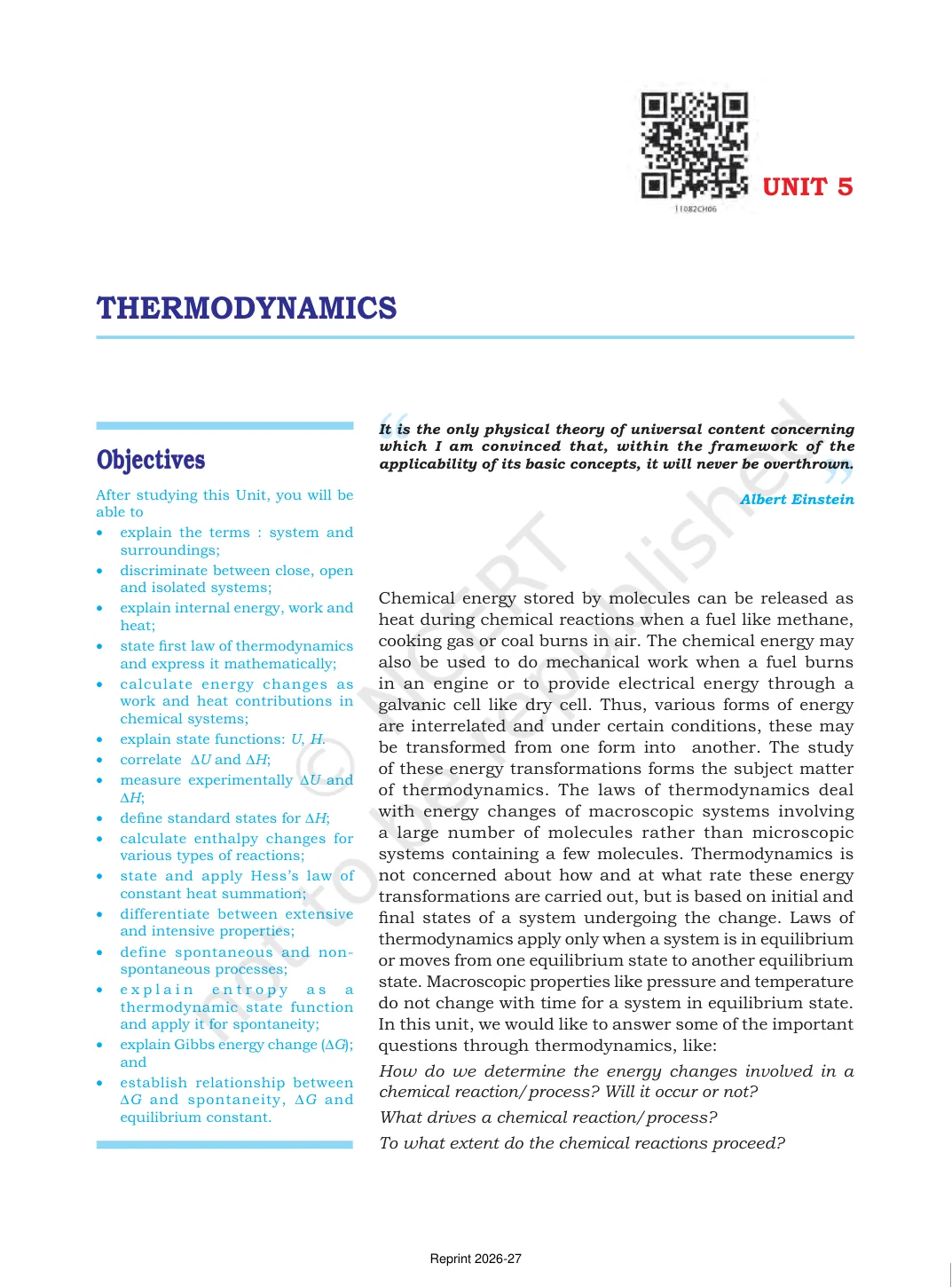
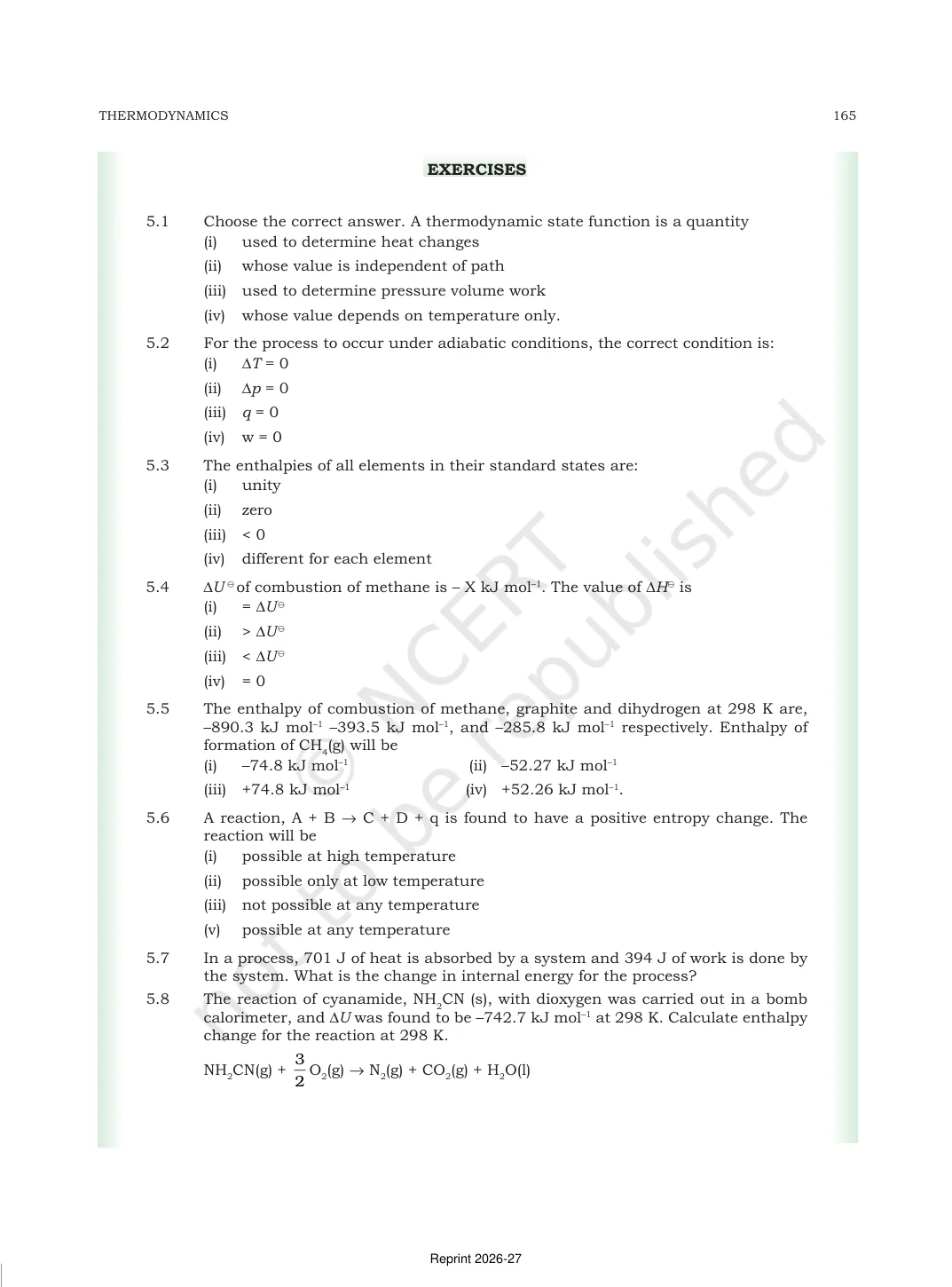
✍️ Chapter 5 Exercise Solutions: Thermodynamics
Exercises
Q5.1. A thermodynamic state function is a quantity:
Answer: (ii) whose value is independent of path.
Q5.2. For the process to occur under adiabatic conditions, the correct condition is:
Answer: (iii) q = 0.
Q5.3. The enthalpies of all elements in their standard states are:
Answer: (ii) zero.
Q5.4. ΔU° of combustion of methane is −X kJ mol−1. The value of ΔH° is:
Answer: (iii) < ΔU° (because CH4(g) + 2O2(g) → CO2(g) + 2H2O(l) has Δng = 1 − 3 = −2, so ΔH° = ΔU° − 2RT < ΔU°).
Q5.5. Enthalpies of combustion of CH4, graphite and H2 at 298 K are −890.3, −393.5, and −285.8 kJ mol−1. Enthalpy of formation of CH4(g) will be:
Answer: (i) −74.8 kJ mol−1. [ΔfH° = −393.5 + 2(−285.8) − (−890.3) = −74.8 kJ mol−1].
Q5.6. A reaction A + B → C + D + q has a positive entropy change. The reaction will be:
Answer: (iv) possible at any temperature (since ΔH < 0 and ΔS > 0, ΔG = ΔH − TΔS < 0 at all T).
Q5.7. In a process, 701 J of heat is absorbed by a system and 394 J of work is done by the system. What is ΔU?
Answer: q = +701 J, w = −394 J. By first law, ΔU = q + w = 701 − 394 = 307 J.
Q5.8. Reaction of NH2CN(s) with O2 in a bomb calorimeter gave ΔU = −742.7 kJ mol−1 at 298 K. Calculate ΔH for: NH2CN(s) + 3/2 O2(g) → N2(g) + CO2(g) + H2O(l).
Answer: Δng = (1 + 1) − 3/2 = +0.5 mol (note: NCERT answer key uses Δng = −0.5 assuming NH2CN(g), giving −743.94 kJ; for NH2CN(s), Δng = +0.5 gives −742.7 + 0.5 × 8.314 × 10−3 × 298 = −741.46 kJ; NCERT key: −743.939 kJ).
Q5.9. Calculate the number of kJ of heat necessary to raise the temperature of 60.0 g of Al from 35°C to 55°C. Molar heat capacity of Al is 24 J mol−1 K−1.
Answer: n = 60.0 / 27 = 2.222 mol, ΔT = 20 K. q = n Cm ΔT = 2.222 × 24 × 20 = 1066.7 J = 1.067 kJ.
Q5.10. Calculate enthalpy change on freezing of 1.0 mol of water at 10.0°C to ice at −10.0°C. ΔfusH = 6.03 kJ mol−1 at 0°C; Cp[H2O(l)] = 75.3, Cp[H2O(s)] = 36.8 J mol−1 K−1.
Answer: ΔH = Cp(l)(0 − 10) + (−ΔfusH) + Cp(s)(−10 − 0) = −0.753 − 6.03 − 0.368 = −7.151 kJ mol−1.
Q5.11. Enthalpy of combustion of carbon to CO2 is −393.5 kJ mol−1. Calculate heat released upon formation of 35.2 g of CO2.
Answer: Moles of CO2 = 35.2 / 44 = 0.8 mol. Heat released = 0.8 × (−393.5) = −314.8 kJ.
Q5.12. Given ΔfH° of CO(g) = −110, CO2(g) = −393, N2O(g) = 81, N2O4(g) = 9.7 kJ mol−1. Find ΔrH for N2O4(g) + 3CO(g) → N2O(g) + 3CO2(g).
Answer: ΔrH = [81 + 3(−393)] − [9.7 + 3(−110)] = −1098 − (−320.3) = −777.7 kJ ≈ −778 kJ.
Q5.13. Given N2(g) + 3H2(g) → 2NH3(g); ΔrH° = −92.4 kJ mol−1. What is standard enthalpy of formation of NH3(g)?
Answer: ΔfH°(NH3) = −92.4 / 2 = −46.2 kJ mol−1.
Q5.14. Calculate ΔfH° of CH3OH(l) from: ΔcH°(CH3OH) = −726, ΔcH°(C) = −393, ΔfH°(H2O) = −286 kJ mol−1.
Answer: C(s) + 2H2(g) + ½O2(g) → CH3OH(l). ΔfH° = −393 + 2(−286) − (−726) = −239 kJ mol−1.
Q5.15. Calculate ΔH for CCl4(g) → C(g) + 4Cl(g) and C–Cl bond enthalpy. ΔvapH°(CCl4) = 30.5, ΔfH°(CCl4) = −135.5, ΔaH°(C) = 715.0, ΔaH°(Cl2) = 242 kJ mol−1.
Answer: ΔrH° = ΔaH°(C) + 2ΔaH°(Cl2) − ΔfH°(CCl4, l) − ΔvapH°(CCl4) = 715.0 + 484 − (−135.5) − 30.5 = 1304 kJ mol−1.
C–Cl bond enthalpy = 1304 / 4 = 326 kJ mol−1.
Q5.16. For an isolated system, ΔU = 0, what will be ΔS?
Answer: ΔS > 0 (entropy of an isolated system increases for any spontaneous process).
Q5.17. For 2A + B → C, ΔH = 400 kJ mol−1 and ΔS = 0.2 kJ K−1 mol−1. At what temperature will the reaction become spontaneous?
Answer: At equilibrium, T = ΔH / ΔS = 400 / 0.2 = 2000 K. Above 2000 K, ΔG < 0 and the reaction is spontaneous.
Q5.18. For 2Cl(g) → Cl2(g), what are the signs of ΔH and ΔS?
Answer: ΔH is negative (energy is released on bond formation) and ΔS is negative (two gaseous atoms combine to form one molecule, decreasing randomness).
Q5.19. For 2A(g) + B(g) → 2D(g), ΔU° = −10.5 kJ and ΔS° = −44.1 J K−1 at 298 K. Calculate ΔG° and predict spontaneity.
Answer: Δng = 2 − 3 = −1. ΔH° = ΔU° + ΔngRT = −10.5 + (−1)(8.314 × 10⁻³)(298) = −12.978 kJ.
ΔG° = ΔH° − TΔS° = −12.978 − 298(−0.0441) = −12.978 + 13.142 = +0.164 kJ. Since ΔG° > 0, the reaction is non-spontaneous.
Q5.20. The equilibrium constant for a reaction is 10. What will be ΔG° at 300 K? (R = 8.314 J K−1 mol−1)
Answer: ΔG° = −2.303 RT log K = −2.303 × 8.314 × 300 × log(10) = −5744.1 J mol−1 = −5.744 kJ mol−1.
Q5.21. Comment on the thermodynamic stability of NO(g) given: ½N2 + ½O2 → NO (ΔH° = +90 kJ mol−1); NO + ½O2 → NO2 (ΔH° = −74 kJ mol−1).
Answer: Positive ΔfH° (+90 kJ mol−1) shows NO(g) is unstable with respect to N2 and O2, whereas negative ΔrH° (−74 kJ mol−1) shows NO(g) readily converts to more stable NO2(g).
Q5.22. Calculate the entropy change in surroundings when 1.00 mol of H2O(l) is formed under standard conditions (298 K). ΔfH° = −286 kJ mol−1.
Answer: qsurr = +286 kJ mol−1 = 286000 J mol−1. ΔSsurr = qsurr / T = 286000 / 298 = 959.73 J K−1 mol−1.