CG Board Class 11 Chemistry Solutions | NCERT Class 11 Chemistry (Part I & II) (2026-27)
Step-by-step solutions for CG Board Class 11 Chemistry Chapter 6: Equilibrium strictly following the prescribed NCERT Class 11 Chemistry (Part I & II) syllabus.
📚 Chapter Overview:
- Board: Chhattisgarh Board (CGBSE / SCERT — NCERT Syllabus)
- Textbook & Chapter: NCERT Class 11 Chemistry (Part I & II) — Chapter 6: Equilibrium
- Medium: English Medium
📖 Textbook Pages (NCERT / CG Board 2026-27)

✍️ Chapter 6 Exercise Solutions: Equilibrium
Exercises
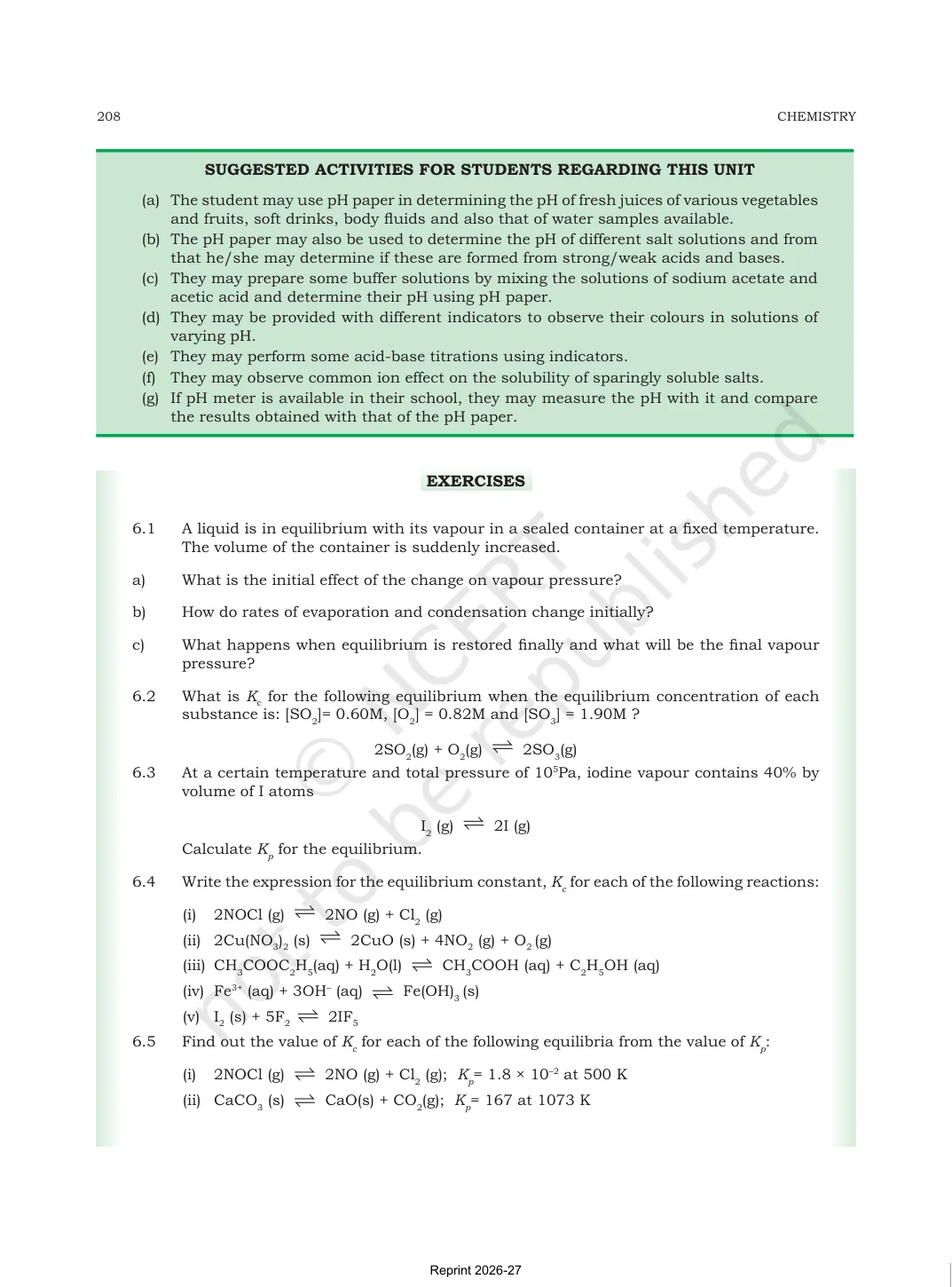
Q6.1. Sealed liquid-vapour equilibrium when container volume suddenly increases: (a) initial vapour pressure effect, (b) evaporation/condensation rates, (c) final state.
Answer: (a) Vapour pressure initially drops because the same vapour molecules occupy a larger volume.
(b) Evaporation rate stays constant (depends on temperature), while condensation rate decreases due to lower vapour density.
(c) More liquid evaporates until equilibrium is restored at the original vapour pressure (constant at fixed T).
Q6.2. Find Kc for 2SO2(g) + O2(g) ⇌ 2SO3(g) given [SO2] = 0.60 M, [O2] = 0.82 M, [SO3] = 1.90 M.
Answer: Kc = [SO3]2 / ([SO2]2[O2]) = (1.90)2 / ((0.60)2 × 0.82) = 3.61 / 0.2952 = 12.23.
Q6.3. For I2(g) ⇌ 2I(g) at 105 Pa total pressure with 40% I atoms by volume, calculate Kp.
Answer: pI = 0.40 × 10⁵ Pa = 0.40 bar; pI2 = 0.60 × 10⁵ Pa = 0.60 bar. Kp = pI2 / pI2 = (0.4 × 10⁵)2 / (0.6 × 10⁵) = 2.67 × 10⁴ Pa.
Q6.4. Write Kc expressions for: (i) 2NOCl(g) ⇌ 2NO + Cl2, (ii) 2Cu(NO3)2(s) ⇌ 2CuO(s) + 4NO2 + O2, (iii) ester hydrolysis, (iv) Fe3+ + 3OH− ⇌ Fe(OH)3(s), (v) I2(s) + 5F2 ⇌ 2IF5.
Answer: (i) Kc = [NO]2[Cl2] / [NOCl]2.
(ii) Kc = [NO2]4[O2].
(iii) Kc = [CH3COOH][C2H5OH] / [CH3COOC2H5].
(iv) Kc = 1 / ([Fe3+][OH−]3).
(v) Kc = [IF5]2 / [F2]5.
Q6.5. Find Kc from Kp for (i) 2NOCl(g) ⇌ 2NO + Cl2 (Kp = 1.8 × 10⁻² at 500 K), (ii) CaCO3(s) ⇌ CaO(s) + CO2 (Kp = 167 at 1073 K).
Answer: (i) Δng = 1. Kc = Kp / (RT) = 1.8 × 10⁻² / (0.0831 × 500) = 4.33 × 10⁻⁴.
(ii) Δng = 1. Kc = 167 / (0.0831 × 1073) = 1.90.
Q6.6. For NO + O3 ⇌ NO2 + O2, Kc = 6.3 × 10¹⁴ at 1000 K. Find Kc for reverse reaction.
Answer: Kc(reverse) = 1 / (6.3 × 10¹⁴) = 1.59 × 10⁻¹⁵.
Q6.7. Why are pure liquids and solids omitted from equilibrium constant expressions?
Answer: Their molar concentration (density / molar mass) remains constant at a given temperature regardless of amount, so it is absorbed into Kc.
Q6.8. 0.482 mol N2 and 0.933 mol O2 in a 10 L vessel form N2O with Kc = 2.0 × 10−37. Find equilibrium composition.
Answer: Since Kc is tiny, reaction proceeds negligibly: [N2] ≈ 0.0482 M, [O2] ≈ 0.0933 M.
[N2O]2 = 2.0 × 10−37 × (0.0482)2 × 0.0933 = 4.335 × 10−41 → [N2O] = 6.6 × 10⁻²¹ M.
Q6.9. 0.087 mol NO and 0.0437 mol Br2 yield 0.0518 mol NOBr at equilibrium in 2NO + Br2 ⇌ 2NOBr. Find equilibrium moles of NO and Br2.
Answer: NO consumed = 0.0518 mol → remaining NO = 0.087 − 0.0518 = 0.0352 mol.
Br2 consumed = 0.0518 / 2 = 0.0259 mol → remaining Br2 = 0.0437 − 0.0259 = 0.0178 mol.
Q6.10. At 450 K, Kp = 2.0 × 10¹⁰ bar−1 for 2SO2 + O2 ⇌ 2SO3. Find Kc.
Answer: Δng = 2 − 3 = −1. Kc = Kp(RT) = 2.0 × 1010 × 0.0831 × 450 = 7.48 × 10¹¹ M−1 (7.47 × 10¹¹).
Q6.11. 2HI(g) ⇌ H2(g) + I2(g): initial pHI = 0.2 atm, equilibrium pHI = 0.04 atm. Find Kp.
Answer: Drop in pHI = 0.16 atm → pH2 = pI2 = 0.08 atm. Kp = (0.08 × 0.08) / (0.04)2 = 4.0.
Q6.12. 1.57 mol N2, 1.92 mol H2, 8.13 mol NH3 in 20 L at 500 K (Kc = 1.7 × 10²). Check equilibrium and direction.
Answer: [N2] = 0.0785 M, [H2] = 0.096 M, [NH3] = 0.4065 M.
Qc = (0.4065)2 / (0.0785 × 0.0963) = 2.38 × 10³. Since Qc > Kc, net reaction shifts backward.
Q6.13. Write the balanced equation for Kc = [NH3]4[O2]5 / ([NO]4[H2O]6).
Answer: 4NO(g) + 6H2O(g) ⇌ 4NH3(g) + 5O2(g).
Q6.14. 1 mol H2O and 1 mol CO in 10 L at 725 K; 40% H2O reacts: H2O + CO ⇌ H2 + CO2. Find Kc.
Answer: At equilibrium: [H2O] = [CO] = 0.06 M; [H2] = [CO2] = 0.04 M. Kc = (0.04 × 0.04) / (0.06 × 0.06) = 0.44.
Q6.15. H2 + I2 ⇌ 2HI has Kc = 54.8 at 700 K. If [HI]eq = 0.5 M starting from HI, find [H2] and [I2].
Answer: [H2] = [I2] = x. (0.5)2 / x2 = 54.8 → x = 0.5 / √54.8 = 0.068 M.
Q6.16. 2ICl(g) ⇌ I2(g) + Cl2(g), Kc = 0.14. Initial [ICl] = 0.78 M. Find equilibrium concentrations.
Answer: Let [I2] = [Cl2] = x, [ICl] = 0.78 − 2x. x2 / (0.78 − 2x)2 = 0.14 → x / (0.78 − 2x) = 0.3742 → x = 0.167 M.
[I2] = [Cl2] = 0.167 M; [ICl] = 0.446 M.
Q6.17. C2H6(g) ⇌ C2H4(g) + H2(g), Kp = 0.04 atm at 899 K. Initial pC2H6 = 4.0 atm. Find equilibrium pC2H6.
Answer: x2 / (4.0 − x) = 0.04 → x2 + 0.04x − 0.16 = 0 → x = 0.38 atm. [C2H6]eq = 4.0 − 0.38 = 3.62 atm.
Q6.18. CH3COOH(l) + C2H5OH(l) ⇌ CH3COOC2H5(l) + H2O(l): (i) Qc, (ii) Kc for 1.00 mol acid + 0.18 mol alcohol giving 0.171 mol ester, (iii) check 0.5 mol alcohol + 1.0 mol acid with 0.214 mol ester.
Answer: (i) Qc = [CH3COOC2H5][H2O] / ([CH3COOH][C2H5OH]).
(ii) Kc = (0.171 × 0.171) / (0.829 × 0.009) = 3.92.
(iii) Qc = (0.214 × 0.214) / (0.786 × 0.286) = 0.204 < Kc, so equilibrium is not yet reached.
Q6.19. PCl5 ⇌ PCl3 + Cl2 (Kc = 8.3 × 10⁻³). At equilibrium [PCl5] = 0.05 M. Find [PCl3] and [Cl2].
Answer: x2 / 0.05 = 8.3 × 10⁻³ → x2 = 4.15 × 10⁻⁴ → x = 0.02 M for both.
Q6.20. FeO(s) + CO(g) ⇌ Fe(s) + CO2(g), Kp = 0.265 at 1050 K. Initial pCO = 1.4 atm, pCO2 = 0.80 atm. Find equilibrium pressures.
Answer: Qp = 0.80 / 1.4 = 0.571 > Kp, so reaction shifts backward. (0.80 − x)/(1.4 + x) = 0.265 → x = 0.339 atm.
pCO = 1.739 atm; pCO2 = 0.461 atm.
Q6.21. N2 + 3H2 ⇌ 2NH3 (Kc = 0.061). Given [N2] = 3.0, [H2] = 2.0, [NH3] = 0.5 M. Check equilibrium.
Answer: Qc = (0.5)2 / (3.0 × 2.03) = 0.0104 < 0.061. Not at equilibrium; proceeds forward to form more NH3.
Q6.22. 2BrCl ⇌ Br2 + Cl2 (Kc = 32 at 500 K). Initial [BrCl] = 3.3 × 10⁻³ M. Find equilibrium [BrCl].
Answer: x2 / (3.3 × 10⁻³ − 2x)2 = 32 → x / (3.3 × 10⁻³ − 2x) = 5.657 → x = 1.515 × 10⁻³ M.
[BrCl]eq = 3.3 × 10⁻³ − 3.03 × 10−3 = 2.7 × 10⁻⁴ M (≈ 3 × 10⁻⁴ M).
Q6.23. C(s) + CO2(g) ⇌ 2CO(g) at 1127 K, 1 atm has 90.55% CO by mass. Find Kc.
Answer: In 100 g gas: nCO = 90.55/28 = 3.234, nCO2 = 9.45/44 = 0.215. Mole fractions: xCO = 0.9377, xCO2 = 0.0623.
Kp = (0.9377)2 / 0.0623 = 14.11 atm. Kc = Kp / (RT) = 14.11 / (0.0821 × 1127) = 0.152 (0.149 with R=0.0831).
Q6.24. NO + ½O2 ⇌ NO2 at 298 K. Given ΔfG°(NO2) = 52.0, ΔfG°(NO) = 87.0 kJ mol−1. Find ΔG° and K.
Answer: (a) ΔG° = 52.0 − 87.0 = −35.0 kJ mol−1.
(b) log K = −ΔG° / (2.303 RT) = 35000 / (2.303 × 8.314 × 298) = 6.134 → K = 1.365 × 10⁶.
Q6.25. Effect of decreasing pressure (increasing volume) on moles of products: (a) PCl5 ⇌ PCl3 + Cl2, (b) CaO(s) + CO2 ⇌ CaCO3(s), (c) 3Fe(s) + 4H2O(g) ⇌ Fe3O4(s) + 4H2(g).
Answer: (a) Increases (Δng = +1, shifts forward). (b) Decreases (Δng = −1, shifts backward). (c) Remains same (Δng = 0).
Q6.26. Which reactions are affected by increasing pressure and in which direction?
Answer: (i) COCl2 ⇌ CO + Cl2: backward; (ii) CH4 + 2S2 ⇌ CS2 + 2H2S: unaffected (Δng = 0); (iii) CO2 + C(s) ⇌ 2CO: backward; (iv) 2H2 + CO ⇌ CH3OH: forward; (v) CaCO3(s) ⇌ CaO(s) + CO2: backward; (vi) 4NH3 + 5O2 ⇌ 4NO + 6H2O: backward.
Q6.27. H2 + Br2 ⇌ 2HBr has Kp = 1.6 × 10⁵ at 1024 K. 10.0 bar HBr is introduced. Find equilibrium pressures.
Answer: Let pH2 = pBr2 = x. (10 − 2x)2 / x2 = 1.6 × 10⁵ → (10 − 2x)/x = 400 → x = 2.5 × 10⁻² bar.
pH2 = pBr2 = 2.5 × 10⁻² bar; pHBr ≈ 10.0 bar.
Q6.28. CH4 + H2O ⇌ CO + 3H2 (endothermic). (a) Write Kp. (b) Effect on Kp and mixture of (i) increasing P, (ii) increasing T, (iii) catalyst.
Answer: (a) Kp = (pCO · pH23) / (pCH4 · pH2O).
(b) (i) Increasing P shifts equilibrium backward; Kp unchanged. (ii) Increasing T shifts equilibrium forward and increases Kp. (iii) Catalyst has no effect on Kp or equilibrium composition.
Q6.29. For 2H2 + CO ⇌ CH3OH, state effect of: (a) adding H2, (b) adding CH3OH, (c) removing CO, (d) removing CH3OH.
Answer: (a) Shifts forward; (b) shifts backward; (c) shifts backward; (d) shifts forward.
Q6.30. PCl5 ⇌ PCl3 + Cl2 (Kc = 8.3 × 10⁻³ at 473 K, ΔrH° = 124 kJ mol−1). (a) Kc expression, (b) reverse Kc, (c) effect of adding PCl5, increasing P, increasing T.
Answer: (a) Kc = [PCl3][Cl2] / [PCl5]. (b) Kc‘ = 1 / (8.3 × 10⁻³) = 120.48.
(c) (i) Adding PCl5: Kc unchanged; (ii) increasing P: Kc unchanged; (iii) increasing T: Kc increases (endothermic).
Q6.31. CO + H2O ⇌ CO2 + H2 (Kp = 10.1 at 400°C). Initial pCO = pH2O = 4.0 bar. Find equilibrium pH2.
Answer: x2 / (4.0 − x)2 = 10.1 → x / (4.0 − x) = 3.178 → x = 3.04 bar.
Q6.32. Which reaction has appreciable reactants and products: (a) Kc = 5 × 10−39, (b) Kc = 3.7 × 10⁸, (c) Kc = 1.8?
Answer: (c) Cl2(g) + 2NO2(g) ⇌ 2NO2Cl(g) with Kc = 1.8 (between 10−3 and 103).
Q6.33. 3O2 ⇌ 2O3 has Kc = 2.0 × 10−50 at 25°C. If [O2] = 1.6 × 10⁻² M, find [O3].
Answer: [O3]2 = 2.0 × 10−50 × (1.6 × 10−2)3 = 8.192 × 10−56 → [O3] = 2.86 × 10⁻²⁸ M.
Q6.34. CO + 3H2 ⇌ CH4 + H2O in 1 L at 1300 K (Kc = 3.90). Given [CO] = 0.30, [H2] = 0.10, [H2O] = 0.02 M. Find [CH4].
Answer: [CH4] = Kc × [CO][H2]3 / [H2O] = 3.90 × 0.30 × (0.10)3 / 0.02 = 5.85 × 10⁻² M.
Q6.35. What is a conjugate acid-base pair? Find conjugate acid/base for HNO2, CN−, HClO4, F−, OH−, CO32−, S2−.
Answer: A conjugate acid-base pair differs by one proton (H+).
Conjugate bases of acids: HNO2 → NO2−; HClO4 → ClO4−.
Conjugate acids of bases: CN− → HCN; F− → HF; OH− → H2O; CO32− → HCO3−; S2− → HS−.
Q6.36. Which are Lewis acids: H2O, BF3, H+, NH4+?
Answer: BF3, H+, and NH4+ act as Lewis acids (electron-pair acceptors); H2O is a Lewis base.
Q6.37. Conjugate bases for Brønsted acids HF, H2SO4, HCO3−:
Answer: F−, HSO4−, and CO32− respectively.
Q6.38. Conjugate acids for Brønsted bases NH2−, NH3, HCOO−:
Answer: NH3, NH4+, and HCOOH respectively.
Q6.39. Give conjugate acid and conjugate base for H2O, HCO3−, HSO4−, NH3.
Answer: H2O: H3O+ (acid), OH− (base).
HCO3−: H2CO3 (acid), CO32− (base).
HSO4−: H2SO4 (acid), SO42− (base).
NH3: NH4+ (acid), NH2− (base).
Q6.40. Classify into Lewis acids/bases: (a) OH−, (b) F−, (c) H+, (d) BCl3.
Answer: (a) OH− and (b) F− are Lewis bases (donate lone pair). (c) H+ and (d) BCl3 are Lewis acids (accept electron pair).
Q6.41. [H+] in soft drink is 3.8 × 10⁻³ M. Find pH.
Answer: pH = −log(3.8 × 10⁻³) = 3 − 0.58 = 2.42.
Q6.42. pH of vinegar is 3.76. Find [H+].
Answer: [H+] = 10−3.76 = 1.74 × 10⁻⁴ M.
Q6.43. Ka of HF, HCOOH, HCN are 6.8 × 10⁻⁴, 1.8 × 10⁻⁴, 4.8 × 10⁻⁹. Find Kb of conjugate bases.
Answer: Kb = Kw / Ka (10−14 / Ka): F− = 1.47 × 10⁻¹¹; HCOO− = 5.56 × 10⁻¹¹; CN− = 2.08 × 10⁻⁶.
Q6.44. Ka of phenol is 1.0 × 10⁻¹⁰. Find [phenolate] in 0.05 M phenol, and α if also 0.01 M in sodium phenolate.
Answer: [C6H5O−] = √(Ka · c) = √(1.0 × 10−10 × 0.05) = 2.24 × 10⁻⁶ M.
In 0.01 M sodium phenolate, α = Ka / [C6H5O−] = 1.0 × 10⁻¹⁰ / 0.01 = 10−8.
Q6.45. For H2S (Ka1 = 9.1 × 10⁻⁸, Ka2 = 1.2 × 10⁻¹³) in 0.1 M solution: find [HS−] and [S2−] alone and in 0.1 M HCl.
Answer: Alone: [HS−] = √(9.1 × 10−8 × 0.1) = 9.54 × 10⁻⁵ M; [S2−] = Ka2 = 1.2 × 10⁻¹³ M.
In 0.1 M HCl: [HS−] = Ka1[H2S]/[H+] = 9.1 × 10⁻⁸ M; [S2−] = Ka1Ka2[H2S]/[H+]2 = 1.09 × 10⁻¹⁹ M.
Q6.46. Ka of CH3COOH is 1.74 × 10⁻⁵. Find α, [CH3COO−] and pH in 0.05 M solution.
Answer: α = √(Ka/c) = √(1.74 × 10⁻⁵ / 0.05) = 1.86 × 10⁻².
[CH3COO−] = cα = 9.3 × 10⁻⁴ M; pH = −log(9.3 × 10⁻⁴) = 3.03.
Q6.47. pH of 0.01 M organic acid is 4.15. Find [A−], Ka and pKa.
Answer: [A−] = [H+] = 10−4.15 = 7.08 × 10⁻⁵ M.
Ka = (7.08 × 10⁻⁵)2 / 0.01 = 5.01 × 10⁻⁷; pKa = −log(5.01 × 10⁻⁷) = 6.30 (6.29).
Q6.48. Calculate pH of: (a) 0.003 M HCl, (b) 0.005 M NaOH, (c) 0.002 M HBr, (d) 0.002 M KOH.
Answer: (a) 2.52; (b) 11.70; (c) 2.70; (d) 11.30.
Q6.49. Calculate pH of: (a) 2 g TlOH in 2 L, (b) 0.3 g Ca(OH)2 in 500 mL, (c) 0.3 g NaOH in 200 mL, (d) 1 mL of 13.6 M HCl diluted to 1 L.
Answer: (a) [OH−] = 2/(221 × 2) = 4.52 × 10⁻³ M → pH = 11.65.
(b) [OH−] = 2 × 0.3/(74 × 0.5) = 0.0162 M → pH = 12.21.
(c) [OH−] = 0.3/(40 × 0.2) = 0.0375 M → pH = 12.57.
(d) [H+] = 0.0136 M → pH = 1.87.
Q6.50. Degree of ionization of 0.1 M bromoacetic acid is 0.132. Find pH and pKa.
Answer: [H+] = 0.1 × 0.132 = 0.0132 M → pH = 1.88.
Ka = cα2 / (1 − α) = 0.1 × (0.132)2 / 0.868 = 2.01 × 10⁻³ → pKa = 2.70.
Q6.51. pH of 0.005 M codeine is 9.95. Find Kb and pKb.
Answer: pOH = 14 − 9.95 = 4.05 → [OH−] = 8.91 × 10⁻⁵ M.
Kb = (8.91 × 10⁻⁵)2 / 0.005 = 1.59 × 10⁻⁶; pKb = 5.80.
Q6.52. Find pH and α of 0.001 M aniline (Kb = 4.27 × 10⁻¹⁰), and Ka of conjugate acid.
Answer: [OH−] = √(4.27 × 10−10 × 0.001) = 6.53 × 10⁻⁷ M → pH = 7.81; α = 6.53 × 10⁻⁴; Ka = 10−14 / (4.27 × 10⁻¹⁰) = 2.34 × 10⁻⁵.
Q6.53. Find α of 0.05 M acetic acid (pKa = 4.74), and α in (a) 0.01 M HCl, (b) 0.1 M HCl.
Answer: Ka = 1.82 × 10⁻⁵; α = √(1.82 × 10⁻⁵ / 0.05) = 0.0191.
(a) In 0.01 M HCl: α = 1.82 × 10⁻⁵ / 0.01 = 1.82 × 10⁻³.
(b) In 0.1 M HCl: α = 1.82 × 10⁻⁵ / 0.1 = 1.82 × 10⁻⁴.
Q6.54. Kb of dimethylamine is 5.4 × 10⁻⁴. Find α in 0.02 M solution, and % ionized in 0.1 M NaOH.
Answer: α = √(5.4 × 10⁻⁴ / 0.02) = 0.164.
In 0.1 M NaOH: α = 5.4 × 10⁻⁴ / 0.1 = 0.0054 → 0.54% ionized.
Q6.55. Find [H+] for: (a) muscle-fluid pH 6.83, (b) stomach fluid pH 1.2, (c) blood pH 7.38, (d) saliva pH 6.4.
Answer: (a) 1.48 × 10⁻⁷ M; (b) 6.31 × 10⁻² M; (c) 4.17 × 10⁻⁸ M; (d) 3.98 × 10⁻⁷ M.
Q6.56. Find [H+] for milk (6.8), black coffee (5.0), tomato juice (4.2), lemon juice (2.2), egg white (7.8).
Answer: Milk: 1.58 × 10⁻⁷ M; coffee: 10−5 M; tomato juice: 6.31 × 10⁻⁵ M; lemon juice: 6.31 × 10⁻³ M; egg white: 1.58 × 10⁻⁸ M.
Q6.57. 0.561 g KOH in 200 mL at 298 K. Find [K+], [OH−], [H+] and pH.
Answer: [K+] = [OH−] = 0.561 / (56.1 × 0.2) = 0.05 M; [H+] = 10−14 / 0.05 = 2.0 × 10⁻¹³ M; pH = 12.70.
Q6.58. Solubility of Sr(OH)2 is 19.23 g/L. Find [Sr2+], [OH−] and pH.
Answer: Molar mass = 121.6 g mol−1. [Sr2+] = 19.23 / 121.6 = 0.1581 M; [OH−] = 0.3162 M; pH = 13.50.
Q6.59. Propanoic acid (Ka = 1.32 × 10⁻⁵) in 0.05 M solution: find α, pH, and α in 0.01 M HCl.
Answer: α = √(1.32 × 10⁻⁵ / 0.05) = 1.625 × 10⁻²; [H+] = 8.12 × 10⁻⁴ M → pH = 3.09.
In 0.01 M HCl: α = 1.32 × 10⁻⁵ / 0.01 = 1.32 × 10⁻³.
Q6.60. pH of 0.1 M HCNO is 2.34. Find Ka and α.
Answer: [H+] = 10−2.34 = 4.57 × 10⁻³ M; α = 4.57 × 10⁻³ / 0.1 = 0.0457; Ka = (4.57 × 10⁻³)2 / 0.1 = 2.09 × 10⁻⁴.
Q6.61. Ka of HNO2 is 4.5 × 10⁻⁴. Find pH and degree of hydrolysis of 0.04 M NaNO2.
Answer: Kh = 10−14 / (4.5 × 10⁻⁴) = 2.22 × 10⁻¹¹; h = √(Kh / c) = 2.36 × 10⁻⁵.
[OH−] = c · h = 9.43 × 10⁻⁷ M → pOH = 6.03 → pH = 7.97.
Q6.62. 0.02 M pyridinium hydrochloride has pH = 3.44. Find Kb of pyridine.
Answer: [H+] = 10−3.44 = 3.63 × 10⁻⁴ M. Kh = (3.63 × 10⁻⁴)2 / 0.02 = 6.59 × 10⁻⁶.
Kb = 10−14 / (6.59 × 10⁻⁶) = 1.52 × 10⁻⁹.
Q6.63. Predict whether aqueous solutions are neutral, acidic or basic: NaCl, KBr, NaCN, NH4NO3, NaNO2, KF.
Answer: Neutral: NaCl, KBr; Basic: NaCN, NaNO2, KF; Acidic: NH4NO3.
Q6.64. Ka of chloroacetic acid is 1.35 × 10⁻³. Find pH of 0.1 M acid and 0.1 M sodium salt.
Answer: Acid: [H+] = √(1.35 × 10−3 × 0.1) = 1.16 × 10⁻² M → pH = 1.94 (1.9).
Salt: [OH−] = √(10−14 × 0.1 / 1.35 × 10⁻³) = 8.6 × 10⁻⁷ M → pH = 7.93 (7.9).
Q6.65. Kw at 310 K is 2.7 × 10⁻¹⁴. Find pH of neutral water.
Answer: [H+] = √(2.7 × 10⁻¹⁴) = 1.643 × 10⁻⁷ M → pH = 6.78.
Q6.66. Calculate pH of mixtures: (a) 10 mL 0.2 M Ca(OH)2 + 25 mL 0.1 M HCl, (b) 10 mL 0.01 M H2SO4 + 10 mL 0.01 M Ca(OH)2, (c) 10 mL 0.1 M H2SO4 + 10 mL 0.1 M KOH.
Answer: (a) Excess OH− = 4 − 2.5 = 1.5 mmol in 35 mL → [OH−] = 0.0429 M → pH = 12.63.
(b) Exact neutralization (0.2 mmol H+ = 0.2 mmol OH−) → pH = 7.00.
(c) Excess H+ = 2 − 1 = 1 mmol in 20 mL → [H+] = 0.05 M → pH = 1.30.
Q6.67. Determine solubilities and ion molarities at 298 K for Ag2CrO4, BaCrO4, Fe(OH)3, PbCl2, Hg2I2.
Answer: Ag2CrO4 (Ksp = 1.1 × 10⁻¹²): S = 0.65 × 10⁻⁴ M; [Ag+] = 1.30 × 10⁻⁴ M, [CrO42−] = 0.65 × 10⁻⁴ M.
BaCrO4 (Ksp = 1.2 × 10⁻¹⁰): S = [Ba2+] = [CrO42−] = 1.1 × 10⁻⁵ M.
Fe(OH)3 (Ksp = 1.0 × 10−38): S = [Fe3+] = 1.39 × 10⁻¹⁰ M, [OH−] = 4.17 × 10⁻¹⁰ M.
PbCl2 (Ksp = 1.6 × 10⁻⁵): S = [Pb2+] = 1.59 × 10⁻² M, [Cl−] = 3.18 × 10⁻² M.
Hg2I2 (Ksp = 4.5 × 10⁻²⁹): S = [Hg22+] = 2.24 × 10⁻¹⁰ M, [I−] = 4.48 × 10⁻¹⁰ M.
Q6.68. Ksp of Ag2CrO4 is 1.1 × 10⁻¹² and AgBr is 5.0 × 10⁻¹³. Ratio of molarities of saturated solutions?
Answer: S(Ag2CrO4) = 6.50 × 10⁻⁵ M; S(AgBr) = 7.07 × 10⁻⁷ M. Ratio = 6.50 × 10⁻⁵ / (7.07 × 10⁻⁷) = 91.9.
Q6.69. Equal volumes of 0.002 M NaIO3 and Cu(ClO3)2 are mixed (Ksp = 7.4 × 10⁻⁸). Will Cu(IO3)2 precipitate?
Answer: After mixing, [Cu2+] = [IO3−] = 0.001 M. Qsp = 0.001 × (0.001)2 = 10−9 < Ksp, so no precipitate forms.
Q6.70. Ka(benzoic acid) = 6.46 × 10⁻⁵, Ksp(silver benzoate) = 2.5 × 10⁻¹³. Solubility ratio at pH 3.19 vs pure water?
Answer: In pure water, S0 = √(2.5 × 10⁻¹³) = 5 × 10⁻⁷ M. At pH 3.19, [H+] = 6.46 × 10⁻⁴ M.
S = √(Ksp(1 + [H+]/Ka)) = √(2.5 × 10−13 × 11) = 1.658 × 10⁻⁶ M. Ratio = 3.317 times more soluble.
Q6.71. Max concentration of equimolar FeSO4 and Na2S mixed in equal volumes without FeS precipitation (Ksp = 6.3 × 10⁻¹⁸)?
Answer: In mixture, [Fe2+] = [S2−] = c/2. (c/2)2 = 6.3 × 10⁻¹⁸ → c/2 = 2.51 × 10⁻⁹ → c = 5.02 × 10⁻⁹ M (NCERT key: 2.5 × 10⁻⁹ M in mixture).
Q6.72. Minimum water needed to dissolve 1 g CaSO4 at 298 K (Ksp = 9.1 × 10⁻⁶)?
Answer: S = √(9.1 × 10⁻⁶) = 3.017 × 10⁻³ mol L−1 = 3.017 × 10−3 × 136 = 0.410 g L−1. Volume for 1 g = 1 / 0.410 = 2.44 L (2.43 L).
Q6.73. 10 mL of [S2−] = 1.0 × 10⁻¹⁹ M added to 5 mL of 0.04 M FeSO4, MnCl2, ZnCl2, CdCl2. Which precipitates?
Answer: [M2+] = 0.04 × 5/15 = 0.0133 M; [S2−] = 10−19 × 10/15 = 6.67 × 10⁻²⁰ M. Qsp = 8.89 × 10⁻²².
Only CdS (Ksp = 8 × 10⁻²⁷) has Qsp > Ksp, so precipitation occurs in CdCl2.