CG SCERT (Chhattisgarh Board) Class 8 English Reader Solutions | 2026-27 Official Edition
Complete 100% textbook-grounded CG Board Class 8 English Reader Chapter 10 Solutions: A Place Fit for Gods to Marry. Includes Word Meanings, MCQs, Fill in Blanks, Textbook Q&A, Grammar on Price Tags / Comparison, and Appendix 1 Madai Mela tasks.
| Class | 8th (CG Board / CGBSE) |
|---|---|
| Subject | English Reader |
| Chapter | Lesson 10: A Place Fit for Gods to Marry |
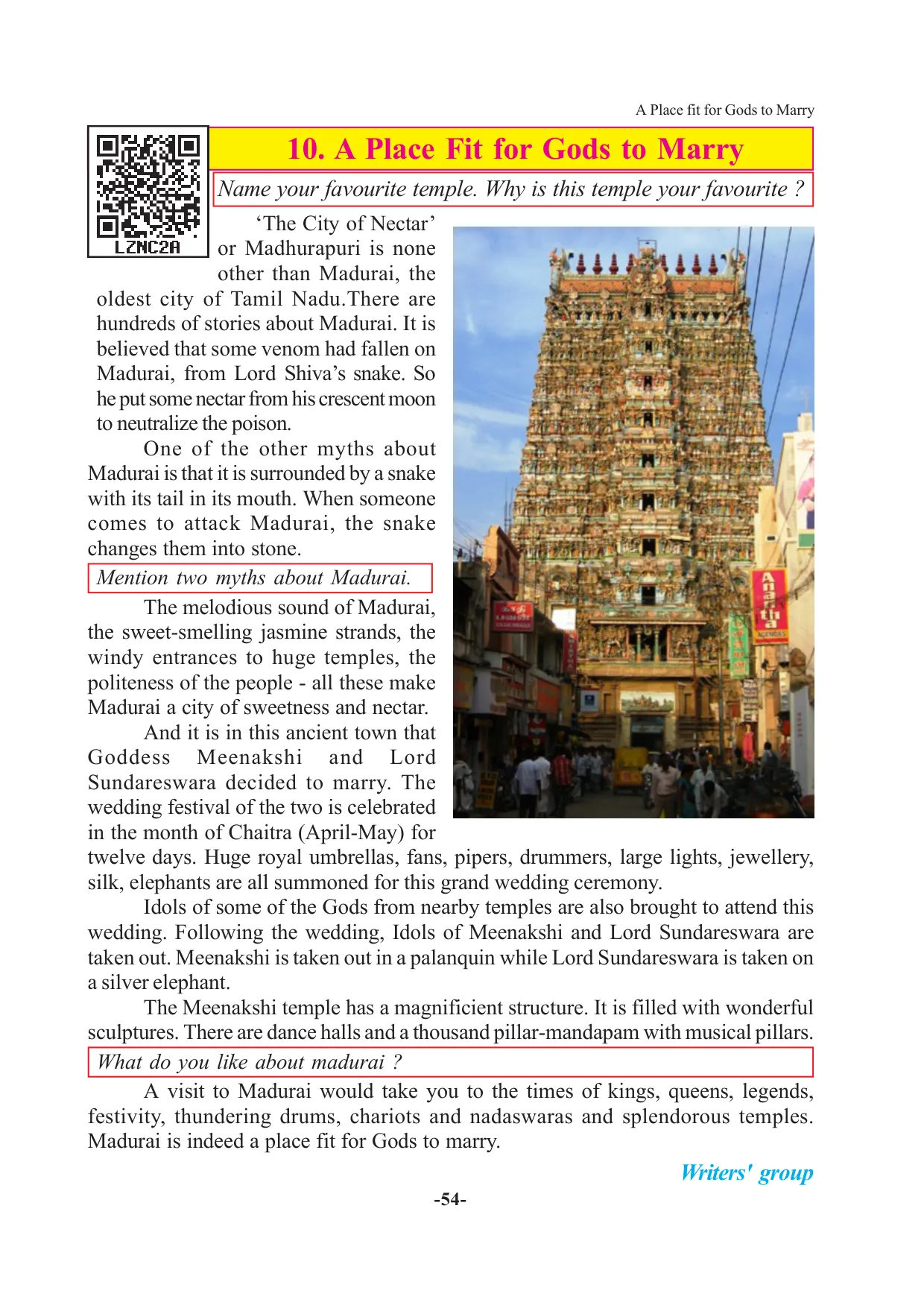
| Topic | Historic City of Madurai & Meenakshi Sundareshwarar Temple |
| Textbook Pages | Pages 54-59 |

| Word | Meaning |
|---|---|
| nectar | amrit; the sweet drink of gods conferring immortality |
| neutralize | to render harmless or ineffective |
| crescent | the curved sickle shape of the waxing/waning moon |
| palanquin | a covered litter for one passenger carried on poles |
| magnificent | extremely beautiful, elaborate, or impressive |
| splendour | magnificent and splendid appearance; grandeur |
| venom | poison secreted by snakes or scorpions |
| chariot | a two-wheeled vehicle drawn by horses; temple car |
Ans: Madurai was earlier known as ‘Madhurapuri’, meaning the city of divine nectar.
Q 2. Why is Madurai called the city of nectar?
Ans: According to legend, when Lord Shiva shook his crescent moon hair locks over the land, drops of sweet divine nectar fell upon the city, blessing it forever. Hence, it is called the city of nectar.
Q 3. Why did Shiva put nectar on Madurai?
Ans: Lord Shiva showered nectar to neutralize the deadly poison released by a venomous serpent sent to destroy the holy kingdom, purifying the land completely.
)
Q 4. How many legends about Madurai have you read in the lesson?
Ans: We read two major legends in the lesson: the legend of the divine drops of nectar neutralizing the serpent’s poison, and the legend of Goddess Meenakshi’s birth and her divine marriage to Lord Sundareshwara.
Q 5. Which of the legends about Madurai do you find the most interesting? Why?
Ans: The legend of Goddess Meenakshi is the most interesting because she was a courageous warrior queen whose extra third breast miraculously disappeared the moment she laid eyes on Lord Shiva, fulfilling the divine prophecy.
- After the wedding, Meenakshi is taken on a palanquin.
- Lord Sundareshwara is carried on a chariot.
- Goddess Meenakshi’s husband is Lord Sundareshwara (Lord Shiva).
- The people of Madurai speak Tamil language.
- Madurai is in Tamil Nadu state.
- The moon on Shiva’s head is crescent shaped.
- melodious: (b) musical
- neutralize: (b) to make something harmless
- venom: (a) poison
- nectar: (d) drink of Gods
- attack: (a) to harm someone
- ancient: (d) old
- summon: (a) tell someone to come
- magnificent: (a) grand
- sculpture: (a) statue
B. Match adjectives in Column A with opposites in Column B:
| Adjective (A) | Opposite (B) |
|---|---|
| polite | rude |
| sweet | bitter |
| bright | dull |
| neat | dirty |
| white | black |
| beautiful | ugly |
- Which item is the cheapest?
Ans: The Ludo is the cheapest item (₹55). - Which is the costliest item?
Ans: The cricket bat is the costliest item (₹200). - Which items are cheaper than the bat?
Ans: The hockey stick, racquet, football, chess-board, and Ludo are all cheaper than the bat. - Which items are as costly as the racquet?
Ans: The hockey stick and football are as costly as the racquet (each costs ₹120).
- Visitors at the mela should use dustbins for:
Ans: (c) (a) and (b), for keeping the venue neat and throwing the waste. - The vehicles should be parked at the:
Ans: (c) parking space.