DAV Class 8 Maths · Chapter 1
Squares and Square Roots: Previous Year Questions Solved
Every question on this chapter we found in DAV Class 8 annual exams, periodic assessments, periodic tests, half yearly exams and mock tests from 2019-20 to 2026-27, grouped by topic in the order of your book, with the full working. The paper name and year are printed on each question.
61 questions6 topics20 papersLatest papers first
Jump to a topic
1. Perfect Squares and Their Facts (5)2. Number Patterns: Non-Square Numbers and Pythagorean Triplets (16)3. Square Root by Repeated Subtraction (1)4. Square Root by Prime Factorisation (8)5. Square Root by Long Division (15)6. Square Roots of Fractions and Decimals (16)
Book exercise answers are on the Chapter 1 solutions page. For the whole chapter as classroom notes (every topic explained, these questions, new practice and a revision sheet), see the Chapter 1 notes PDF.
✦ DAV CLASS 8 · ANNUAL EXAM REVISION
Revise Maths fast: handwritten-style chapter notes
📖 Every chapter in short, neat pages🧠 Diagrams, tables, points to remember⚡ PDF on your email at once
Maths notes: all 16 chapters in one PDF, ₹99

Or one chapter at a time:
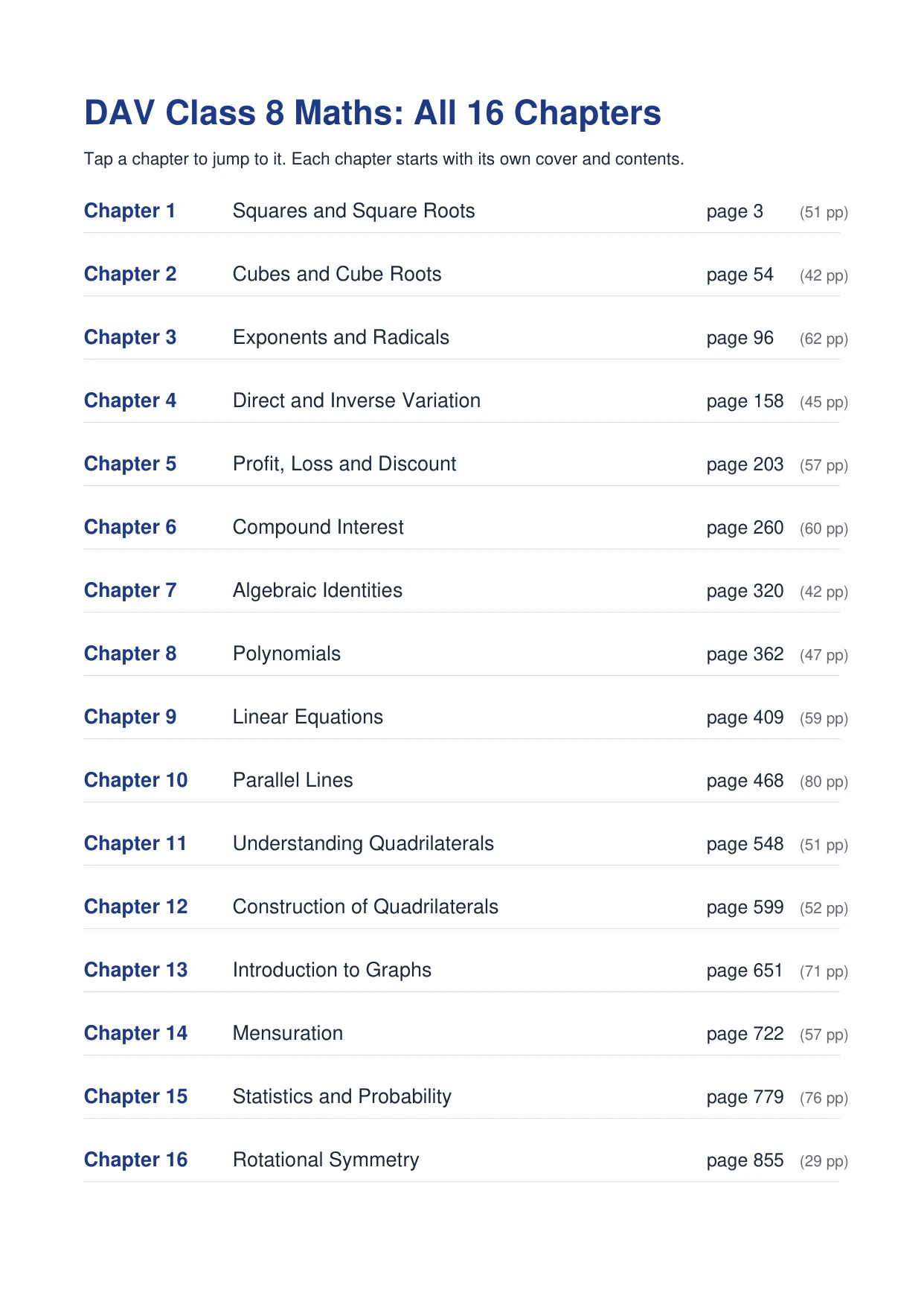
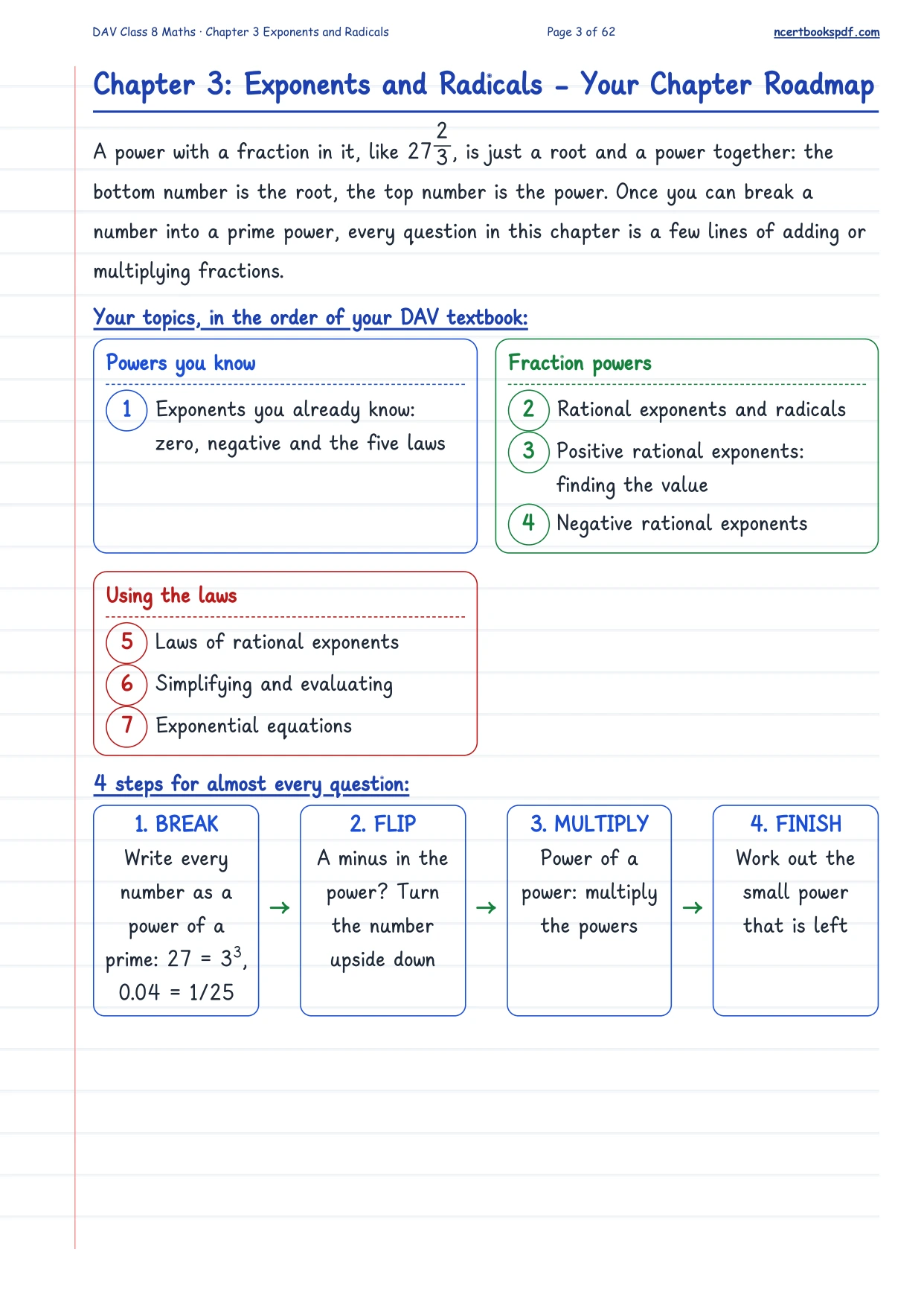
Ch 1 · Squares and Square Roots ₹11Ch 2 · Cubes and Cube Roots ₹11Ch 3 · Exponents and Radicals ₹11Ch 4 · Direct and Inverse Variation ₹11Ch 5 · Profit, Loss and Discount ₹11Ch 6 · Compound Interest ₹11Ch 7 · Algebraic Identities ₹11Ch 8 · Polynomials ₹11Ch 9 · Linear Equations ₹11Ch 10 · Parallel Lines ₹11Ch 11 · Understanding Quadrilaterals ₹11Ch 12 · Construction of Quadrilaterals ₹11Ch 13 · Introduction to Graphs ₹11Ch 14 · Mensuration ₹11Ch 15 · Statistics and Probability ₹11Ch 16 · Rotational Symmetry ₹11
Any problem or question about the notes or your payment? Email [email protected]
1Perfect Squares and Their Facts
Q11 markLatest paperAsked in: Periodic Test 1, 2025-26, West Bengal
The difference between the squares of two consecutive numbers is equal to their ______. (A) Difference (B) Sum (C) Product (D) Quotient
Solution
(n + 1)² − n² = 2n + 1 = (n + 1) + n, the sum of the two numbers.
Example: 7² − 6² = 49 − 36 = 13 = 7 + 6.
Answer: (B) Sum
Q21 markLatest paperAsked in: Periodic Test 2, 2025-26, West Bengal
Assertion (A): The square of an even number is always odd.
Reason (R): An even number can be expressed as 2n, where n is an integer. (a) Both A and R are true and R is the correct explanation of A (b) Both A and R are true and R is not the correct explanation of A (c) A is true but R is false (d) A is false but R is true
Solution
(2n)² = 4n², which is even. So the square of an even number is always even: (A) is false.
Every even number can be written as 2n: (R) is true. Example: 6² = 36 is even.
Answer: (d) A is false but R is true
Q31 markAsked in: Periodic Test 2, 2023-24, West Bengal
Which of the following numbers is not a perfect square? A) 529 B) 961 C) 1024 D) 1222
Solution
A perfect square never ends in 2, 3, 7 or 8. 1222 ends in 2, so it cannot be a square.
The others are squares: 23² = 529, 31² = 961, 32² = 1024.
Answer: D) 1222
Q42026-27 marksAsked in: Periodic Assessment 1
, 1 mark):
Solution
131 when expressed as the difference of the squares of the two consecutive natural numbers is A) 64² − 63² B) 62² − 61² C) 65² − 64² D) 66² − 65²
The difference of squares of n + 1 and n is their sum, so (n + 1) + n = 131.
2n + 1 = 131 gives n = 65.
131 = 66² − 65² (4,356 − 4,225 = 131).
Answer: D) 66² − 65²
Q52026-27 marksAsked in: Periodic Assessment 1
, 1 mark):
Solution
The smallest number, which when added to the difference of the squares of 15 and 11 gives a perfect square is A) 11 B) 12 C) 17 D) 15
15² − 11² = 225 − 121 = 104.
104 lies between 10² = 100 and 11² = 121.
The next square is 121, so add 121 − 104 = 17.
Answer: C) 17
2Number Patterns: Non-Square Numbers and Pythagorean Triplets
Q61 markLatest paperAsked in: Periodic Assessment 2, 2026-27
The number of non-perfect square numbers lying between 40² and 41² is: (A) 40 (B) 80 (C) 81 (D) 82
Solution
Between n² and (n + 1)² there are 2n non-square numbers.
Here n = 40, so there are 2 × 40 = 80.
Check: 40² = 1,600 and 41² = 1,681; the numbers in between are 1,601 to 1,680, that is 80 numbers, none of them a square.
Answer: (B) 80
Q71 markLatest paperAsked in: Periodic Test 1, 2025-26, West Bengal
The number of non-perfect square numbers lie between 225 and 256 is: (A) 31 (B) 450 (C) 30 (D) 481
Solution
225 = 15² and 256 = 16² are consecutive squares.
Between 15² and 16² there are 2 × 15 = 30 non-squares.
Answer: (C) 30
Q81 markLatest paperAsked in: Periodic Assessment 1, 2025-26
How many non-square numbers lies between 10² and 12²? (A) 23 (B) 42 (C) 24 (D) 1
Solution
The squares are two steps apart, so count in two blocks.
Between 10² and 11²: 2 × 10 = 20.
Between 11² and 12²: 2 × 11 = 22.
Total = 20 + 22 = 42.
Trap: 11² = 121 itself is a square, so it is not counted.
Answer: (B) 42
Q91 markLatest paperAsked in: Periodic Test 2, 2026-27, West Bengal
Assertion (A): There are 20 non-perfect square numbers between 10² and 11².
Reason (R): There are 2n non-perfect square numbers between two consecutive natural numbers n and (n + 1). A. Both A and R are true and R is the correct explanation of A. B. Both A and R are true but R is not the correct explanation of A. C. A is true but R is false. D. A is false but R is true
Solution
Between 10² = 100 and 11² = 121 there are 2 × 10 = 20 non-squares: (A) is true.
(R) as printed is wrong: between the numbers n and n + 1 there is no whole number at all. The rule is about their squares, n² and (n + 1)².
The paper's own answer key also gives (C).
Answer: C. A is true but R is false
Q101 markLatest paperAsked in: Periodic Test 1, 2026-27, West Bengal
If one member of a Pythagorean triplet is 2m, then the other two members are: (A) m, m² + 1 (B) m² + 1, m² − 1 (C) m², m² − 1 (D) m², m + 1
Solution
(m² − 1)² + (2m)² = m⁴ − 2m² + 1 + 4m² = m⁴ + 2m² + 1 = (m² + 1)².
So the triplet is 2m, m² − 1, m² + 1.
Answer: (B) m² + 1, m² − 1
Q111 markAsked in: Periodic Test 2, 2024-25, West Bengal
How many non-square numbers lies between 100² and 101²? (a) 100 (b) 150 (c) 200 (d) 250
Solution
Between n² and (n + 1)² there are 2n non-square numbers.
Here n = 100, so there are 2 × 100 = 200.
Check: 100² = 10,000 and 101² = 10,201; the numbers in between are 10,001 to 10,200, that is 200 numbers, none of them a square.
Answer: (c) 200
Q121 markAsked in: Periodic Test 1, 2024-25
How many non-square numbers are there between 49² and 50²? (a) 49 (b) 50 (c) 98 (d) 100
Solution
Between n² and (n + 1)² there are 2n non-square numbers.
Here n = 49, so there are 2 × 49 = 98.
Check: 49² = 2,401 and 50² = 2,500; the numbers in between are 2,402 to 2,499, that is 98 numbers, none of them a square.
Answer: (c) 98
Q131 markAsked in: Half Yearly Exam 2022-23
How many non-square numbers lie between 12² and 13²?
Solution
Between n² and (n + 1)² there are 2n non-square numbers.
Here n = 12, so there are 2 × 12 = 24.
Check: 12² = 144 and 13² = 169; the numbers in between are 145 to 168, that is 24 numbers, none of them a square.
Answer: 24
Q142026-27 marksAsked in: Periodic Assessment 1
, 1 mark):
Solution
How many non-square numbers lie between 9² and 11²? A) 22 B) 18 C) 9 D) 38
The squares are two steps apart, so count in two blocks.
Between 9² and 10²: 2 × 9 = 18.
Between 10² and 11²: 2 × 10 = 20.
Total = 18 + 20 = 38.
Trap: 10² = 100 itself is a square, so it is not counted.
Answer: D) 38
Q151 markAsked in: Periodic Assessment 2, 2023-24
The number of non-perfect square numbers present between 11² and 13² is A. 22 B. 24 C. 46 D. 48
Solution
The squares are two steps apart, so count in two blocks.
Between 11² and 12²: 2 × 11 = 22.
Between 12² and 13²: 2 × 12 = 24.
Total = 22 + 24 = 46.
Trap: 12² = 144 itself is a square, so it is not counted.
Answer: C. 46
Q161 markAsked in: Periodic Test 2, 2024-25, West Bengal
Which of the following is a Pythagorean triplet? (a) (2,3,5) (b) (5,7,9) (c) (6,9,11) (d) (8,15,17)
Solution
Check a² + b² = c² for each.
8² + 15² = 64 + 225 = 289 = 17². The others fail: 4 + 9 ≠ 25, 25 + 49 ≠ 81, 36 + 81 ≠ 121.
Answer: (d) (8, 15, 17)
Q171 markAsked in: Half Yearly Exam 2022-23
Find the Pythagorean Triplet whose smallest number is 6.
Solution
Take 2m = 6, so m = 3.
m² − 1 = 8 and m² + 1 = 10.
Check: 6² + 8² = 36 + 64 = 100 = 10².
Answer: 6, 8, 10
Q181 markAsked in: Half Yearly Exam 2022-23
Write the Pythagorean triplet whose one of the numbers is 4.
OR Write down the correct number in the box. 41² − 40² = ☐ = ☐
Solution
Take 2m = 4, so m = 2: m² − 1 = 3, m² + 1 = 5. The triplet is 3, 4, 5 (9 + 16 = 25).
OR The difference of squares of consecutive numbers is their sum: 41² − 40² = 41 + 40 = 81.
Answer: 3, 4, 5; OR 41 + 40 = 81
Q191 markAsked in: Annual Exam 2019-20
Express 16 as sum of odd numbers.
OR Find the square root of the sum of the cubes of first three natural numbers.
Solution
16 = 4², and n² is the sum of the first n odd numbers: 16 = 1 + 3 + 5 + 7.
OR 1³ + 2³ + 3³ = 1 + 8 + 27 = 36, and √36 = 6.
Answer: 16 = 1 + 3 + 5 + 7; OR 6
Q202 marksAsked in: Annual Exam 2023-24
Find the Pythagorean triplet whose smallest number is 12.
Solution
Take 2m = 12, so m = 6.
m² − 1 = 35 and m² + 1 = 37.
Check: 12² + 35² = 144 + 1,225 = 1,369 = 37².
Answer: 12, 35, 37
Q212 marksAsked in: Annual Exam 2021-22
Write a Pythagorean triplet whose one member is 16.
OR Sum of the squares of 2 numbers is 145. If square root of one number is 3, find the other.
Solution
Take 2m = 16, so m = 8: m² − 1 = 63, m² + 1 = 65. Check: 256 + 3,969 = 4,225 = 65².
OR The number whose square root is 3 is 9. Its square is 81.
The other square = 145 − 81 = 64, so the other number is 8.
Answer: 16, 63, 65; OR 8
3Square Root by Repeated Subtraction
Q222 marksLatest paperAsked in: Periodic Assessment 1, 2025-26
Find √16 by repeated subtraction method.
Solution
Subtract odd numbers 1, 3, 5, 7, … until you reach 0.
16 − 1 = 15, 15 − 3 = 12, 12 − 5 = 7, 7 − 7 = 0.
Zero came after 4 subtractions, so √16 = 4.
Answer: 4
4Square Root by Prime Factorisation
Q231 markLatest paperAsked in: Periodic Test 2, 2025-26, West Bengal
The smallest number by which 125 must be divided to make it a perfect square is: (a) 7 (b) 5 (c) 8 (d) 2
Solution
125 = 5 × 5 × 5. One 5 has no partner.
Divide by 5: 125 ÷ 5 = 25 = 5².
Answer: (b) 5
Q241 markLatest paperAsked in: Annual Exam 2025-26
The least number to be multiplied by 12348 so that the product is a perfect square is: (A) 3 (B) 4 (C) 5 (D) 7
Solution
12348 = 2 × 2 × 3 × 3 × 7 × 7 × 7.
One 7 has no partner, so multiply by 7.
12348 × 7 = 86,436 = 294².
Answer: (D) 7
Q251 markLatest paperAsked in: Periodic Test 2, 2026-27, West Bengal
The least perfect square which is divisible by 8, 15 and 21 is: (A) 44100 (B) 88200 (C) 176400 (D) 352800
Solution
LCM of 8, 15 and 21 = 840 = 2 × 2 × 2 × 3 × 5 × 7.
Unpaired: one 2, 3, 5 and 7. Multiply by 2 × 3 × 5 × 7 = 210.
840 × 210 = 1,76,400 = 420².
Answer: (C) 176400
Q262 marksLatest paperAsked in: Periodic Assessment 2, 2026-27
Find the smallest number by which 1280 must be multiplied so that the product is a perfect square.
Solution
1280 = 2 × 2 × 2 × 2 × 2 × 2 × 2 × 2 × 5 (eight 2s make four pairs).
The 5 has no partner, so multiply by 5.
1280 × 5 = 6,400 = 80².
Answer: 5
Q271 markAsked in: Half Yearly Exam 2022-23
Find the square root of 441 by prime factorization.
Solution
441 = 3 × 3 × 7 × 7.
Take one number from each pair: √441 = 3 × 7 = 21.
Answer: 21
Q282 marksAsked in: Mock Test 2023-24, West Bengal
By what smallest number must 180 be multiplied so that it becomes a perfect square? Also, find the square root of number so obtained.
Solution
180 = 2 × 2 × 3 × 3 × 5.
The 5 has no partner, so multiply by 5: 180 × 5 = 900.
√900 = 2 × 3 × 5 = 30.
Answer: 5; √900 = 30
Q292 marksAsked in: Periodic Assessment 2, 2023-24
Find the smallest number by which 3750 must be multiplied so that the product becomes a perfect square.
Solution
3750 = 2 × 3 × 5 × 5 × 5 × 5.
2 and 3 have no partners, so multiply by 2 × 3 = 6.
3750 × 6 = 22,500 = 150².
Answer: 6
Q303 marksAsked in: Periodic Assessment 2, 2024-25
Find the smallest perfect square which is divisible by 3, 4, 5 and 6.
Solution
LCM of 3, 4, 5 and 6 = 60 = 2 × 2 × 3 × 5.
3 and 5 have no partners, so multiply by 3 × 5 = 15.
60 × 15 = 900 = 30², and 900 is divisible by 3, 4, 5 and 6.
Answer: 900
5Square Root by Long Division
Q312 marksLatest paperAsked in: Periodic Test 1, 2026-27, West Bengal
Find the least number of four digits that is a perfect square.
Solution
The least 4-digit number is 1,000. 31² = 961 has 3 digits.
32² = 1,024, so 1,024 is the least four-digit perfect square.
Also asked in: Mock Test 2023-24, West Bengal.
Answer: 1024
Q323 marksLatest paperAsked in: Periodic Assessment 2, 2026-27
Find the least number that must be added to 6412 to make it a perfect square.
Solution
Pair the digits from the right: 64 | 12.
Largest square ≤ 64 is 8² = 64. Quotient 8, remainder 0.
Bring down 12: dividend 12. Divisor 16_ ; 160 × 0 = 0 ≤ 12. Remainder 12.
6,412 lies between 80² = 6,400 and 81² = 6,561.
Least number to add = 6,561 − 6,412 = 149.
The perfect square is 6,561 and its square root is 81.
Answer: 149; √6,561 = 81
Q333 marksLatest paperAsked in: Periodic Test 2, 2025-26, West Bengal
Find the least number which must be added to 7581 to obtain a perfect square. Also find the square root of the number obtained.
OR Find the greatest four-digit number which is a perfect square.
Solution
Pair the digits from the right: 75 | 81.
Largest square ≤ 75 is 8² = 64. Quotient 8, remainder 11.
Bring down 81: dividend 1181. Divisor 16_ ; 167 × 7 = 1169 ≤ 1181. Remainder 12.
7,581 lies between 87² = 7,569 and 88² = 7,744.
Least number to add = 7,744 − 7,581 = 163.
The perfect square is 7,744 and its square root is 88.
OR The greatest 4-digit number is 9,999. √9,999 is a little under 100 (100² = 10,000).
99² = 9,801, so 9,801 is the greatest four-digit perfect square.
Answer: 163; √7,744 = 88; OR 9801
Q345 marksLatest paperAsked in: Periodic Test 2, 2026-27, West Bengal
Find the square root of 10 2/3 correct to three places of decimal.
OR An army officer wishes to draw up his 36,581 soldiers in the form of a square. After arranging them, he found that some of the soldiers are left out. 1. How many soldiers are left out? 2. How many soldiers were arranged in the form of a square? 3. Find the number of soldiers in each row.
Solution
10 2/3 = 32/3 = 10.666666…
Long division of 10.66 66 66 66 gives 3.2659…, so to three places √(10 2/3) = 3.266.
Check: 3.266² = 10.666756, very close to 10.6667.
OR Pair the digits from the right: 3 | 65 | 81.
Largest square ≤ 3 is 1² = 1. Quotient 1, remainder 2.
Bring down 65: dividend 265. Divisor 2_ ; 29 × 9 = 261 ≤ 265. Remainder 4.
Bring down 81: dividend 481. Divisor 38_ ; 381 × 1 = 381 ≤ 481. Remainder 100.
1. 191² = 36,481, so 36,581 − 36,481 = 100 soldiers are left out.
2. 36,481 soldiers were arranged in the square.
3. Each row has √36,481 = 191 soldiers.
Answer: 3.266; OR 1. 100 2. 36,481 3. 191
Q352 marksAsked in: Periodic Assessment 2, 2023-24
Find the least number which must be added to 7083 to get a perfect square.
Solution
Pair the digits from the right: 70 | 83.
Largest square ≤ 70 is 8² = 64. Quotient 8, remainder 6.
Bring down 83: dividend 683. Divisor 16_ ; 164 × 4 = 656 ≤ 683. Remainder 27.
7,083 lies between 84² = 7,056 and 85² = 7,225.
Least number to add = 7,225 − 7,083 = 142.
The perfect square is 7,225 and its square root is 85.
Answer: 142; √7,225 = 85
Q363 marksAsked in: Half Yearly Exam 2022-23
Find the square root of 4401604 by long division method.
Solution
Pair the digits from the right: 4 | 40 | 16 | 04.
Largest square ≤ 4 is 2² = 4. Quotient 2, remainder 0.
Bring down 40: dividend 40. Divisor 4_ ; 40 × 0 = 0 ≤ 40. Remainder 40.
Bring down 16: dividend 4016. Divisor 40_ ; 409 × 9 = 3681 ≤ 4016. Remainder 335.
Bring down 04: dividend 33504. Divisor 418_ ; 4188 × 8 = 33504 ≤ 33504. Remainder 0.
Remainder 0, so √4,401,604 = 2,098.
Check: 2098² = 4,401,604.
Answer: 2098
Q372026-27 marksAsked in: Periodic Assessment 1
, 3 marks):
Solution
Find the least number which must be added to 6203 to obtain a perfect square. Also find the square root of the number so obtained.
Pair the digits from the right: 62 | 03.
Largest square ≤ 62 is 7² = 49. Quotient 7, remainder 13.
Bring down 03: dividend 1303. Divisor 14_ ; 148 × 8 = 1184 ≤ 1303. Remainder 119.
6,203 lies between 78² = 6,084 and 79² = 6,241.
Least number to add = 6,241 − 6,203 = 38.
The perfect square is 6,241 and its square root is 79.
Answer: 38; √6,241 = 79
Q383 marksAsked in: Annual Exam 2021-22
Find the least number which must be added to 5431 to make it a perfect square. Also find square root of the number so obtained.
Solution
Pair the digits from the right: 54 | 31.
Largest square ≤ 54 is 7² = 49. Quotient 7, remainder 5.
Bring down 31: dividend 531. Divisor 14_ ; 143 × 3 = 429 ≤ 531. Remainder 102.
5,431 lies between 73² = 5,329 and 74² = 5,476.
Least number to add = 5,476 − 5,431 = 45.
The perfect square is 5,476 and its square root is 74.
Answer: 45; √5,476 = 74
Q393 marksAsked in: Periodic Test 2, 2023-24, West Bengal
Find the least number that must be added to 15370 to make it a perfect square? Also, find the square root of the number so obtained.
Solution
Pair the digits from the right: 1 | 53 | 70.
Largest square ≤ 1 is 1² = 1. Quotient 1, remainder 0.
Bring down 53: dividend 53. Divisor 2_ ; 22 × 2 = 44 ≤ 53. Remainder 9.
Bring down 70: dividend 970. Divisor 24_ ; 243 × 3 = 729 ≤ 970. Remainder 241.
15,370 lies between 123² = 15,129 and 124² = 15,376.
Least number to add = 15,376 − 15,370 = 6.
The perfect square is 15,376 and its square root is 124.
Also asked in: Periodic Test 1, 2025-26, West Bengal.
Answer: 6; √15,376 = 124
Q403 marksAsked in: Half Yearly Exam 2022-23
Find the least number that must be added to 1500 so as to get a perfect square. Also find the square root of the perfect square.
OR Find the least square number which is exactly divisible by 3, 4, 5, 6 and 8.
Solution
Pair the digits from the right: 15 | 00.
Largest square ≤ 15 is 3² = 9. Quotient 3, remainder 6.
Bring down 00: dividend 600. Divisor 6_ ; 68 × 8 = 544 ≤ 600. Remainder 56.
1,500 lies between 38² = 1,444 and 39² = 1,521.
Least number to add = 1,521 − 1,500 = 21.
The perfect square is 1,521 and its square root is 39.
OR LCM of 3, 4, 5, 6 and 8 = 120 = 2 × 2 × 2 × 3 × 5.
Unpaired: one 2, the 3 and the 5. Multiply by 2 × 3 × 5 = 30: 120 × 30 = 3,600 = 60².
Answer: 21; √1,521 = 39; OR 3600
Q413 marksAsked in: Annual Exam 2022-23
Find the least number which must be subtracted from 7581 to obtain a perfect square. Also find the square root of the number so obtained.
Solution
Pair the digits from the right: 75 | 81.
Largest square ≤ 75 is 8² = 64. Quotient 8, remainder 11.
Bring down 81: dividend 1181. Divisor 16_ ; 167 × 7 = 1169 ≤ 1181. Remainder 12.
The remainder 12 is the extra over a perfect square.
Subtract 12: 7,581 − 12 = 7,569 = 87².
Also asked in: Periodic Assessment 2, 2024-25.
Answer: 12; √7,569 = 87
Q422026-27 marksAsked in: Periodic Assessment 1
, 3 marks):
Solution
A farmer has 8934 tiles to arrange into a square-shaped field, with each side having an equal number of tiles. He finds 8934 cannot form a perfect square. What is the least number of tiles he must remove to arrange the rest into a perfect square, and how many tiles will each side have?
Pair the digits from the right: 89 | 34.
Largest square ≤ 89 is 9² = 81. Quotient 9, remainder 8.
Bring down 34: dividend 834. Divisor 18_ ; 184 × 4 = 736 ≤ 834. Remainder 98.
Remainder 98: remove 98 tiles.
8,934 − 98 = 8,836 = 94², so each side has 94 tiles.
Answer: Remove 98 tiles; 94 tiles on each side
Q433 marksAsked in: Annual Exam 2023-24
Find the greatest number of 6 digits which is a perfect square. Also find the square root of the resulting number.
Solution
The greatest 6-digit number is 9,99,999.
Pair the digits from the right: 99 | 99 | 99.
Largest square ≤ 99 is 9² = 81. Quotient 9, remainder 18.
Bring down 99: dividend 1899. Divisor 18_ ; 189 × 9 = 1701 ≤ 1899. Remainder 198.
Bring down 99: dividend 19899. Divisor 198_ ; 1989 × 9 = 17901 ≤ 19899. Remainder 1998.
Subtract the remainder: 9,99,999 − 1,998 = 9,98,001 = 999².
Answer: 998001; √998,001 = 999
Q443 marksAsked in: Periodic Test 2, 2024-25, West Bengal
In a lecture hall, 8,649 students are sitting in such a manner that there are as many students in a row as there are rows in the lecture hall. How many students are there in each row of the lecture hall?
OR Find the least number of six digits which is a perfect square. Find the square root of this number.
Solution
Rows × students in a row = 8,649 with both equal, so the answer is √8,649.
Pair the digits from the right: 86 | 49.
Largest square ≤ 86 is 9² = 81. Quotient 9, remainder 5.
Bring down 49: dividend 549. Divisor 18_ ; 183 × 3 = 549 ≤ 549. Remainder 0.
Remainder 0: 93 students in each row.
OR 316² = 99,856 has 5 digits; 317² = 1,00,489 is the least 6-digit square.
Answer: 93; OR 100489, √ = 317
Q454 marksAsked in: Periodic Assessment 2, 2019-20
Find the least number of 6 digits which is a perfect square. Find the square root of this number.
Solution
The least 6-digit number is 1,00,000.
Pair the digits from the right: 10 | 00 | 00.
Largest square ≤ 10 is 3² = 9. Quotient 3, remainder 1.
Bring down 00: dividend 100. Divisor 6_ ; 61 × 1 = 61 ≤ 100. Remainder 39.
Bring down 00: dividend 3900. Divisor 62_ ; 626 × 6 = 3756 ≤ 3900. Remainder 144.
316² = 99,856 has only 5 digits, so take the next square.
317² = 1,00,489 is the least 6-digit perfect square; its square root is 317.
Also asked in: Periodic Assessment 2, 2025-26.
Answer: 100489; √1,00,489 = 317
6Square Roots of Fractions and Decimals
Q461 markLatest paperAsked in: Periodic Test 2, 2025-26, West Bengal
If √(16/49) = n/49, then value of n is (a) 28 (b) 4 (c) 7 (d) 16
Solution
√(16/49) = √16 ÷ √49 = 4/7.
4/7 = 28/49 (multiply top and bottom by 7), so n = 28.
Answer: (a) 28
Q471 markLatest paperAsked in: Periodic Assessment 1, 2025-26
The value of √144 + √1.44 is (A) 24 (B) 1.32 (C) 13.2 (D) 13.44
Solution
√144 = 12 and √1.44 = 1.2.
12 + 1.2 = 13.2.
Answer: (C) 13.2
Q485 marksLatest paperAsked in: Periodic Test 1, 2025-26, West Bengal
Find the square root of 2 1/5 correct to two places of decimal.
Solution
2 1/5 = 11/5 = 2.2.
Long division of 2.20 00 00: 1; 24 × 4 = 96; 288 × 8 = 2,304; 2963 × 3 = 8,889. So √2.2 = 1.483…
Find three places, then round: 1.483 ≈ 1.48.
Answer: 1.48
Q495 marksLatest paperAsked in: Periodic Test 1, 2026-27, West Bengal
Find the square root of 7 correct to three decimal places, hence find the value of √(28/9).
Solution
Long division of 7.00 00 00 00: 2 (remainder 3); 46 × 6 = 276 (remainder 24); 524 × 4 = 2,096 (remainder 304); 5285 × 5 = 26,425; next digit 7.
√7 = 2.6457…, so to three places √7 = 2.646.
√(28/9) = √(4 × 7) ÷ 3 = 2√7 ÷ 3 = 2 × 2.6457 ÷ 3 = 1.7638… ≈ 1.764.
Answer: √7 = 2.646; √(28/9) = 1.764
Q501 markAsked in: Periodic Test 2, 2023-24, West Bengal
√72 × √98 = ? A) 42 B) 84 C) 64 D) 74
Solution
√72 × √98 = √(72 × 98) = √7,056.
72 × 98 = 2 × 36 × 2 × 49 = 4 × 36 × 49, so the root is 2 × 6 × 7 = 84.
Answer: B) 84
Q511 markAsked in: Periodic Test 2, 2024-25, West Bengal
√0.9 × √1.6 = ? (a) 0.12 (b) 1.2 (c) 0.75 (d) 12
Solution
√0.9 × √1.6 = √(0.9 × 1.6) = √1.44.
√1.44 = 1.2 (because 1.2 × 1.2 = 1.44).
Answer: (b) 1.2
Q522026-27 marksAsked in: Periodic Assessment 1
, 1 mark):
Solution
√0.012321 is equal to A) 1.11 B) 11.1 C) 0.111 D) 111
0.012321 = 12321 / 10,00,000.
√12321 = 111 and √10,00,000 = 1,000, so the root is 0.111.
Check: 0.111 × 0.111 = 0.012321.
Also asked in: Periodic Assessment 1, 2026-27 (Set B).
Answer: C) 0.111
Q531 markAsked in: Periodic Assessment 2, 2024-25
If √x + 3 = 5.5, then value of x is a) 6.25 b) 2.5 c) 5 d) 1.5
Solution
√x = 5.5 − 3 = 2.5.
x = 2.5² = 6.25.
Answer: a) 6.25
Q541 markAsked in: Annual Exam 2023-24
The value of √(44 + √(14 + √121)) is: (a) 7 (b) 4 (c) 15 (d) 11
Solution
Work from the innermost root outwards.
√121 = 11, so √(14 + 11) = √25 = 5.
√(44 + 5) = √49 = 7.
Answer: (a) 7
Q551 markAsked in: Periodic Assessment 2, 2024-25
The Value of √(248 + √(52 + √144)) is: a) 14 b) 12 c) 16 d) 13
Solution
√144 = 12, so √(52 + 12) = √64 = 8.
√(248 + 8) = √256 = 16.
Answer: c) 16
Q561 markAsked in: Periodic Assessment 2, 2019-20
Find the square of 0.009.
Solution
0.009 = 9/1,000.
(9/1,000)² = 81/10,00,000 = 0.000081 (six decimal places: twice the three of 0.009).
Answer: 0.000081
Q572 marksAsked in: Half Yearly Exam 2022-23
Evaluate: √64 + √0.0064 + √0.0441.
Solution
√64 = 8.
√0.0064 = √(64/10,000) = 8/100 = 0.08.
√0.0441 = √(441/10,000) = 21/100 = 0.21.
Sum = 8 + 0.08 + 0.21 = 8.29.
Answer: 8.29
Q582 marksAsked in: Periodic Test 1, 2024-25
Find the value of √(18 + √(39 + √(88 + √144)))
Solution
√144 = 12, so √(88 + 12) = √100 = 10.
√(39 + 10) = √49 = 7.
√(18 + 7) = √25 = 5.
Answer: 5
Q593 marksAsked in: Periodic Assessment 2, 2023-24
Find the square root of 10 correct to two decimal places.
Solution
Write 10 as 10.00 00 00.
Long division: 3 (remainder 1); 61 × 1 = 61 (remainder 39); 626 × 6 = 3,756 (remainder 144); 6322 × 2 = 12,644.
√10 = 3.162…, so to two places √10 = 3.16.
Answer: 3.16
Q603 marksAsked in: Periodic Assessment 2, 2019-20
Find the square root of 5 1/2 correct to two places of decimal.
Solution
5 1/2 = 5.5 = 5.50 00 00.
Long division: 2 (remainder 1); 43 × 3 = 129 (remainder 21); 464 × 4 = 1,856 (remainder 244); 4685 × 5 = 23,425.
√5.5 = 2.345…, and the third digit 5 rounds the second up: 2.35.
Answer: 2.35
Q615 marksAsked in: Periodic Test 2, 2023-24, West Bengal
Find the square root of 2 correct to three places of decimal.
Solution
Write 2 as 2.00 00 00 00 and divide in pairs.
Digits: 1 (1² = 1, remainder 1); 24 × 4 = 96 (remainder 4); 281 × 1 = 281 (remainder 119); 2824 × 4 = 11,296 (remainder 604).
Next digit: 28282 × 2 = 56,564 ≤ 60,400, so √2 = 1.4142…
Correct to three places: 1.414.
Answer: 1.414