DAV Class 8 Maths · Chapter 10
Parallel Lines: Previous Year Questions Solved
Every question on this chapter we found in DAV Class 8 annual exams, periodic assessments, periodic tests and half yearly exams from 2019-20 to 2026-27, grouped by topic in the order of your book, with the full working. The paper name and year are printed on each question.
55 questions7 topics20 papersLatest papers first
Jump to a topic
1. Transversal and the Names of Angle Pairs (1)2. Parallel Lines Cut by a Transversal: Finding the Angles (18)3. Proving That Two Lines Are Parallel (9)4. Harder Figures: Several Lines, Triangles and Bends (17)5. Lines Parallel or Perpendicular to the Same Line (2)6. Dividing a Line Segment into Equal Parts (1)7. Dividing a Line Segment in a Given Ratio (7)
Book exercise answers are on the Chapter 10 solutions page. For the whole chapter as classroom notes (every topic explained, these questions, new practice and a revision sheet), see the Chapter 10 notes PDF.
✦ DAV CLASS 8 · ANNUAL EXAM REVISION
Revise Maths fast: handwritten-style chapter notes
📖 Every chapter in short, neat pages🧠 Diagrams, tables, points to remember⚡ PDF on your email at once
Maths notes: all 16 chapters in one PDF, ₹99

Or one chapter at a time:
Ch 1 · Squares and Square Roots ₹11Ch 2 · Cubes and Cube Roots ₹11Ch 3 · Exponents and Radicals ₹11Ch 4 · Direct and Inverse Variation ₹11Ch 5 · Profit, Loss and Discount ₹11Ch 6 · Compound Interest ₹11Ch 7 · Algebraic Identities ₹11Ch 8 · Polynomials ₹11Ch 9 · Linear Equations ₹11Ch 10 · Parallel Lines ₹11Ch 11 · Understanding Quadrilaterals ₹11Ch 12 · Construction of Quadrilaterals ₹11Ch 13 · Introduction to Graphs ₹11Ch 14 · Mensuration ₹11Ch 15 · Statistics and Probability ₹11Ch 16 · Rotational Symmetry ₹11
Any problem or question about the notes or your payment? Email [email protected]
1Transversal and the Names of Angle Pairs
Q11 markAsked in: Annual Exam 2023-24
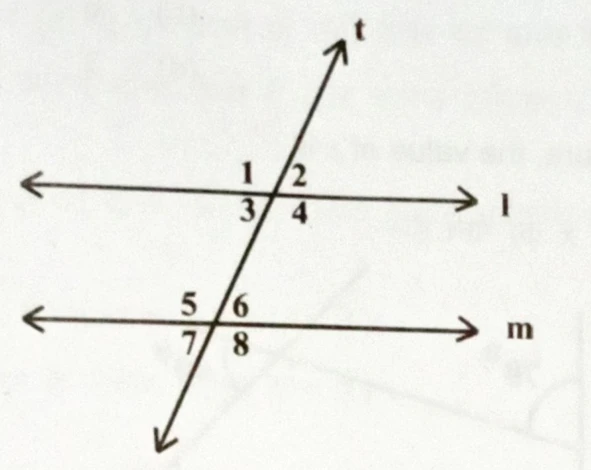
In the figure given below, l ∥ m and t is a transversal line. Which pair of angles is not supplementary? (a) ∠1 and ∠6 (b) ∠3 and ∠8 (c) ∠3 and ∠5 (d) ∠4 and ∠8
Solution
In the figure the angles are numbered 1 (top-left), 2 (top-right), 3 (bottom-left), 4 (bottom-right) at l, and 5 to 8 in the same corners at m.
∠1 and ∠6: ∠6 = ∠3 (alternate angles) and ∠1 + ∠3 = 180° (linear pair), so they add to 180°.
∠3 and ∠8: ∠8 = ∠4 (corresponding) and ∠3 + ∠4 = 180°. ∠3 and ∠5 are co-interior: 180°.
∠4 and ∠8 are corresponding angles: they are EQUAL, not supplementary (unless both are 90°).
Answer: (d) ∠4 and ∠8
2Parallel Lines Cut by a Transversal: Finding the Angles
Q21 markLatest paperAsked in: Periodic Assessment 2, 2026-27
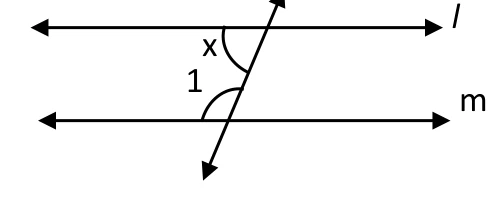
If l ∥ m and ∠1 = 115°, then the value of x is: (A) 70° (B) 60° (C) 50° (D) 65°
Solution
x is below l and ∠1 is above m, both on the left of the transversal: co-interior angles.
So x + 115° = 180° and x = 65°.
Also asked in: Periodic Assessment 2, 2025-26.
Answer: (D) 65°
Q31 markLatest paperAsked in: Periodic Assessment 2, 2026-27
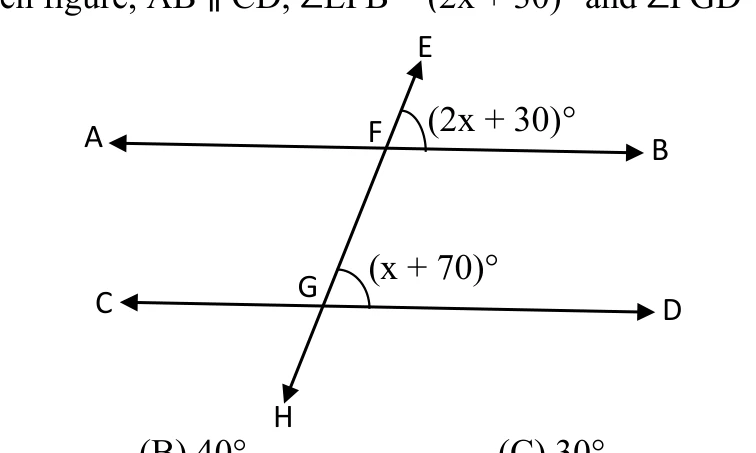
In the given figure, AB ∥ CD, ∠EFB = (2x + 30)° and ∠FGD = (x + 70)°. The value of x is: (A) 50° (B) 40° (C) 30° (D) 20°
Solution
∠EFB and ∠FGD are corresponding angles (both on the right of the transversal, above AB and above CD).
AB ∥ CD, so 2x + 30 = x + 70 and x = 40.
Answer: (B) 40°
Q41 markLatest paperAsked in: Annual Exam 2025-26
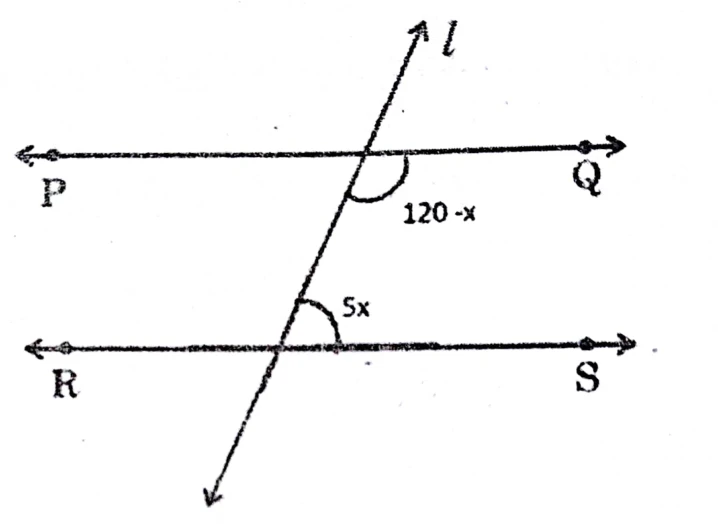
In the given figure PQ ∥ RS and line l is a transversal, then the value of x is: (A) 15° (B) 20° (C) 25° (D) 30°
Solution
(120° − x) is below PQ and 5x is above RS, both on the right of l: they are interior angles on the same side (co-interior).
(120 − x) + 5x = 180, so 4x = 60 and x = 15.
Check: 120° − 15° = 105° and 5 × 15° = 75°; 105° + 75° = 180°.
Answer: (A) 15°
Q51 markLatest paperAsked in: Periodic Test 2, 2025-26, West Bengal
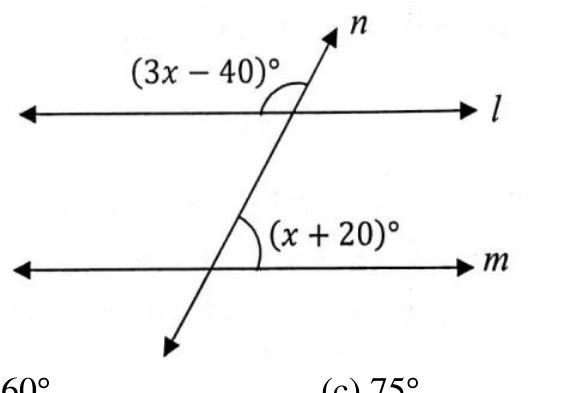
In the given figure l ∥ m, find the value of x: (a) 50° (b) 60° (c) 75° (d) 90°
Solution
(3x − 40)° is above l on the left of n; the angle above m on the left of n corresponds to it, and makes a linear pair with (x + 20)°.
(3x − 40) + (x + 20) = 180, so 4x = 200 and x = 50.
Answer: (a) 50°
Q61 markLatest paperAsked in: Periodic Test 1, 2025-26, West Bengal
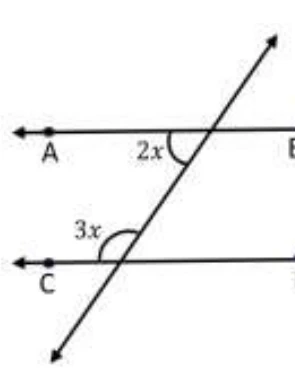
In the given figure, if AB ∥ CD, then the value of x is: (A) 80° (B) 10° (C) 72° (D) 36°
Solution
2x and 3x are interior angles on the same side of the transversal.
2x + 3x = 180°, so x = 36°.
Answer: (D) 36°
Q71 markLatest paperAsked in: Periodic Assessment 2, 2025-26
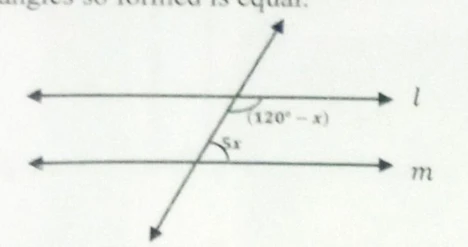
Assertion (A): The value of x from the adjoining figure, if l ∥ m, is 15°.
Reason (R): If two parallel lines are intersected by a transversal, then each pair of corresponding angles so formed is equal.
Reason (R): If two parallel lines are intersected by a transversal, then each pair of corresponding angles so formed is equal.
Solution
(120° − x) is below l and 5x is above m, both on the right of the transversal: co-interior angles, so they add to 180°.
(120 − x) + 5x = 180, so 4x = 60 and x = 15°. (A) is true.
(R) is a true fact, but the figure uses co-interior angles, not corresponding angles, so (R) does not explain (A).
Answer: Both A and R are true, but R is not the correct explanation of A
Q82 marksLatest paperAsked in: Periodic Test 2, 2025-26, West Bengal
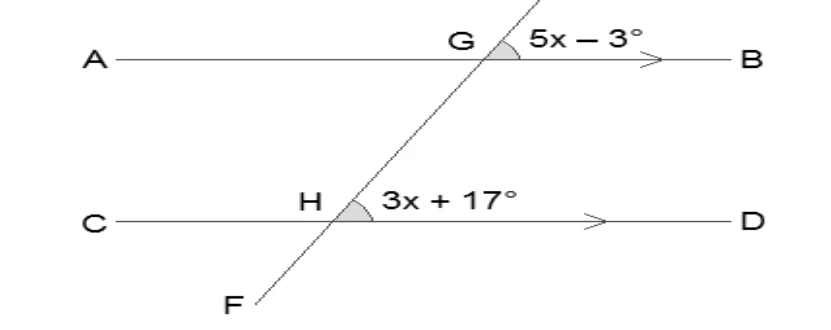
In the given figure, AB ∥ CD, find the value of ∠GHD. (∠BGE = (5x − 3)° and ∠GHD = (3x + 17)°.) (The
OR part has its own figure and is not included here.)
OR part has its own figure and is not included here.)
Solution
∠BGE and ∠GHD are corresponding angles (both to the right of EF, above AB and above CD).
5x − 3 = 3x + 17, so 2x = 20 and x = 10.
∠GHD = 3 × 10 + 17 = 47°.
Answer: 47°
Q94 marksLatest paperAsked in: Periodic Test 2, 2026-27, West Bengal
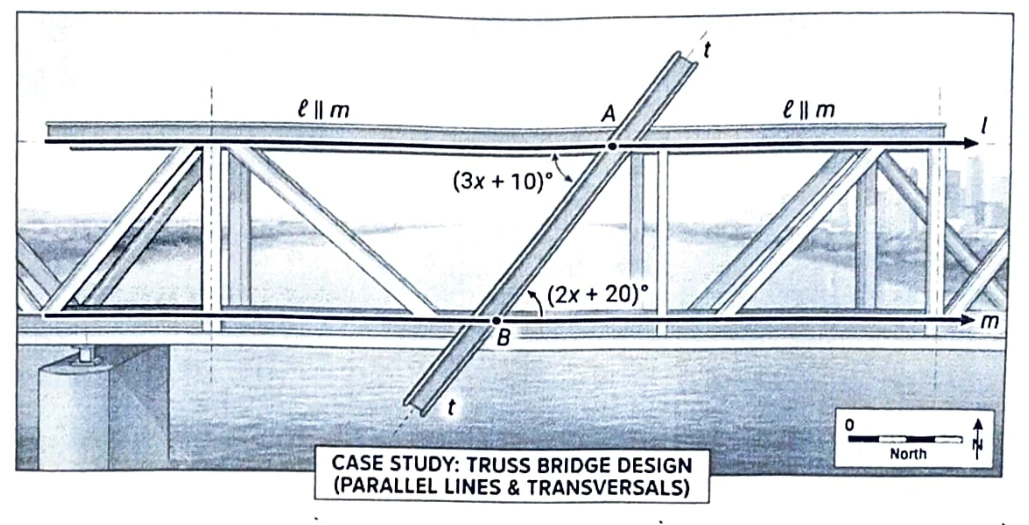
CASE STUDY: An architect is designing a steel truss bridge. The two parallel top and bottom beams are horizontal lines l and m (l ∥ m), and diagonal cables are transversals. A diagonal beam t meets l at A and m at B. The angle between t and l at A measures (3x + 10)°. An interior angle at B measures (2x + 20)°. (i) Find the value of x. (ii) Write the name of the pair of angles and the property for the two interior angles on the same side of a transversal intersecting two parallel lines. (iii) (A) Find the measure of the alternate interior angle to (3x + 10)°.
OR (B) Another cable p cuts l and m so that a pair of alternate exterior angles are (4y − 15)° and (2y + 35)°. Find y.
OR (B) Another cable p cuts l and m so that a pair of alternate exterior angles are (4y − 15)° and (2y + 35)°. Find y.
Solution
(i) In the figure the two angles are alternate interior angles, so 3x + 10 = 2x + 20 and x = 10.
(ii) Interior angles on the same side of a transversal are co-interior angles; for parallel lines they are supplementary (add to 180°).
(iii) (A) The alternate interior angle equals 3 × 10 + 10 = 40°.
OR (B) Alternate exterior angles are equal: 4y − 15 = 2y + 35, so 2y = 50 and y = 25.
Answer: (i) x = 10 (ii) co-interior angles; they add to 180° (iii) (A) 40° OR (B) y = 25
Q101 markAsked in: Periodic Test 2, 2023-24, West Bengal
If two parallel lines are intersected by a transversal, then the pair of alternate interior angles are: A) equal B) supplementary C) complementary D) none of the above
Solution
Alternate interior angles sit between the parallel lines on opposite sides of the transversal (a Z shape).
For parallel lines they are always equal.
Answer: A) equal
Q111 markAsked in: Periodic Assessment 2, 2024-25
Assertion (A): If the interior angles on the same side of the transversal intersecting two parallel lines are in the ratio 4 : 5, then the difference between the two angles is 20°.
Reason (R): If a transversal intersects two parallel lines, then the sum of the interior angles on the same side of the transversal is 90°.
Reason (R): If a transversal intersects two parallel lines, then the sum of the interior angles on the same side of the transversal is 90°.
Solution
Co-interior angles add to 180°: 4k + 5k = 180, so k = 20 and the angles are 80° and 100°.
Difference = 100° − 80° = 20°, so (A) is true.
Co-interior angles add to 180°, not 90°, so (R) is false.
Answer: A is true but R is false
Q121 markAsked in: Periodic Assessment 1, 2024-25
Statement A (Assertion): The corresponding angles formed by two parallel lines l and m are (6x − 20)° and (2x + 20)°. The value of x is 10°. Statement R (Reason): If a transversal intersects two lines then a pair of corresponding angles are equal. (a) Both A and R are true and R is the correct explanation of A. (b) Both A and R are true and R is not the correct explanation of A. (c) A is true but R is false. (d) A is false but R is true.
Solution
l ∥ m, so the corresponding angles are equal: 6x − 20 = 2x + 20, 4x = 40, x = 10. (A) is true.
(R) leaves out "parallel": for two lines that are not parallel, corresponding angles are not equal. So (R) is false.
Answer: (c) A is true but R is false
Q131 markAsked in: Annual Exam 2024-25
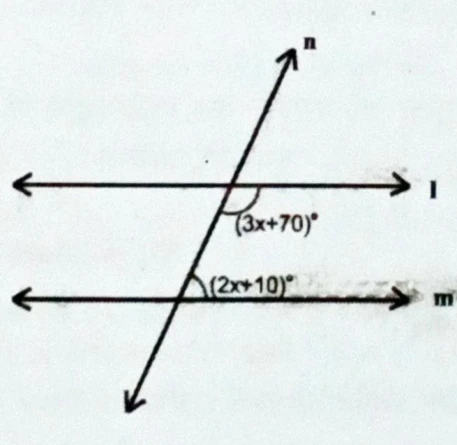
In the given figure, l ∥ m, n is a transversal, then the value of x is ______. (a) 20 (b) 55 (c) 110 (d) 35
Solution
(3x + 70)° and (2x + 10)° are interior angles on the same side of n.
(3x + 70) + (2x + 10) = 180, so 5x = 100 and x = 20.
Answer: (a) 20
Q141 markAsked in: Periodic Assessment 2, 2023-24
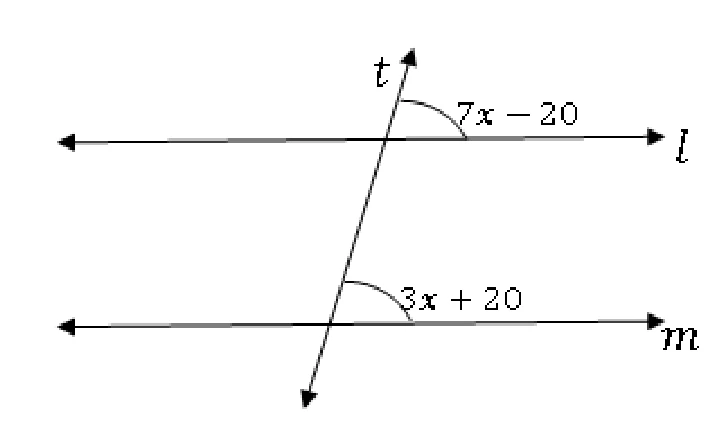
Assertion (A): In the given figure, l and m are parallel to each other, then x = 20°.
Reason (R): If a transversal intersects two parallel lines, then each pair of corresponding angles are equal.
Reason (R): If a transversal intersects two parallel lines, then each pair of corresponding angles are equal.
Solution
(7x − 20)° and (3x + 20)° are corresponding angles, so 7x − 20 = 3x + 20, 4x = 40 and x = 10, not 20. (A) is false.
(R) is the corresponding-angles rule: true.
Answer: A is false but R is true
Q152 marksAsked in: Periodic Assessment 2, 2023-24
In the given figure, if a ∥ b and line m is a transversal, find the value of 'x'.

Solution
4x and 2x lie on the same side of m, one at each parallel line, and are co-interior angles.
4x + 2x = 180°, so 6x = 180° and x = 30°.
Answer: x = 30°
Q162 marksAsked in: Annual Exam 2019-20
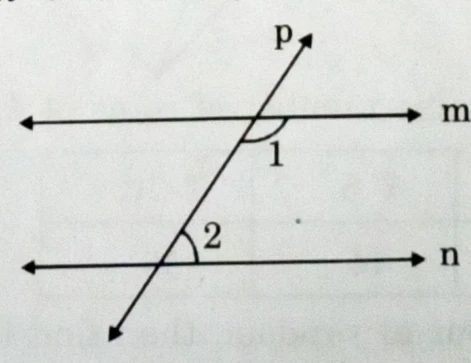
In the given figure, line m is parallel to line n and ∠1 = 2∠2. Find the measure of ∠1 and ∠2.
Solution
∠1 and ∠2 are interior angles on the same side of the transversal, so ∠1 + ∠2 = 180°.
2∠2 + ∠2 = 180°, so ∠2 = 60° and ∠1 = 120°.
Answer: ∠1 = 120°, ∠2 = 60°
Q172 marksAsked in: Periodic Test 2, 2024-25, West Bengal
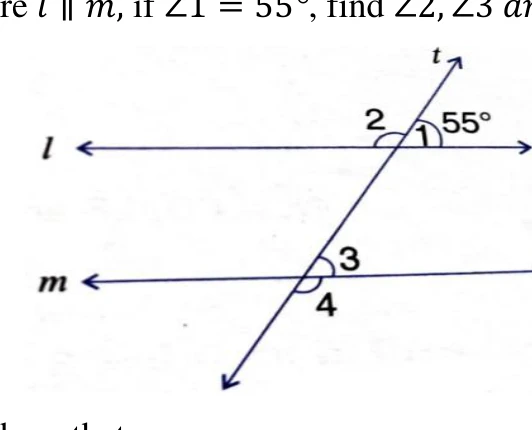
In the following figure l ∥ m, if ∠1 = 55°, find ∠2, ∠3 and ∠4.
Solution
∠1 + ∠2 = 180° (linear pair), so ∠2 = 180° − 55° = 125°.
∠3 = ∠1 = 55° (corresponding angles, l ∥ m).
∠4 = ∠2 = 125° (alternate exterior angles).
Also asked in: Half Yearly Exam 2022-23 (∠2 and ∠3 only).
Answer: ∠2 = 125°, ∠3 = 55°, ∠4 = 125°
Q182 marksAsked in: Periodic Test 2, 2023-24, West Bengal
In the given figure, if line m ∥ line n and line p is a transversal, then find x.
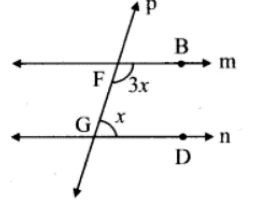
Solution
3x and x are interior angles on the same side of p.
3x + x = 180°, so 4x = 180° and x = 45°.
Answer: x = 45°
Q193 marksAsked in: Periodic Test 2, 2024-25, West Bengal
Two parallel lines l and m are cut by a transversal t. If the interior angles on the same side of t are (2x − 8)° and (3x − 7)°, find the measure of each of these angles.
Solution
Interior angles on the same side of the transversal (co-interior angles) add to 180°.
(2x − 8) + (3x − 7) = 180
5x − 15 = 180, so 5x = 195 and x = 39.
The angles are 2 × 39 − 8 = 70° and 3 × 39 − 7 = 110°.
Answer: 70° and 110°
3Proving That Two Lines Are Parallel
Q201 markLatest paperAsked in: Periodic Test 2, 2025-26, West Bengal
Two lines intersected by a transversal will be parallel if: (a) Interior angles on the same side of the transversal are complementary. (b) Vertically opposite angles are equal. (c) Alternate interior angles are equal. (d) Corresponding angles are supplementary.
Solution
Co-interior angles must be supplementary (not complementary), and corresponding angles must be equal (not supplementary).
Vertically opposite angles are equal at every crossing, so they prove nothing.
Equal alternate interior angles do make the lines parallel.
Also asked in: Periodic Test 1, 2025-26, West Bengal; Mock Test 2024-25, West Bengal.
Answer: (c) Alternate interior angles are equal
Q211 markLatest paperAsked in: Periodic Test 1, 2026-27, West Bengal
On a blueprint, two parallel pipelines are crossed by a straight road. To ensure the lines are parallel, the pair of corresponding angles satisfy the relationship: (A) they are supplementary (B) they are complementary (C) they are equal in measure (D) they are vertically opposite
Solution
Lines are parallel exactly when a pair of corresponding angles is equal.
Answer: (C) they are equal in measure
Q222 marksLatest paperAsked in: Annual Exam 2025-26
In the figure given below, PQ is parallel to OL. Is OL parallel to ST? Give reasons. (∠PQR = 130°, ∠QRS = 70°, ∠RST = 120°; R lies on OL.)
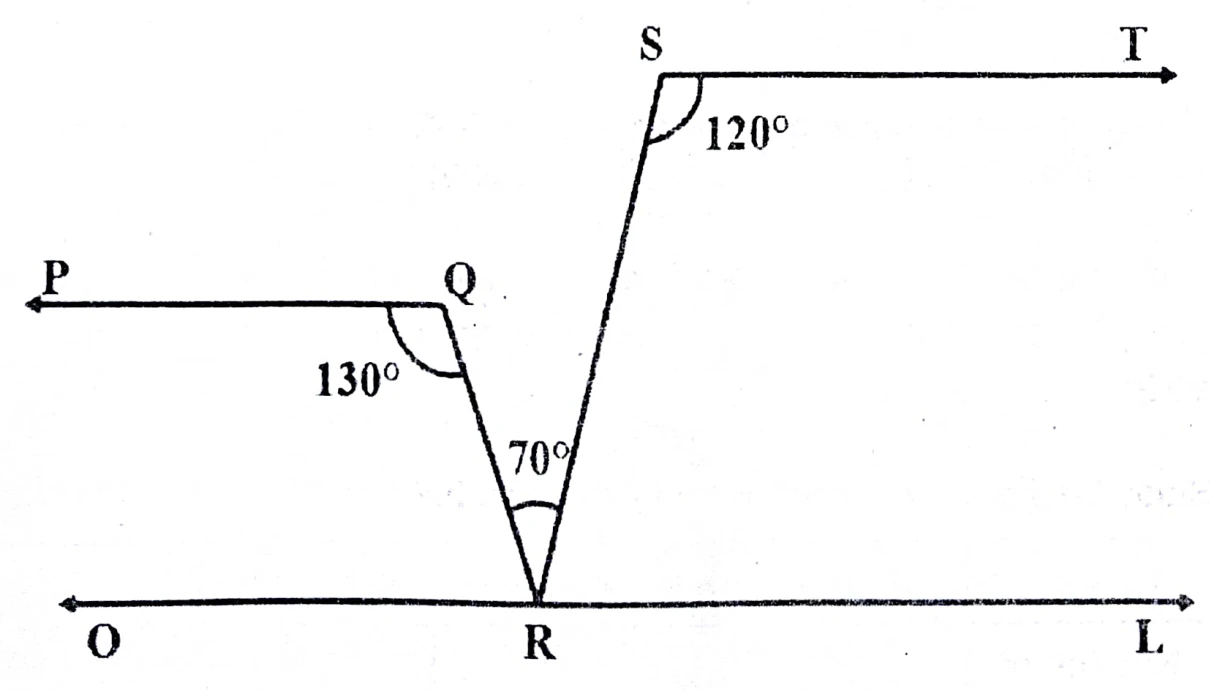
Solution
PQ ∥ OL and QR is a transversal: ∠PQR + ∠QRO = 180° (co-interior), so ∠QRO = 50°.
O, R, L are on a straight line: ∠QRO + ∠QRS + ∠SRL = 180°, so ∠SRL = 180° − 50° − 70° = 60°.
For OL and ST with transversal RS: ∠SRL + ∠RST = 60° + 120° = 180°. Co-interior angles add to 180°, so OL ∥ ST.
Answer: Yes, OL ∥ ST
Q233 marksLatest paperAsked in: Periodic Assessment 1, 2026-27
ABCD is a quadrilateral in which all the four angles are equal. Show that AB ∥ CD and AD ∥ BC.
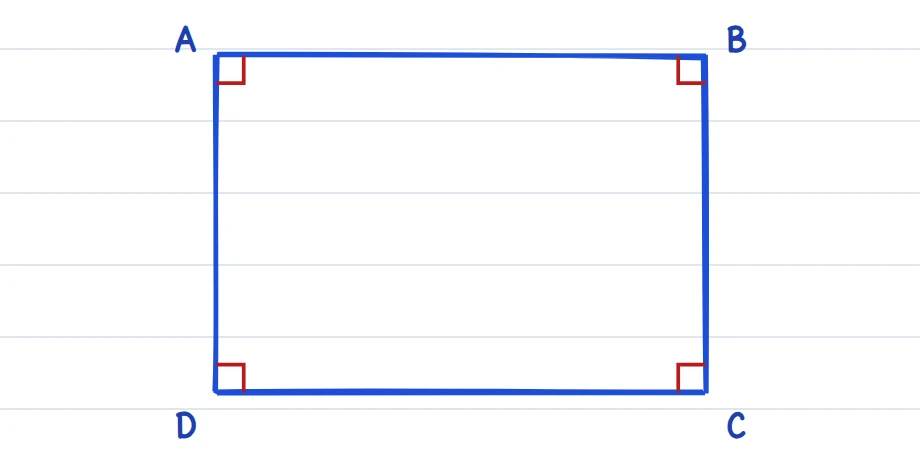
Solution
Given: ABCD is a quadrilateral with ∠A = ∠B = ∠C = ∠D.
To prove: AB ∥ CD and AD ∥ BC
| Step | Statement | Reason |
|---|---|---|
| 1 | ∠A + ∠B + ∠C + ∠D = 360° | angle sum of a quadrilateral |
| 2 | 4∠A = 360°, so each angle = 90° | all four angles are equal |
| 3 | ∠A + ∠D = 180° | step 2 |
| 4 | AB ∥ CD | AD is a transversal and the co-interior angles A and D add to 180° |
| 5 | ∠A + ∠B = 180° | step 2 |
| 6 | AD ∥ BC | AB is a transversal and the co-interior angles A and B add to 180° |
Hence proved.
Also asked in: Periodic Test 2, 2025-26, West Bengal (AB ∥ CD only).
Answer: AB ∥ CD and AD ∥ BC
Q241 markAsked in: Annual Exam 2022-23
For what value of x is l ∥ m? (The marked angles are (5x + 35)° and 45°.)
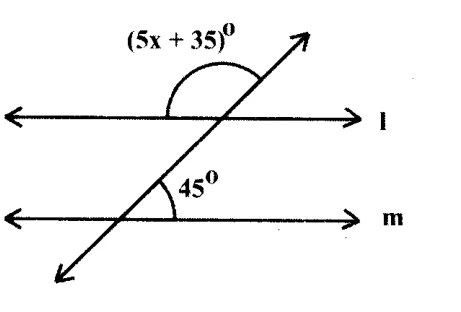
Solution
(5x + 35)° is above l on the left of the transversal; 45° is above m on the right.
The angle above m on the left makes a linear pair with 45°, so it is 135°. It corresponds to (5x + 35)°.
l ∥ m exactly when 5x + 35 = 135, that is (5x + 35) + 45 = 180: 5x = 100 and x = 20.
Answer: x = 20
Q251 markAsked in: Periodic Assessment 2, 2024-25
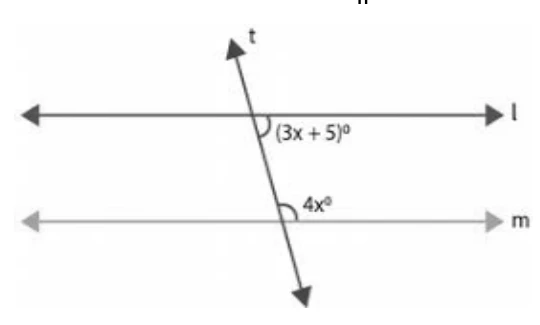
For what value of x is l ∥ m? a) 100° b) 72° c) 20° d) 25°
Solution
(3x + 5)° is below l and 4x° is above m, both on the right of t: co-interior angles.
l ∥ m when they add to 180°: 3x + 5 + 4x = 180, so 7x = 175 and x = 25.
Answer: d) 25°
Q262 marksAsked in: Periodic Assessment 2, 2019-20
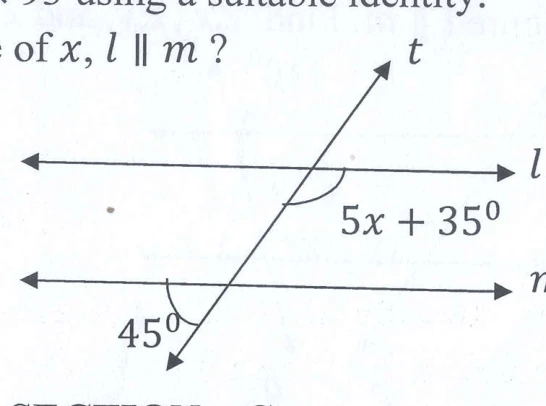
For what value of x is l ∥ m? (The marked angles are (5x + 35)° and 45°.)
Solution
45° is below m on the left of the transversal; the angle vertically opposite it (above m, on the right) and (5x + 35)° are co-interior angles.
l ∥ m exactly when they add to 180°: 5x + 35 + 45 = 180, so 5x = 100 and x = 20.
Also asked in: Periodic Test 2, 2024-25, West Bengal.
Answer: x = 20
Q272 marksAsked in: Half Yearly Exam 2022-23
In the figure, transversal TU intersects PQ and RS at V and W respectively. For which value of x is PQ ∥ RS? (Angles (5x − 22)° and (3x + 10)° are marked.)

Solution
(5x − 22)° and (3x + 10)° are both above their line on the right of TU: corresponding angles.
PQ ∥ RS when they are equal: 5x − 22 = 3x + 10, so 2x = 32 and x = 16.
Answer: x = 16
Q283 marksAsked in: Periodic Assessment 1, 2024-25
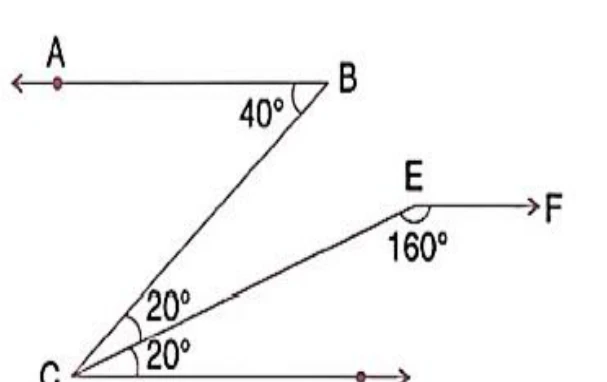
In the given figure, show that (i) AB ∥ CD (ii) CD ∥ EF (iii) AB ∥ EF. Justify your answer. (∠ABC = 40°, ∠BCE = ∠ECD = 20°, ∠CEF = 160°.)
Solution
Given: ∠ABC = 40°, ∠BCE = 20°, ∠ECD = 20°, ∠CEF = 160°.
To prove: (i) AB ∥ CD (ii) CD ∥ EF (iii) AB ∥ EF
| Step | Statement | Reason |
|---|---|---|
| 1 | ∠BCD = 20° + 20° = 40° | angle addition |
| 2 | ∠ABC = ∠BCD = 40° | given and step 1 |
| 3 | AB ∥ CD | BC is a transversal and the alternate angles are equal |
| 4 | ∠ECD + ∠CEF = 20° + 160° = 180° | given |
| 5 | CD ∥ EF | CE is a transversal and the co-interior angles add to 180° |
| 6 | AB ∥ EF | AB and EF are both parallel to CD |
Hence proved.
Also asked in: Annual Exam 2022-23; Periodic Test 2, 2023-24, West Bengal; Periodic Test 2, 2024-25, West Bengal (parts (a) and (b)).
Answer: AB ∥ CD, CD ∥ EF and AB ∥ EF
4Harder Figures: Several Lines, Triangles and Bends
Q291 markLatest paperAsked in: Periodic Assessment 2, 2026-27
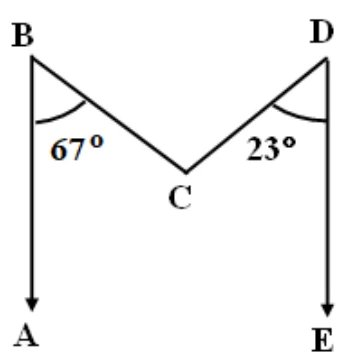
In the figure, if AB ∥ DE, then the value of ∠BCD is (A) 90° (B) 42° (C) 45° (D) 100° (∠ABC = 67°, ∠CDE = 23°.)
Solution
Draw a line through C parallel to AB and DE.
It splits ∠BCD into two alternate angles: 67° (with AB) and 23° (with DE).
∠BCD = 67° + 23° = 90°.
Answer: (A) 90°
Q301 markLatest paperAsked in: Periodic Test 2, 2026-27, West Bengal
In the given figure AF ∥ BE and AB ∥ FE. ∠AFE = 40° and ∠BAC = 80°. The measure of ∠DCE is: (A) 120° (B) 100° (C) 80° (D) 60°
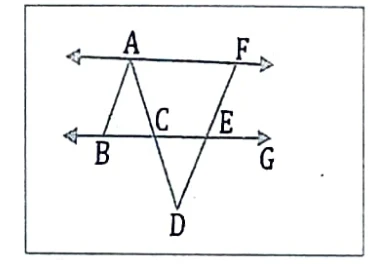
Solution
AB ∥ FE with transversal AF: ∠FAB + ∠AFE = 180° (co-interior), so ∠FAB = 140°.
AF ∥ BE with transversal AB: ∠FAB + ∠ABE = 180° (co-interior), so ∠ABC = 40°.
In triangle ABC: ∠ACB = 180° − 80° − 40° = 60°.
∠DCE = ∠ACB = 60° (vertically opposite angles).
Answer: (D) 60°
Q312 marksLatest paperAsked in: Periodic Test 2, 2026-27, West Bengal
In the following figure, AB ∥ CD. Find the value of x. (∠BAE = 105°, ∠AEC = 25°.)
OR In the quadrilateral ABCD as shown in the figure ∠1 = ∠2 = 90°. Is AD parallel to BC? Justify your answer.
OR In the quadrilateral ABCD as shown in the figure ∠1 = ∠2 = 90°. Is AD parallel to BC? Justify your answer.
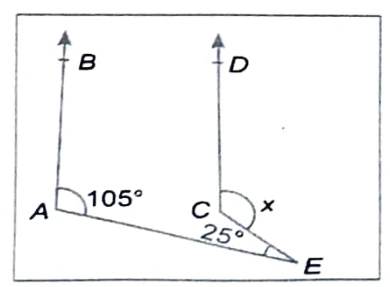
Solution
Draw EF through E parallel to AB (so EF ∥ CD too).
AB ∥ EF: ∠BAE + ∠AEF = 180° (co-interior), so ∠AEF = 75°.
∠CEF = ∠AEF − ∠AEC = 75° − 25° = 50°.
CD ∥ EF: x + ∠CEF = 180° (co-interior), so x = 130°.
OR ∠1 + ∠2 = 90° + 90° = 180°. ∠1 and ∠2 are co-interior angles for AD and BC with transversal AB, so AD ∥ BC.
Answer: x = 130°; OR Yes, AD ∥ BC
Q322 marksLatest paperAsked in: Periodic Assessment 2, 2025-26
(A) In the figure, AB ∥ CD. Find the value of x if ∠1 = 45° and ∠2 = 30°. (The
OR part (B) has a different figure and is not included here.)
OR part (B) has a different figure and is not included here.)
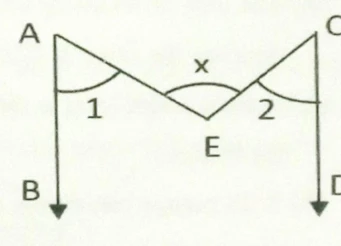
Solution
Draw a line through E parallel to AB and CD.
It splits x into two alternate angles: 45° (with AB) and 30° (with CD).
x = 45° + 30° = 75°.
Answer: x = 75°
Q333 marksLatest paperAsked in: Periodic Test 2, 2026-27, West Bengal
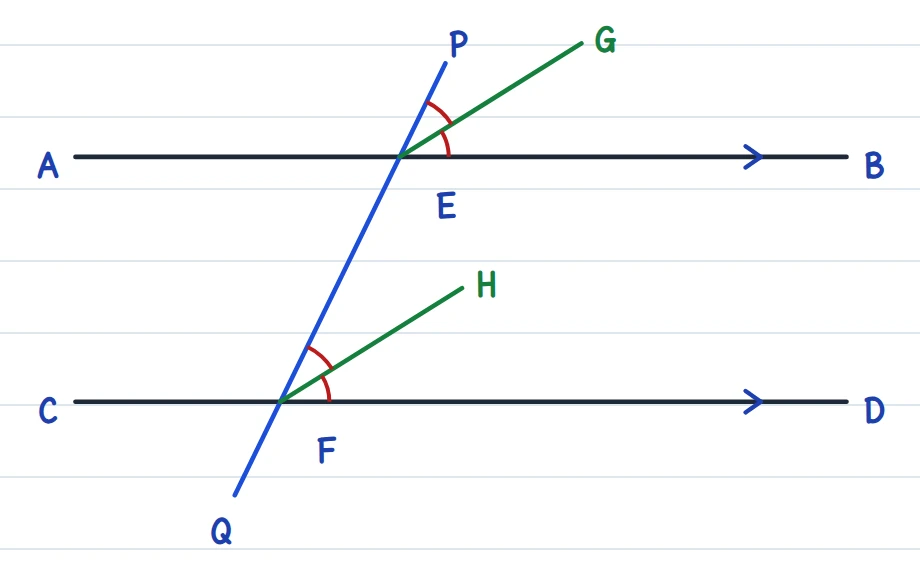
Prove that the bisectors of two corresponding angles formed by a transversal with two parallel lines are parallel to each other.
Solution
Given: AB ∥ CD and a transversal PQ cuts AB at E and CD at F. EG bisects ∠PEB and FH bisects ∠EFD (a pair of corresponding angles).
To prove: EG ∥ FH
| Step | Statement | Reason |
|---|---|---|
| 1 | ∠PEB = ∠EFD | corresponding angles, AB ∥ CD |
| 2 | ∠PEG = 1/2 ∠PEB | EG bisects ∠PEB |
| 3 | ∠EFH = 1/2 ∠EFD | FH bisects ∠EFD |
| 4 | ∠PEG = ∠EFH | halves of equal angles (steps 1, 2, 3) |
| 5 | EG ∥ FH | ∠PEG and ∠EFH are corresponding angles for EG and FH with transversal PQ, and they are equal |
Hence proved.
Answer: The bisectors are parallel
Q343 marksLatest paperAsked in: Periodic Assessment 1, 2026-27
In the figure, ∠A = 75° and CE ∥ AB. If ∠ECD = 40°, find the other two angles of the triangle ABC.
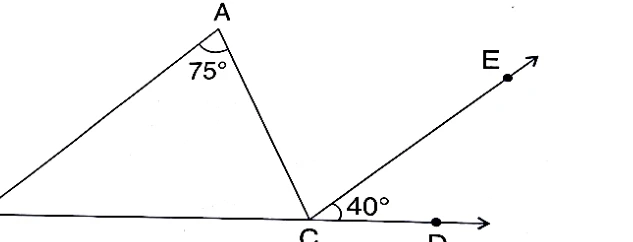
Solution
CE ∥ AB and BD is a transversal: ∠ABC = ∠ECD = 40° (corresponding angles).
Angle sum of triangle ABC: ∠ACB = 180° − 75° − 40° = 65°.
Answer: ∠B = 40°, ∠ACB = 65°
Q353 marksLatest paperAsked in: Periodic Assessment 1, 2026-27
In the given figure, if AB ∥ CD, find y. (∠BAP = 108°, ∠PCD = 112°.)
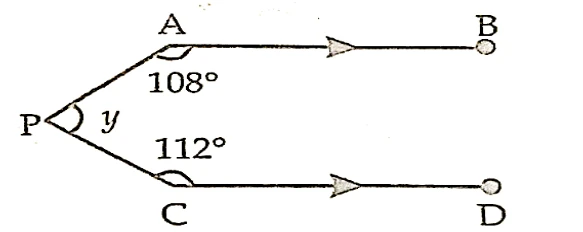
Solution
Draw PE through P parallel to AB and CD, pointing the same way as B and D.
AB ∥ PE: ∠BAP + ∠APE = 180° (co-interior), so ∠APE = 72°.
CD ∥ PE: ∠PCD + ∠CPE = 180° (co-interior), so ∠CPE = 68°.
y = 72° + 68° = 140°.
Answer: y = 140°
Q365 marksLatest paperAsked in: Periodic Assessment 1, 2026-27
In the given figure, l ∥ m and t is the transversal. The angle bisectors of interior angles intersect at P and Q. Find the value of angle x and y. What type of quadrilateral is PRQS?

Solution
Given: l ∥ m, t cuts l at R and m at S. RP, RQ, SP, SQ bisect the four interior angles.
To prove: ∠P = ∠Q = 90° and PRQS is a rectangle
| Step | Statement | Reason |
|---|---|---|
| 1 | ∠R1 + ∠S1 = 180° | co-interior angles on one side of t, l ∥ m |
| 2 | ∠PRS + ∠PSR = 1/2 (∠R1 + ∠S1) = 90° | RP and SP bisect them |
| 3 | y = ∠RPS = 180° − 90° = 90° | angle sum of triangle RPS |
| 4 | x = ∠RQS = 90° | the same steps on the other side of t |
| 5 | ∠PRQ = 1/2 × 180° = 90° | RP and RQ bisect the two angles of a linear pair at R |
| 6 | ∠PSQ = 90° | the same at S |
| 7 | PRQS is a rectangle | all four angles are 90° |
Hence proved.
Answer: x = 90°, y = 90°; PRQS is a rectangle
Q371 markAsked in: Periodic Test 2, 2023-24, West Bengal
In the given figure, AB ∥ PQ, find y. A) 59° B) 121° C) 116° D) 118°
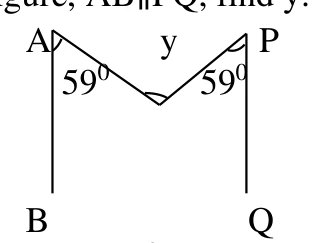
Solution
Draw a line through the bend parallel to AB and PQ.
It splits y into two alternate angles of 59° each.
y = 59° + 59° = 118°.
Answer: D) 118°
Q381 markAsked in: Periodic Assessment 2, 2024-25
In the given figure, l ∥ m ∥ n. The measure of ∠x + ∠y is a) 80° b) 20° c) 120° d) 160°
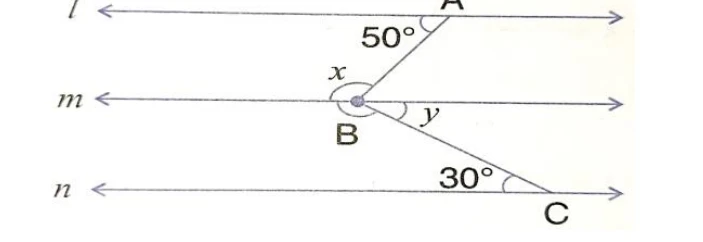
Solution
l ∥ m: x = 50° (alternate angles on the first segment).
m ∥ n: y = 30° (alternate angles on the second segment).
x + y = 50° + 30° = 80°.
Answer: a) 80°
Q391 markAsked in: Periodic Test 2, 2024-25, West Bengal
In the given figure, ∠OAB = 110° and ∠BCD = 130°, then ∠ABC is equal to (a) 40° (b) 50° (c) 60° (d) 70° (AO ∥ CD.)
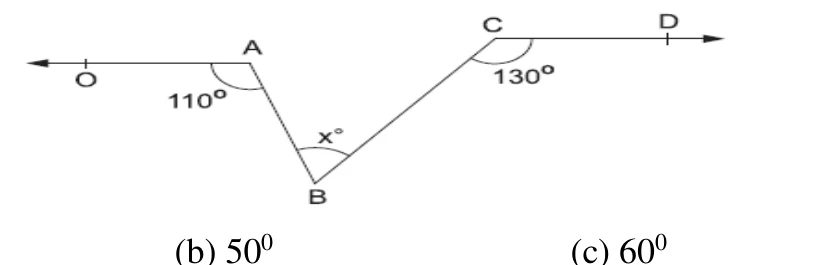
Solution
Draw a line XY through B parallel to AO and CD (X on the left, Y on the right).
AO ∥ XY and AB is a transversal: ∠OAB + ∠ABX = 180° (co-interior), so ∠ABX = 70°.
CD ∥ XY and CB is a transversal: ∠BCD + ∠CBY = 180° (co-interior), so ∠CBY = 50°.
Angles on the straight line XY: ∠ABX + ∠ABC + ∠CBY = 180°, so ∠ABC = 180° − 70° − 50° = 60°.
Also asked in: Mock Test 2024-25, West Bengal (∠PQR = 110°, ∠RST = 130°).
Answer: (c) 60°
Q401 markAsked in: Periodic Assessment 1, 2024-25
In the given figure ∠A = 75° and CE ∥ AB. If ∠ECD = 40°, find the measurement of ∠ACE. (a) 75° (b) 35° (c) 15° (d) 105°
Solution
CE ∥ AB and AC is a transversal.
∠ACE = ∠BAC = 75° (alternate angles). The 40° is not needed here.
Answer: (a) 75°
Q411 markAsked in: Periodic Assessment 1, 2024-25
In the given figure, MN ∥ SP. The measure of ∠1 is equal to (a) 50° (b) 70° (c) 90° (d) 60°

Solution
MN ∥ SP and NS is a transversal: ∠MNT = ∠NSP = 70° (alternate angles).
In triangle MNT: ∠1 + 70° + 50° = 180°, so ∠1 = 60°.
Answer: (d) 60°
Q421 markAsked in: Half Yearly Exam 2022-23
In the given figure AB ∥ CD and PR is the bisector of ∠APQ. If ∠RPQ = 38°, find the measure of ∠PQD.
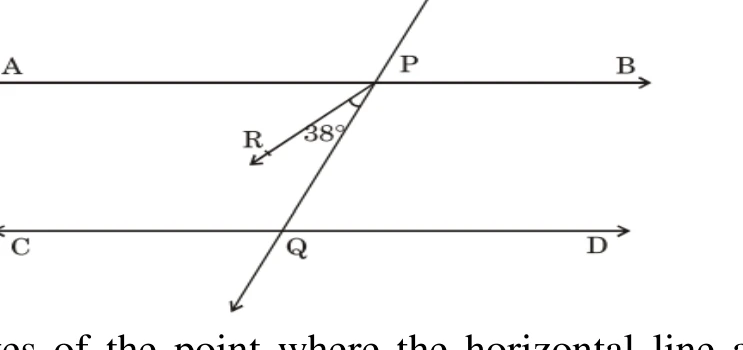
Solution
PR bisects ∠APQ, so ∠APQ = 2 × 38° = 76°.
AB ∥ CD and PQ is a transversal: ∠PQD = ∠APQ = 76° (alternate angles).
Also asked in: Half Yearly Exam 2022-23, Zone I.
Answer: 76°
Q431 markAsked in: Annual Exam 2021-22
In the given figure, PQ ∥ RS and EF ∥ QS. If ∠PQS = 60°, find the measure of ∠RFE.
OR A line segment AB = 15 cm is divided internally in the ratio 2 : 3. Find the length of each part.
OR A line segment AB = 15 cm is divided internally in the ratio 2 : 3. Find the length of each part.
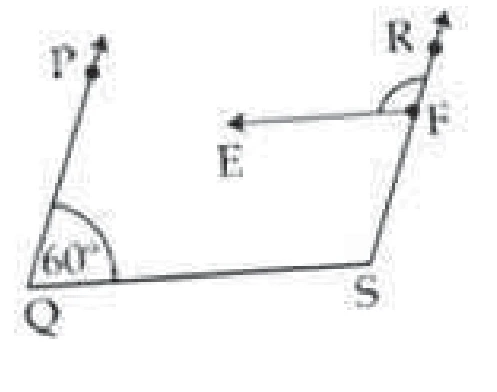
Solution
PQ ∥ RS and QS is a transversal. P and R are on the same side of QS, so ∠PQS + ∠QSR = 180° (co-interior angles): ∠QSR = 180° − 60° = 120°.
EF ∥ QS and RS is a transversal: ∠RFE = ∠RSQ = 120° (corresponding angles).
OR 2 + 3 = 5 equal parts of 15 ÷ 5 = 3 cm: 2 × 3 = 6 cm and 3 × 3 = 9 cm.
Answer: 120°; OR 6 cm and 9 cm
Q442 marksAsked in: Annual Exam 2022-23
In the given figure, ∠P = 70° and RT ∥ PQ. If ∠TRS = 40°, find the other two angles of the triangle PQR.
OR In the given figure, AB ∥ DE. Find ∠ACD. (∠BAC = 35°, ∠CDE = 53°.)
OR In the given figure, AB ∥ DE. Find ∠ACD. (∠BAC = 35°, ∠CDE = 53°.)
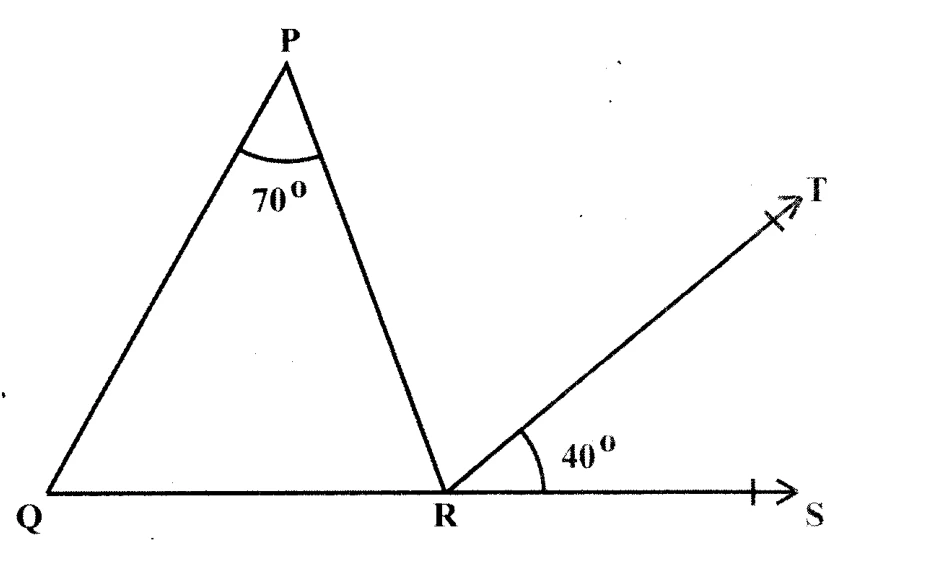
Solution
RT ∥ PQ and QS is a transversal: ∠PQR = ∠TRS = 40° (corresponding angles).
Angle sum of triangle PQR: ∠PRQ = 180° − 70° − 40° = 70°.
OR Draw a line through C parallel to AB and DE. It splits ∠ACD into alternate angles 35° and 53°, so ∠ACD = 35° + 53° = 88°.
Answer: ∠PQR = 40°, ∠PRQ = 70°; OR ∠ACD = 88°
Q453 marksAsked in: Half Yearly Exam 2022-23
In the given figure l ∥ m. Find ∠x, ∠y and ∠z.
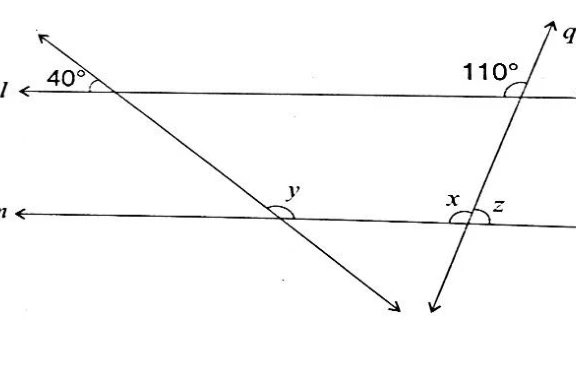
Solution
First transversal: the 40° at l and the angle above m at the same corner are corresponding, so that angle is 40°; y makes a linear pair with it: y = 180° − 40° = 140°.
Second transversal q: the 110° is above l on the left of q, and x is above m on the left of q: corresponding angles, so x = 110°.
x + z = 180° (linear pair on m), so z = 70°.
Also asked in: Periodic Assessment 2, 2019-20.
Answer: x = 110°, y = 140°, z = 70°
5Lines Parallel or Perpendicular to the Same Line
Q461 markLatest paperAsked in: Periodic Assessment 1, 2026-27
Two lines on the same plane which are perpendicular to a given line are ______ to each other. A) parallel B) perpendicular C) non intersecting D) such lines cannot be drawn
Solution
Each line makes 90° with the given line, so a pair of corresponding angles is 90° = 90°.
Equal corresponding angles: the two lines are parallel.
Answer: A) parallel
Q471 markAsked in: Periodic Assessment 1, 2024-25
l, m, n are three lines in a plane such that m ⊥ l and n ⊥ l, then (a) m ⊥ n (b) m ∥ l (c) m ∥ n (d) n ∥ l
Solution
m and n are both perpendicular to the same line l.
Lines in a plane perpendicular to the same line are parallel, so m ∥ n.
Answer: (c) m ∥ n
6Dividing a Line Segment into Equal Parts
Q482 marksAsked in: Half Yearly Exam 2022-23
Draw a line segment AB = 5 cm and divide it internally into 6 equal parts.

Solution
Steps of construction:
1. Draw AB = 5 cm. Draw a ray AX making an acute angle with AB.
2. With one compass opening, mark 6 equal steps A1, A2, …, A6 on AX.
3. Join A6 to B.
4. Through A1, …, A5 draw lines parallel to A6B. They cut AB into 6 equal parts.
5. Each part = 5 ÷ 6 = 0.833333 cm (too small to measure exactly with a ruler, which is why we construct).
Answer: 6 equal parts of 0.833333 cm (5/6 cm ≈ 0.83 cm) each
7Dividing a Line Segment in a Given Ratio
Q492 marksLatest paperAsked in: Periodic Assessment 2, 2025-26
Draw a line segment AB of length 7.5 cm and divide it internally in the ratio 2 : 3.
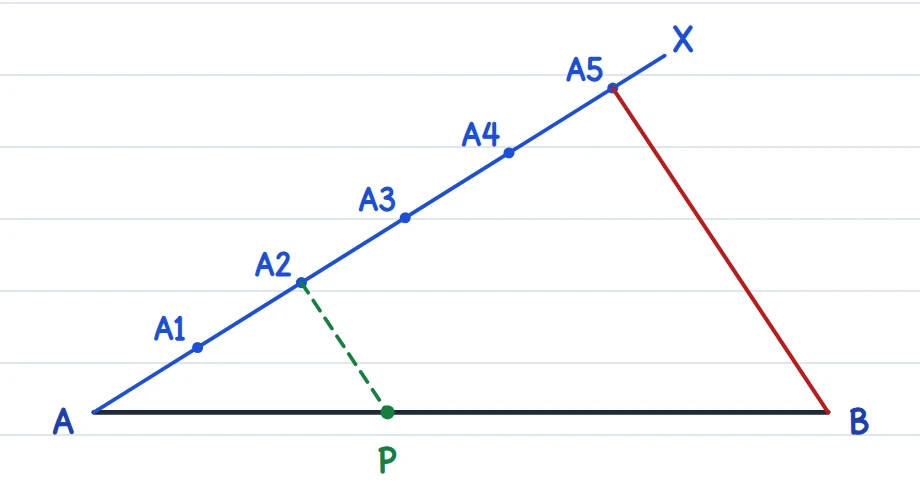
Solution
Steps of construction:
1. Draw AB = 7.5 cm. Draw a ray AX making an acute angle with AB.
2. With one compass opening, mark 5 equal steps A1, A2, …, A5 on AX: 2 parts and 3 parts make 5 steps.
3. Join A5 to B.
4. Through A2 draw a line parallel to A5B (copy the angle at A5). It meets AB at P.
5. AP : PB = 2 : 3. Check by measuring: AP = 7.5 × 2/5 = 3 cm and PB = 7.5 × 3/5 = 4.5 cm.
Answer: AP = 3 cm, PB = 4.5 cm
Q503 marksLatest paperAsked in: Periodic Test 1, 2025-26, West Bengal
Draw a line segment AB = 6 cm. Find a point Q on it such that AQ = 2/3 QB.
OR Divide a line segment AB = 8 cm into 5 equal parts.
OR Divide a line segment AB = 8 cm into 5 equal parts.
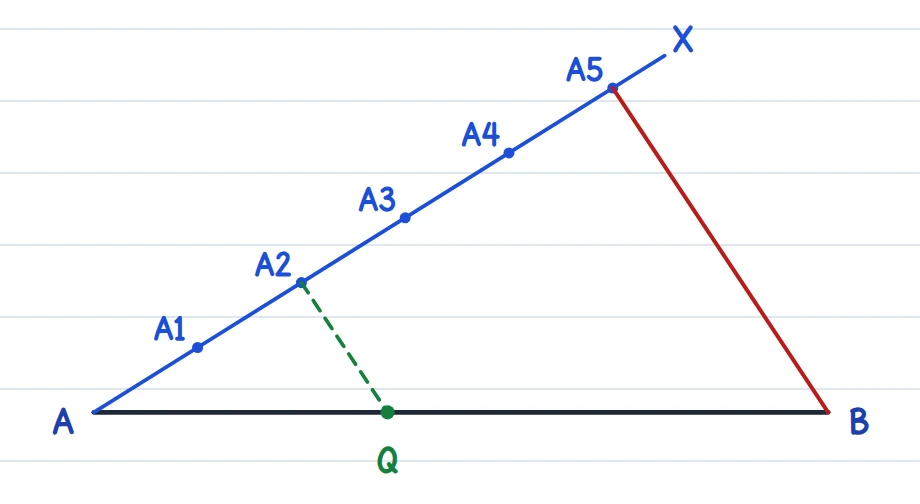
Solution
AQ = 2/3 QB means AQ : QB = 2 : 3.
Steps of construction:
1. Draw AB = 6 cm. Draw a ray AX making an acute angle with AB.
2. With one compass opening, mark 5 equal steps A1, A2, …, A5 on AX: 2 parts and 3 parts make 5 steps.
3. Join A5 to B.
4. Through A2 draw a line parallel to A5B (copy the angle at A5). It meets AB at Q.
5. AQ : QB = 2 : 3. Check by measuring: AQ = 6 × 2/5 = 2.4 cm and QB = 6 × 3/5 = 3.6 cm.
OR
1. Draw AB = 8 cm. Draw a ray AX making an acute angle with AB.
2. With one compass opening, mark 5 equal steps A1, A2, …, A5 on AX.
3. Join A5 to B.
4. Through A1, …, A4 draw lines parallel to A5B. They cut AB into 5 equal parts.
5. Each part = 8 ÷ 5 = 1.6 cm.
Answer: AQ = 2.4 cm, QB = 3.6 cm; OR each part = 1.6 cm
Q513 marksAsked in: Periodic Test 2, 2023-24, West Bengal
Draw a line segment AB = 5.5 cm. Find a point P on it such that AP = 2/3 PB.
OR Divide a line segment PQ = 5.5 cm in three equal parts.
OR Divide a line segment PQ = 5.5 cm in three equal parts.
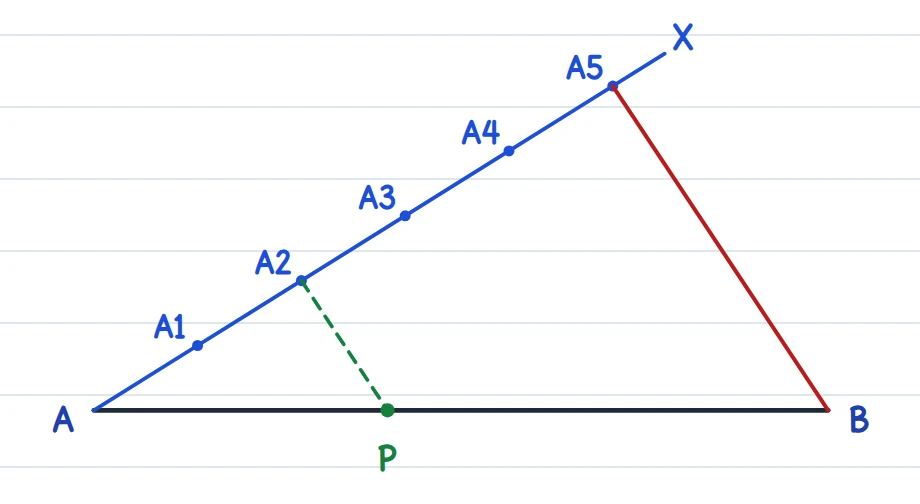
Solution
AP = 2/3 PB means AP : PB = 2 : 3.
Steps of construction:
1. Draw AB = 5.5 cm. Draw a ray AX making an acute angle with AB.
2. With one compass opening, mark 5 equal steps A1, A2, …, A5 on AX: 2 parts and 3 parts make 5 steps.
3. Join A5 to B.
4. Through A2 draw a line parallel to A5B (copy the angle at A5). It meets AB at P.
5. AP : PB = 2 : 3. Check by measuring: AP = 5.5 × 2/5 = 2.2 cm and PB = 5.5 × 3/5 = 3.3 cm.
OR: mark 3 equal steps on a ray from P, join the third mark to Q and draw two parallels; each part = 5.5 ÷ 3 ≈ 1.83 cm.
Answer: AP = 2.2 cm, PB = 3.3 cm; OR each part = 5.5/3 ≈ 1.83 cm
Q523 marksAsked in: Half Yearly Exam 2022-23
Draw a line segment AB of length 7 cm and find a point P on it such that AP : PB = 2 : 3.
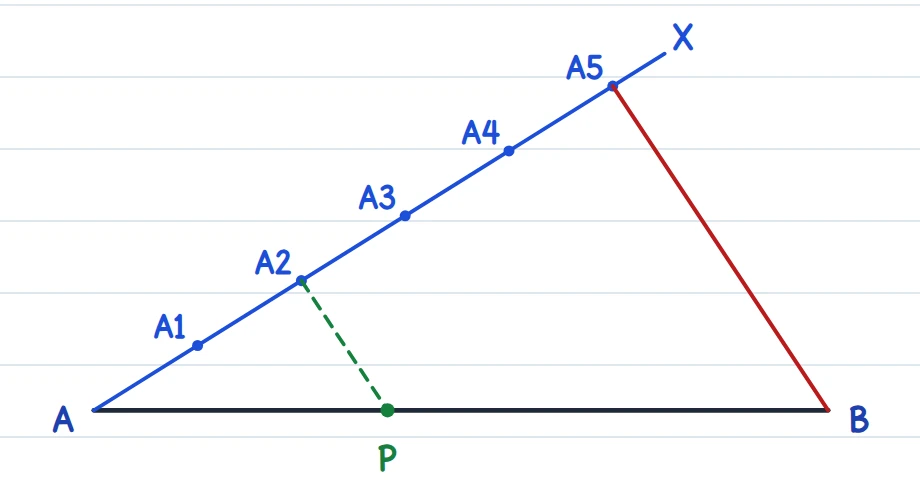
Solution
Steps of construction:
1. Draw AB = 7 cm. Draw a ray AX making an acute angle with AB.
2. With one compass opening, mark 5 equal steps A1, A2, …, A5 on AX: 2 parts and 3 parts make 5 steps.
3. Join A5 to B.
4. Through A2 draw a line parallel to A5B (copy the angle at A5). It meets AB at P.
5. AP : PB = 2 : 3. Check by measuring: AP = 7 × 2/5 = 2.8 cm and PB = 7 × 3/5 = 4.2 cm.
Answer: AP = 2.8 cm, PB = 4.2 cm
Q533 marksAsked in: Periodic Assessment 2, 2024-25
Draw a line segment AB of length 8 cm and find a point P on it such that AP : PB = 1 : 3. Find the measure of AP and PB.
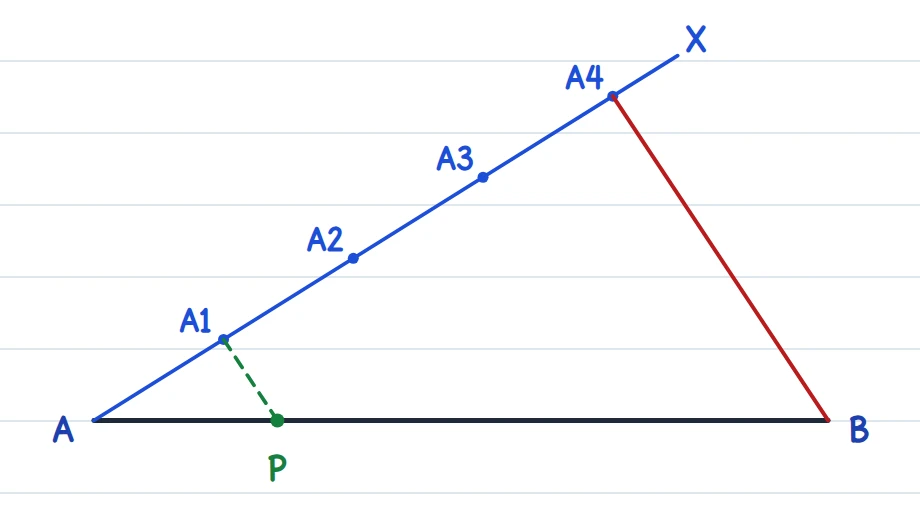
Solution
Steps of construction:
1. Draw AB = 8 cm. Draw a ray AX making an acute angle with AB.
2. With one compass opening, mark 4 equal steps A1, A2, …, A4 on AX: 1 part and 3 parts make 4 steps.
3. Join A4 to B.
4. Through A1 draw a line parallel to A4B (copy the angle at A4). It meets AB at P.
5. AP : PB = 1 : 3. Check by measuring: AP = 8 × 1/4 = 2 cm and PB = 8 × 3/4 = 6 cm.
Answer: AP = 2 cm, PB = 6 cm
Q544 marksAsked in: Periodic Assessment 2, 2019-20
Draw a line segment AB = 9 cm. Find a point P on it such that AP : PB = 2 : 3. Measure AP and PB.
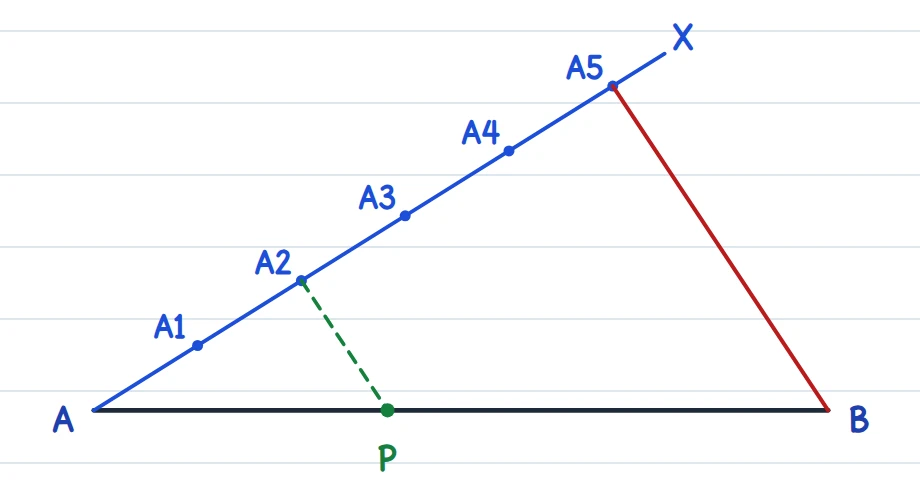
Solution
Steps of construction:
1. Draw AB = 9 cm. Draw a ray AX making an acute angle with AB.
2. With one compass opening, mark 5 equal steps A1, A2, …, A5 on AX: 2 parts and 3 parts make 5 steps.
3. Join A5 to B.
4. Through A2 draw a line parallel to A5B (copy the angle at A5). It meets AB at P.
5. AP : PB = 2 : 3. Check by measuring: AP = 9 × 2/5 = 3.6 cm and PB = 9 × 3/5 = 5.4 cm.
Answer: AP = 3.6 cm, PB = 5.4 cm
Q555 marksAsked in: Periodic Assessment 1, 2024-25
Draw a line segment AB = 6 cm. Find a point Q on AB such that AQ = 2/5 AB. Also measure the length of AQ and QB.
Solution
AQ = 2/5 AB means AQ is 2 parts out of 5, so AQ : QB = 2 : 3.
Steps of construction:
1. Draw AB = 6 cm. Draw a ray AX making an acute angle with AB.
2. With one compass opening, mark 5 equal steps A1, A2, …, A5 on AX: 2 parts and 3 parts make 5 steps.
3. Join A5 to B.
4. Through A2 draw a line parallel to A5B (copy the angle at A5). It meets AB at Q.
5. AQ : QB = 2 : 3. Check by measuring: AQ = 6 × 2/5 = 2.4 cm and QB = 6 × 3/5 = 3.6 cm.
Answer: AQ = 2.4 cm, QB = 3.6 cm