DAV Class 8 Maths Chapter 12 Construction of Quadrilaterals Previous Year Questions Solved

DAV Class 8 Maths · Chapter 12
Construction of Quadrilaterals: Previous Year Questions Solved
Every question on this chapter we found in DAV Class 8 annual exams and mock tests from 2019-20 to 2024-25, grouped by topic in the order of your book, with the full working. The paper name and year are printed on each question.
9 questions5 topics7 papersLatest papers first

Book exercise answers are on the Chapter 12 solutions page. For the whole chapter as classroom notes (every topic explained, these questions, new practice and a revision sheet), see the Chapter 12 notes PDF.

Share with classmates & study groups

Any problem or question about the notes or your payment? Email [email protected]
1Why Five Measurements, and When a Quadrilateral Cannot Be Drawn

Q11 markAsked in: Mock Test 2023-24, West Bengal
Assertion (A): A quadrilateral ABCD in which AB = 4 cm, BC = 5 cm, CD = 4.5 cm, AD = 5.5 cm and diagonal AC = 7.5 cm can be constructed.
Reason (R): In a triangle sum of length of any two sides is always greater than third side. (a) Both A and R are true and R is the correct explanation of A. (b) Both A and R are true and R is not the correct explanation of A. (c) A is true but R is false. (d) A is false but R is true.
Solution
Think: a quadrilateral is two triangles joined along a diagonal. If both triangles can be drawn, the quadrilateral can be drawn.
Diagonal AC splits ABCD into triangles ABC and ADC.
Triangle ABC: AB + BC = 4 + 5 = 9 cm, more than AC = 7.5 cm, so it can be drawn.
Triangle ADC: AD + DC = 5.5 + 4.5 = 10 cm, more than AC = 7.5 cm, so it can be drawn.
Both triangles exist, so ABCD can be constructed: (A) is true. (R) is the triangle rule, and it is exactly what decides (A): (a).
Answer: (a) Both A and R are true and R is the correct explanation of A

2Four Sides and One Diagonal

Q25 marksAsked in: Mock Test 2023-24, West Bengal
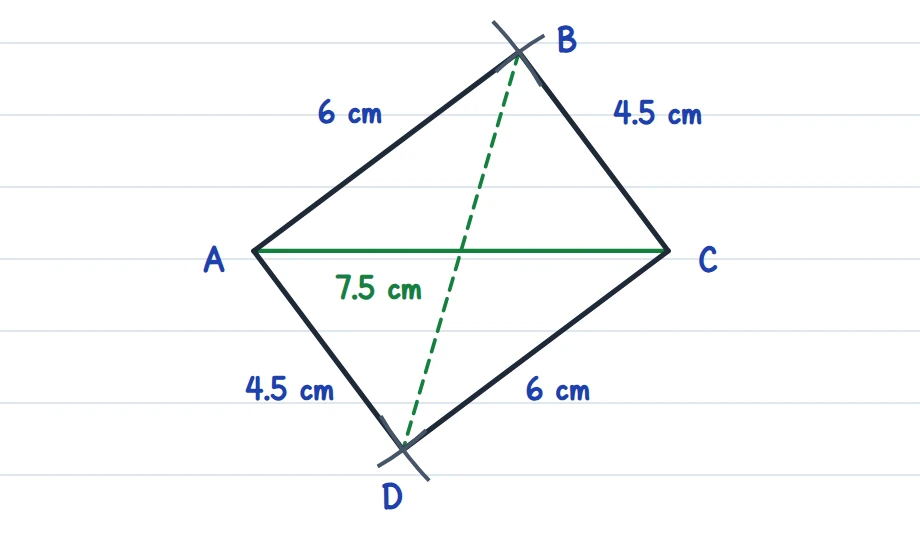
Construct a quadrilateral ABCD in which AB = 6 cm, BC = 4.5 cm, CD = 6 cm, AD = 4.5 cm and diagonal AC = 7.5 cm. Measure the diagonal BD. Is it equal to AC?

Figure for Q2

Solution
Think: the diagonal AC is a side of both triangles ABC and ADC. So draw AC first and hang one triangle above it and one below.
Check first: triangle ABC: 6 + 4.5 = 10.5, more than 7.5. Triangle ADC: 4.5 + 6 = 10.5, more than 7.5. Both triangles can be drawn.
Steps of construction:
1. Rough sketch: diagonal AC splits ABCD into triangles ABC and ADC on opposite sides of AC.
2. Draw AC = 7.5 cm.
3. With A as centre and radius 6 cm, draw an arc above AC. With C as centre and radius 4.5 cm, draw an arc cutting it at B.
4. With A as centre and radius 4.5 cm, draw an arc below AC. With C as centre and radius 6 cm, draw an arc cutting it at D.
5. Join AB, BC, CD and DA. ABCD is the required quadrilateral.
Measure: BD ≈ 7.5 cm.
Yes, BD = AC = 7.5 cm.
Why: AB² + BC² = 36 + 20.25 = 56.25 = 7.5² = AC², so ∠B = 90°. Opposite sides are equal (6 and 6, 4.5 and 4.5), so ABCD is a parallelogram with a right angle: a rectangle, and the diagonals of a rectangle are equal.
Answer: BD = 7.5 cm, equal to AC (ABCD is a rectangle)

3Three Sides and Both Diagonals

Q35 marksAsked in: Mock Test 2024-25, West Bengal
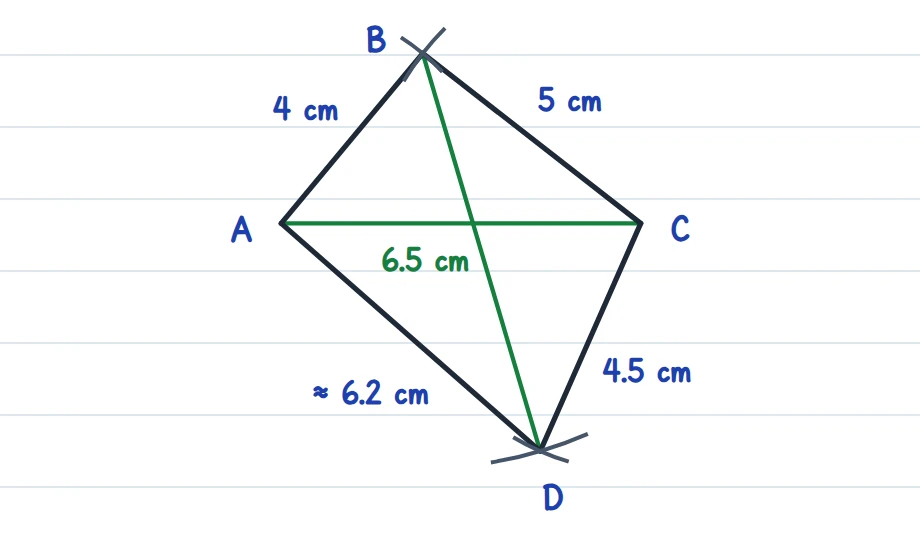
Construct a quadrilateral ABCD in which side AB = 4 cm, BC = 5 cm, CD = 4.5 cm and diagonal AC = 6.5 cm and BD = 7.5 cm.

Figure for Q3

Solution
Think: in triangle ABC all three sides are known (AB, BC and the diagonal AC), so draw it first. Then D is the point that is 4.5 cm from C and 7.5 cm from B.
Check first: triangle ABC: 4 + 5 = 9, more than 6.5. Triangle BCD: 5 + 4.5 = 9.5, more than 7.5. Both can be drawn.
Steps of construction:
1. Rough sketch: triangle ABC uses AB, BC and the diagonal AC; then D is fixed by CD and the diagonal BD.
2. Draw AC = 6.5 cm.
3. With A as centre and radius 4 cm, draw an arc above AC. With C as centre and radius 5 cm, draw an arc cutting it at B.
4. With C as centre and radius 4.5 cm, draw an arc below AC.
5. With B as centre and radius 7.5 cm, draw an arc cutting the last arc at D.
6. Join AB, BC, CD, DA (and BD). ABCD is the required quadrilateral.
Check: the side that was not given, DA ≈ 6.2 cm.
Answer: ABCD constructed (the fourth side DA measures about 6.2 cm)

4Two Adjacent Sides and Three Angles

Q45 marksAsked in: Annual Exam 2021-22
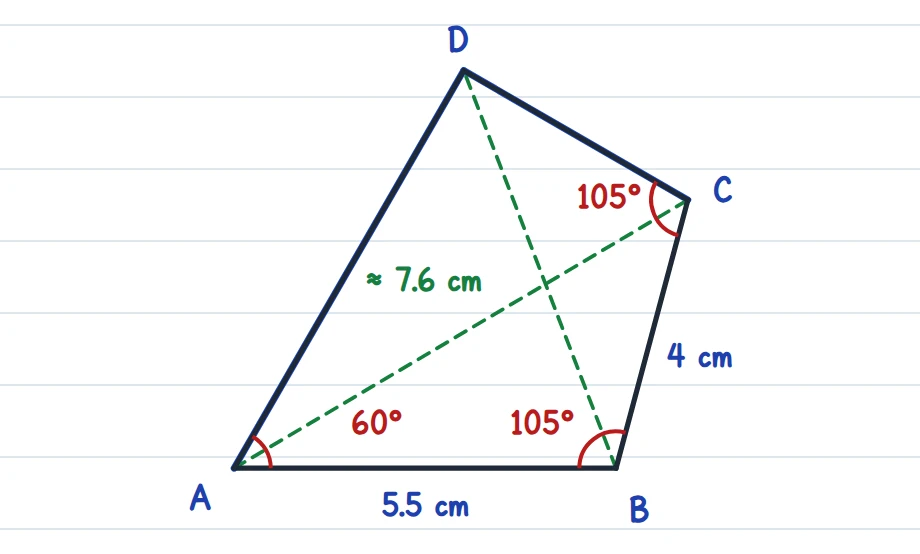
Construct a quadrilateral ABCD in which AB = 5.5 cm, BC = 4 cm, ∠A = 60°, ∠B = 105° and ∠D = 90°. Measure the length of each diagonal.

Figure for Q4

Solution
Think: AB and BC meet at B. Draw AB, turn by ∠B, draw BC. The angles at A and C send out two rays; where they cross is D.
Steps of construction:
1. Find the missing angle first (the four angles add up to 360°): ∠C = 360° − (∠A + ∠B + ∠D) = 360° − 255° = 105°.
3. Draw AB = 5.5 cm.
4. At B, construct ∠ABX = 105° (with compasses: bisect the angle between 90° and 120°). Cut off BC = 4 cm on BX.
5. At C, construct ∠BCY = 105° (with compasses: bisect the angle between 90° and 120°), on the same side as A.
6. At A, construct ∠BAZ = 60° (with compasses: one arc, cut it once from where it meets the arm). Rays AZ and CY meet at D.
7. ABCD is the required quadrilateral.
Check: measure ∠D with a protractor. It should be 90°, because the four angles add up to 360°.
Measure the diagonals: AC ≈ 7.6 cm and BD ≈ 6.1 cm.
Answer: ∠C = 105°; AC ≈ 7.6 cm and BD ≈ 6.1 cm
Q55 marksAsked in: Annual Exam 2022-23
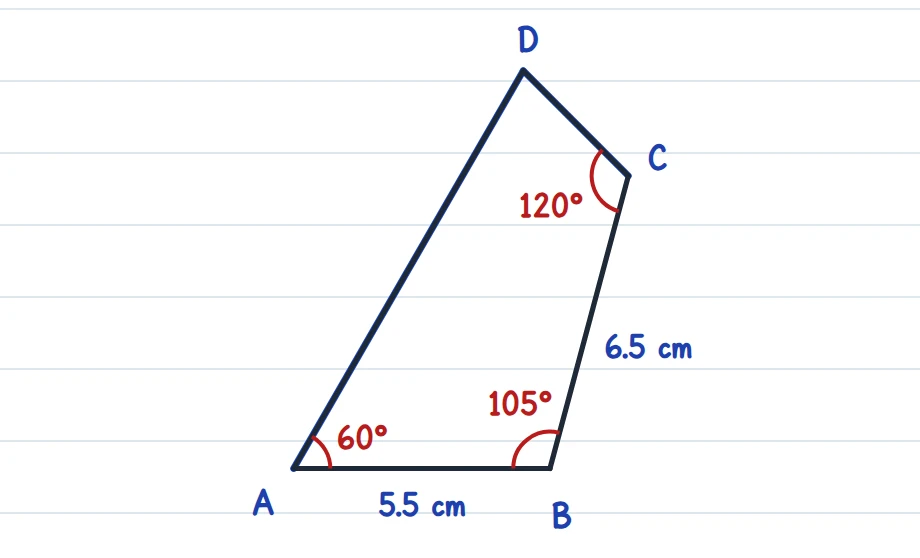
Construct a quadrilateral ABCD in which AB = 5.5 cm, BC = 6.5 cm, ∠A = 60°, ∠C = 120° and ∠D = 75°.

Figure for Q5

Solution
Think: AB and BC meet at B. Draw AB, turn by ∠B, draw BC. The angles at A and C send out two rays; where they cross is D.
Steps of construction:
1. Find the missing angle first (the four angles add up to 360°): ∠B = 360° − (∠A + ∠C + ∠D) = 360° − 255° = 105°.
3. Draw AB = 5.5 cm.
4. At B, construct ∠ABX = 105° (with compasses: bisect the angle between 90° and 120°). Cut off BC = 6.5 cm on BX.
5. At C, construct ∠BCY = 120° (with compasses: one arc, cut it twice), on the same side as A.
6. At A, construct ∠BAZ = 60° (with compasses: one arc, cut it once from where it meets the arm). Rays AZ and CY meet at D.
7. ABCD is the required quadrilateral.
Check: measure ∠D with a protractor. It should be 75°, because the four angles add up to 360°.
Answer: ∠B = 105°; ABCD constructed
Q65 marksAsked in: Annual Exam 2023-24
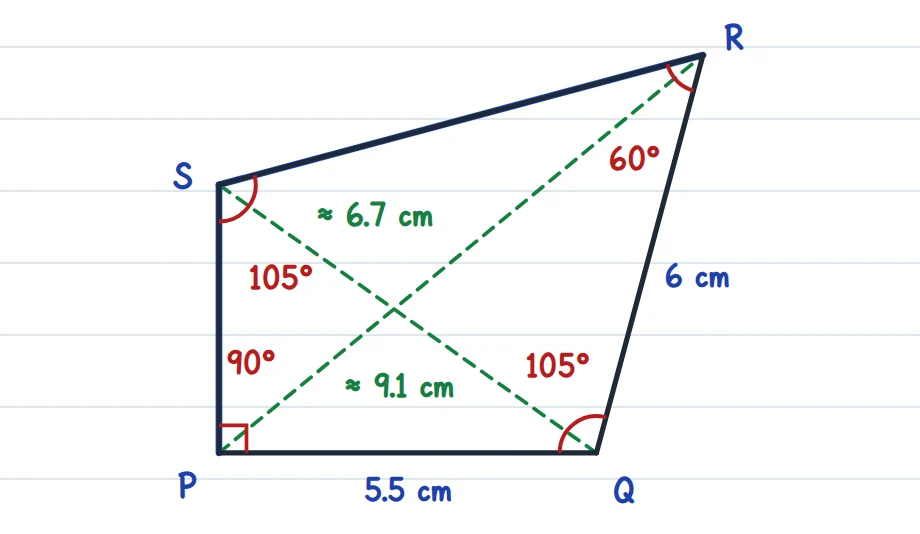
Construct a quadrilateral PQRS in which PQ = 5.5 cm, ∠P = 90°, ∠Q = 105°, ∠R = 60° and QR = 6 cm. Measure the length of each diagonal. (steps of construction not required)

Figure for Q6

Solution
Think: PQ and QR meet at Q. Draw PQ, turn by ∠Q, draw QR. The angles at P and R send out two rays; where they cross is S.
The paper does not ask for steps, but drawing in this order makes it easy:
1. Find the missing angle first (the four angles add up to 360°): ∠S = 360° − (∠P + ∠Q + ∠R) = 360° − 255° = 105°.
3. Draw PQ = 5.5 cm.
4. At Q, construct ∠PQX = 105° (with compasses: bisect the angle between 90° and 120°). Cut off QR = 6 cm on QX.
5. At R, construct ∠QRY = 60° (with compasses: one arc, cut it once from where it meets the arm), on the same side as P.
6. At P, construct ∠QPZ = 90° (with compasses: bisect the angle between 60° and 120°). Rays PZ and RY meet at S.
7. PQRS is the required quadrilateral.
Check: measure ∠S with a protractor. It should be 105°, because the four angles add up to 360°.
Measure the diagonals: PR ≈ 9.1 cm and QS ≈ 6.7 cm.
Also asked in: Annual Exam 2023-24, another set.
Answer: PR ≈ 9.1 cm and QS ≈ 6.7 cm
Q75 marksAsked in: Annual Exam 2024-25
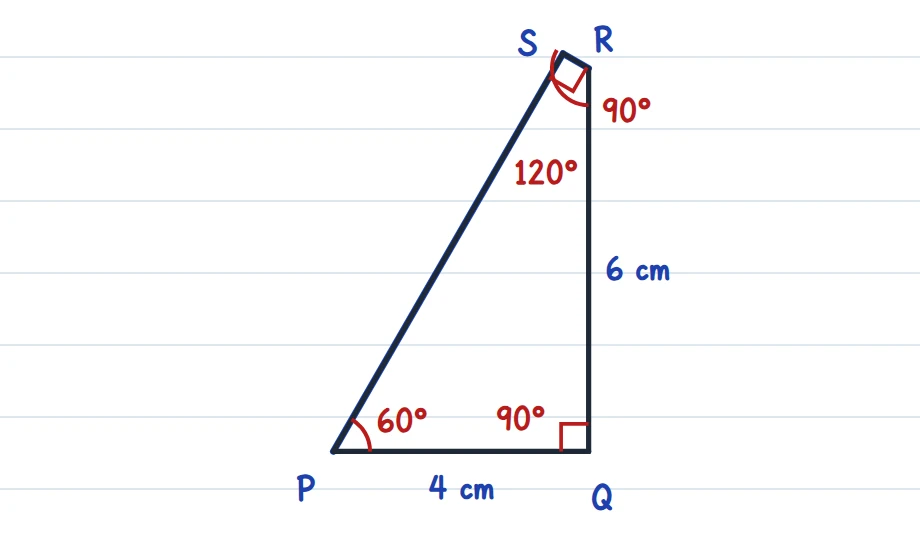
Construct a quadrilateral PQRS, given that PQ = 4 cm, QR = 6 cm, ∠P = 60°, ∠Q = 90° and ∠R = 120°.

Figure for Q7

Solution
Think: PQ and QR meet at Q. Draw PQ, turn by ∠Q, draw QR. The angles at P and R send out two rays; where they cross is S.
Steps of construction:
1. Find the missing angle first (the four angles add up to 360°): ∠S = 360° − (∠P + ∠Q + ∠R) = 360° − 270° = 90°.
3. Draw PQ = 4 cm.
4. At Q, construct ∠PQX = 90° (with compasses: bisect the angle between 60° and 120°). Cut off QR = 6 cm on QX.
5. At R, construct ∠QRY = 120° (with compasses: one arc, cut it twice), on the same side as P.
6. At P, construct ∠QPZ = 60° (with compasses: one arc, cut it once from where it meets the arm). Rays PZ and RY meet at S.
7. PQRS is the required quadrilateral.
Check: measure ∠S with a protractor. It should be 90°, because the four angles add up to 360°.
Answer: ∠S = 90°; PQRS constructed

5Three Sides and the Two Included Angles

Q84 marksAsked in: Annual Exam 2019-20
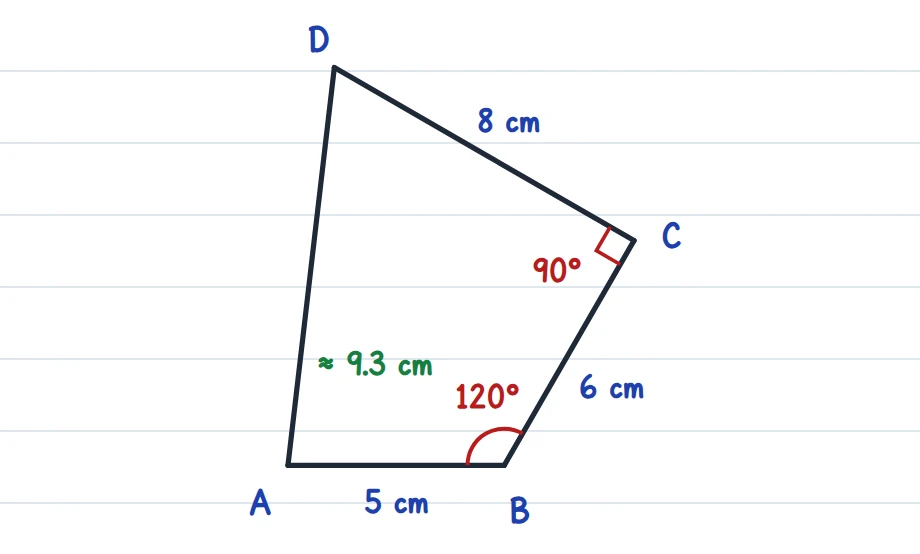
Construct a quadrilateral ABCD in which AB = 5 cm, BC = 6 cm, CD = 8 cm, ∠B = 120° and ∠C = 90°.

Figure for Q8

Solution
Think: walk round the shape. Side AB, turn by ∠B, side BC, turn by ∠C, side CD. The last side DA just joins the two ends.
Steps of construction:
1. Draw AB = 5 cm.
2. At B, construct ∠ABX = 120° (with compasses: one arc, cut it twice). Cut off BC = 6 cm on BX.
3. At C, construct ∠BCY = 90° (with compasses: bisect the angle between 60° and 120°), on the same side as A. Cut off CD = 8 cm on CY.
4. Join DA. ABCD is the required quadrilateral.
Check: the fourth side AD ≈ 9.3 cm.
Answer: ABCD constructed (DA measures about 9.3 cm)
Q95 marksAsked in: Mock Test 2023-24, West Bengal
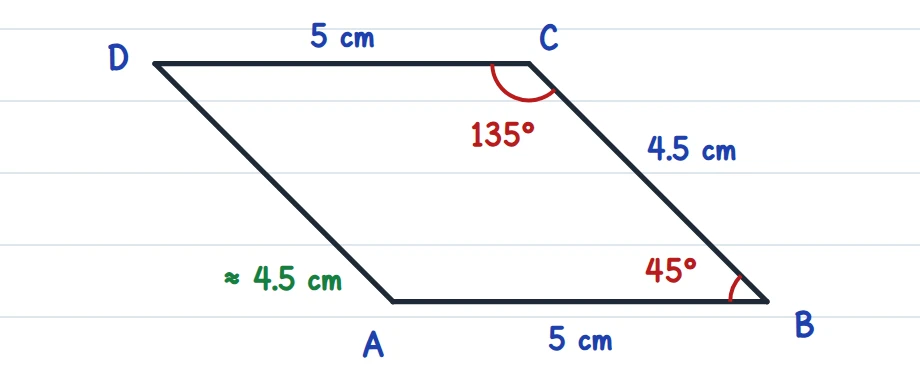
Construct a quadrilateral ABCD in which AB = CD = 5 cm, BC = 4.5 cm, ∠B = 45°, ∠C = 135° by using ruler and compasses only.

Figure for Q9

Solution
Think: walk round the shape. Side AB, turn by ∠B, side BC, turn by ∠C, side CD. The last side DA just joins the two ends.
Steps of construction:
1. Draw AB = 5 cm.
2. At B, construct ∠ABX = 45° (with compasses: bisect 90°). Cut off BC = 4.5 cm on BX.
3. At C, construct ∠BCY = 135° (with compasses: bisect the angle between 90° and 180°), on the same side as A. Cut off CD = 5 cm on CY.
4. Join DA. ABCD is the required quadrilateral.
∠B + ∠C = 45° + 135° = 180°, so AB ∥ DC (co-interior angles). With AB = DC as well, ABCD is a parallelogram: DA = BC (AD ≈ 4.5 cm).
Answer: ABCD constructed; it is a parallelogram (DA ≈ 4.5 cm = BC)
Share with classmates & study groups

Leave a Comment

Have a doubt in this chapter, or found a mistake? Write it here and our team will reply.

Link copied to clipboard!
Share with Classmates
WhatsApp

📑 Chapter Navigation Directory

Add as a preferred source on Google
See ncertbookspdf.com first in Google Search