| Class | Class 10 |
|---|---|
| Subject | Mathematics |
| Chapter | Chapter 5: Ratio and Proportion |
| Curriculum | CG SCERT Raipur (2026-27 textbook) |
| Textbook Pages | Pages 125-142 |
Exercise 1 · Exercise 2 · Exercise 3
Exercise 1 solutions: 6 questions
Exercise 1, Q.1
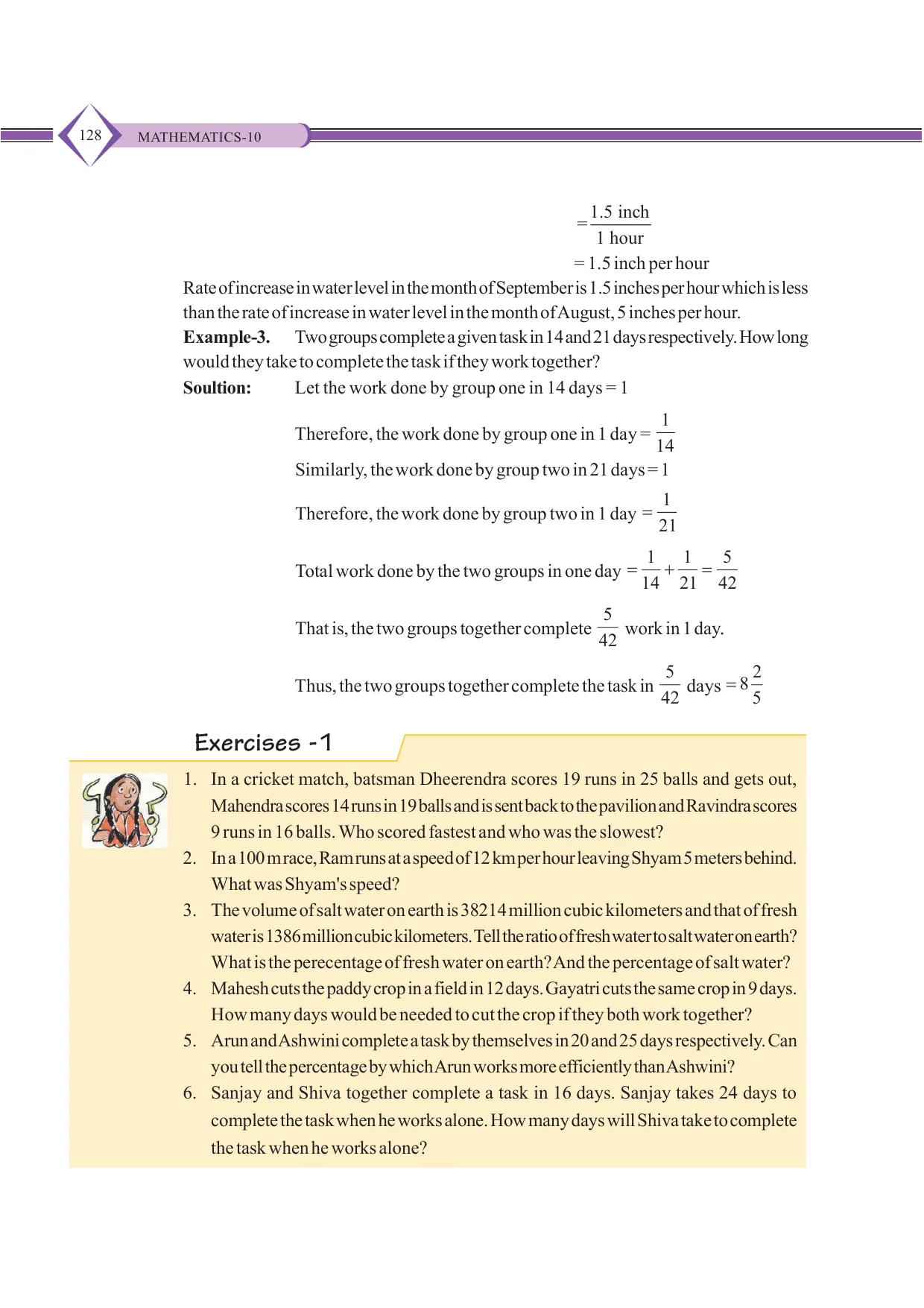
In a cricket match, batsman Dheerendra scores 19 runs in 25 balls and gets out, Mahendra scores 14 runs in 19 balls and is sent back to the pavilion and Ravindra scores 9 runs in 16 balls. Who scored fastest and who was the slowest?
The rates in runs per ball are 19/25, 14/19 and 9/16 respectively. Cross multiplication gives 361 > 350 and 224 > 171.
Answer: Fastest: Dheerendra. Slowest: Ravindra.
Exercise 1, Q.2
In a 100 m race, Ram runs at a speed of 12 km per hour leaving Shyam 5 meters behind. What was Shyam’s speed?
In the same time, Shyam runs 95 m while Ram runs 100 m. His speed is 12 × 95/100 = 11.4 km/h.
Answer: 11.4 km/hour
Exercise 1, Q.3
The volume of salt water on earth is 38214 million cubic kilometers and that of fresh water is 1386 million cubic kilometers. Tell the ratio of fresh water to salt water on earth? What is the perecentage of fresh water on earth? And the percentage of salt water?
Dividing 1386 and 38214 by 198 gives 7 and 193. Of the 200 equal parts, 7 are fresh and 193 are salt water. Multiplying each fraction by 100 gives the percentages.
Answer: 7:193, 3.5%, 96.5%
Exercise 1, Q.4
Mahesh cuts the paddy crop in a field in 12 days. Gayatri cuts the same crop in 9 days. How many days would be needed to cut the crop if they both work together?
Together they cut 1/12 + 1/9 = 7/36 of the field per day. One field takes 36/7 days.
Answer: 5 1/7 days
Exercise 1, Q.5
Arun and Ashwini complete a task by themselves in 20 and 25 days respectively. Can you tell the percentage by which Arun works more efficiently than Ashwini?
Arun and Ashwini finish 1/20 and 1/25 of the task per day. The increase relative to Ashwini is (1/20 − 1/25)/(1/25) × 100 = 25%.
Answer: 25% (Textbook answer key prints: One more)
Exercise 1, Q.6
Sanjay and Shiva together complete a task in 16 days. Sanjay takes 24 days to complete the task when he works alone. How many days will Shiva take to complete the task when he works alone?
Shiva completes 1/16 − 1/24 = 1/48 of the task per day.
Answer: 48 days
Exercise 2 solutions: 5 questions
Exercise 2, Q.1
The runs scored by three batsmen A, B and C in a cricket match are in the ratio A:B = B:C = 1:2. If the total of their runs is 364 then find the runs scored individually be each batsman.
The combined ratio is 1:2:4. One part is 364/7 = 52 runs. The other scores are 2 × 52 and 4 × 52.
Answer: 52, 104, 208
Exercise 2, Q.2
The salaries of three workers A, B and C are in the ratio 2:3:5. If their salaries are respectively increased by 15%, 10% and 20% then what will be the ratio of their new salaries?
Apply the increases to 2, 3 and 5 parts. The new amounts are 2.30, 3.30 and 6.00 parts. Multiply all three by 10.
Answer: 23:33:60
Exercise 2, Q.3
Three persons earn a profit of Rs. 70,000 in a business which they to divide in the ratio A:B = 4:2 and B:C = 10:5. How much money will each person get? The money received by A would be how many times the money received by C?
B:C simplifies to 2:1, so A:B:C = 4:2:1. Each part is ₹70,000/7 = ₹10,000. A receives four times C’s share.
Answer: ₹40,000, ₹20,000, ₹10,000, four times
Exercise 2, Q.4
A bag Rs. 1, Rs. 2 and Rs. 5 coins. If the coins are in the ratio 1:2:5 and the total money in the bag is Rs. 1590 then find the number of each type of coin.
For every group of 1, 2 and 5 coins, the value is 1 × 1 + 2 × 2 + 5 × 5 = ₹30. There are 1590/30 = 53 groups.
Answer: 53, 106, 265
Exercise 2, Q.5
We have 100 liters of a mixture of milk and water which is 10% water. How much more pure milk should be added so that the new mixture has only 5% water?
The water stays at 10 litres. At 5% water the total must be 10/0.05 = 200 litres. Add 200 − 100 litres of milk.
Answer: 100 litres of pure milk (Textbook answer key prints: 4 liter)
Exercise 3 solutions: 19 questions
Exercise 3, Q.1
If the cost of 29 books is Rs. 783 then how many books can be purchased in Rs. 2214?
Each book costs ₹783/29 = ₹27. ₹2214 buys 2214/27 = 82 books.
Answer: 82
Exercise 3, Q.2
If 14 : 35 :: 16 : x then find the value of x?
Cross multiplication gives 14x = 35 × 16, so x = 40.
Answer: 40
Exercise 3, Q.3
Find the fourth proportion in 2xy, x2, y2
If the fourth term is d, then 2xy × d = x2y2. Dividing by 2xy gives d = xy/2.
Answer: xy/2
Exercise 3, Q.4
What should be added to 10, 18, 22, 38 so that they become proportional?
With t added, (10+t)(38+t) = (18+t)(22+t). Cancelling t2 gives 380+48t = 396+40t, so t = 2.
Answer: 2
Exercise 3, Q.5
If b is the mean proportional of a and c then prove that(a2+b2)/ab = (a+c)/b.
Since b2 = ac, the numerator a2 + b2 equals a(a+c). Dividing by ab gives (a+c)/b.
Answer: Hence proved
Exercise 3, Q.6
Find the numbers whose mean proportional is 24 and third proportional is 192.
Let the numbers be u and v. Then uv = 576 and v² = 192u. Hence v³ = 192 × 576 = 48³. Thus v = 48 and u = 576/48 = 12.
Answer: 12 & 48
Exercise 3, Q.7
Find x if (1 + x) : (3 + x) : (6 + x)
The ratio alone gives no equation for x. If continued proportion was intended, (3+x)² = (1+x)(6+x) gives 9+6x = 6+7x and x = 3.
Answer: Undetermined as printed (Textbook answer key prints: 3, assuming continued proportion)
Exercise 3, Q.8
Two numbers are in the ratio 3:5. If 9 is subtracted from both the new ratio is 12:23. Find the first number.
Write the numbers as 3k and 5k. Then 23(3k−9) = 12(5k−9), so 9k = 99. The first number is 3 × 11 = 33.
Answer: 33 (Textbook answer key prints: 27)
Exercise 3, Q.9
A task is completed by 45 labourers in 24 days if they work 6 hours per day. How many labourers will be needed to complete the task in 15 days if they work for 8 hours every day?
The task takes 45 × 24 × 6 worker-hours. Each worker gives 15 × 8 hours. Dividing gives 6480/120 = 54 workers.
Answer: 54 workers
Exercise 3, Q.10
A task is completed by 25 persons in 9 days if they work 6 hours per day. How many days will be needed to complete the task if 15 persons work for 9 hours every day?
The task takes 25 × 9 × 6 person-hours. Each day supplies 15 × 9 person-hours. Dividing gives 1350/135 = 10 days.
Answer: 10 days
Exercise 3, Q.11
A task is completed by 30 persons in 15 days if they work 6 hours per day. How many hours of work will be needed every day if 20 persons have to complete it in 15 days?
Divide 30 × 15 × 6 person-hours by 20 people and 15 days. Dividing gives 2700/300 = 9 hours/day.
Answer: 9 hours/day
Exercise 3, Q.12
A car leaves Saraipalli, travels at 75 km per hour and reaches Raipur in 4 hours. The next time there was traffic and construction work on the road due to which the speed is decreased by 15 km per hour. How long will the car take to reach Raipur?
The distance is 75 × 4 km. The reduced speed is 75 − 15 km/h. Dividing gives 300/60 = 5 hours.
Answer: 5 hours
Exercise 3, Q.13
If 10 bulbs are lighted 4 hours every day for 60 days then the electricity bill is Rs. 80. How many bulbs can be lighted for 3 hours every day for 16 days so that the electricity bill is Rs. 40?
Half the bill pays for half of 10 × 4 × 60 bulb-hours. Each bulb runs 3 × 16 hours. Dividing gives 1200/48 = 25 bulbs.
Answer: 25 bulbs
Exercise 3, Q.14
A task is completed by 48 persons in 25 days if they work 8 hours per day. How many days will be needed to complete double the task if 30 persons work for 10 hours every day?
Double the work takes 2 × 48 × 25 × 8 person-hours. Each day supplies 30 × 10. Dividing gives 19200/300 = 64 days.
Answer: 64 days
Exercise 3, Q.15
A and B together complete a task in 24 days, C and B together complete the same task in 18 days, and A and C together complete the task in 12 days. How many days will A take to complete the task if he works alone?
Twice A’s daily rate is (A+B)+(A+C)−(B+C) = 1/24+1/12−1/18 = 5/72. A takes 144/5 days.
Answer: 28 4/5 days
Exercise 3, Q.16
A task is completed by 15 men in 16 days. How many men will be needed to complete 1/4th of the task in 15 days?
A quarter of the task takes 15 × 16/4 person-days. Each man works 15 days. Dividing gives 60/15 = 4 persons.
Answer: 4 persons
Exercise 3, Q.17
A camp has sufficient provisions for 120 soldiers. If after 40 days, 40 soldiers were deputed elsewhere, how long will the remaining provisions last for the remaining soldiers?
If provisions originally last D days, 120(D−40) soldier-days remain. For 80 soldiers this lasts 3(D−40)/2 days. The initial duration is unspecified.
Answer: Cannot be determined without initial days (Textbook answer key prints: 30 days)
Exercise 3, Q.18
If 11 spiders spin 11 webs in 11 days then how many webs will one spider spin in one day?
The 11 spiders work 121 spider-days to spin 11 webs. One spider averages 11/121 = 1/11 web per day.
Answer: 1/11 web per day (Textbook answer key prints: 11 days)
Exercise 3, Q.19
To taps together fill a tank in 6 hours. One of the taps alone fills it in 10 hours. How long will it take to fill the tank if only the second tap is open?
The second tap fills 1/6 − 1/10 = 1/15 of the tank per hour.
Answer: 15 hours