DAV Class 3 Science Chapter 1 My Body solutions from the DAV textbook My Living World. Here you will find clear, step-by-step, age-appropriate answers, solved textbook activities, and the official tongue taste diagram with taste buds.
DAV Class 3 Science All Chapters | Next: Chapter 2 Plants Around Us »
Chapter Overview: My Body (Class 3 Science)
Our body is a wonderful gift of nature. It has many external parts and five vital sense organs: eyes, ears, nose, tongue, and skin. These sense organs help us to see, hear, smell, taste, and feel everything happening in our surroundings.
Introductory Activity (Book Page 1): Label the Parts of Human Body
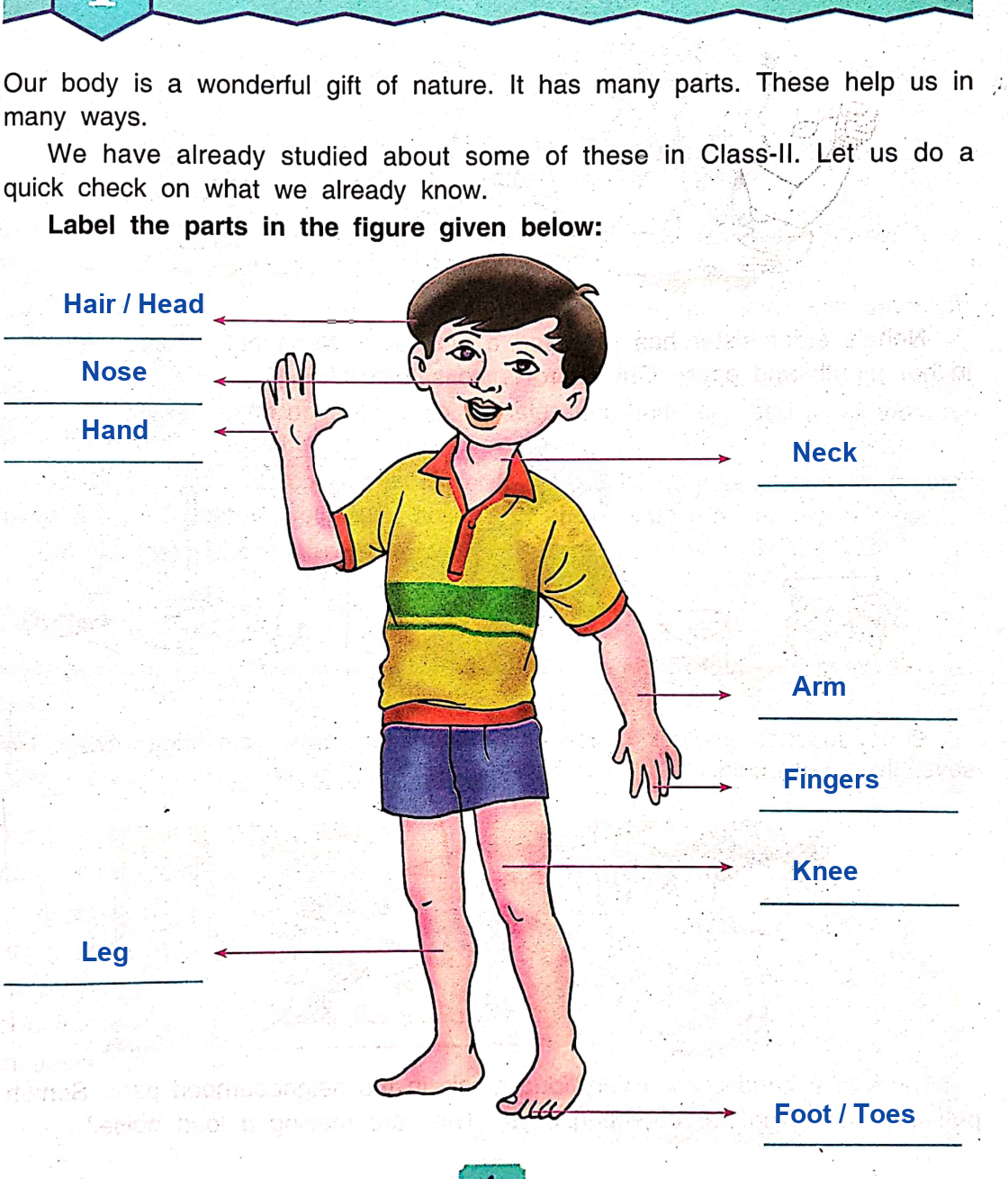
Question: Label the parts in the figure given below (Class 2 Review Activity):
Answer (Correct Labels for the Diagram):
- Left Side (Top to Bottom):
- Hair / Head — Indicator arrow pointing to hair on top of head
- Nose — Indicator arrow pointing to nose (sense organ for smell)
- Hand — Indicator arrow pointing to open palm/hand
- Leg — Indicator arrow pointing to lower leg/shin
- Right Side (Top to Bottom):
- Neck — Indicator arrow pointing to neck collar
- Arm — Indicator arrow pointing to forearm
- Fingers — Indicator arrow pointing to hand fingers
- Knee — Indicator arrow pointing to knee joint
- Foot / Toes — Indicator arrow pointing to foot and toes
A. Fill in the blanks.
1. Our tongue is sensitive to different tastes.
Explanation: The tongue has taste buds that help us detect sweet, sour, salty, and bitter flavours.
2. Loud sounds are unpleasant and harmful for ears.
Explanation: Very loud noise can damage our sensitive eardrums and cause hearing problems.
3. Skin helps us to feel smooth and rough surfaces.
Explanation: The skin is our largest sense organ and lets us sense touch, texture, pain, heat, and cold.
4. We should avoid reading in dim light.
Explanation: Reading in poor or dim lighting strains our eyes and causes headaches.
5. We have five sense organs.
Explanation: The five sense organs are eyes, ears, nose, tongue, and skin.
B. Write True or False for the following statements.
1. Our body has many parts. — True
Reason: Our body is made of many parts like head, hands, legs, chest, and sense organs working together.
2. Sense organs help us to sense various things around us. — True
Reason: They receive information from our surroundings and send signals to our brain.
3. We can find out whether the tea is hot or cold just by smelling it. — False
Reason: We need our sense of touch (skin) to know whether something is hot or cold; smelling tells us aroma, not temperature.
4. We get the feeling of pain when we are injured. — True
Reason: The nerves under our skin alert us about injuries through the feeling of pain.
5. We can find out the colour of a leaf by just touching it. — False
Reason: Touching can tell us if a leaf is smooth, rough, or soft, but we need our eyes (sense of sight) to see colour.
C. Tick the correct option.
1. We feel through our—
(a) nose
(b) skin
(c) eyes
(d) ears
Answer: (b) skin
Explanation: The skin covers our whole body and contains sensory receptors that enable us to feel touch, heat, cold, and pressure.
2. We should take bath—
(a) daily
(b) weekly
(c) fortnightly
(d) monthly
Answer: (a) daily
Explanation: Daily bathing washes away dirt, sweat, and germs, keeping our skin healthy and fresh.
3. It is not a sense organ.
(a) nose
(b) stomach
(c) ears
(d) skin
Answer: (b) stomach
Explanation: The stomach is a digestive organ inside our body, whereas nose, ears, and skin are sense organs.
D. Answer the following questions in brief.
Question 1: Name all the sense organs.
Answer: The five sense organs in our body are:
- Eyes (sense of sight)
- Ears (sense of hearing)
- Nose (sense of smell)
- Tongue (sense of taste)
- Skin (sense of touch)
Question 2: What does our nose help us to do?
Answer: Our nose helps us in two key ways:
- It helps us to breathe fresh air.
- It helps us to smell different fragrances (like flowers or perfume) and foul odours (like rotting garbage).
Question 3: What types of sounds are differentiated by our ears?
Answer: Our ears help us differentiate between:
- Pleasant sounds: Soft music, birds chirping, gentle whispering.
- Unpleasant sounds (noise): Honking of horns, loud speakers, barking of a fierce dog.
- Loud sounds and soft / faint sounds.
Question 4: Why should we meditate and exercise regularly?
Answer: We should meditate and exercise regularly because:
- Exercise keeps our body active, strong, and healthy.
- Meditation calms our mind, reduces stress, and improves concentration in our studies.
E. Answer the following questions.
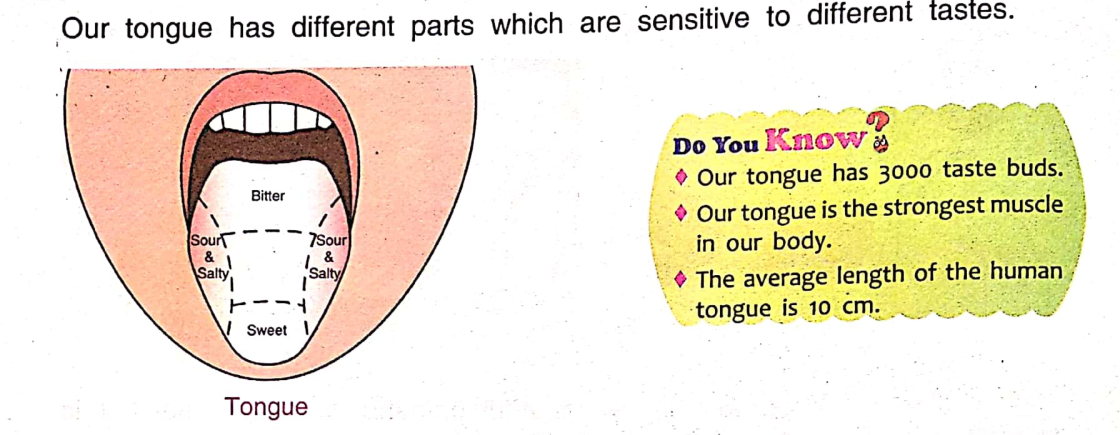
Question 1: Name the different types of tastes. Draw a diagram of a tongue showing all its taste related parts.
Answer: There are four primary types of tastes detected by our tongue:
- Sweet — tasted mostly at the tip of the tongue (e.g., honey, sugar, ice cream).
- Salty — tasted at the sides near the front (e.g., table salt, potato chips).
- Sour — tasted at the sides towards the back (e.g., lemon, raw mango).
- Bitter — tasted at the back of the tongue (e.g., bitter gourd/karela, medicines).
Question 2: How are eyes useful to us?
Answer: Eyes are our most important sense organ because:
- They help us to see beautiful colours, shapes, and sizes of everything around us.
- They help us to read books, write, and navigate without bumping into objects.
- They help us express emotions like happiness and sadness.
Question 3: List some pleasant and unpleasant sounds around us.
Answer: Here is a comparison of pleasant and unpleasant sounds:
| Category | Sound Type | Examples |
|---|---|---|
| Pleasant Sounds | Soft, sweet, and soothing to the ears | Chirping of birds, sweet flute/piano music, gentle rustle of leaves, mother singing a lullaby |
| Unpleasant Sounds | Loud, harsh, jarring noise that disturbs us | Vehicles honking constantly, bursting firecrackers, loud construction drill, screaming |
Question 4: Write the role of skin in our body.
Answer: The skin plays several essential roles in our body:
- It acts as a protective cover for the entire body, keeping muscles and internal organs safe.
- It allows us to feel sensations such as hot, cold, smooth, rough, soft, hard, and pain.
- It helps regulate body temperature by releasing sweat through tiny pores.
Question 5: Write any two activities where we use more than one sense organ.
Answer:
- 1. Eating Food: We use our eyes to look at the food, our nose to smell its aroma, our tongue to taste its flavours, and our skin (hands/lips) to feel its texture and temperature.
- 2. Watching Television: We use our eyes to watch the visuals and pictures, and our ears to listen to the dialogues and music.
Value Based Question
Rahul noticed that over the last few days his grandfather was not very quick in responding to queries. His father took grandfather to an ENT specialist. The specialist checked his ears and provided a hearing aid. Grandfather was happy to hear clearly again.
Question: Think of the problems that Rahul’s grandfather might have faced due to his not being able to hear clearly:
(a) While at home: He might not hear the doorbell ring, the telephone ring, or family members talking to him.
(b) On the road: He might not hear vehicles honking behind him, which can cause severe accidents.
(c) In the park: He might miss chirping of birds, greetings from fellow walkers, or children calling out while playing.
(d) At the market: He might face trouble understanding shopkeepers, calculating money, and hearing street vendor announcements.
DAV Class 3 Science All Chapters | Next: Chapter 2 Plants Around Us »