DAV Class 3 Science Chapter 2 Plants Around Us solutions from DAV textbook My Living World. Here you will find comprehensive question answers, complete classification of plants (trees, shrubs, herbs, climbers, creepers), and the solved diagram of parts of a plant snipped directly from the DAV book.
« Previous: Chapter 1 My Body | DAV Class 3 Science All Chapters | Next: Chapter 3 Leaf »
Chapter Overview: Plants Around Us (Class 3 Science)
Plants are our green friends that grow all around us in gardens, fields, forests, and roadsides. A plant is broadly divided into two main systems: the Root System (under the ground) and the Shoot System (above the ground, consisting of stem, branches, leaves, buds, flowers, and fruits).
A. Fill in the blanks.
1. Stem carries all the parts of the shoot in a plant.
Explanation: The stem grows upright above the soil and holds the branches, leaves, flowers, and fruits.
2. The strong woody stem of a tree is called the trunk.
Explanation: Big trees have a thick, brown, hard stem called the trunk, covered with bark.
3. A herb has a thin and green stem.
Explanation: Herbs like mint, tomato, and coriander have soft, tender green stems.
4. Muskmelon and grass are examples of creepers.
Explanation: Creepers have very weak stems that crawl and spread along the surface of the ground.
5. Money plant / Pea plant is an example of a climber type plant.
Explanation: Climbers have weak stems and need external support like sticks or walls to climb up.
B. Match the following:
Here is the completed and verified matching table based on the DAV Class 3 textbook:
| Column A | Column B (Plant Category) | Correct Match & Reason |
|---|---|---|
| 1. Tree | Mango | Mango is a big, tall plant with a thick woody trunk that lives for many years. |
| 2. Shrub | Rose | Rose is a medium-sized bushy plant with multiple woody stems branching near the ground. |
| 3. Herb | Tomato | Tomato has a soft, green stem and lives for only one or two seasons. |
| 4. Climber | Pea plant | Pea plant has a very weak stem with tendrils that wrap around support to climb. |
| 5. Creeper | Bitter gourd / Grass | Spreads horizontally on the ground because the stem cannot support upright growth. |
C. Tick the correct option.
1. The part of a plant that produces seeds is the—
(a) root
(b) leaf
(c) flower
(d) stem
Answer: (c) flower
Explanation: Flowers grow into fruits, and fruits contain seeds which give rise to new plants.
2. It fixes the plant in the soil.
(a) root
(b) stem
(c) leaf
(d) flower
Answer: (a) root
Explanation: Roots spread deep inside the soil to anchor and hold the plant firmly in place.
3. It has a woody and strong stem.
(a) herb
(b) shrub
(c) climber
(d) tree
Answer: (d) tree
Explanation: Trees have the strongest, thickest woody trunk among all plant types.
4. It lives for one or two seasons only.
(a) banyan
(b) rose
(c) coriander (herb)
(d) neem
Answer: (c) coriander
Explanation: Herbs are seasonal plants with short lifespans of one or two seasons.
5. An example of a climber is—
(a) watermelon
(b) money plant
(c) grass
(d) pumpkin
Answer: (b) money plant
Explanation: Money plant needs support (like a pole or rope) to climb upward.
D. Answer the following questions in brief.
Question 1: State the function of a leaf.
Answer: The primary function of a leaf is to prepare food for the plant through the process of photosynthesis using sunlight, water, chlorophyll, and carbon dioxide. That is why leaves are called the kitchen or food factory of the plant.
Question 2: Write the role of roots of a tree.
Answer: Roots perform two vital functions:
- They fix the tree firmly in the soil so it does not fall during strong winds.
- They absorb water and mineral nutrients from deep inside the soil and send them up through the trunk.
Question 3: What type of stem do climbers have?
Answer: Climbers have very thin, soft, and weak stems. Because their stems are not strong enough to stand upright on their own, they use special tendrils to cling to external support (sticks, walls, other trees) and grow upward.
Question 4: State whether a banyan tree is a tree, shrub, herb, climber or creeper.
Answer: A banyan tree is a tree because it is huge, tall, has a massive woody trunk, spread-out branches, and lives for hundreds of years.
Question 5: Name any two creepers that grow along the ground.
Answer: Two common creepers are Watermelon and Pumpkin.
E. Answer the following questions.
Question 1: Draw and label different parts of a plant.
Activity (Book Page 12): Label the various parts of a plant using the words given in the Help Box (Help Box: flower, roots, leaf, bud, stem, branch, fruit):
Answer (Correct Labels from Help Box — Top to Bottom):
- leaf — Broad, green food-making organ of the plant (top indicator arrow).
- fruit — Red tomato containing and protecting seeds (second indicator arrow).
- branch — Side shoot bearing leaves and flowers (third indicator arrow).
- flower — Bright yellow blossom that develops into fruit (fourth indicator arrow).
- bud — Small unopened flower shoot tip (fifth indicator arrow).
- stem — Central upright stalk supporting the shoot system (sixth indicator arrow).
- roots — Underground root system that anchors the plant and absorbs water (bottom indicator arrow).
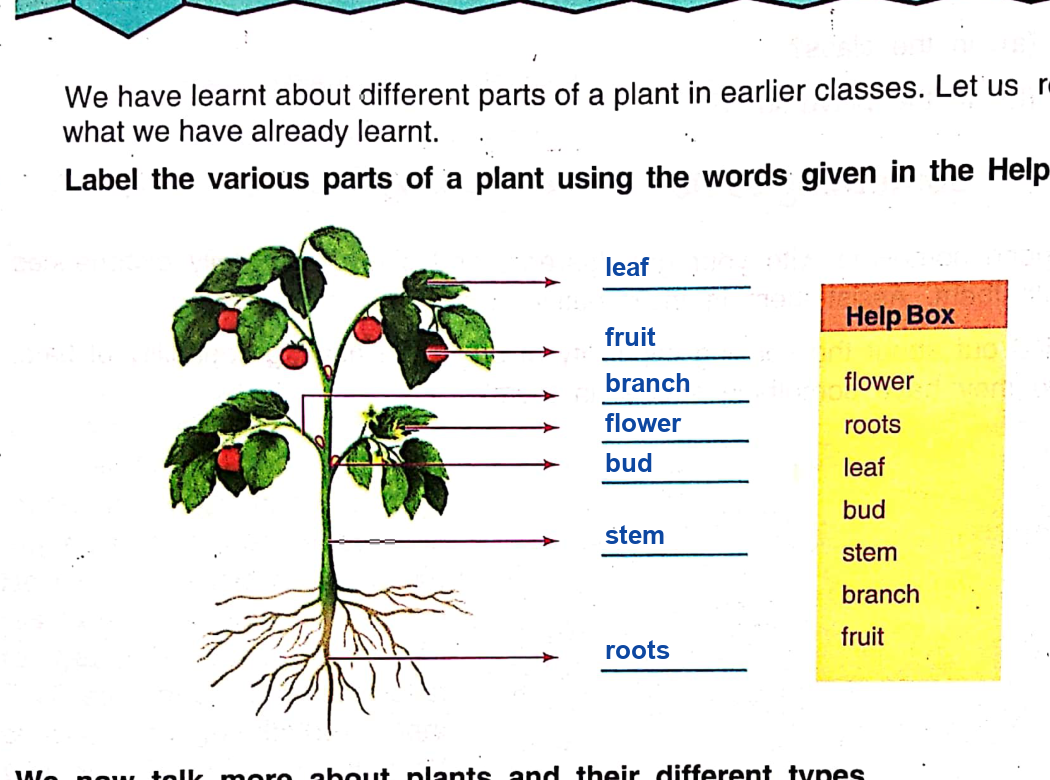
Here are the parts and their functions as taught in the DAV curriculum:
| Part of Plant | Location / Appearance | Function in Plant |
|---|---|---|
| Root | Below ground (Root System) | Fixes the plant firmly in the soil and absorbs water and minerals. |
| Stem | Above ground (Main axis) | Carries all parts of the shoot (leaves, flowers, fruits) and transports water. |
| Leaf | Attached to branches | Prepares food for the plant using sunlight and chlorophyll. |
| Bud | Young undeveloped shoot tip | Grows and blossoms into a beautiful flower. |
| Flower | Brightly coloured shoot part | Attracts insects and develops into a fruit. |
| Fruit | Fleshy part formed from flower | Stores food and protects seeds inside it. |
Question 2: Write three examples of trees, shrubs, herbs, climbers and creepers.
Answer: Here are 3 examples of each plant category with pictures from the textbook:
| Plant Category | Key Characteristics | 3 Examples from Textbook |
|---|---|---|
| Trees | Big, tall, thick woody trunk, lives many years | Mango, Banyan, Neem, Coconut |
| Shrubs | Medium bushy, woody stem branching near ground | Rose, Bougainvillea, Cotton, Mehendi |
| Herbs | Small seasonal plants, soft green tender stems | Tomato, Mint, Coriander, Wheat |
| Climbers | Weak stems, need support to climb upward | Pea plant, Grapevine, Money plant |
| Creepers | Weak stems crawling horizontally on ground | Pumpkin, Watermelon, Strawberry, Grass |
Question 3: Differentiate between the stem of a shrub and the stem of a herb.
Answer:
| Feature | Stem of a Shrub | Stem of a Herb |
|---|---|---|
| Hardness | Woody, hard, and stiff | Soft, tender, and non-woody |
| Colour | Brownish in colour | Green in colour |
| Branching | Branches out near the ground level | Thin single central shoot with soft leaves |
| Lifespan | Lasts for several years | Lasts for only 1 or 2 seasons |
| Examples | Rose, Hibiscus, Mehendi | Mint, Spinach, Tomato |
Question 4: Compare a tomato plant and grass. In what category does each fall?
Answer:
| Property | Tomato Plant | Grass |
|---|---|---|
| Category | Herb | Creeper |
| Growth Pattern | Grows upright up to a small height with green stems | Crawls and spreads horizontally on the soil |
| Stem Nature | Green, soft, produces branches, flowers, and fruits | Very thin, flexible runner stem that roots along the nodes |
| Fruits | Bears fleshy red tomato fruits with seeds | Does not bear large fruits |
Question 5: Why do climbers need support?
Answer: Climbers have very thin, delicate, and weak stems that cannot bear the weight of their own leaves and branches. Therefore, they cannot stand erect on their own and need external support such as a stick, bamboo trellis, fence, or wall to climb toward sunlight.
Value Based Question
Rita visited her grandmother’s orchard where mangoes and guavas were growing. Her grandmother explained that trees take years to grow and provide shade, fresh air, and fruits for generations, so we must never cut healthy trees.
Question: What values do we learn from Rita’s grandmother?
Answer: We learn to respect nature, protect trees, avoid cutting green branches, and practice patience, because trees serve living beings selflessly for decades.
« Previous: Chapter 1 My Body | DAV Class 3 Science All Chapters | Next: Chapter 3 Leaf »