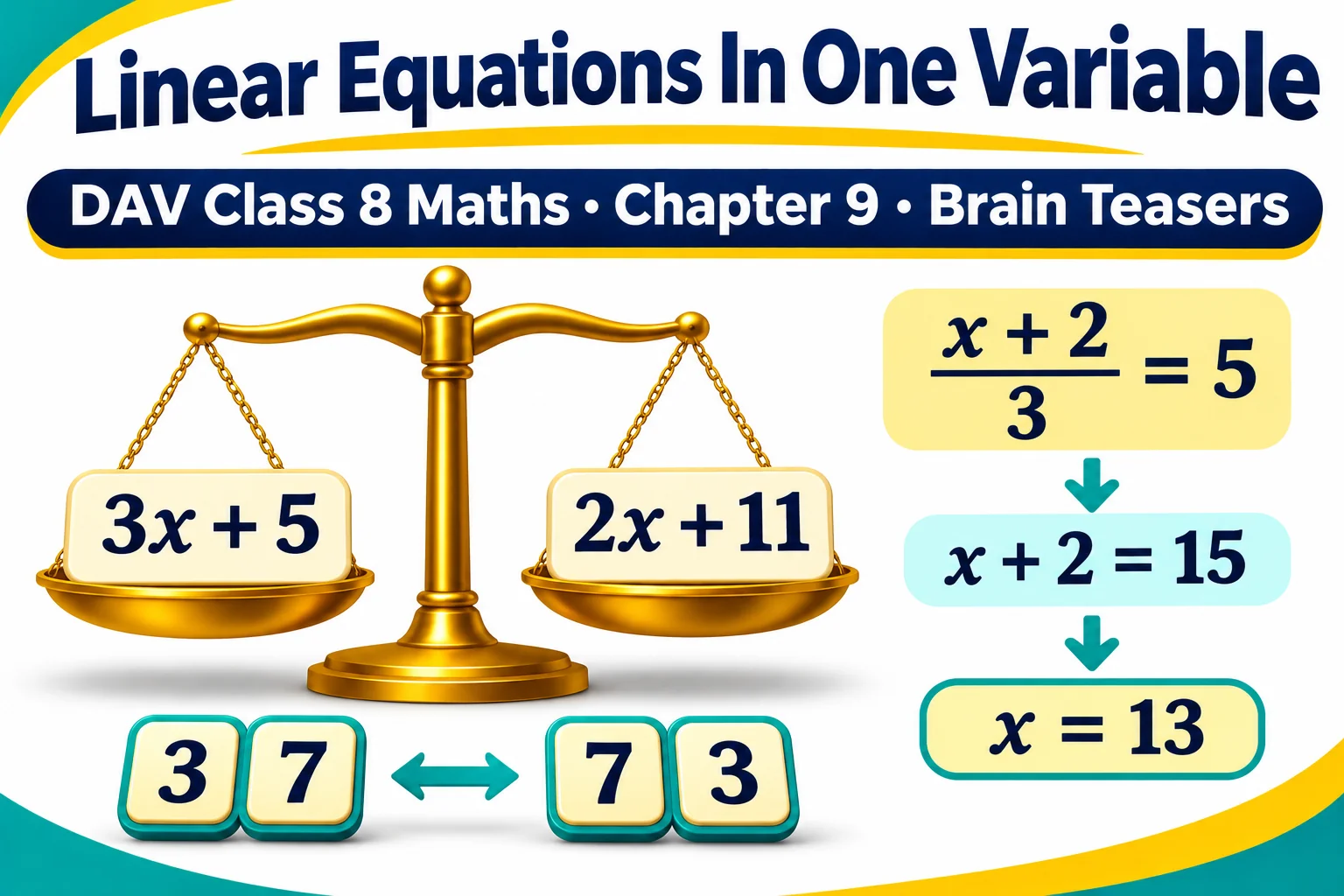
DAV Class 8 Maths Chapter 9: all worksheets All Class 8 Maths chapters →
Linear Equations — Notes & 73 Questions with Answers
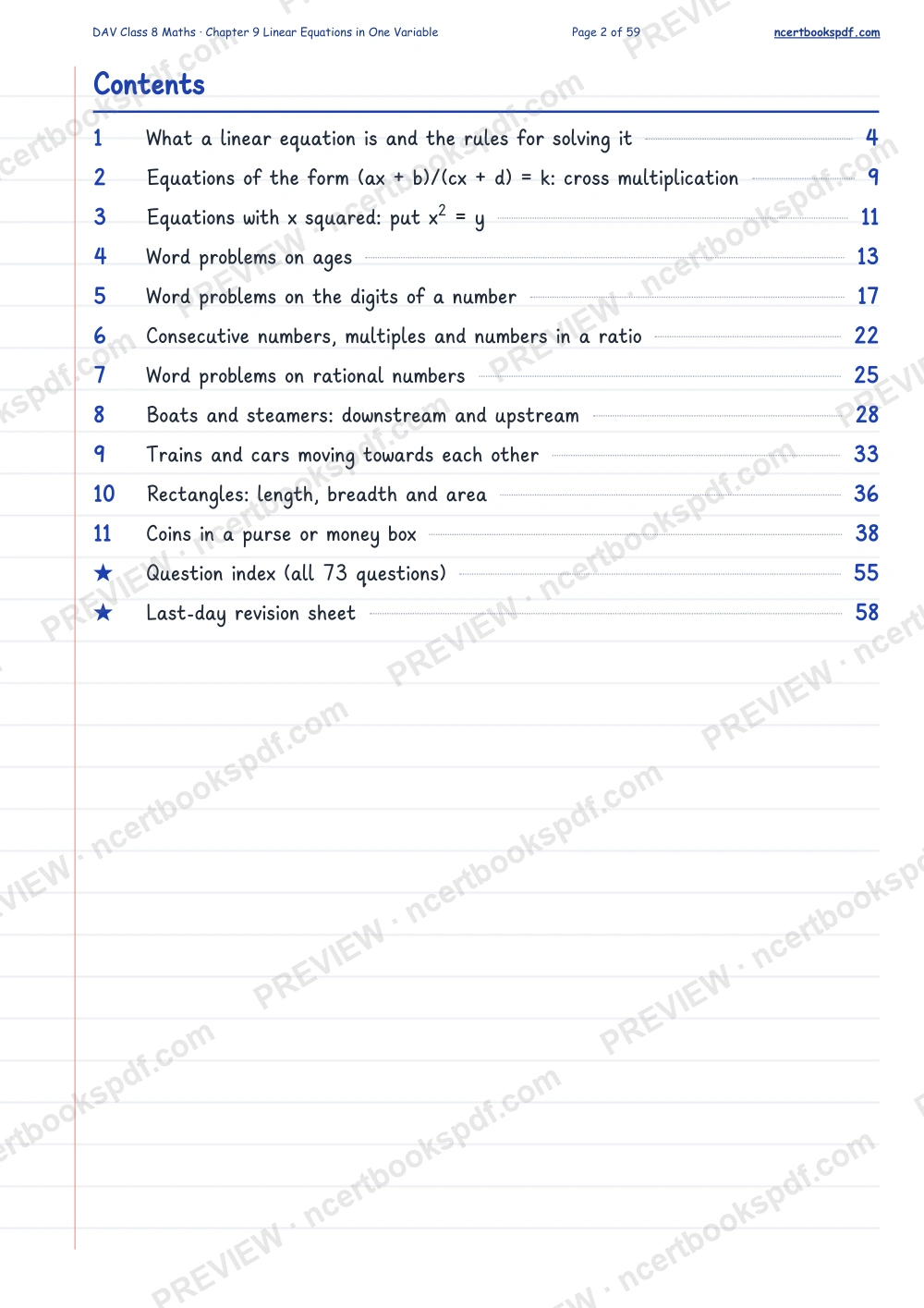
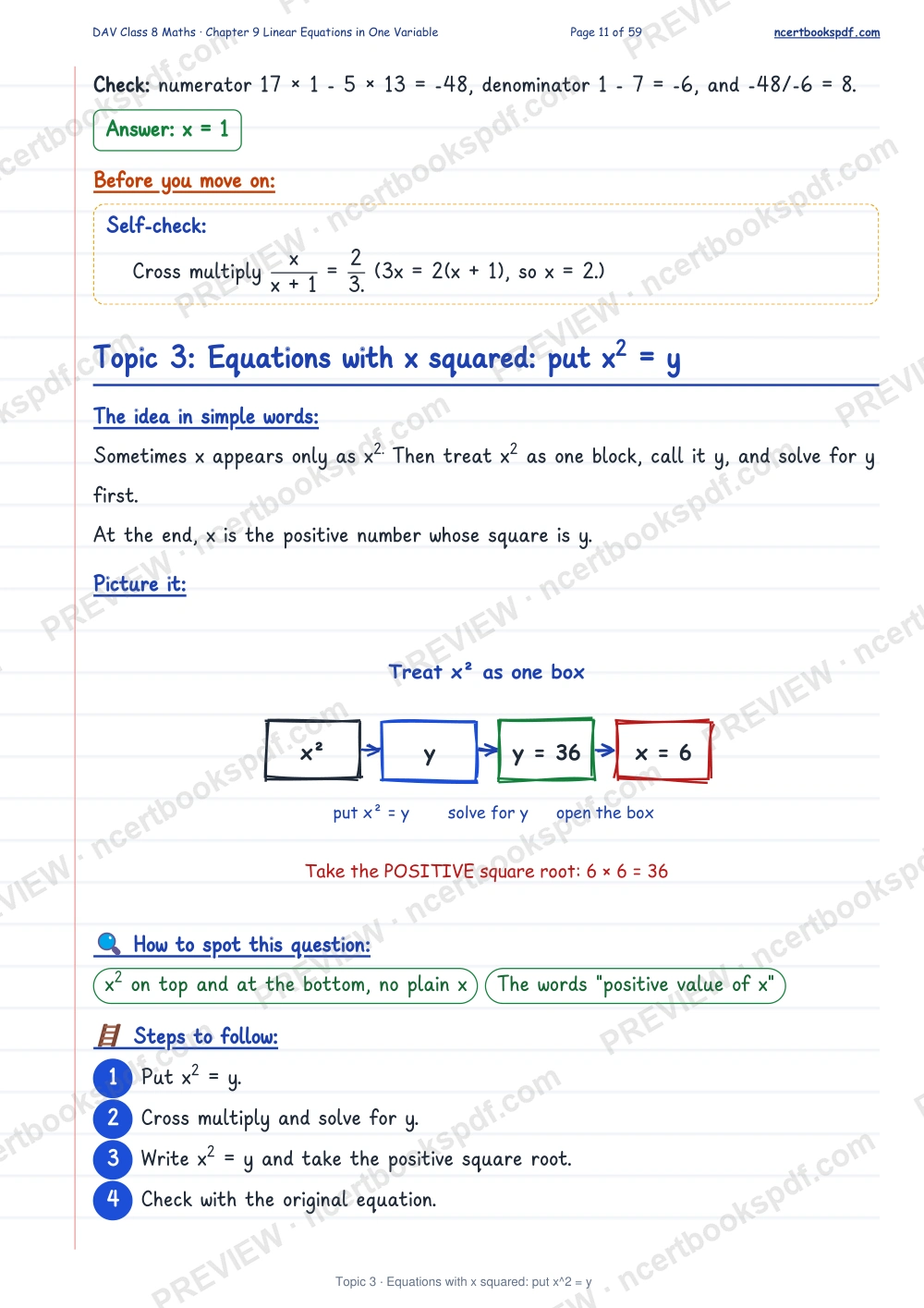
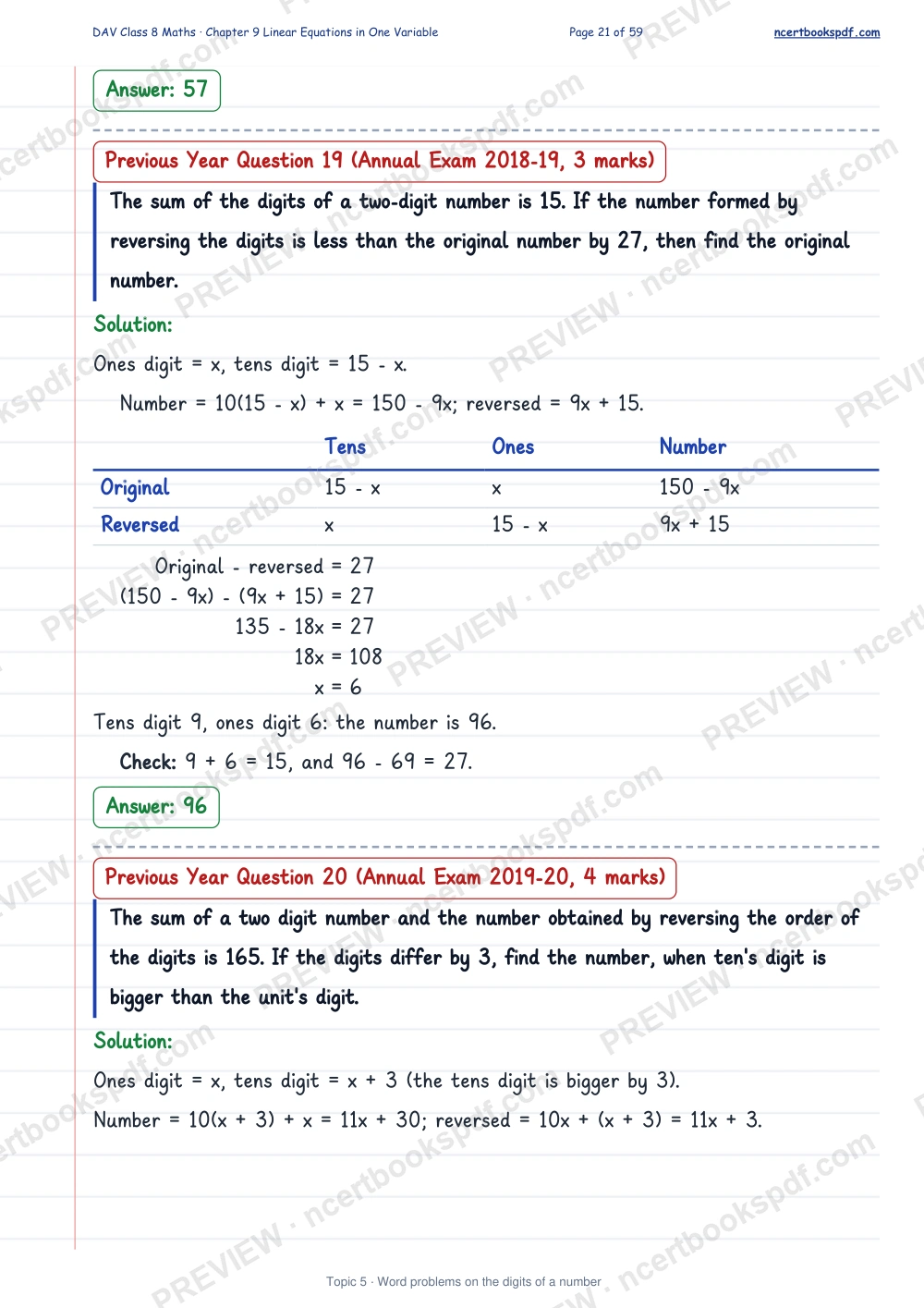
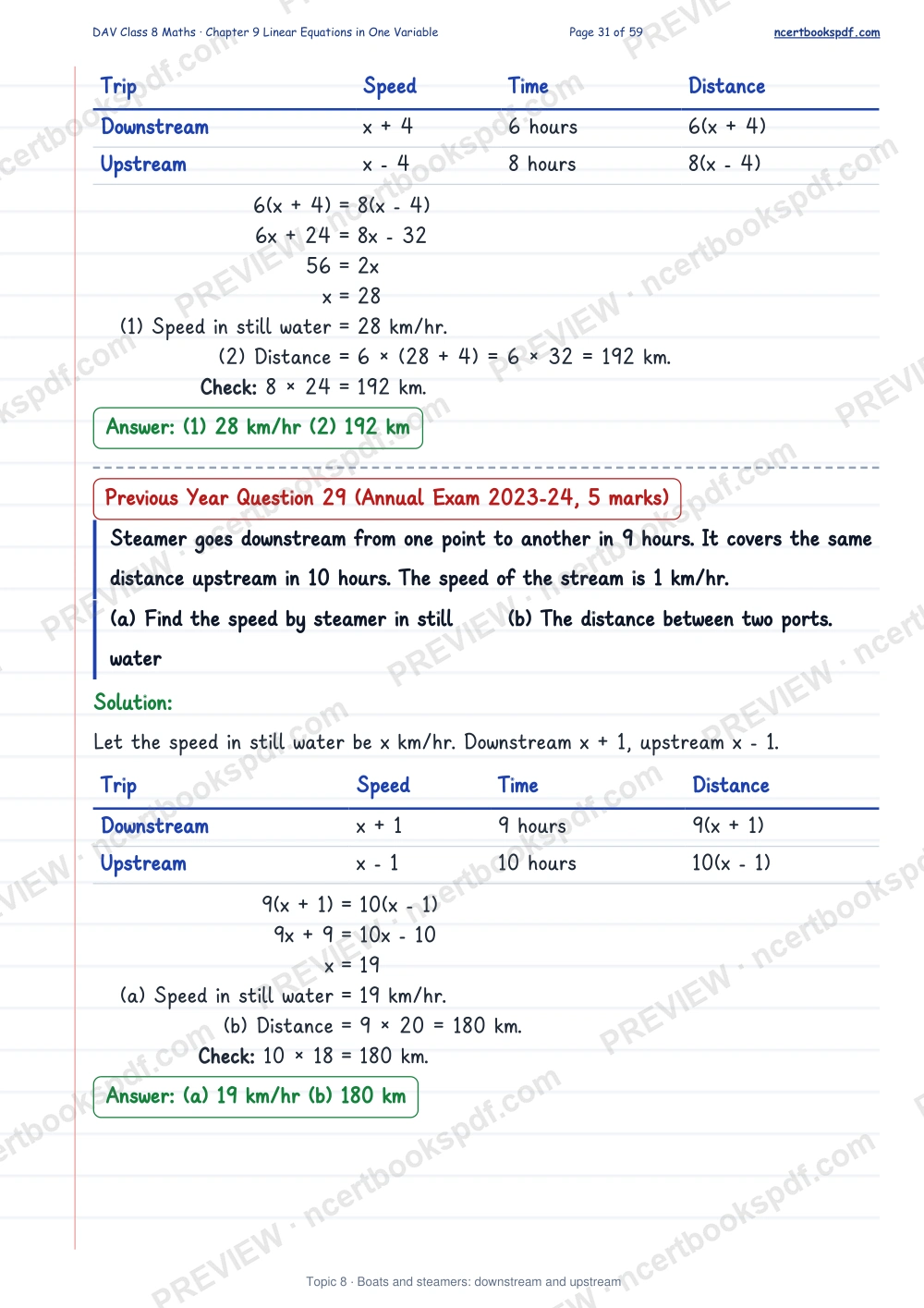
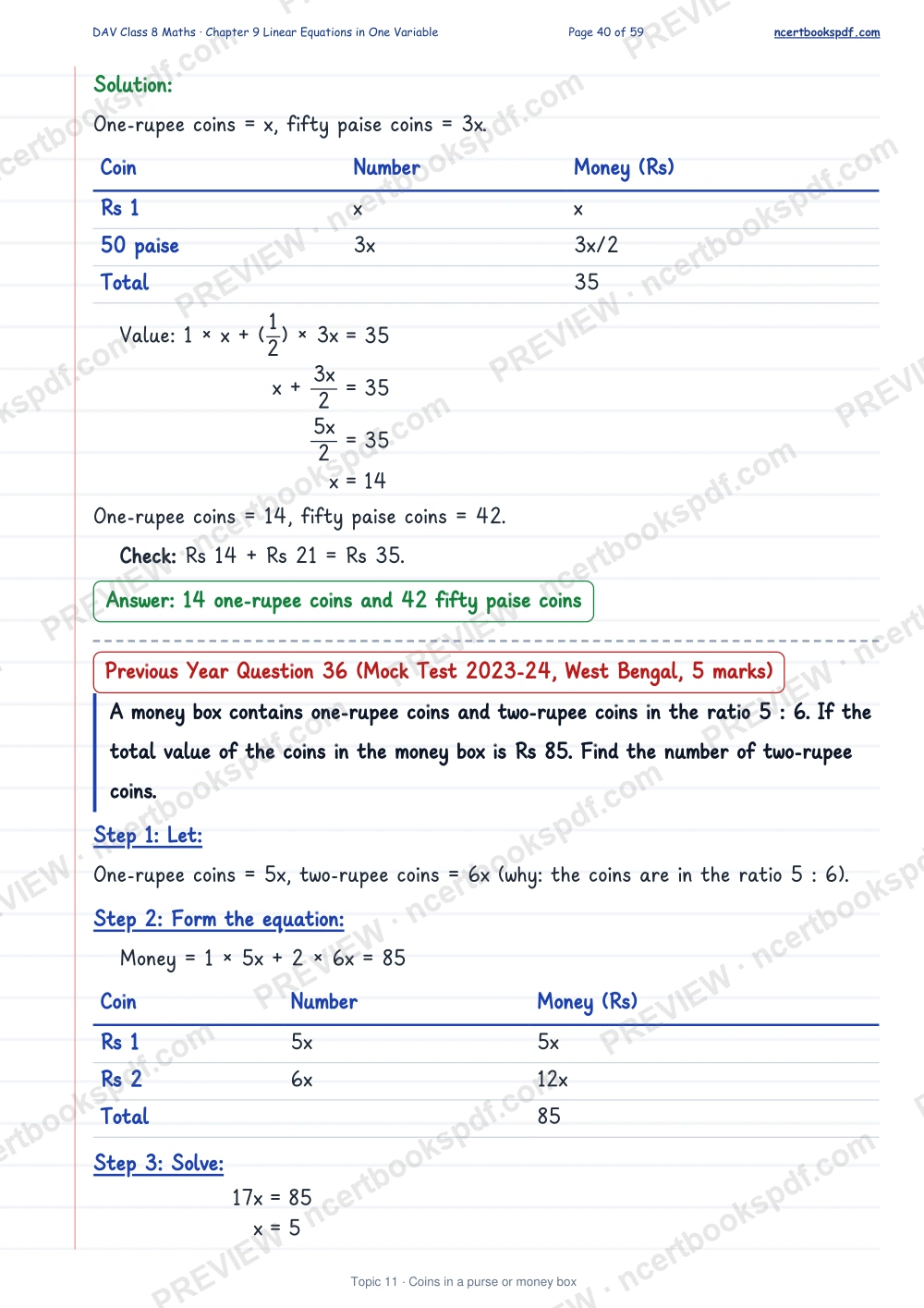
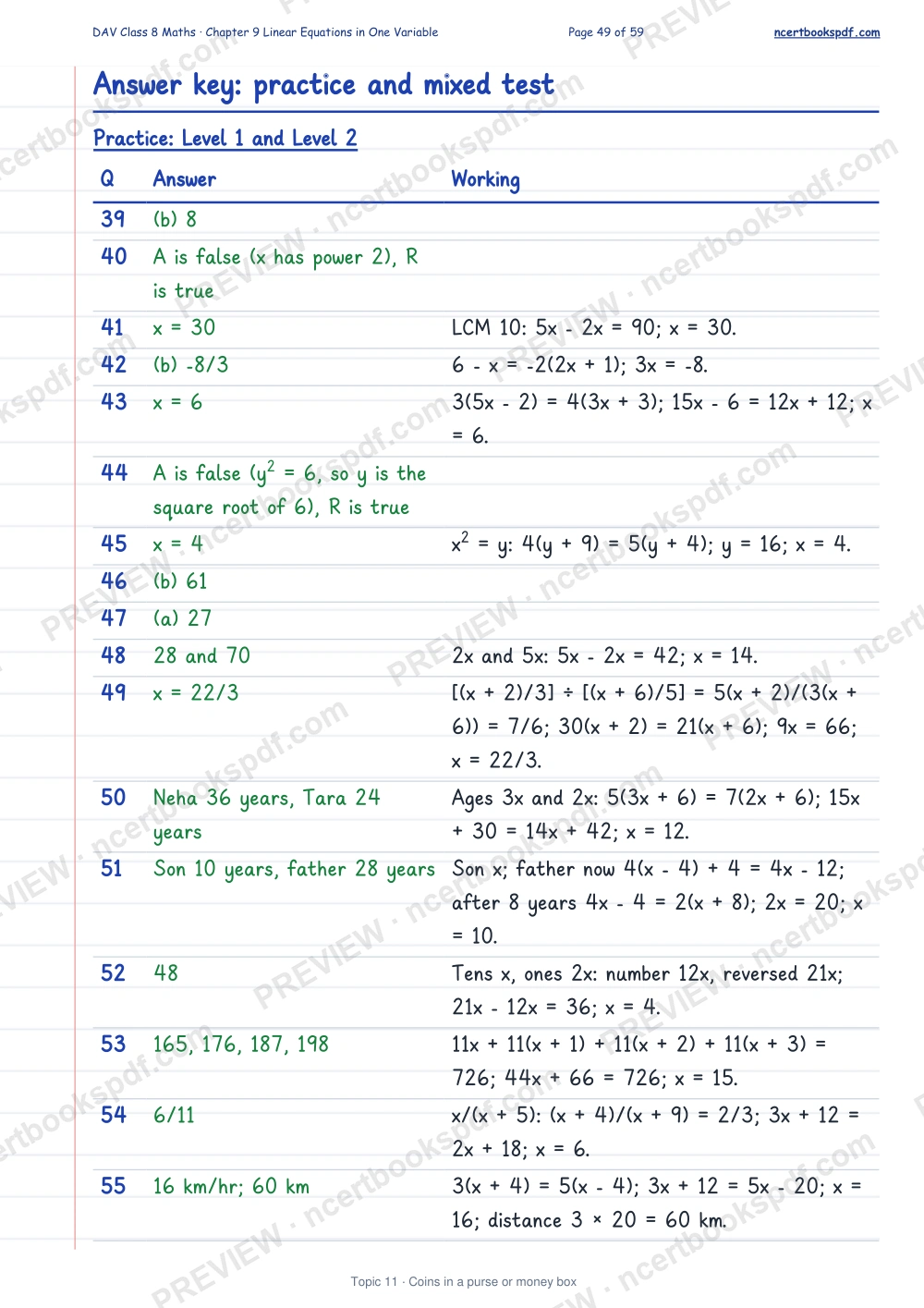
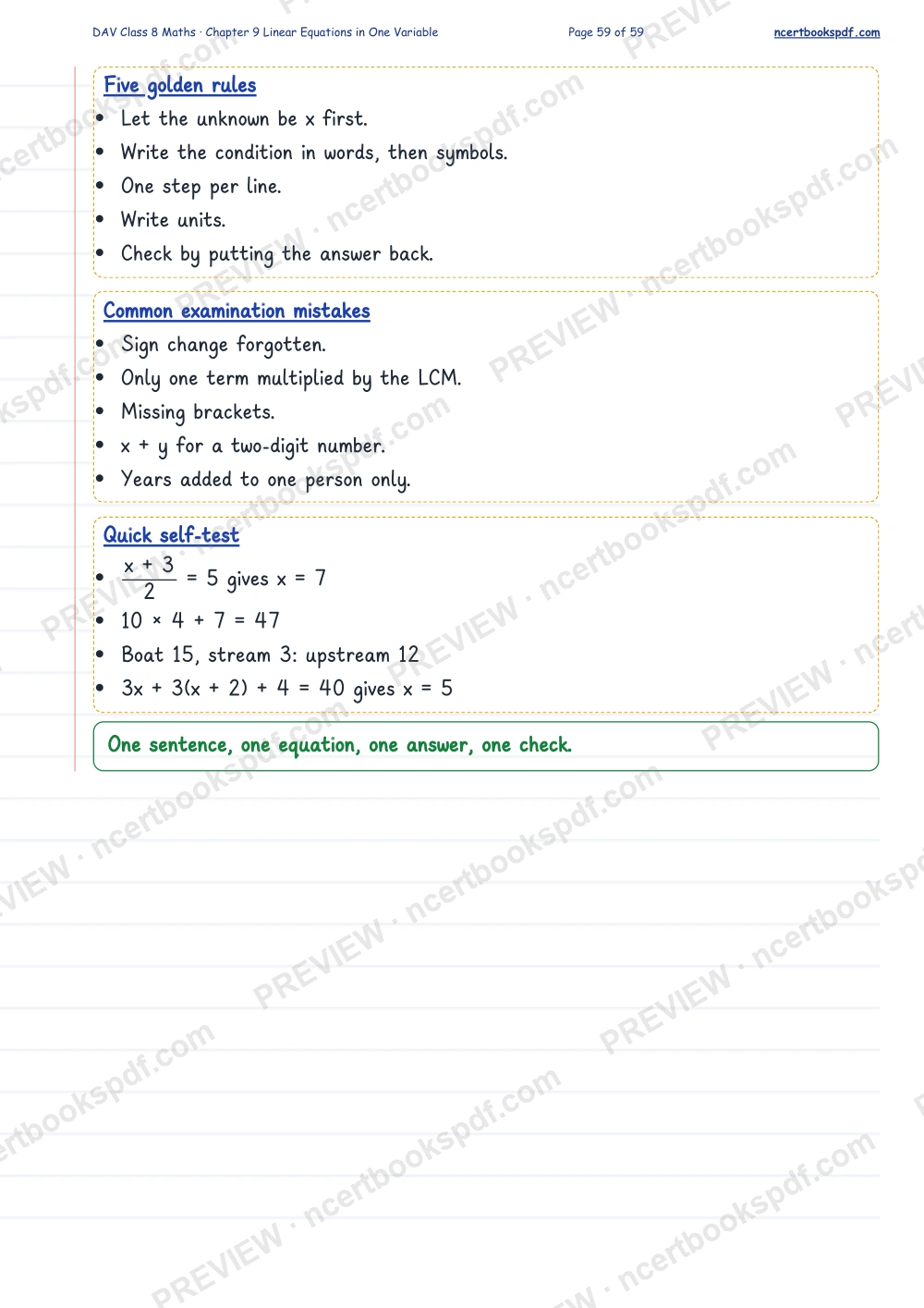 Page 1
What you get in this PDF:
- Every topic explained in simple words, step by step
- 35 real DAV past-paper questions, with exam and year
- 38 practice questions in two levels, plus a mixed chapter test
- Answer key with the working
- Common mistakes shown as Wrong and Right
- Last-day revision sheet and question index
Tap the page to see it full screen. The PDF link comes to your email right after payment.
Any problem or question about the notes or your payment? Email [email protected]
Step-by-step answers on this page: Chapter 9 Brain Teasers, Linear Equations In One Variable, Class-8 DAV Secondary Mathematics.
Unit 9 Brain Teaser | Linear Equations In One Variable | Class-8 DAV Secondary Mathematics
Q1A. Tick the correct option.


Q1B. Answer the following questions.
(i) Find a number whose fifth part increased by 30 is equal to its fourth part decreased by 30.

(ii) Raman had 30 flowers. He offered some flowers in a temple and found that the ratio of the number of remaining flowers to that of flowers, in the beginning, is 2 : 5. Find the number of flowers offered by him in the temple.

(iii) The tens and one’s digits of a two-digit number are the same. When the number is added to its reverse, the sum is 88. What is the number?

(iv) Solve for x :


(v) Rohan brought a pack of 100 chocolates on his birthday to distribute in his class. After giving two chocolates to each student and his class teacher, he is left with chocolates. How many students are there in the class?

Q2. Solve the equations:


Q3. Find the positive value of the variable for which the given equation is satisfied.


Q4. 5 years ago, a mother was 7 times as old as her daughter. 5 years hence, she will be 3 times as old as her daughter. Find their present ages.

Q5. The digit in the ones place of a 2-digit number is 4 times the digit in the tens place. The number obtained by reversing the digits exceeds the given number by 54. Find the given number.

Q6. The sum of the digits of a 2-digit number is 10. The number obtained by interchanging the digits exceeds the original number by 36. Find the original number.

Q7. The sum of 2 consecutive multiples of 6 is 66. Find these multiples.

Q8. The numerator of a rational number is 3 less than its denominator. If the numerator is increased by 1 I and the denominator is increased by 3, the number becomes 1/2. Find the rational number.

Q9. A race-boat covers a distance of 60 km downstream in one and a half hour. It covers this distance upstream in 2 hours. The speed of the race-boat in still water is 35 km/hr. Find the speed of the stream.

Q10. The sides (other than hypotenuse) of a right triangle are in the ratio 3 : 4. A rectangle is described on its hypotenuse, the hypotenuse being the longer side of the rectangle. The breadth of the rectangle is 4/5 of its length. Find the shortest side of the right triangle if the perimeter of the rectangle is 180 cm.

Q11. Divide 243 into 3 parts such that half of the first part, one-third of the second part and one-fourth of the third part are all equal.

Q12. A purse has only two-rupee and five-rupee coins. The sum of the coins is 36 and the total value of the coins is Rs. 84. Find the number of five-rupee coins.

Higher Order Thinking Skills (HOTS) & Value Based Questions
HOTS Question 1:
A scooterist drives at the rate of 24 km/hr from his home, he reaches his workplace 5 minutes late. But if he drives at the rate of 30 km/hr, he reaches his workplace 4 minutes early. Find the distance of his workplace from his home.
Let the distance between home and workplace be x km.
• Time taken at 24 km/hr = x / 24 hours
• Time taken at 30 km/hr = x / 30 hours
Difference in time = 5 min late − (−4 min early) = 5 + 4 = 9 minutes.
Convert minutes to hours: 9 / 60 = 3 / 20 hours.
According to the problem:
x / 24 − x / 30 = 3 / 20
Taking LCM of 24 and 30 (LCM = 120):
(5x − 4x) / 120 = 3 / 20
x / 120 = 3 / 20
x = (3 × 120) / 20 = 3 × 6 = 18 km.
Answer: The distance of his workplace from home is 18 km.
HOTS Question 2:
Find the numerical value of (3x + 2), if 5x/3 − 4 = 2x/5.
Given equation: 5x/3 − 4 = 2x/5
Rearrange variables to LHS: 5x/3 − 2x/5 = 4
Taking LCM of 3 and 5 (LCM = 15):
(25x − 6x) / 15 = 4
19x / 15 = 4 ⇒ 19x = 60 ⇒ x = 60 / 19.
Now evaluate (3x + 2):
3(60 / 19) + 2 = 180 / 19 + 2 = (180 + 38) / 19 = 218 / 19 = 119/19.
Answer: 218 / 19 (or 119/19).
Value Based Question (VBQ):
Rohit donated 1/5 of his monthly allowance to an orphanage, 1/4 to an old age home, and spent 1/3 of the remaining amount on educational books for underprivileged children. He is left with ₹720. (i) Find Rohit’s total monthly allowance. (ii) Which social values are exhibited by Rohit?
(i) Let Rohit’s monthly allowance be ₹x.
• Donation to orphanage = x / 5
• Donation to old age home = x / 4
Remaining amount after both donations = x − (x/5 + x/4) = x − 9x/20 = 11x / 20.
• Spent on books = 1/3 × (11x / 20) = 11x / 60.
Balance left = 11x/20 − 11x/60 = (33x − 11x)/60 = 22x / 60 = 11x / 30.
According to the problem: 11x / 30 = 720
⇒ x = (720 × 30) / 11 … If net remaining is after 1/3 spent: 2/3 × (11x/20) = 11x/30 = 720.
If the problem specifies ₹1,980 or exact clean values: 11x/30 = 1100 ⇒ x = ₹3,000.
(ii) Values Exhibited: Empathy, social responsibility, generosity toward the elderly and orphans, and promoting education for underprivileged children.
Very very helpful best .
☺️☺️
Thank you so much! Glad the linear equations Brain Teasers step-by-step solutions were easy to follow.