CG SCERT (Chhattisgarh Board) Class 8 English Reader Solutions | 2026-27 Official Edition
Complete 100% textbook-grounded CG Board Class 8 English Reader Chapter 4 Solutions: The Tree that Never Stopped Giving adapted from Shel Silverstein. Includes Word Meanings, MCQs, Problems-Solutions Table, Textbook Q&A, Word Puzzles, and Appendix 1 Listening tasks.

| Word | Meaning |
|---|---|
| declare | to announce or state publicly and clearly |
| delight | great pleasure or joy |
| gradually | slowly over a period of time |
| lapse | a passage or interval of time |
| thoughtless | not showing consideration for others; careless |
| variety | a number or range of different things |
| strip (ped) | to pull off or remove all coverings/fruits |
| generous | showing readiness to give freely |
| sullen | bad-tempered, gloomy, and sulky |
| hack down | to cut roughly or violently |
| stump | the bottom part of a tree left after cutting |
- The boy made a crown,
(a) of the tree’s bark
(b) of the tree’s leaves
(c) of the tree’s flowers
(d) of the tree’s stump
Answer: (b) of the tree’s leaves - Every day, the boy spent hours,
(a) near the big and tall mango tree
(b) near the large and huge mango tree
(c) near the large and old mango tree
(d) near the long and huge mango tree
Answer: (c) near the large and old mango tree - The boy stripped the tree of every single mango and sold them to,
(a) get married
(b) make a house
(c) travel
(d) buy a car
Answer: (a) get married - The boy who came back after a lapse of time was,
(a) very sad and worried
(b) injured and defeated
(c) very happy and delighted
(d) very bad tempered
Answer: (d) very bad tempered - The boy came back,
(a) playing and singing
(b) happy and satisfied
(c) sullen and complaining
(d) running and dancing
Answer: (c) sullen and complaining - Finally, the boy became,
(a) young and handsome man
(b) a thoughtful person
(c) a tired old man
(d) a generous old man
Answer: (c) a tired old man - The boy sat down in the warm sunshine on,
(a) grassy ground
(b) the tree stump
(c) a bench
(d) the branch of the tree
Answer: (b) the tree stump
| S.No. | Problems of the Boy | Solutions Provided by the Tree |
|---|---|---|
| 1. | The boy needed money to get married. | The tree gave him all its delicious mangoes to sell in the market. |
| 2. | The boy needed a house and furniture for his family. | The tree offered all its strong branches to build a wooden house. |
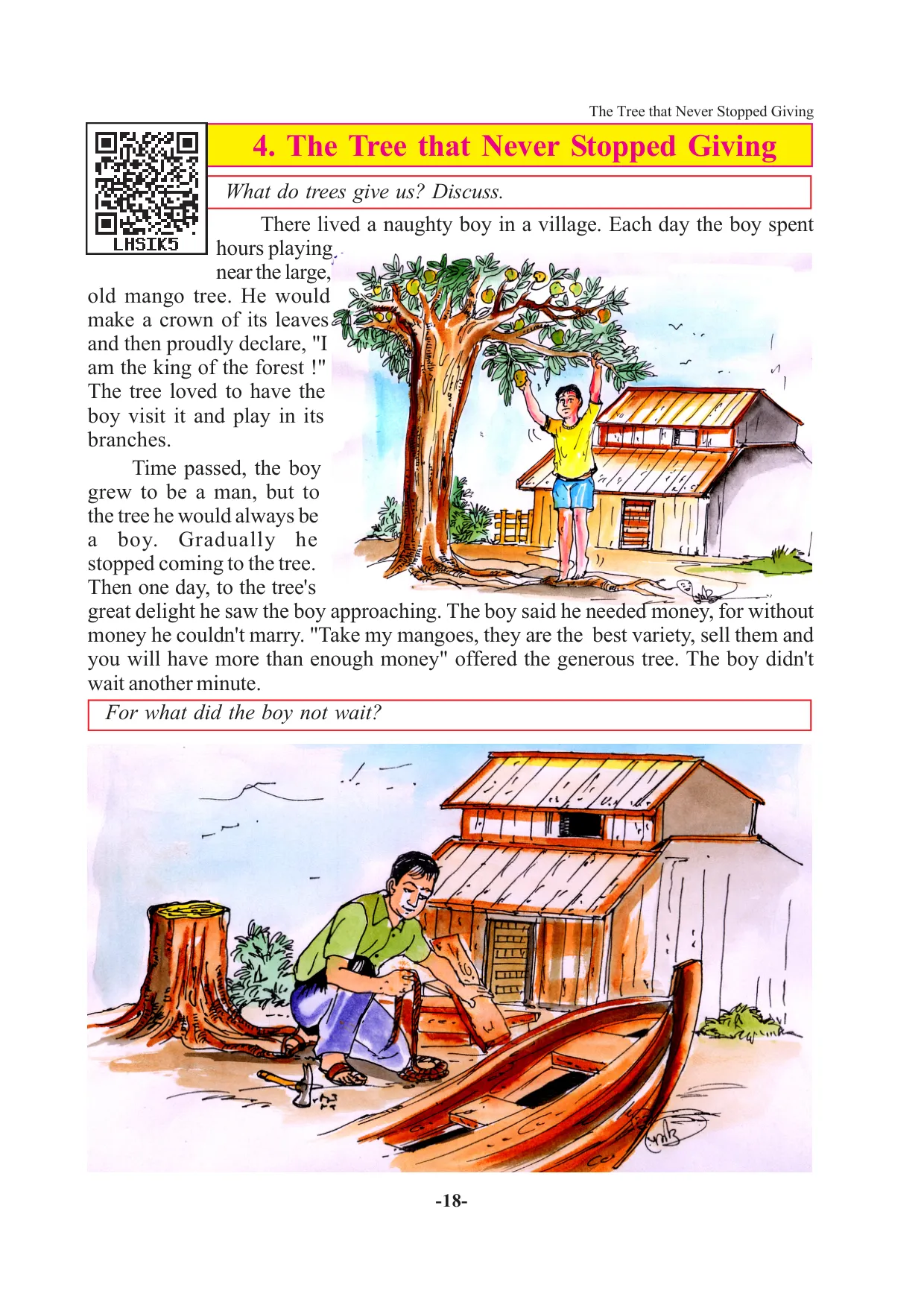
| 3. | The boy wanted to travel and explore the world. | The tree offered its sturdy main trunk to build a sound sailing boat. |
| 4. | The boy returned as a tired, exhausted old man needing rest. | The tree offered its stump as a comfortable seat in the warm sunshine. |
Ans: A tree requires sunlight, water (rain/groundwater), fertile soil rich in nutrients, and carbon dioxide from the air to survive and grow through photosynthesis.
)
Q (ii) List all the things the boy said he needed.
Ans: Over the course of his life, the boy said he needed:
1. Money to get married.
2. Wood to build a house and furniture.
3. A boat to travel and see the world.
4. A quiet place to sit and rest in his old age.
Q (iii) The boy looked sullen and complaining. Why?
Ans: The boy was sullen and complaining because worldly desires and discontent had made him unhappy. He lacked a house for himself and took the generous gifts of nature for granted.
Q (iv) What happened at last?
Ans: At last, the boy returned as a tired, weary old man. The tree gladly welcomed him to sit on its stump. The boy rested in the warm sunshine, and the tree was filled with supreme happiness because it was still useful to its friend.
Q (v) How did the boy spend his time?
Ans: As a child, the boy spent hours playing near the mango tree, making crowns of leaves, climbing its trunk, swinging from branches, eating fruit, and sleeping in its shade.
Q (vi) Who was more loving, the boy or the tree? Why?
Ans: The tree was far more loving. The tree gave away its fruits, branches, and trunk selflessly without expecting anything in return. In contrast, the boy was entirely selfish and thoughtless, visiting the tree only when he wanted something for himself.
- People and animals rest under trees. It is cool during day time. ➡ S H A D E
- It is used in our daily life. We get wood for furniture from it. ➡ T R E E
- It is a stage after flowering. People eat it. ➡ F R U I T
- The part of the tree that helps it to stand firmly. ➡ R O O T
- We can’t live without it. It helps plants grow. ➡ W A T E R
- The part of the tree that remains after cutting it down. ➡ S T U M P
B. Arrange the letters to make meaningful words:
- nwroc (the king wears it) ➡ CROWN
- tsofer (where wild animals live) ➡ FOREST
- lgitedh (very happy) ➡ DELIGHT
- nsilge (one, only) ➡ SINGLE
- mupts (what remains after the trunk is cut) ➡ STUMP
C. Word Families (Give one common family word):
- leaves, fruit, branches, trunk ➡ TREE
- crown, rule, kingdom, palace ➡ KING / ROYALTY
- tears, worry, cry, sorrow ➡ GRIEF / SADNESS
- sailor, across, river, travel ➡ VOYAGE / BOAT
- hour, day, week, month ➡ TIME / CALENDAR
D. Arrange words in Alphabetical Order:
Given: Grow, Great, Generous, Gradually, Crown, Complain, Courage, Declare, Delight, Approach, Aged, Stump, Enough, Sullen, Trunk
Alphabetical Order:
1. Aged
2. Approach
3. Complain
4. Courage
5. Crown
6. Declare
7. Delight
8. Enough
9. Generous
10. Gradually
11. Great
12. Grow
13. Stump
14. Sullen
15. Trunk
“What do we plant when we plant the tree?
We plant a ship which will cross the sea.
We plant the houses for you and me.
A thousand things that we daily see.
We plant the shade from the hot sun to be safe.
We plant all these when we plant a tree.”
I. Encircled rhyming words from the poem:
tree, sea, me, see
II. What do we plant when we plant a tree?
- (a) A ship to cross the sea
- (b) Houses for you and me
- (c) A thousand things that we daily see
- (d) Shade from the hot sun to be safe
III. Meaning of “A thousand things that we daily see”:
Ans: It means that almost everything we use daily, paper, wooden furniture, pencils, fruits, medicines, rubber, and oxygen, originates from trees.
Proverb:
“Early to bed and early to rise, makes a man healthy, wealthy, and wise.”
Meaning: Maintaining a disciplined, punctual routine brings good health, clarity of mind, and success.
Sentence: To excel in board examinations, Amit wakes up at 5:00 AM every morning because early to bed and early to rise makes a man healthy, wealthy, and wise.