CG Board Class 9 Social Science Chapter 7 Solutions: The Reformation and the Enlightenment (1300-1800 CE) (धर्म सुधार और प्रबोधन) – 2026-27

CG SCERT (Chhattisgarh Board) Class 9 Social Science Solutions | 2026-27 Official Edition

Share with classmates & study groups

Complete 100% textbook-grounded CG Board Class 9 Social Science Chapter 7 Solutions: The Reformation and the Enlightenment (1300-1800 CE) (धर्म सुधार और प्रबोधन) in Bilingual Format (English & Hindi Medium).
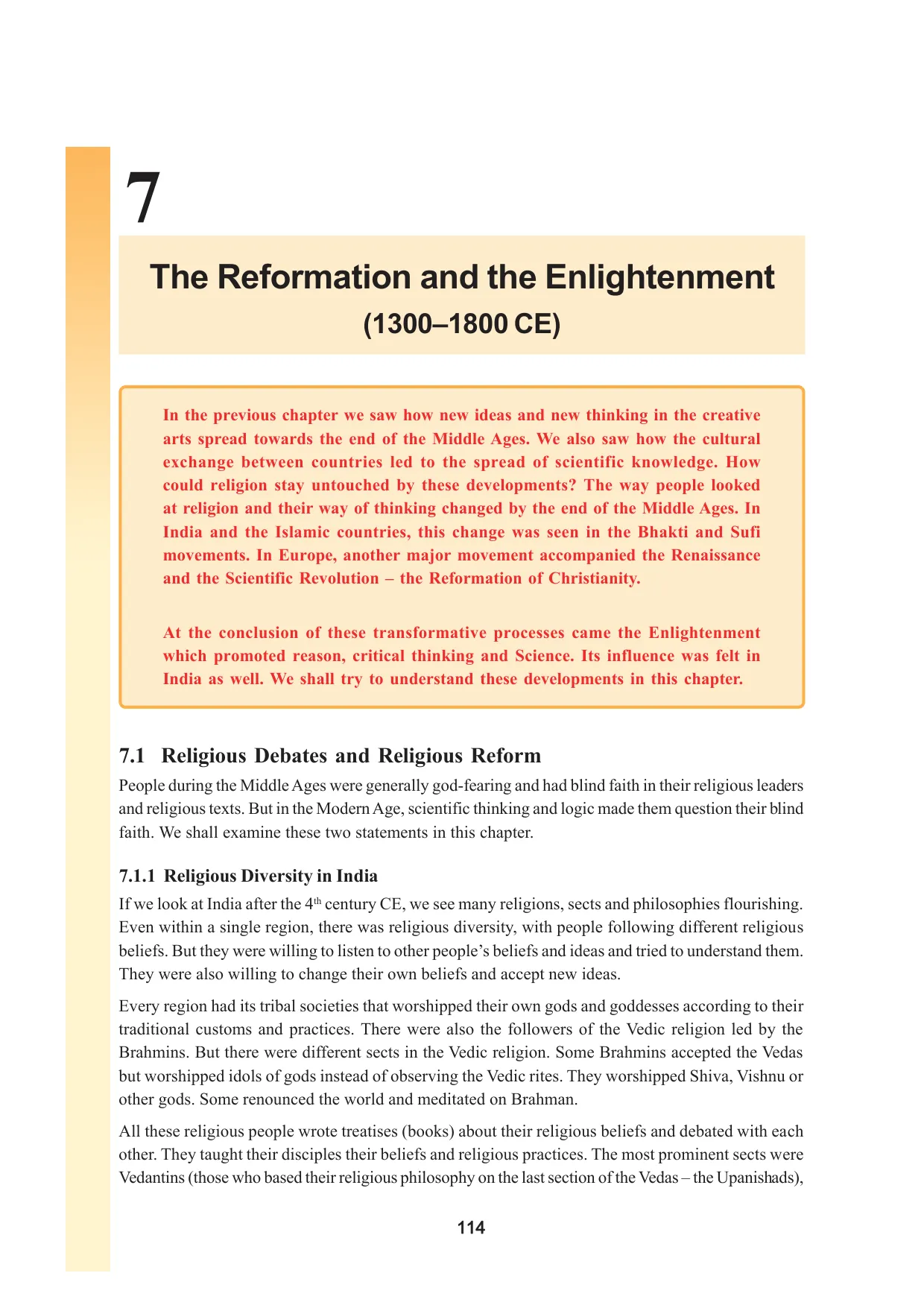
CG SCERT कक्षा 9 सामाजिक विज्ञान Chapter 7 Official Textbook Page
📖 Official CG SCERT कक्षा 9 सामाजिक विज्ञान अध्याय 7 पाठ्यपुस्तक पृष्ठ

🌐 Select Language / माध्यम चुनें:

Official Textbook Exercises

End-of-Chapter Exercises (Solutions)

CG SCERT कक्षा 9 सामाजिक विज्ञान Chapter 7 Official Textbook Exercises Page
📝 Official CG SCERT कक्षा 9 सामाजिक विज्ञान अध्याय 7 अभ्यास प्रश्न पृष्ठ
Question 1

Question 1: How did people in India conceptualise the 'ultim…


📝 Question:

  1. Question 1: How did people in India conceptualise the ‘ultimate truth’ during the Middle Ages? / ‘ ‘ ?
  • English Summary: Protestantism emphasized individual enterprise, literacy (to read translated Bibles), personal discipline, and hard work as spiritual virtues. By removing Church restrictions on trade, interest, and scientific inquiry, Protestant nations (such as Britain and Germany) created an environment conducive to technological innovation, capital accumulation, and the Industrial Revolution.
  • English Summary: François-Marie Arouet (Voltaire, 1694-1778) was a French Enlightenment thinker who championed freedom of speech, civil liberties, and religious tolerance. He fiercely criticized the religious fanaticism and corruption of the Catholic Church, advocating that human reason and scientific tolerance should guide society.
💡 Solution:

  • Answer: In the Middle Ages, Adi Shankaracharya defined the ultimate truth as ‘Brahman’, a single supreme reality attained by renouncing the world and contemplating unity through monastic life. Ramanujacharya conceptualised the ultimate truth as Lord Vishnu, attainable through devotion (Bhakti). Bhakti and Sufi saints conceptualised god as a universal creator accessible to all through love, compassion, and inner devotion without requiring temples, mosques, or caste rituals.
  • Answer: Religious diversity promoted active debate, intellectual exchange, and mutual tolerance among different communities. Because no central authority dictated religion, individuals enjoyed personal freedom to choose their faith. However, it also led to occasional sectarian disputes and social conservatism like caste-based prohibitions on temple entry and study of texts.
  • Answer: The caste system severely curtailed religious freedom by enforcing birth-based restrictions. Dalits and women were prohibited from studying religious texts like the Vedas, entering temples, or performing sacrificial rites. Anyone attempting to cross these caste boundaries faced harsh punishments.
  • Answer: Akbar adopted ‘Sulah-i-kul’ (universal peace and harmony) because he recognized that governing a multi-religious country required respecting all faiths equally. As a rationalist, he believed the ruler is god’s representative who must shower blessings on all subjects without religious discrimination.
  • Answer: Kabir rejected formal religions because their ritualism, idol worship, and priestcraft created social divisions and conflict. He advocated that god is one, requiring no physical temples or mosques, and can be reached solely through pure love, devotion, and easing human suffering.
  1. Question 6: What similarities and differences do you see in the lives of the women devotees? / ?
  • Answer: – Similarities: Women devotees like Akkamahadevi, Lal Ded, and Mira broke patriarchal family boundaries, rejected temple ritualism and idol worship, and expressed independent devotion through poetry and song.
  • Differences: Akkamahadevi led the Veerashaiva movement in Karnataka; Lal Ded combined Shaivism with Sufism as a wandering sanyasini in Kashmir; and Mira was a Rajput royal widow who defied royal persecution to preach Krishna devotion across Rajasthan.
  1. Question 7: What are the differences between traditional Muslims, the philosopher Muslims and the Sufis? / , ?
  • Answer: – Traditional Muslims: Strictly followed orthodox Islamic laws and rituals, opposing both rational philosophy and mystical practices.
  • Philosopher Muslims (e.g., Mutazilites, Ibn Sina, Ibn Rushd): Applied Greek logic, free will, and scientific investigation to understand god and nature.
  • Sufis: Focused on divine love, spiritual devotion, meditation, and music, viewing rational philosophy as an obstacle to attaining god.
  • Answer: Arabic scholars translated Greek philosophical and scientific texts (such as Aristotle and Plato) into Arabic, preserved and analyzed them, and added original breakthroughs in medicine, mathematics, and astronomy. These Arabic works were later translated into European languages, sparking the European Renaissance and Enlightenment.
  • Answer: In the Middle Ages, the Catholic Church exercised absolute religious, judicial, and political control, owning vast lands, collecting tithes, and controlling state administrations. The Reformation broke the Church’s religious monopoly, separated Church from State, and enabled individuals to choose their faith.
  • Answer: Martin Luther criticized the sale of ‘indulgences’ (pardon certificates sold for money), the claim that salvation comes from external rituals or financial payments, and the excessive authority and wealth of the Pope and clergy. He advocated that salvation comes solely through personal faith in God’s grace.
  • Answer: The Reformation dismantled the absolute monopoly of the Catholic Church, promoting individual reading of vernacular Bibles and direct personal faith without clerical intervention. This severed state-church control, establishing religious freedom and secular governance in Europe.
  1. Question 12: What were the defining aspects of the Enlightenment? What relationship did it have with the Scientific Revolution? / ? ?
  • Answer: The Enlightenment was defined by reason, critical inquiry, belief in human progress, individual freedom, and asking ‘why’ and ‘how’. It applied the empirical methods of the Scientific Revolution (experimentation and observation) to evaluate religion, human society, and governance.
  • Answer: Romanticists opposed the excessive industrialization, cold rationality, pollution, and destruction of nature brought by modern progress. They advocated for human emotions, feelings, nature preservation, idyllic rural life, and folk arts (such as Sanskrit classics like Kalidasa’s Shakuntalam).

Share with classmates & study groups

Leave a Comment

Have a doubt in this chapter, or found a mistake? Write it here and our team will reply.

Link copied to clipboard!
Share with Classmates
WhatsApp

📑 Chapter Navigation Directory

Add as a preferred source on Google
See ncertbookspdf.com first in Google Search