CG Board (CGBSE / SCERT Chhattisgarh) Class 10 Science Solutions | 2026-27 New Edition (English & Hindi Medium)
📚 Chapter Overview:
- Board: Chhattisgarh Board of Secondary Education (CGBSE) / CG SCERT Raipur
- Class & Subject: Class 10 Science (विज्ञान) – 2026-27 Edition
- Chapter 1: Evolution (जीवों का विकास)
- CGBSE Board Weightage: 4 Marks (6 Academic Periods)
- Medium: Bilingual Solutions (English Medium + हिंदी माध्यम)
Activity-1 Reference: Homologous Characters in Plants and Animals (समजात लक्षण)
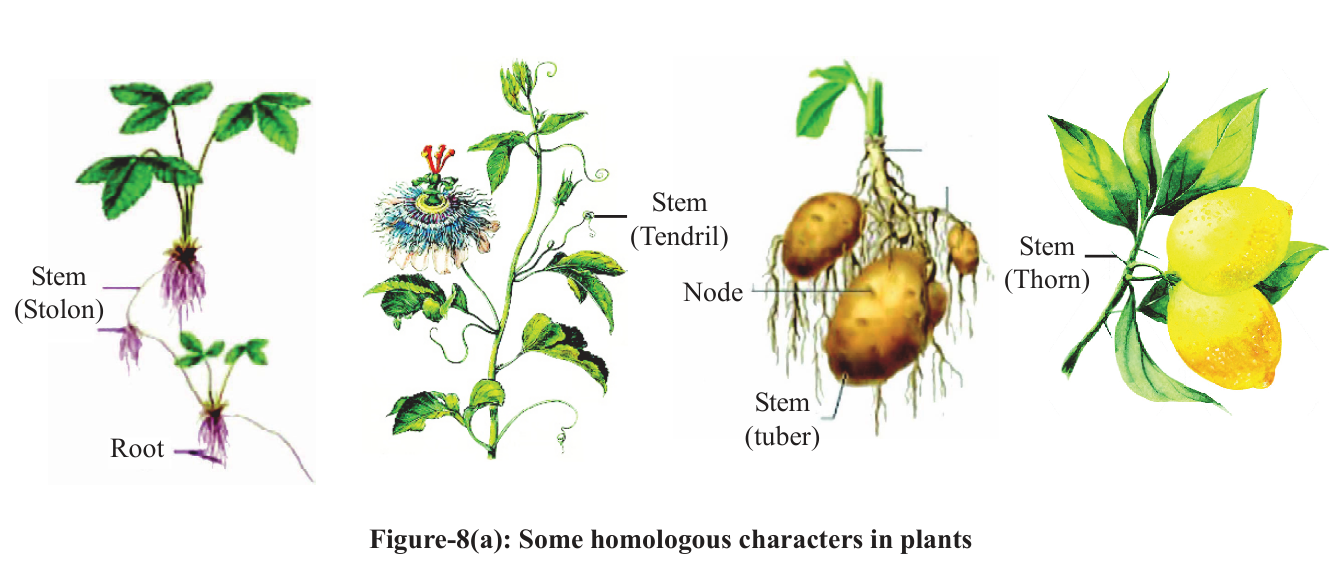
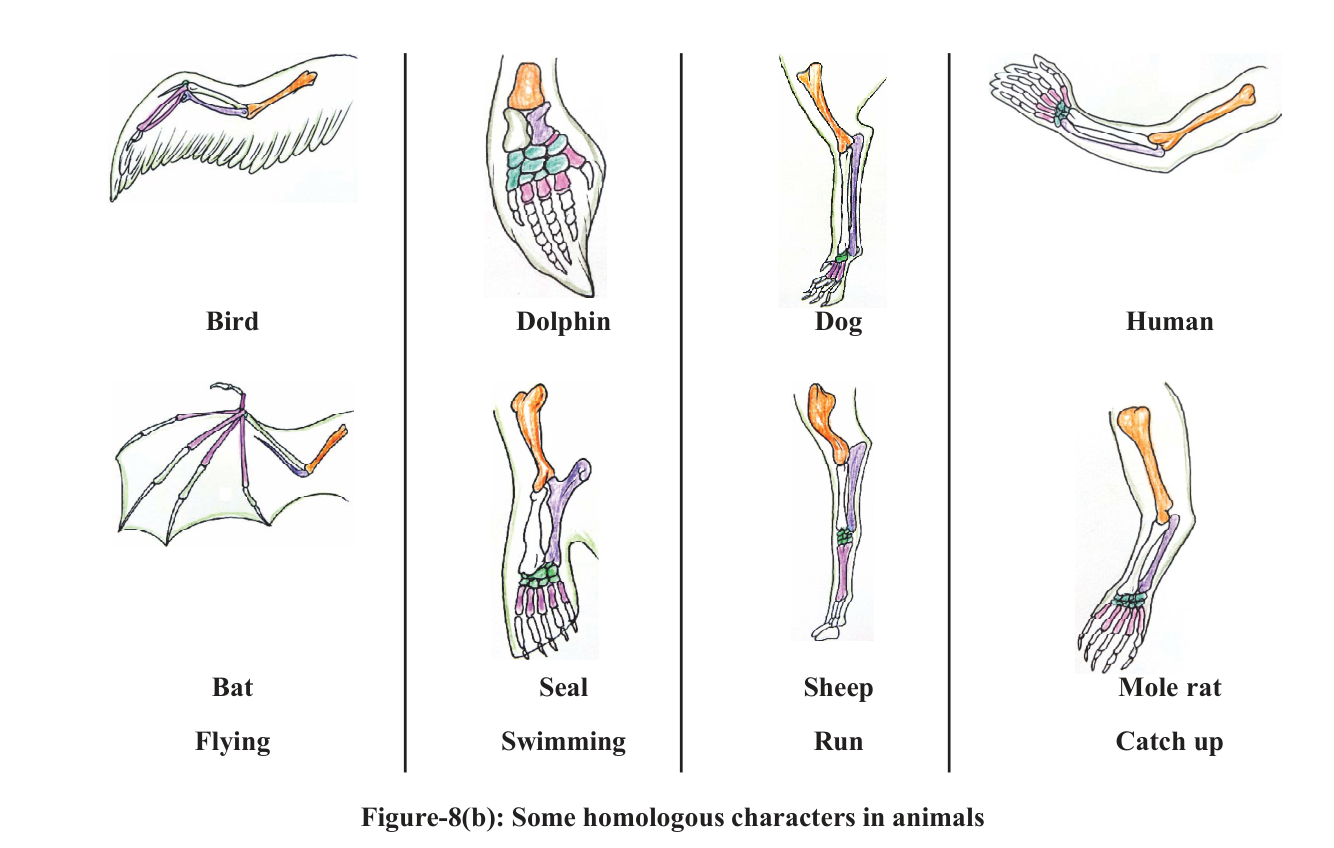
In Activity-1 (Page 6-7) of the CG SCERT Class 10 Science textbook, homologous organs in plants (stems modified into stolon in strawberry, tendrils in passion flower, tuber in potato, and thorns in lemon) and animals (forelimbs of bird, bat, dolphin, seal, dog, sheep, human, and mole rat containing humerus, radius, and ulna) are illustrated below:
Think how this may have happened Dinosaurs became…
सोचिए ऐसा कैसे हुआ होगा डायनासोर विलुप्त हो…
Dinosaurs could not adapt to the drastic environmental changes over time, leading to their extinction. In contrast, species like Gingko, ferns, algae, and cockroaches possessed advantageous variations and physiological adaptations that allowed them to survive changing natural conditions.
When dinosaurs were abundant on earth do you…
जब पृथ्वी पर डायनासोर प्रचुर मात्रा में थे…
Yes, during the era of dinosaurs, food and habitat resources were plentiful, supporting a diverse variety of giant herbivores, carnivores, and associated flora and fauna.
Would their population increase if resources were adequate
यदि संसाधन पर्याप्त होते तो क्या उनकी जनसंख्या…
Yes, when habitat resources like food, space, and safety are adequate, organisms reproduce at a rapid rate, leading to an increase in their population size.
You have read about the food chain What…
आपने खाद्य श्रृंखला के बारे में पढ़ा है।…
If any organism in a food chain vanishes, the ecological balance is disrupted. Predators depending on that organism face food scarcity, while the population of organisms it used to feed upon may increase uncontrollably.
What do you think may be the cause…
बाघों की संख्या में तीव्र गिरावट का कारण…
The primary cause is the destruction and shrinkage of natural habitats. Human population growth leads to deforestation, encroachment, and resource depletion, directly causing a rapid decline in tiger populations.
What will happen if the population of a…
यदि किसी विशिष्ट प्रजाति के जीवों की जनसंख्या…
An unusual increase in population leads to severe competition for limited food and habitat resources. This scarcity eventually halts population growth or causes a sharp decline due to starvation and natural regulation.
Is the rate of population growth of a…
क्या किसी प्रजाति की जनसंख्या वृद्धि की दर…
No, population grows at a geometric/uncontrolled rate, whereas food and abiotic resources increase at a much slower arithmetic rate, as shown in Thomas Malthus’s studies.
Is the rate of population growth and that…
क्या जनसंख्या वृद्धि की दर और खाद्य संसाधनों…
No, the rate of population growth is much faster and steeper compared to the gradual increase in food resources.
Which graph shows growth at a faster rate…
कौन सा ग्राफ तेज़ दर से वृद्धि दर्शाता…
The graph representing population growth shows a much faster rate of increase than the graph for food resources.
Do organisms that survive have some special abilities
क्या जीवित रहने वाले जीवों में कुछ विशेष…
Yes, surviving organisms possess advantageous variations and adaptive traits that make them better suited to cope with geographical, climatic, and resource challenges in their environment.
Does nature have any influence on the number…
क्या जीवों की संख्या पर प्रकृति का कोई…
Yes, nature exerts strong control over population size through natural selection, limited food supplies, climate changes, natural disasters, and predator-prey dynamics.
Could declining amount of resources in habitat be…
क्या आवास में संसाधनों की घटती मात्रा डायनासोर…
Yes, a decline in habitat resources along with environmental changes created intense competition, and giant dinosaurs could not get sufficient food and space, contributing to their extinction.
What do you think fossils help us to…
आपके अनुसार जीवाश्म हमें किस विषय में अध्ययन…
Fossils provide direct evidence of ancient life, showing mutual relationships between extinct and modern organisms, structural changes over geological time, and past environmental conditions.
What type of selection is selective breeding by…
मनुष्यों द्वारा किए जाने वाले चयनात्मक प्रजनन को…
Selective breeding performed by humans to obtain organisms with desired traits is called Artificial Selection.
What do we understand about natural selection by…
प्रोजेक्ट कार्य करने से हम प्राकृतिक चयन के…
Natural selection is a continuous, non-intentional process where nature selects organisms bearing advantageous variations suited for survival in changing environments.
Is natural selection an intentional process of selection…
क्या प्राकृतिक चयन कृत्रिम चयन की तरह प्रकृति…
No, natural selection occurs spontaneously and non-intentionally due to environmental factors, unlike artificial selection which is consciously driven by human choice.
Activity2 Observe the figure Radish field affected by…
गतिविधि2 चित्र बाढ़ से प्रभावित मूली का खेत…
This represents Natural Selection. The flood acts as a natural calamity that eliminates weaker or vulnerable radish plants, leaving only surviving plants to reproduce and pass on traits.
Could the extinction of dinosaurs be due to…
क्या डायनासोर का विलुप्त होना अधिक लाभदायक विविधताओं…
Yes, as smaller mammals and birds evolved with traits better suited for energy efficiency and adapting to climate changes, they outcompeted giant dinosaurs for resources.
Were dinosaurs not well adapted to the changing…
क्या डायनासोर पर्यावरण की बदलती परिस्थितियों के प्रति…
Yes, sudden and massive environmental shifts reduced resource availability, and giant dinosaurs lacked the adaptive variations needed to survive, leading to extinction.
How do you think the fishes of Kotumsar…
आपके विचार से कुटुंबसर गुफा की मछलियाँ गुफा…
Kotumsar cave fishes adapted to perpetual darkness through structural variations over generations: their eyes became non-functional/blind or vestigial, while their tactile and sensory organs heightened.
Choose the correct answer
Choose the correct answer
(i) Name the process through which modern breed of pet dog was acquired:**
- (a) Natural selection
- (b) Artificial selection
- (c) Juvenile selection
- (d) Work selection
(b) Artificial selection
Explanation: Humans selectively bred dogs with desired traits over generations, which is artificial selection.
(ii) Forelimbs of dog and sheep are for walking, whale for swimming and that of bat for flying. All these are examples of:
- (a) Analogous
- (b) Homologous
- (c) Undeveloped organ
- (d) All above
Answer: (b) Homologous
Explanation: These organs share a common internal skeletal origin (humerus, radius, ulna) but perform different functions.
(iii) Which of the following are analogous structures:
- (a) Wings of bat and butterfly
- (b) Gills of prawn and fish
- (c) Thorns of bougainvillea and tendrils of bottle gourd
- (d) Wings of bat and legs of horse
Answer: (a) Wings of bat and butterfly
Explanation: Wings of bats (skin folds over bones) and butterflies (skin folds) perform the same function (flying) but have different structural origins.
(iv) While proposing his theory, Darwin was influenced by:
- (a) The observations of his voyage
- (b) Cell theory
- (c) Law of genetics of Mendel
- (d) None of the above
Answer: (a) The observations of his voyage
Explanation: Darwin’s 5-year voyage on HMS Beagle provided crucial empirical evidence regarding biodiversity, fossils, and island variations.
Fill in the blanks
Fill in the blanks
(i) A group of organisms which can interbreed sexually producing viable off-springs is known as …………………………**
Biological Species
(ii) Difference among beaks of finches show the ………………….. among them.
Variation
(iii) Some bacteria can grow in the medium containing streptomycin (antibiotic). The reason behind this is ………………………
Beneficial variation / Antibiotic resistance
CaseParagraphBased Questions Bacterial Evolution Antibiotic Resistance Read the…
CaseParagraphBased Questions Bacterial Evolution Antibiotic Resistance Read the…
When antibiotics are administered, non-resistant bacteria die, while bacteria possessing pre-existing resistant variations survive, reproduce rapidly, and dominate the population. Nature selects the resistant strain.
Variations arise during the process of rapid asexual reproduction / cell division.
Variation provides survival advantages during environmental changes. In bacteria, variations allow certain individuals to survive antibiotic exposure, ensuring population survival and evolution.
- Slow Evolution: Evolution of horses or humans over millions of years.
- Fast Evolution: Development of antibiotic resistance in bacteria within days/weeks.
Yes, bacteria with advantageous variations adapt better to the presence of antibiotics, survive, and form an antibiotic-resistant population.
Write two differences between natural and artificial selection
प्राकृतिक और कृत्रिम चयन में दो अंतर लिखिए।
| Feature | Natural Selection | Artificial Selection |
|---|---|---|
| Purpose | Non-intentional; enhances survival in nature. | Intentional; yields human-preferred traits. |
What do we come to know from the…
डार्विन और वॉलेस द्वारा प्रतिपादित विकास के सिद्धांत…
- All existing organisms originated from pre-existing common ancestors through gradual modification.
- Natural selection spontaneously selects advantageous variations, creating diverse new species over time.
What are the main points of the theory…
जीवों के विकास के सिद्धांत के मुख्य बिंदु…
- Variations: Differences exist within every population.
- Struggle for Existence: Rapid population growth causes competition for limited resources.
- Survival of the Fittest & Natural Selection: Organisms with advantageous traits survive and reproduce.
- Speciation: Accumulation of variations over generations leads to new species.
What is the role of selection and adaptation…
विकास की प्रक्रिया में चयन और अनुकूलन की…
Adaptation enables organisms to fit into their changing environment. Natural selection identifies and preserves these adapted organisms, allowing them to pass beneficial traits to offspring, driving evolution.
Observe the figure Pitcher leaf pea tendril bougainvillea…
चित्र घटपर्णी की पत्ती मटर का प्रतान बोगनविलेलिया…
These represent Homologous Structures.
Justification: All these organs are modified leaves sharing the same ancestral origin, but they perform different specialized functions (pitcher for catching insects, tendril for climbing, bract for attracting pollinators, spines for protection).
Evolutionary Tree FigureBased Questions
Evolutionary Tree FigureBased Questions
(i) Observe the branched tree of evolution given in the figure and find out the closest relative of humans.**
Chimpanzee.
(ii) Write the names of two organisms that show maximum similarity and two that show maximum differences.
- Maximum Similarity: Rat and Mouse (or Chimpanzee and Human).
- Maximum Difference: Platypus and Human (or Platypus and Cow).
(iii) What do you understand from the figure about evolution of organisms shown there? Write a brief description.
The tree illustrates common ancestry among mammals. Species closer on branches share a more recent common ancestor, while diverged branches show adaptation into distinct lineages over time.