CG Board Class 11 Political Science Solutions | NCERT Class 11 Political Science (Constitution at Work & Political Theory) (2026-27)
Complete solutions for CG Board Class 11 Political Science Chapter 10: The Philosophy of the Constitution strictly following the prescribed NCERT Class 11 Political Science (Constitution at Work & Political Theory) syllabus.
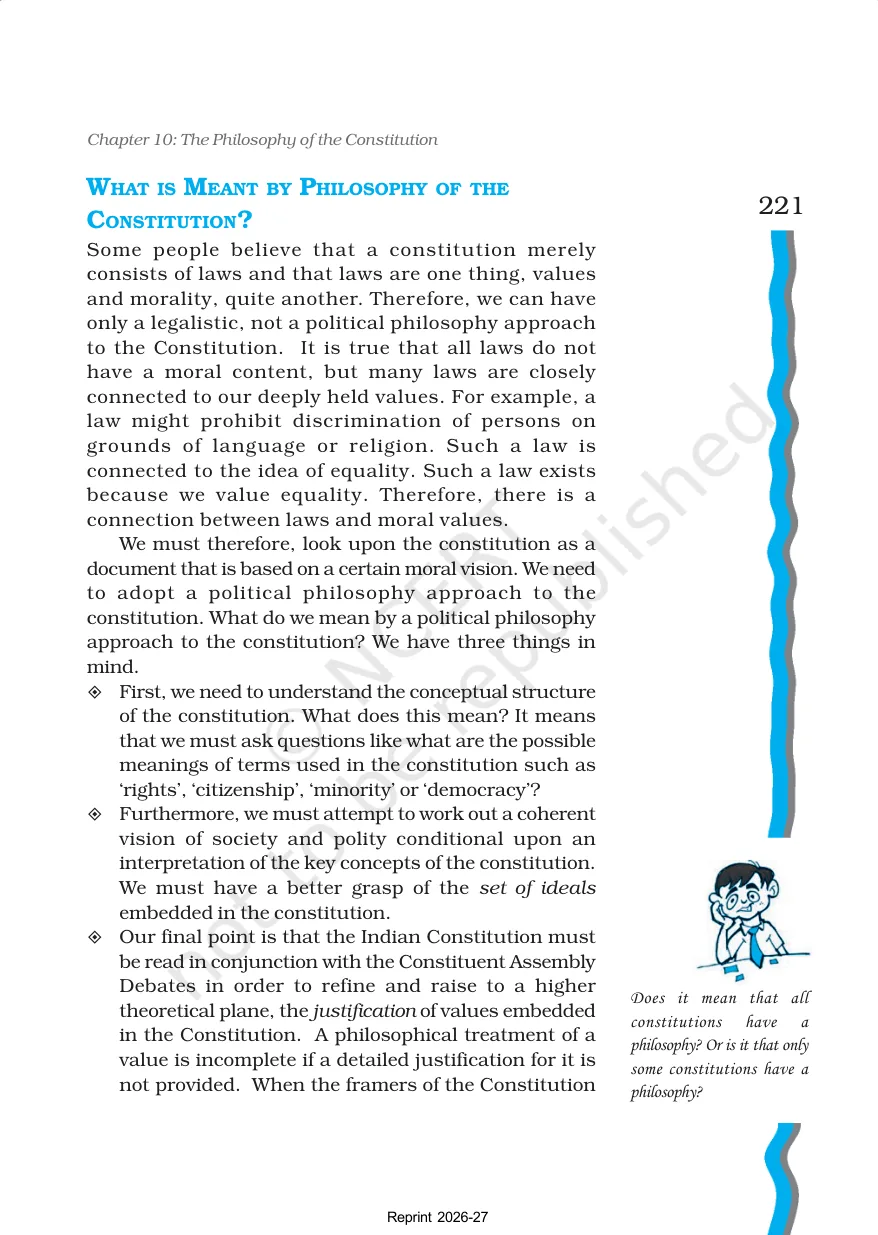
📖 Textbook Pages (NCERT / CG Board 2026-27)
✍️ Chapter 10 Exercise Solutions: The Philosophy of the Constitution
Exercises
1. The following are certain laws. Are they connected with any value? If yes, then what is the underlying value? Give reasons.
- (a) Both daughters and sons will have share in the family property: Yes — Gender Justice / Equality. It ends patriarchal discrimination and treats women and men as equal inheritors.
- (b) There will be different slabs of sales tax on different consumer items: Yes — Economic Justice / Equity. Essential goods used by the poor are taxed lightly or exempted, while luxury items consumed by the affluent carry higher tax.
- (c) Religious instructions will not be given in any government school: Yes — Secularism. State-funded institutions remain neutral toward all religions and avoid promoting any single faith.
- (d) There shall be no begar or forced labour: Yes — Human Dignity and Freedom against Exploitation. Every person has the right to fair wages and freedom from coercion.
2. Which of the options given below cannot be used to complete the following statement? Democratic countries need a constitution to
Independence is achieved through a freedom struggle before or alongside constitution-making; a constitution governs an independent democratic state.
3. The following are different positions about reading and understanding Constituent Assembly debates. (i) Which of these statements argues that Constituent Assembly debates are relevant even today? Which statement says that they are not relevant? (ii) With which of these positions do you agree and why?
(i) Statement (c) argues that Constituent Assembly debates are relevant today because they explain the reasons behind constitutional practices. Statements (a) and (b) argue they are not relevant (due to tough legal language or changed times).
(ii) I agree with position (c). Understanding the original reasoning of the framers helps us defend core constitutional values like secularism, federalism, and minority rights when they face challenges today.
4. Explain the difference between the Indian Constitution and western ideas in the light of (a) Understanding of secularism (b) Articles 370 and 371 (c) Affirmative action (d) Universal adult franchise.
- (a) Secularism: Western secularism largely means strict separation (mutual exclusion) between state and religion. Indian secularism follows principled distance—the state respects all religions, supports minority institutions, and can intervene to reform unjust religious practices like untouchability.
- (b) Articles 370 and 371: Unlike uniform symmetric federalism in countries like the US, India adopted asymmetric federalism, granting special constitutional provisions to regions with distinct historical and tribal contexts (such as North-Eastern states under Article 371).
- (c) Affirmative action: India embedded affirmative action (reservations for SCs, STs, and OBCs) directly into the Constitution from the start to remedy centuries of caste-based exclusion, whereas Western democracies adopted affirmative measures much later.
- (d) Universal adult franchise: Western democracies extended voting rights gradually over decades (based on property, race, and gender). India adopted universal adult franchise immediately in 1950 for all adult citizens regardless of caste, class, gender, or literacy.
5. Which of the following principles of secularism are adopted in the Constitution of India?
6. Match the following.
| Column A | Column B |
|---|---|
| (a) Freedom to criticise treatment of widows | (i) Substantive achievement |
| (b) Taking decisions in the constituent assembly on the basis of reason, not self interest | (ii) Procedural achievement |
| (c) Accepting importance of community in an individual’s life | (iv) Liberal individualism (adapted to Indian context; note: India’s liberalism balances individual and community rights) |
| (d) Article 370 and 371 | (v) Attention to requirements of a particular region |
| (e) Unequal rights to women regarding family property and children | (iii) Neglect of gender justice |
7. This discussion was taking place in a class (Jayesh, Saba, Neha). Read the various arguments and state which of these do you agree with and why.
8. Why is it said that the making of the Indian Constitution was unrepresentative? Does that make the Constitution unrepresentative? Give reasons for your answer.
However, this does not make the Constitution unrepresentative in substance. Its members included leaders from every region, religion, caste, and political stream, and its debates addressed the needs of all Indians—especially Dalits, women, minorities, and the poor—culminating in universal adult franchise.
9. One of the limitations of the Constitution of India is that it does not adequately attend to gender justice. What evidence can you give to substantiate this charge? If you were writing the Constitution today, what provisions would you recommend for remedying this limitation?
Evidence: Family and personal laws concerning marriage, divorce, inheritance, and custody were left largely untouched by the Constitution, leaving unequal gender practices intact in several communities; women’s political representation in legislatures also remained unaddressed until later local-body amendments.
Recommendations today: Explicit constitutional guarantee of equal property and inheritance rights for women across all communities, mandatory reservation for women in Parliament and State Assemblies, and stronger enforceable socio-economic rights for working women.
10. Do you agree with the statement that ‘it is not clear why in a poor developing country, certain basic socio-economic rights were relegated to the section on Directive Principles rather than made an integral feature of our Fundamental Rights’? Give reasons for your answer. What do you think are the possible reasons for putting socio-economic rights in the section on Directive Principles?
11. How did your school celebrate the Constitution Day on November 26th?
Answer (Sample): On November 26th (Samvidhan Diwas), our school organised a morning assembly where students and teachers read the Preamble to the Constitution together. This was followed by a speech on the making of the Constitution and Dr. B.R. Ambedkar’s role, a quiz on Fundamental Rights and Duties, and a classroom discussion on constitutional values like equality and secularism.