CG SCERT (Chhattisgarh Board) Class 6 Science Solutions | 2026-27 Official Edition
Welcome to the complete, authentic, 100% textbook-grounded CG Board Class 6 Science Chapter 9 Solutions: Methods of Separation in Everyday Life (दैनिक जीवन में पृथक्करण विधियाँ) in Bilingual Format (English Medium + हिंदी माध्यम). Every single question from the official textbook exercise section (Let us enhance our learning / आइए अपने अधिगम को बढ़ाएँ) has been meticulously solved strictly according to the new NEP 2020 / SCERT Chhattisgarh textbook Curiosity / जिज्ञासा (pp. 163–182 (PDF pp. 181–200)).
📖 Official SCERT Chhattisgarh Textbook Reference Snapshots (pp. 163–182 (PDF pp. 181–200)):

Chapter Opening Page
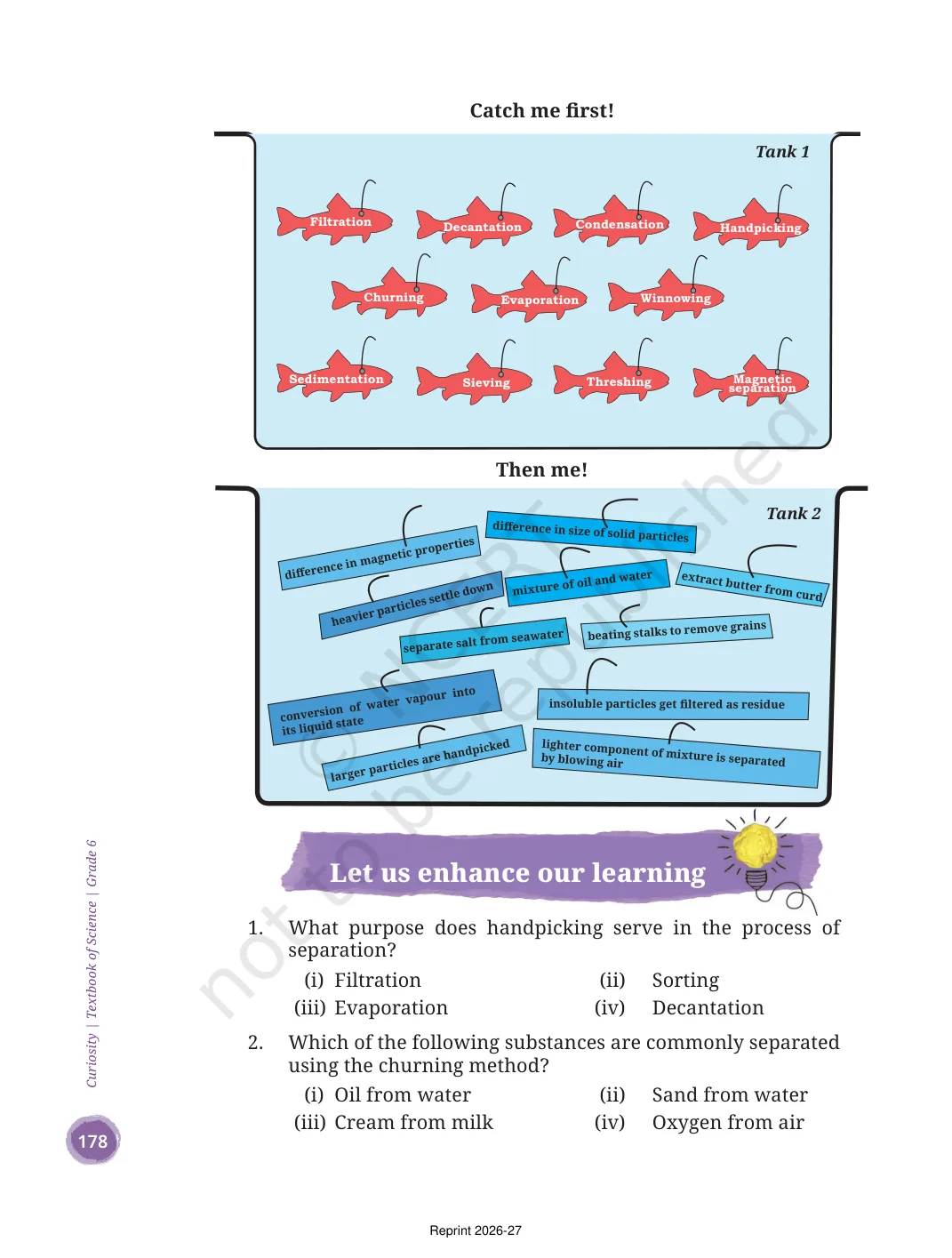
Official Exercise Questions Page
📚 Chapter 9 Summary & Core Scientific Concepts / सारांश एवं प्रमुख अवधारणाएँ
- Why Separate Substances?: To remove non-useful or harmful impurities (e.g., stones from rice), to separate two useful components (e.g., butter from curd), or to obtain pure substances for scientific use.
- Solid-Solid Separation: Handpicking (based on size/colour), Threshing (separating grains from stalks by beating), Winnowing (separating lighter husk from heavier grains using wind), Sieving (separating particles of different sizes through mesh holes).
- Insoluble Solid-Liquid Separation: Sedimentation (heavier insoluble particles settle at bottom), Decantation (gently pouring off the top clear liquid without disturbing the sediment), Filtration (liquid passes through filter pores while solid residue is trapped).
- Soluble Solid-Liquid Separation: Evaporation (liquid solvent turns to vapour upon heating, leaving solid solute behind). Condensation (cooling vapour to recover pure liquid).
- पदार्थों के पृथक्करण की आवश्यकता: हानिकारक या अवांछित अशुद्धियों को दूर करने के लिए (जैसे चावल से कंकड़), दो उपयोगी घटकों को अलग करने के लिए (जैसे दही से मक्खन), अथवा शुद्ध पदार्थ प्राप्त करने के लिए।
- ठोस से ठोस का पृथक्करण: हस्त-चयन (आकार व रंग के आधार पर हाथ से चुनना), थ्रेशिंग (सूखे पौधों की डंडियों को पीटकर अन्नकण अलग करना), निष्पावन (हवा के झोंके से भारी दानों से हल्के भूसे को अलग करना), चालन (छलनी के छिद्रों से भिन्न आकार के कणों को अलग करना)।
- अविलेय ठोस-द्रव मिश्रण का पृथक्करण: अवसादन (मिश्रण में भारी ठोस कणों का तली में बैठ जाना), निस्तारण (तली में बैठे ठोस को हिलाए बिना ऊपर के स्वच्छ द्रव को दूसरे बर्तन में उड़ेलना), निस्यंदन (छलनी या फिल्टर पेपर से द्रव को छानना जहाँ अशुद्धि ऊपर अवशेष बचती है)।
- विलेय ठोस-द्रव का पृथक्करण: वाष्पीकरण (गर्म करने पर द्रव वाष्प बनकर उड़ जाता है और ठोस पदार्थ शेष रह जाता है, जैसे समुद्र के पानी से नमक)। संघनन (वाष्प को ठंडा करके पुनः शुद्ध द्रव प्राप्त करना)।
✍️ Official Textbook Solutions: Let Us Enhance Our Learning (अभ्यास के संपूर्ण प्रश्न-उत्तर)
Each question below is taken verbatim from the SCERT CG Board textbook and answered with complete scientific reasoning, step-by-step procedures, and bilingual clarity.
Q1. What purpose does handpicking serve in the process of separation?
(i) Filtration
(ii) Sorting
(iii) Evaporation
(iv) Decantation
Explanation: Handpicking is a physical sorting technique used to separate slightly larger, distinct particles (like small stones, dirt, or broken grains) from food grains based on differences in size, shape, or colour.
प्र. 1. पृथक्करण की प्रक्रिया में हस्त-चयन (Handpicking) किस उद्देश्य की पूर्ति करता है?
(i) निस्यंदन (छानना)
(ii) छँटाई (Sorting)
(iii) वाष्पीकरण
(iv) निस्तारण
व्याख्या: हस्त-चयन एक भौतिक छँटाई विधि है, जिसका उपयोग दालों और अनाजों में से भिन्न रंग, आकार या रूप वाले कंकड़-पत्थरों और अशुद्धियों को हाथ से बीनकर अलग करने में किया जाता है।
Q2. Which of the following substances are commonly separated using the churning method?
(i) Oil from water
(ii) Sand from water
(iii) Cream from milk
(iv) Oxygen from air
Explanation: Churning (मंथन / बिलोना) involves vigorous centrifugal rotation. The lighter fat globules (butter) clump together and float to the surface while the denser liquid buttermilk (chaach) remains at the bottom.
प्र. 2. निम्नलिखित में से किन पदार्थों को आमतौर पर मंथन (Churning) विधि द्वारा अलग किया जाता है?
(i) पानी से तेल
(ii) पानी से रेत
(iii) दूध/दही से मक्खन (मलाई)
(iv) हवा से ऑक्सीजन
व्याख्या: मथानी द्वारा तेजी से मथने (Churning) पर कम घनत्व वाले वसा के कण (मक्खन) ऊपर तैरने लगते हैं, जिन्हें आसानी से अलग कर लिया जाता है और छाछ नीचे रह जाती है।
Q3. Complete the ‘Catch me first! Then me!’ matching activity from Tank 1 and Tank 2:
Match the separation method with its corresponding scientific principle.
| Separation Method | Underlying Scientific Principle / Example |
|---|---|
| 1. Filtration | Insoluble solid particles get filtered as residue on filter paper |
| 2. Decantation | Pouring off upper clear liquid from sediment; separating mixture of oil and water |
| 3. Condensation | Conversion of water vapour into its liquid state upon cooling |
| 4. Handpicking | Larger visible particles are handpicked based on size/colour |
| 5. Churning | Extract butter/fat from curd or milk by rapid spinning |
| 6. Evaporation | Separate dissolved salt from seawater upon heating/sunlight |
| 7. Winnowing | Lighter component of mixture is separated from heavier grains by blowing wind |
| 8. Sedimentation | Heavier insoluble solid particles settle down at the bottom of liquid |
| 9. Sieving | Difference in size of solid particles passing through mesh pores |
| 10. Threshing | Beating harvested dry stalks against a hard board to detach grains |
| 11. Magnetic Separation | Separating magnetic iron particles using difference in magnetic properties |
प्र. 3. ‘पहले मुझे पकड़ो! फिर मुझे!’ गतिविधि के अनुसार टैंक 1 की पृथक्करण विधियों को टैंक 2 के उनके संबंधित वैज्ञानिक सिद्धांतों से सुमेलित कीजिए।
| पृथक्करण की विधि | वैज्ञानिक सिद्धांत / उदाहरण |
|---|---|
| 1. निस्यंदन (Filtration) | अविलेय ठोस कण फिल्टर पेपर पर अवशेष के रूप में छन जाते हैं |
| 2. निस्तारण (Decantation) | अवसाद को बिना हिलाए ऊपरी स्वच्छ द्रव को अलग करना; तेल और पानी का मिश्रण |
| 3. संघनन (Condensation) | जलवाष्प का ठंडा होकर पुनः द्रव अवस्था में बदलना |
| 4. हस्त-चयन (Handpicking) | आकार और रंग के आधार पर बड़े कणों को हाथ से बीनकर अलग करना |
| 5. मंथन (Churning) | दही या दूध को मथकर मक्खन अलग करना |
| 6. वाष्पीकरण (Evaporation) | समुद्री जल से नमक प्राप्त करना |
| 7. निष्पावन (Winnowing) | हवा के झोंके द्वारा भारी दानों से हल्के भूसे को उड़ाकर अलग करना |
| 8. अवसादन (Sedimentation) | द्रव में भारी ठोस कणों का तली में नीचे बैठ जाना |
| 9. चालन (Sieving) | छलनी के छिद्रों से भिन्न-भिन्न आकार के ठोस कणों को अलग करना |
| 10. थ्रेशिंग (Threshing) | सूखे पौधों के डंठलों को पीटकर अनाज के दानों को अलग करना |
| 11. चुंबकीय पृथक्करण | चुंबकीय गुणों के अंतर के आधार पर लोहे के कणों को अलग करना |
Q4. Which factor is usually essential for filtration?
(i) Apparatus size
(ii) Presence of air
(iii) Pore size
(iv) Temperature of the mixture
Explanation: Filtration relies strictly on the principle that the pores of the filter medium (filter paper, muslin cloth, fine mesh) must be smaller than the insoluble particles being trapped, while allowing the liquid molecules to pass through unhindered.
प्र. 4. निस्यंदन (Filtration) के लिए आमतौर पर कौन-सा कारक अनिवार्य है?
(i) उपकरण का आकार
(ii) हवा की उपस्थिति
(iii) छिद्रों का आकार (Pore size)
(iv) मिश्रण का तापमान
व्याख्या: निस्यंदन की सफलता इस बात पर निर्भर करती है कि फिल्टर माध्यम (कपड़ा, छलनी या फिल्टर पेपर) के छिद्र इतने छोटे होने चाहिए कि वे ठोस अशुद्धियों को रोक लें और केवल द्रव ही आर-पार जा सके।
Q5. State with reason(s) whether the following statements are True [T] or False [F]. Also, correct the False statements:
(i) A mixture of milk and water can be separated by filtration. [ ]
(ii) A mixture of powdered salt and sugar can be separated by winnowing. [ ]
(iii) Separation of sugar from tea can be done with filtration. [ ]
(iv) Grain and husk can be separated with the process of decantation. [ ]
(i) False [F].
Reason: Milk and water are completely miscible liquids. Their molecules are far smaller than the microscopic pores of any filter paper. Correction: They cannot be separated by filtration; they can be separated by distillation.
(ii) False [F].
Reason: Winnowing requires a significant difference in weight where one component is very light and easily blown away by wind. Powdered salt and sugar have comparable densities and fine weights. Correction: Winnowing cannot separate them.
(iii) False [F].
Reason: Sugar is completely dissolved in hot tea at a molecular level. It passes right through the tea strainer. Correction: Tea leaves can be separated by filtration, but dissolved sugar cannot be separated by filtration.
(iv) False [F].
Reason: Decantation is used to pour liquid off a settled solid. Grain and husk are both dry solids. Correction: Grain and husk are separated by winnowing.
प्र. 5. कारण सहित बताइए कि निम्नलिखित कथन सत्य [T] हैं या असत्य [F]। असत्य कथनों को सही भी कीजिए:
(i) दूध और पानी के मिश्रण को निस्यंदन (छानकर) द्वारा अलग किया जा सकता है। [ ]
(ii) पिसे हुए नमक और चीनी के मिश्रण को निष्पावन (फटककर) द्वारा अलग किया जा सकता है। [ ]
(iii) चाय से चीनी को निस्यंदन (छलनी) द्वारा अलग किया जा सकता है। [ ]
(iv) अनाज और भूसे को निस्तारण की प्रक्रिया द्वारा अलग किया जा सकता है। [ ]
(i) असत्य [F]।
कारण: दूध और पानी आपस में पूरी तरह घुलनशील द्रव हैं। इनके कण फिल्टर पेपर के छिद्रों से आसानी से निकल जाते हैं। सुधार: इन्हें छानकर अलग नहीं किया जा सकता (आसवन विधि से अलग किया जा सकता है)।
(ii) असत्य [F]।
कारण: निष्पावन (उड़ाने) के लिए एक घटक का हवा से उड़ने योग्य हल्का होना जरूरी है। पिसा हुआ नमक और चीनी दोनों ठोस पाउडर हैं जिनका भार लगभग समान है। सुधार: इन्हें निष्पावन से अलग नहीं किया जा सकता।
(iii) असत्य [F]।
कारण: चीनी चाय में पूरी तरह घुल जाती है। चाय की छलनी से केवल अविलेय चाय की पत्तियाँ अलग होती हैं, घुली हुई चीनी नहीं। सुधार: चाय से घुली हुई चीनी को छानकर अलग नहीं किया जा सकता।
(iv) असत्य [F]।
कारण: निस्तारण द्रव और अविलेय ठोस के मिश्रण के लिए होता है। अनाज और भूसा दोनों सूखे ठोस हैं। सुधार: अनाज और भूसे को निष्पावन (Winnowing) द्वारा अलग किया जाता है।
Q6. You want to prepare a glass of sweet lemonade on a hot summer day. You have sugar, lemon juice, water, and ice cubes. Would you add ice cubes before or after dissolving sugar? Why?
I will add ice cubes AFTER dissolving the sugar completely in water.
Scientific Reason:
The solubility of a solid solute (sugar) in a liquid solvent (water) is directly proportional to temperature:
- At room temperature or in normal water, water molecules have higher kinetic energy, allowing sugar crystals to dissolve rapidly and in large quantities.
- If ice cubes are added first, the water temperature plummets close to 0 °C. At low temperatures, the solubility of sugar drops drastically and dissolution becomes extremely slow, causing sugar crystals to settle at the bottom undissolved.
- Therefore, dissolving sugar in normal water first, followed by adding lemon juice and ice, ensures rapid and complete dissolution.
प्र. 6. गर्मियों के दिन में आप मीठी शिकंजी (नींबू पानी) बनाना चाहते हैं। आपके पास चीनी, नींबू का रस, पानी और बर्फ के टुकड़े हैं। आप चीनी घोलने से पहले बर्फ डालेंगे या चीनी घोलने के बाद? क्यों?
मैं बर्फ के टुकड़े पानी में चीनी पूरी तरह घोलने के बाद डालूँगा।
वैज्ञानिक कारण:
जल में चीनी की घुलनशीलता (Solubility) तापमान पर निर्भर करती है:
- सामान्य या गुनगुने पानी में जल के अणुओं की गतिज ऊर्जा अधिक होती है, जिससे चीनी बहुत जल्दी और आसानी से घुल जाती है।
- यदि हम पहले ही बर्फ डाल देंगे, तो पानी बहुत ठंडा हो जाएगा। ठंडे पानी में चीनी के घुलने की क्षमता और गति बहुत कम हो जाती है, जिससे चीनी बहुत देर तक पेंदे में बिना घुले बैठी रहेगी।
- अतः पहले सामान्य पानी में चीनी को पूरी तरह घोल लेना चाहिए, फिर नींबू का रस और अंत में ठंडा करने के लिए बर्फ मिलानी चाहिए।
Q7. How would you separate a mixture containing iron filings, sand, and common salt?
This ternary mixture can be completely separated into its three pure components using a four-step sequential process:
- Step 1: Magnetic Separation (To separate Iron Filings):
Spread the dry mixture on a sheet of paper. Move a strong bar magnet repeatedly over the mixture. The magnetic iron filings will be attracted and cling to the magnet, leaving behind only sand and salt. - Step 2: Dissolution in Water:
Transfer the remaining mixture of sand and salt into a beaker. Add water and stir thoroughly with a glass rod. Common salt dissolves completely in water, while sand remains completely insoluble. - Step 3: Filtration (To separate Sand):
Pour the mixture through a funnel fitted with filter paper. The insoluble sand is trapped on the filter paper as residue. Rinse with clean water and dry in the sun to obtain pure sand. - Step 4: Evaporation (To recover Salt):
Collect the clear saltwater filtrate in a porcelain dish. Heat the dish over a burner (or leave it in bright sunlight). Water evaporates into the air as vapour, leaving behind pure white crystals of common salt.
प्र. 7. लोहे के बुरादे (चूर्ण), रेत और साधारण नमक के मिश्रण को आप किस प्रकार अलग करेंगे?
इस त्रिकोणीय मिश्रण को चार सरल वैज्ञानिक चरणों में अलग किया जा सकता है:
- चरण 1: चुंबकीय पृथक्करण (लोहे का बुरादा अलग करना):
मिश्रण को एक कागज पर फैलाएँ और उसके ऊपर एक शक्तिशाली चुंबक घुमाएँ। लोहे का सारा बुरादा चुंबक से चिपक जाएगा। इस प्रकार लोहा पूरी तरह अलग हो जाएगा और केवल रेत व नमक बचेंगे। - चरण 2: जल में घोलना:
बचे हुए रेत और नमक के मिश्रण को एक बीकर में डालें और पानी मिलाकर चम्मच से अच्छी तरह हिलाएँ। नमक पानी में पूरी तरह घुल जाएगा, जबकि रेत अघुलनशील होकर नीचे बैठ जाएगी। - चरण 3: निस्यंदन (रेत को छानना):
इस घोल को फिल्टर पेपर लगी कीप से छान लें। रेत फिल्टर पेपर पर अवशेष (Residue) के रूप में रुक जाएगी। इसे सुखाकर शुद्ध रेत प्राप्त हो जाएगी। - चरण 4: वाष्पीकरण (नमक प्राप्त करना):
छने हुए नमक के साफ पानी को एक प्याली में गर्म करें। सारा पानी वाष्प बनकर उड़ जाएगा और प्याली में शुद्ध साधारण नमक के क्रिस्टल शेष रह जाएंगे।
Q8. A bag of wheat flour is accidentally mixed with husk particles. Which separation technique should be employed and why?
Separation Technique: Sieving (चालन विधि)
Scientific Reason:
Sieving is used when the components of a dry solid mixture have a difference in particle size:
- The mixture is placed in a fine mesh sieve (चलनी) and shaken gently.
- The fine particles of milled wheat flour are much smaller than the sieve’s mesh holes, so they easily pass through and collect in the dish below.
- The larger, coarser husk particles cannot pass through the tiny pores and remain behind on the surface of the sieve, achieving complete separation.
प्र. 8. गेहूँ के आटे में गलती से चोकर (भूसा) मिल गया है। इसे अलग करने के लिए किस तकनीक का उपयोग करना चाहिए और क्यों?
पृथक्करण तकनीक: चालन विधि (Sieving – छलनी से छानना)
वैज्ञानिक कारण:
चालन विधि का उपयोग तब किया जाता है जब सूखे ठोस मिश्रण के कणों के आकार में पर्याप्त अंतर होता है:
- मिश्रण को बारीक जाली वाली छलनी में डालकर धीरे-धीरे हिलाया जाता है।
- पिसे हुए आटे के महीन कण छलनी के छोटे छिद्रों से आसानी से नीचे गिरकर थाली में एकत्र हो जाते हैं।
- चोकर (भूसे) के कण आकार में बड़े होते हैं, अतः वे छलनी के ऊपर ही रुक जाते हैं और आटा तथा चोकर पूरी तरह अलग हो जाते हैं।
Q9. You are given a mixture of wheat grains, kidney beans (rajma), and tiny black mustard seeds. Outline a step-by-step procedure to separate all three.
All three components are dry seeds with distinct physical sizes and shapes. We can separate them using a two-step mechanical method based on size differences:
- Step 1: Sieving with a Coarse Mesh (or Handpicking) to Separate Rajma:
Rajma beans are much larger than both wheat and mustard seeds. Pass the mixture through a sieve whose holes are large enough to let wheat and mustard pass through, but small enough to retain kidney beans. Alternatively, since the beans are few and distinctly large and red, they can simply be removed by handpicking. - Step 2: Sieving with a Fine Mesh to Separate Wheat from Mustard:
The remaining mixture contains medium-sized elongated wheat grains and very tiny, spherical mustard seeds. Pass this mixture through a fine sieve whose mesh holes are slightly larger than mustard seeds but smaller than wheat grains. The tiny mustard seeds will fall through the holes into the container below, while the wheat grains remain trapped on top of the sieve.
Result: Pure kidney beans, clean wheat, and pure mustard seeds are neatly separated.
प्र. 9. आपको गेहूँ के दाने, राजमा (Kidney beans) और बारीक काली सरसों (राई) के बीजों का मिश्रण दिया गया है। तीनों को अलग करने की चरणबद्ध कार्यप्रणाली बताइए।
तीनों घटकों के बीजों के आकार में स्पष्ट अंतर है। इन्हें दो सरल चरणों में अलग किया जा सकता है:
- चरण 1: राजमा को अलग करना (हस्त-चयन या बड़े छिद्र वाली छलनी):
राजमा के दाने गेहूँ और सरसों दोनों से काफी बड़े और लाल रंग के होते हैं। इन्हें या तो हाथ से बीनकर (Handpicking) अलग कर लिया जाए, या ऐसी छलनी से छाना जाए जिसके छेदों से गेहूँ और सरसों नीचे गिर जाएँ और राजमा ऊपर ही रुक जाए। - चरण 2: गेहूँ और सरसों को अलग करना (बारीक छलनी द्वारा चालन):
बचे हुए मिश्रण में गेहूँ के दाने और बहुत छोटी गोल सरसों (राई) है। इसे एक ऐसी बारीक छलनी से छानें जिसके छेदों से छोटी सरसों आसानी से नीचे निकल जाए, परंतु गेहूँ के दाने ऊपर ही रुक जाएँ।
परिणाम: तीनों घटक—राजमा, गेहूँ और सरसों—पूरी तरह अलग-अलग प्राप्त हो जाएंगे।
Q10. Read the story titled ‘Intelligent Leela’: Leela accidentally dropped a packet of salt on dry sand. Explain how she applied her knowledge of science to recover clean, dry salt from the sand.
Intelligent Leela applied the distinct physical properties of salt (soluble in water) and sand (insoluble in water) through the following systematic scientific procedure:
- Collection & Dissolution: She swept the mixture of salt and sand into a container, added clean water, and stirred until all the salt dissolved completely to form saltwater.
- Sedimentation & Decantation: She allowed the mixture to sit undisturbed. The dense sand quickly settled to the bottom (sedimentation). She carefully poured off the clear saltwater supernatant into another pot without disturbing the sand layer (decantation).
- Filtration: To remove any residual fine suspended sand particles, she filtered the poured liquid through a clean, folded fine cotton cloth.
- Evaporation: She heated the clear saltwater in a covered pan until all the water boiled and turned to steam, or spread it in a shallow flat plate under the scorching hot sun. The water evaporated into the air, leaving behind pure, sparkling white, dry crystals of salt!
प्र. 10. ‘बुद्धिमान लीला’ की कहानी के संदर्भ में: लीला के हाथ से नमक का पैकेट सूखी रेत पर गिर गया। समझाइए कि उसने रेत से साफ और सूखा नमक पुनः प्राप्त करने के लिए विज्ञान के किन सिद्धांतों और चरणों का प्रयोग किया।
बुद्धिमान लीला ने नमक (जल में विलेय) और रेत (जल में अविलेय) के भिन्न-भिन्न भौतिक गुणों का उपयोग करके निम्नलिखित चरणों द्वारा नमक वापस प्राप्त किया:
- घोल बनाना: उसने रेत और नमक के सारे मिश्रण को एक बर्तन में इकट्ठा किया, उसमें पानी डाला और अच्छी तरह हिलाया। सारा नमक पानी में घुल गया जबकि रेत नहीं घुली।
- अवसादन एवं निस्तारण: बर्तन को थोड़ी देर स्थिर छोड़ दिया गया। भारी रेत तली में बैठ गई (अवसादन)। इसके बाद उसने ऊपर के साफ नमकीन पानी को धीरे से दूसरे बर्तन में उड़ेल लिया (निस्तारण)।
- निस्यंदन (छानना): किसी भी बारीक रेत के कण को हटाने के लिए उसने उस पानी को एक साफ सूती कपड़े से छान लिया।
- वाष्पीकरण: छने हुए नमकीन पानी को उसने धूप में एक छिछली थाली में रख दिया (या आग पर उबाला)। सारा पानी भाप बनकर उड़ गया और थाली में शुद्ध, सूखा और खाने योग्य नमक शेष रह गया।